
“Types of CNC machine” is one of the most asked questions among engineers, buyers, and makers trying to match a process to their parts. The challenge is real: there are many CNC machine types—like CNC lathe machines, CNC drilling machines, and CNC plasma cutting machines—with overlapping capabilities, different costs, tolerances, and throughput. These popular CNC machines power modern shops and define how machines work across industries. This guide solves that with a data‑driven overview, a quick decision framework, and side‑by‑side comparisons. You’ll see core machines (milling, turning, routers, laser/plasma/waterjet, EDM, drilling, grinding), advanced options (5‑axis, Swiss‑type, mill‑turn, hybrid additive), axis classifications, and real‑world scenarios. Use the tables, visuals, and tool suggestions to choose faster, quote smarter, and reduce risk. If you only have five minutes, scan the “at‑a‑glance” section and key numbers, then jump to the decision framework.
Types of CNC machine at a glance
Here’s a quick snapshot of the main CNC machine types. The table shows core operations, ideal materials, typical tolerances, volume sweet spots, and relative cost—making it easy to see the differences at a glance.
Snapshot comparison table
The table below gives a fast, practical way to compare the main types of CNC machines by operation, best materials, typical tolerances, volume sweet spot, and relative cost. Values are typical for well‑set‑up machines and standard tooling; actual performance depends on part geometry, material, fixturing, and programming.
| Machine type | Core operations | Best materials | Typical tolerances | Volume sweet spot | Relative cost |
|---|---|---|---|---|---|
| CNC milling machine / machining center (3/4/5‑axis) | Facing, contouring, pocketing, drilling, tapping | Aluminum, steel, tool steel, plastics | ±0.01–0.05 mm | Prototypes to mid‑volume | Medium |
| CNC lathe / turning center | OD/ID turning, grooves, threads | All machinable metals, engineering plastics | ±0.01–0.03 mm | Medium to high volume | Medium |
| Swiss‑type/automatic lathe | Long, slender, small turned parts with milling features | Stainless, titanium, nickel alloys, brass | ±0.005–0.02 mm | High volume small parts | High |
| CNC router | 2.5D profiling, pockets, drilling | Wood, plastics, composites, soft metals | ±0.10–0.50 mm | Sheets/panels, low to high volume | Low–Medium |
| CNC laser cutter (fiber/CO₂) | Sheet/profile cutting, engraving | Metals (fiber), plastics/wood (CO₂) | ±0.05–0.20 mm | Low to very high volume | Medium–High |
| CNC plasma cutter | Plate/profile cutting | Conductive metals | ±0.25–1.00 mm | Low to high volume fab | Low |
| CNC waterjet (abrasive/pure) | Cold cutting, thick or sensitive materials | Metals, stone, glass, composites | ±0.10–0.30 mm | Low to mid volume | High |
| Wire EDM & sinker EDM | Profile cutting, die cavities | Conductive materials only | ±0.002–0.010 mm | Low to mid volume precision | High |
| CNC drilling/tapping machine | High‑speed holemaking and threading | Metals, plastics | Position ±0.05–0.20 mm | High volume repetitive holes | Low–Medium |
| CNC grinding (surface/cylindrical/centerless) | Finishing, geometry control | Hardened steels, carbides | ±0.002–0.010 mm | Low to high (finishing step) | Medium–High |
| 5‑axis machining center | Simultaneous multi‑face milling, complex surfaces | Aluminum, titanium, hardened steels | ±0.005–0.020 mm | Complex parts, low to mid volume | High |
| Mill‑turn / multitasking | Turning + milling in one setup | Metals, superalloys | ±0.01–0.03 mm | Medium to high volume complex parts | High |
| Hybrid additive–subtractive | Metal AM + milling | Tool steels, superalloys | AM ±0.05–0.20 mm; milled faces tighter | Repair, short‑run complex | Very High |
The core list
When people say “types of CNC,” they usually mean the set above. Each CNC machine has specific uses—CNC routers reduce waste on panels, plasma machines handle conductive metals, and milling machines require rigid setups depending on the type of material. This CNC equipment is essential for shops to cover diverse production needs. These are the most common types of CNC machines used in industry and shops today.
Key numbers that matter
- 3‑axis VMC repeatability: ±0.005–0.01 mm; 5‑axis on critical parts: ±0.005 mm with the right setup.
- 5‑axis machines cost about 2–5× the price of a basic 3‑axis; moving multi‑setup 3‑axis work to one‑and‑done 5‑axis often cuts cycle time 30–60%.
- Fiber laser on 3–6 mm steel can reach tens of meters per minute; waterjet practical thickness spans ~50–150 mm.
- 3‑axis covers about 90% of standard prismatic parts; a twin‑spindle lathe with a bar feeder can deliver very high throughput on round parts.
How to choose right CNC machine: a quick decision framework
Choosing the right CNC machine starts with a few key questions: part geometry, material, required precision, and production volume. The flowchart and decision matrix below provide a clear framework to match your needs with the machine type that fits best, helping you make faster, more informed choices.
Step 1: Identify Part Geometry
Ask yourself: Is your part mostly rotational (like shafts, bushings, threaded rods) or prismatic/freeform (blocks, pockets, multi-face features)?
- Rotational parts: Start with a CNC lathe. If your part is particularly small, long, and slender, a Swiss-type lathe is ideal because it handles slender components with excellent precision and can automate bar feeding. Example: Precision watch shafts, small hydraulic fittings.
- Prismatic or freeform parts: Start with a CNC milling machine. If your part has multiple faces, angled features, or curved surfaces, consider a 5-axis mill to reduce setups and maintain tight tolerances. Example: Aerospace brackets, medical implants, molds.
Step 2: Consider Material
Ask: What material are you machining? Material affects tool choice, machine type, and process.
- Sheet metal profiles: Use laser, plasma, or waterjet cutting. Choose based on thickness, precision, and budget.
- Laser: high precision, low kerf, good for thin to medium sheets.
- Plasma: cost-effective for thicker metals, lower precision.
- Waterjet: no heat-affected zone, versatile, but slower.
- Wood, plastics, composites: Use a CNC router, especially for large panels or furniture parts.
- Hardened steels or sharp internal corners: Use EDM (wire or sinker) to achieve tight geometries that conventional cutting can’t handle.
Step 3: Define Required Precision
Ask: How tight are your tolerances?
- Very tight (±0.005 mm): Grinding, EDM, or finely tuned 5-axis/turning operations are necessary, based on ISO 54964 standards for precision machining.
- Medium (±0.01–0.05 mm): Standard 3-axis or 4-axis milling, turning, or routing works.
- Loose tolerances: CNC routers, plasma, and waterjet are sufficient.
Step 4: Assess Production Volume
Ask: Are you making prototypes, low-mid volume, or high volume?
- High-volume rotational parts: Use a turning center or Swiss-type lathe with bar feed and automation.
- Mixed operations or many setups: Use mill-turn machines or 5-axis mills to minimize handling and reduce total lead time.
- Prototyping / small batches: 3-axis mills, basic lathes, or CNC routers are often enough.
Flowchart (textual walk‑through)
Start with four questions and work down:
- Geometry: Is the part mostly rotational (shafts, bushings, threads) or prismatic/freeform (blocks, pockets, multi‑face features)?
- Rotational → start with a CNC lathe; if it is small, long, and slender, consider Swiss‑type.
- Prismatic/freeform → start with a CNC milling machine; if many faces or organic curves, consider 5‑axis.
- Material: Is it metal, wood/plastic/composite, or any material with heat sensitivity?
- Sheet metal profiles → laser, plasma, or waterjet (pick based on thickness, precision, and budget).
- Wood/plastics/composites panels → CNC router.
- Hardened tool steel with sharp internal corners → EDM.
- Precision: Do you need ±0.005 mm, ±0.01–0.05 mm, or looser?
- Very tight → CNC grinding, EDM, or dialed‑in 5‑axis/turning.
- General machining → 3‑axis or 4‑axis milling, turning, router (for non‑metals).
- Volume and takt time: Prototype, low‑mid volume, or high volume?
- High volume rotational → turning center or Swiss‑type with bar feed and automation.
- Mixed operations or many setups → mill‑turn or 5‑axis to cut handling and total lead time.

Decision matrix (qualitative)
Use this table to confirm fit. “Precision” and “Complexity” columns reflect what the machine handles well; “Automation” and “Operating cost” help with budgeting and staffing.
| Machine type | Precision capability | Complexity handling | Automation friendliness | Operating cost band |
|---|---|---|---|---|
| 3‑axis mill | Medium | Medium | Medium | Medium |
| 4‑axis mill | Medium | Medium–High | Medium | Medium |
| 5‑axis mill | High | High | High | High |
| CNC lathe | Medium–High | Medium | High (bar feed) | Medium |
| Swiss‑type lathe | High | High (small parts) | High | High |
| Mill‑turn | Medium–High | High | High | High |
| Router | Low–Medium | Low–Medium | Medium–High (panel cells) | Low–Medium |
| Laser | Medium | Low–Medium | High (sheet automation) | Medium–High |
| Plasma | Low–Medium | Low–Medium | High | Low–Medium |
| Waterjet | Medium | Low–Medium | Medium | High |
| EDM (wire/sinker) | Very High | High | Medium | High |
| Drilling/tapping | Medium | Low–Medium | High | Low–Medium |
| Grinding | Very High | Medium | Medium | Medium–High |
Which CNC machine is best for beginners?
A 3-axis CNC milling machine or a basic 2‑axis CNC lathe is the easiest starting point. Both teach core skills: workholding, tool selection, feeds and speeds, and computer numerical control workflow. A CNC router is also beginner‑friendly for wood and plastics, especially if you want large panels with simpler tolerances.
3‑axis vs 5‑axis — when should you upgrade?
Upgrade when your parts need many setups on a 3‑axis, when features span multiple faces with tight positional tolerances, or when freeform surfaces matter (impellers, implants). If you can save 30–60% cycle time or remove multiple fixtures per part, the higher cost of 5‑axis can pay back fast.
Core metal‑cutting machines (milling, turning, grinding)
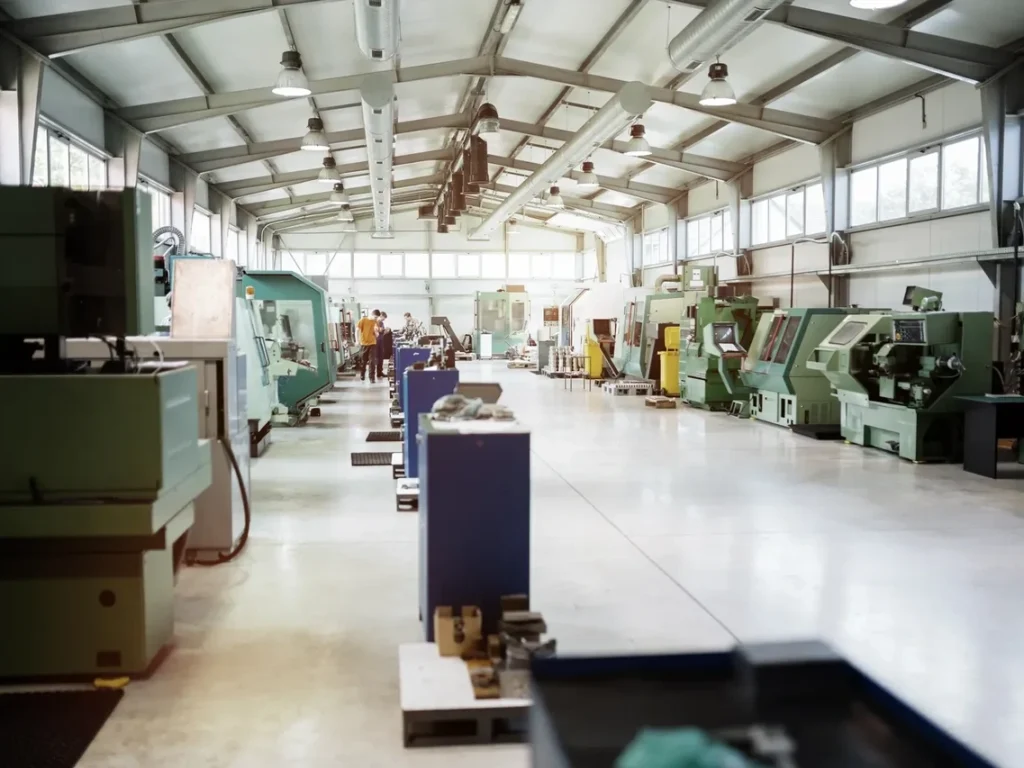
Core metal‑cutting machines—CNC milling machines, CNC turning centers, and CNC grinding machines—form the backbone of most machine shops. These machines are ideal for cutting metals with precision and repeatability, whether removing bulk material or finishing critical surfaces. The sections below break down how each works, typical tolerances, ideal applications, and key setups, giving a clear view of what to expect from VMCs, HMCs, lathes, and grinding centers.
CNC milling/machining centers (3/4/5‑axis)
A CNC milling machine uses a rotating cutting tool to remove material from a stationary or moving workpiece. Common operations include facing, contouring, pocketing, drilling, and tapping. You’ll see three main configurations. A Vertical Machining Center (VMC) has a vertical spindle and is the most common for prismatic parts and fixtures. A Horizontal Machining Center (HMC) has a horizontal spindle and often includes a pallet changer; it shines on multi‑face work and better chip evacuation. Large gantry mills are used for big plates, molds, and composite tooling.
Typical milling performance lands around ±0.01–0.05 mm for general work with the right setup. With careful calibration, probing, and thermal control, 5‑axis machines can hit ±0.005 mm on critical features. Milling is ideal for aluminum housings, steel fixtures, mold cavities, and general job shop work. It scales well from prototypes to mid‑volume. If you need tight cross‑face position without refixturing, a 5‑axis or a 4‑axis with indexing will reduce setup count and stack‑up error.
Common question: what is CNC VMC and HMC? In short, VMC means vertical machining center (vertical spindle), and HMC means horizontal machining center (horizontal spindle). VMCs are flexible and cost‑effective. HMCs often deliver higher throughput on multi‑face parts because you can fixture parts on tombstones and use pallet changers for near‑continuous cutting.
CNC lathes & turning centers (with live tooling/Y‑axis)
A CNC lathe rotates the work while a tool moves along X/Z (and sometimes Y) to create OD/ID features, grooves, and threads. A turning center adds live tooling and sometimes a Y‑axis so you can mill flats, keyways, and holes in one setup. For shafts, bushings, and threaded parts, turning centers deliver some of the best “dollars per spindle hour.” Add a bar feeder and parts catcher, and you unlock lights‑out potential for medium to high volume. Typical tolerances are ±0.01–0.03 mm, and surface finish is excellent on bearing and seal surfaces. When parts are long, small, and need very tight runout, look at Swiss‑type machines.
CNC grinding (surface, cylindrical, centerless)
A CNC grinding machine uses an abrasive wheel to finish parts to very tight sizes and smooth surfaces. Surface grinding squares up faces; cylindrical grinding finishes diameters; centerless grinding excels at high‑volume round parts without centers. Grinding is a finishing step for hardened steels, cutting tools, bearing races, and dies. It reaches very tight tolerances (±0.002–0.010 mm) with low roughness average (Ra), often after milling or turning has done the heavy stock removal.
Axis motion basics
In most 3‑axis mills, X and Y move the table and Z moves the spindle. Add a fourth axis (A or B) and you can rotate the part. Add a fifth axis (usually A/C or B/C) and the tool or the part tilts and rotates, reaching more faces without refixturing. In turning, Z is along the spindle, X is radial, and some machines add Y for off‑center milling.
Sheet, plate, and profile cutting (laser, plasma, waterjet, routers)
Sheet, plate, and profile cutting use specialized CNC machines, including CNC plasma cutting, CNC laser cutting, CNC water jet cutting, and CNC router machines. These machines are perfect for various materials—from metals and plastics to composites—and can handle a wide range of thicknesses efficiently. The sections below cover lasers, plasma, waterjets, and routers, highlighting how each works, their strengths, and the types of parts they handle best.
CNC laser cutters (fiber vs CO₂)
Laser cutting machines focus a high‑energy beam to cut thin‑to‑medium sheet with a narrow kerf and clean edge. Fiber lasers excel on metals; CO₂ lasers are used for plastics, wood, and textiles. On 3–6 mm steel, fiber lasers can cut at tens of meters per minute, especially with nitrogen assist for clean edges. If you need fast sheet metal throughput and sharp details, laser is often the best balance of speed, precision, and cost.

CNC plasma cutters
Plasma cutting uses an ionized gas arc to cut conductive metals. It is very cost‑effective for thicker plates and structural parts, though kerf is wider and edges are rougher than laser. If you run a fabrication cell cutting brackets, gussets, and frames with moderate tolerances, a CNC plasma cutter is hard to beat on cost per cut. For very thin stainless with cosmetic needs or intricate detail, laser or waterjet is a better fit.
CNC waterjet machines (abrasive & pure)
A waterjet forces water at very high pressure through a nozzle; add abrasive to cut metal, stone, glass, and composites. The big win is there’s no heat‑affected zone (HAZ), so material properties stay stable. This is great for aerospace alloys, hardened steels, and brittle materials. Waterjet is slower than laser/plasma on thin sheet and has higher consumables (abrasive and pump wear), but it can handle thicknesses in the ~50–150 mm range with strong edge quality.
CNC routers
A CNC router looks like a big gantry mill optimized for wood, plastics, and composites. Routers have large work envelopes, vacuum tables, and high‑speed spindles. They excel at nested‑based machining for cabinetry, furniture, and signs. Many routers can cut aluminum at light depths if you manage chip load and rigidity, but if you need tight metal tolerances, a metal‑cutting mill is more suitable.
Advanced and specialized machines (EDM, Swiss, mill‑turn, 5‑axis, hybrid)
Advanced and specialized CNC machines handle complex, high‑precision, or high‑volume tasks that standard mills and lathes cannot. The sections below explain EDM, Swiss‑type lathes, mill‑turn centers, 5‑axis machining, and hybrid additive–subtractive systems, highlighting their capabilities, applications, and key advantages.
Wire EDM & sinker EDM
Electrical discharge machines remove material by controlled sparks in a dielectric fluid. Wire EDM cuts profiles with a moving wire; sinker (die‑sinker/ram) EDM uses shaped electrodes to burn cavities. Only conductive materials will work. EDM is slow, but very precise: think ±0.002–0.010 mm and razor‑sharp internal corners. Tool and die, mold making, and turbine components rely on EDM when milling can’t reach or would leave unwanted fillets.
Swiss‑type/automatic lathes
Swiss‑type lathes and mill‑turn centers are examples of multi-axis CNC machines. From 3-axis machines to multi-axis machines like 5-axis CNC centers, shops can achieve tighter tolerances and reduce multiple setups, especially for complex or slender parts.
Mill‑turn/multitasking centers
A mill‑turn combines turning and milling so you can finish complex parts in one setup. Reducing fixtures and manual handling improves part quality (better positional accuracy across faces) and raises Cpk in production. These machines pair well with gantry loaders or robots and are great when you want to collapse a process chain into one machine.
5‑axis machining centers & hybrid additive–subtractive
5‑axis machining supports one‑and‑done setups on impellers, blisks, orthopedic implants, and parts with undercuts or compound angles. You can reach more faces with shorter tools, so surfaces look better and runout is lower. Hybrid additive–subtractive machines combine metal 3D printing (directed energy or powder bed) with milling on the same platform. They shine in repair, build‑ups on expensive parts, and internal channels you cannot mill from solid.
Axis count and kinematics classification
Axis count determines the directions a CNC machine can move and directly affects the complexity of parts you can produce. The sections below explain 2‑ through 6+‑axis machines, their capabilities, trade‑offs, and common kinematics setups, helping you see when more axes are worth the investment.
2/2.5/3/4/5/6+ axes — capability ladder
Axis count tells you how many directions of motion the CNC system controls. 2‑axis turning handles basic cylinders. 2.5‑axis milling steps in Z while profiling in X/Y for pockets and faces. 3‑axis milling covers most prismatic work. 4‑axis adds a rotary for indexing or wrapping toolpaths around a cylinder. 5‑axis adds a second rotary so you can tilt and rotate, reaching complex freeform surfaces with fewer setups. 6+ axes show up in advanced machining and robotics.
Pros/cons by axis count
Fewer axes are simpler to program and set up, but need more fixtures and setups, which stacks error across faces. More axes reduce setup count and part handling, improve positional accuracy between faces, and open up new geometries. The trade‑off is higher cost, more complex programming, and tighter process control.
Axis stacking (trunnion vs head‑head vs table‑table)
In trunnion machines, the table tilts and rotates under a fixed spindle. In head‑head, the spindle tilts and rotates while the table stays still. Table‑table splits rotary axes between the table and an auxiliary rotary. Each style changes reachable surfaces, workholding options, and how chips fall.
Is 3‑axis enough for most parts?
For many shops, yes. A good 3‑axis CNC mill with a 4th‑axis indexer will cover a large share of prismatic parts and fixtures. When you face repeated multi‑side work, long reach, tight angular features, or many manual re‑clamps, that’s the signal to step up.
Cost, throughput, automation, controls, and skills
Cost, throughput, automation, and operator skills all influence which CNC machine fits your shop. The sections below break down relative capital and operating costs, productivity levers, automation options, and control systems, giving a clear view of investment, efficiency, and learning requirements.
Relative cost & operating bands
Use this table to gauge relative capital and running costs. Bands vary by size, options, and local rates, but the pattern holds.
| Machine type | Relative capital cost | Relative operating cost | Notes on consumables |
|---|---|---|---|
| 3‑axis mill | Low–Medium | Medium | Tools, holders, coolant |
| 5‑axis mill | High | High | Tools, probing, calibration |
| CNC lathe | Medium | Medium | Inserts, bar stock handling |
| Swiss‑type | High | High | Small tooling, bar stock, coolants |
| Mill‑turn | High | High | Multi‑station tooling |
| Router | Low–Medium | Low–Medium | Router bits, vacuum spoilboards |
| Laser | Medium–High | Medium–High | Assist gas, optics |
| Plasma | Low–Medium | Low–Medium | Tips, electrodes, gas |
| Waterjet | High | High | Abrasive, pump maintenance |
| EDM | High | High | Wire/electrodes, dielectric |
| Drilling/tapping | Low–Medium | Low–Medium | Taps, drills, fixtures |
| Grinding | Medium–High | Medium–High | Wheels, dressers, coolant |

Throughput levers and case examples
- Moving multi‑setup 3‑axis jobs to a single‑setup 5‑axis often cuts cycle time by 30–60% and reduces fixtures by half or more.
- A twin‑spindle turning center with a bar feeder can run medium or high‑volume shafts with little intervention.
- A palletized HMC boosts spindle uptime by letting you fixture the next part while the machine cuts.
- A router cell with nested‑based machining turns 4×8 ft sheets into parts in minutes, with low waste.
Automation & Industry 4.0
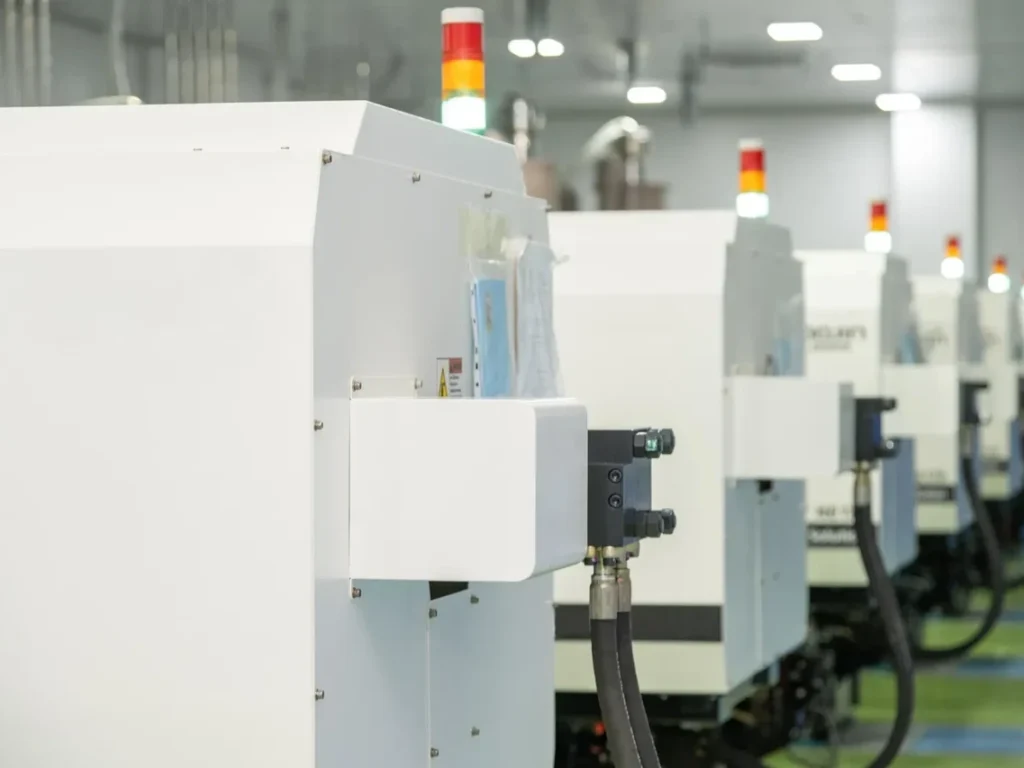
Common automation includes pallet pools, robot tending, gantry loaders, and bar feeders. Machine monitoring and predictive maintenance help cut downtime and improve planning. Even simple steps like in‑process probing and tool life tracking raise quality and reduce scrap, according to the National Institute of Standards and Technology (NIST), a leader in smart manufacturing research.
Controls & CAM: skills and concepts
Modern CNC software on the machine reads G‑code from your CAM program. The learning curve grows with axis count and part complexity. Mill/turn/5‑axis/EDM toolpaths require stronger CAM skills and process planning.
- What is CNC vs NC vs DNC? NC (numerical control) is hard‑coded or tape‑driven motion control. CNC (computer numerical control) adds a computer for flexible programs, offsets, probing, and storage. DNC (distributed numerical control) networks machines so you can send, manage, and track programs from a central system.
- Which is better, CNC or PLC? They do different jobs. A CNC controls precise tool motion for cutting; a PLC controls machine logic (pumps, doors, conveyors). Most modern machines use both: CNC for motion, PLC for safety and automation.
- How much does a 5‑axis cost vs a 3‑axis? A practical rule: expect a 2–5× price premium for a 5‑axis compared with a basic 3‑axis of similar size. Many shops justify it with fewer setups, higher quality, and shorter lead times.
Industry and material mapping + scenarios
Different industries and materials demand specific CNC approaches. The sections below map metals, plastics, wood, and composites to machine types and workflows, showing typical scenarios and how shops choose the right equipment for precision, volume, and material challenges.
Metals: aluminum, steel, titanium, Inconel
For precision machined metal parts, milling, turning, and grinding are core. Use laser/plasma/waterjet to blank plates and profiles; then finish on mills and lathes. EDM comes in for hardened steels, sharp internal corners, or thin ribs. Titanium and nickel alloys call for rigid setups, sharp tools, and strong chip control; 5‑axis helps hold accuracy with shorter tools.

Plastics, wood, composites
Routers and CO₂ lasers are common for panels, signs, and composite skins. In plastics, careful fixturing, lower heat, and sharp cutters prevent melting and burrs. Chip evacuation matters because melted chips can weld back to the cut. For composites, consider dust extraction and proper cutters to avoid fiber pull‑out.
Sector mapping: who uses what and why
- Aerospace: 5‑axis milling for structural parts and blisks; EDM and grinding for tooling; waterjet for thick and composite panels.
- Automotive: turning for shafts and powertrain, HMCs for blocks and carriers, laser/plasma for sheet and frames, grinding for gears and precision fits.
- Medical: 5‑axis for implants and instruments, Swiss‑type for small screws and fittings, EDM for die details.
- General job shops: 3‑axis mill + 2‑axis lathe baseline; add 4th/5th‑axis, mill‑turn, or router/laser as the part mix expands.
Real‑world scenarios (case‑style)
- You need 500 aluminum housings per month with features on five faces. A 3‑axis with smart fixtures can work, but you’ll juggle multiple setups and more QA. A 5‑axis with one‑and‑done fixturing likely cuts cycle time by 30–60% and stabilizes cross‑face true position.
- You plan 50,000 steel shafts per year with threads and grooves. A CNC lathe with a bar feeder is the natural fit; if parts are long and small diameter, Swiss‑type boosts speed and accuracy.
- You cut large furniture panels from plywood and MDF. A CNC router with vacuum hold‑down and nested‑based programming turns out clean parts all day with minimal waste.
- You must repair a high‑value aerospace die with worn edges and internal channels. A hybrid additive–subtractive machine can build up material where needed, then mill to final size in one cell.
What are the 5 types of CNC machines?
If you’re looking for the short answer students and buyers often ask for, the five common types are:
- CNC milling machines,
- CNC lathes/turning centers,
- CNC grinding machines,
- CNC laser cutters, and
- CNC EDM machines (wire and sinker). In practice, many shops also include routers, plasma, and waterjet as common CNC cutting machines, depending on the work.
CNC machine basics: what is a CNC machine used for?
A CNC machine is a computer-controlled machine tool that moves a cutting tool or energy beam in precise paths to shape material. In simple terms, it turns a CAD design into parts. You’ll see them used in aerospace, automotive, medical, electronics, furniture, and general manufacturing—anywhere precise and repeatable parts are needed. Typical uses include milling pockets, turning shafts, cutting sheet metal, burning complex shapes with a laser or plasma, finishing with a cnc grinder, or creating die cavities with cnc electrical discharge machines.
Axis count, machine types, and your part: a quick recap
- Start simple: 3‑axis machines cover a large share of prismatic parts.
- Add a rotary (4‑axis) to reduce setups on multi‑face parts.
- Move to 5‑axis when you need complex surfaces or tight positional accuracy across many faces.
- Use turning machines for round parts, Swiss for small slender parts, grinding for tight finish, and EDM for hardened steels and sharp inner corners.
- For sheet and plate: laser for speed and precision on thin‑to‑medium metal, plasma for cost‑effective thicker metal, and waterjet when you must avoid heat or cut thick/sensitive materials.
- For wood and plastics, a cnc router is similar to a gantry mill and reduces waste on large panels.
FAQs
CNC machines come in all shapes and sizes, but there are five that you’ll see most often in workshops and factories. First, there’s CNC milling machines, which are super versatile—they can cut, drill, and shape metal or plastic into pretty much any shape. Then we have CNC lathes, which are perfect for turning cylindrical parts, like rods or shafts. CNC routers are similar to mills but are often used for wood, plastic, or softer materials, making them popular in furniture and signage. CNC plasma cutters use a high-temperature plasma torch to cut metal sheets quickly and accurately. And lastly, CNC EDM machines—electrical discharge machining—is a bit specialized, but essential when you need super precise cuts or complex shapes that traditional tools can’t handle. Each type has its own strengths, so it’s really about matching the machine to the job you want to do.
Okay, so if you’ve heard people talking about VMC and HMC, they’re just two common styles of CNC machining centers. VMC, or Vertical Machining Center, has the spindle mounted vertically, which is perfect for drilling and milling flat surfaces. Most job shops love VMCs because they’re flexible and handle small-to-medium parts well. On the other hand, HMC, or Horizontal Machining Center, has the spindle mounted horizontally. This setup is great for big production runs because gravity helps with chip removal, and you can work on multiple sides of a part without flipping it over. Basically, VMC is more “all-rounder” for smaller jobs, and HMC is more of a production powerhouse for larger or more complex parts.
This one gets a bit technical, but here’s the gist in simple terms. NC, or Numerical Control, is the old-school version—machines controlled by punched tapes or simple programs. CNC, Computer Numerical Control, is the modern version, where a computer handles all the instructions, so it’s faster, more precise, and easier to program. DNC, or Direct Numerical Control, is like a networked version of CNC. Instead of loading programs manually, DNC connects several machines to a central computer that feeds them instructions in real time. So in short: NC is the grandparent, CNC is the workhorse, and DNC is the smart networked sibling.
Here’s where people sometimes get confused. CNC is specifically designed to control machining operations—think cutting, milling, turning, drilling—where precise motion is key. PLC, or Programmable Logic Controller, is more general-purpose automation: it controls everything from conveyor belts to robotic arms to factory processes. So “better” depends on what you’re trying to do. If your goal is precise machining, CNC is the clear winner. If you want to automate a whole production line or control multiple machines, a PLC is what you need. Sometimes, the two even work together: CNC handles the machining, and PLC handles the overall factory logic.
CNC machines are literally everywhere in modern manufacturing. You’ll see them in aerospace, making complex turbine blades or structural components. Automotive factories use them to produce engines, chassis parts, and custom accessories. They’re also common in medical device production, where precision is critical for implants or surgical tools. Then there’s electronics, making housings or intricate components, and even furniture or signage with CNC routers. Basically, if it’s a part that needs to be precise, repeatable, and efficient, there’s probably a CNC machine making it somewhere. And honestly, their use is only growing as automation and smart manufacturing take off.

 English
  German
  French
  Italian
  Spanish
  Polish
  Czech
Czech  Japanese