
In modern manufacturing, the performance and longevity of critical parts often depend on precise dimensions and surface quality. CNC grinding services, using advanced CNC precision grinding machines and rotating wheels or belts, allow small amounts of material to be removed to achieve exact specifications and tight tolerances. Whether for gears, crankshafts, or high-precision components just a few inches in diameter, precision grinding provides a cost-effective and reliable solution. This process can be used as a final finishing step or to prepare parts for other polishing or finishing services, ensuring each workpiece meets functionality requirements and maintains fit and function in assembly. With automation, in-process gauging, and high-quality metrology, modern CNC grinding delivers consistent results across applications, from automotive and aerospace to medical components, while meeting the demanding project requirements of today’s precision-driven industries.
What CNC Grinding Is (and When to Use It)
Rectification CNC is a computer numerically controlled finishing process that uses a rotating abrasive grinding wheel (or belt) to remove small amounts of material from a workpiece. The goal is not high material removal. The goal is geometry control (size, roundness, flatness) and surface integrity (surface finish, low damage, stable performance in use).
Grinding is typically used after a part is already close to size from milling or turning. A common trigger is when the part has to meet tight tolerances or surface finish requirements that are hard to hold with a cutting tool alone, especially once heat treat enters the route. Grinding can also be the method that makes a fit possible, such as a bearing seat, a precision bore, or a sealing surface where the surface finishes and shape control drive function.
CNC grinding vs. milling/turning for finishing work (table: process, use case, trade-offs)
The most common sourcing question is not “Can grinding make it accurate?” It is “Is grinding the right last step, or can we hold this with turning or milling and inspection?” The table below frames that decision for typical finishing work.
| Processus | Où il s'adapte le mieux | Typical finishing use case | Trade-offs to plan for |
|---|---|---|---|
| Milling (CNC) | Prismatic features, pockets, complex 3D surfaces | Finishing faces and profiles when moderate surface finish is acceptable | Tool deflection and cutter marks; harder to control flatness/parallelism on thin walls; heat-treat distortion can move datums after milling |
| Turning (CNC) | Axisymmetric parts | Finishing diameters and faces before heat treat, or when tolerances are not extreme | Roundness and taper depend on rigidity and tool wear; post-heat-treat changes can break fits |
| Rectification CNC (plane, cylindrique, sans centre) | Final sizing and geometry control | Bearing fits, tight runout, flatness/parallelism, controlled surface finishes on hard metals | Added setup and inspection steps; burn and distortion risk if parameters and coolant control are weak; stock allowance must be planned earlier |
A practical rule used by many engineers is: if the requirement is driven by fit, sealing, fatigue performance, or stable motion (bearings, guides, spools, shafts, valve components), grinding often becomes the risk-reduction step. If the requirement is driven by shape complexity and the finish is secondary, milling or tournant may be the better last process.
Key CNC grinding outcomes: tight tolerances + surface finish requirements
Buyers usually ask for grinding when one or more of these outcomes drives function:
- Geometry control after heat treat. Many alloys move during hardening. Even if the part is milled or turned accurately in the soft state, heat treatment can shift size and straightness. Grinding gives a controlled way to “bring it back” to a datum scheme after hardening.
- Surface finish tied to wear, sealing, or friction. Surface texture affects lubrication films, leak paths, and contact stress. Surface finish requirements are often specified using standardized roughness parameters (such as Ra) defined in surface texture standards.
- Surface integrity. Grinding can improve or damage surface integrity. A good grind avoids thermal damage and unwanted residual stress patterns. A bad grind can introduce grinding burn, microcracks, or tensile residual stress that reduces fatigue life. This is why process control and inspection matter more than the machine label.
Because grinding is abrasive, it can “average out” small tool marks and bring a surface to a smoother, more uniform texture than many cutting operations. On the other hand, it concentrates energy at the contact zone, so thermal management is part of feasibility, not a detail.
What is CNC grinding used for?
CNC grinding is used to obtain precise dimensions and controlled surface finishes, often as a final finishing process. Common targets include bearing fits on shafts, precision bores, flat reference faces, and parts made from hardened steels or other hard metals. It is also used when roundness, taper, or runout limits are tighter than what is practical with milling or turning after heat treat.
Where grinding fits in the production workflow
Most grinding services follow a workflow where the earlier manufacturing steps create the general shape of the part, and grinding then “locks in” the final critical geometry. Typically, the process begins with roughing or semi-finishing through fraisage or turning, followed by stress relief or heat treatment if required. The part then moves to grinding—whether surface grinding, cylindrical (OD/ID), centerless, or creep-feed—before undergoing thorough inspection using CMMs, roundness gauges, profilometers, or in-process measurement tools. Finally, downstream steps such as coating, assembly, or final quality assurance complete the workflow.
The key point is that grinding often acts as a bridge between metallurgy, particularly the heat-treated condition of the part, and metrology, ensuring the part meets final acceptance criteria. If the drawing does not clearly define this bridge—through datums, stock allowance, and inspection methods—then quoting and execution become slower, and the risk of errors increases.
CNC Grinding Services: Processes You Can Buy
CNC grinding services are not one process. They are a family of grinding methods chosen based on part geometry, where the critical surfaces are, and how the part will be held and referenced.
Surface grinding for flatness and parallelism
Surface grinding services focus on flat faces. They are often chosen for tooling, machine ways, fixtures, and any part where two faces must be flat and parallel within the drawing limits.
Two key factors should be considered early in the grinding process: first, how the part will be held without introducing distortion, and second, how the ground surface aligns with the part’s datum scheme. Thin plates and long, narrow components can “relax” when unclamped, meaning that a surface that appears flat on the chuck may fail flatness checks once the part is free if internal stresses are present.
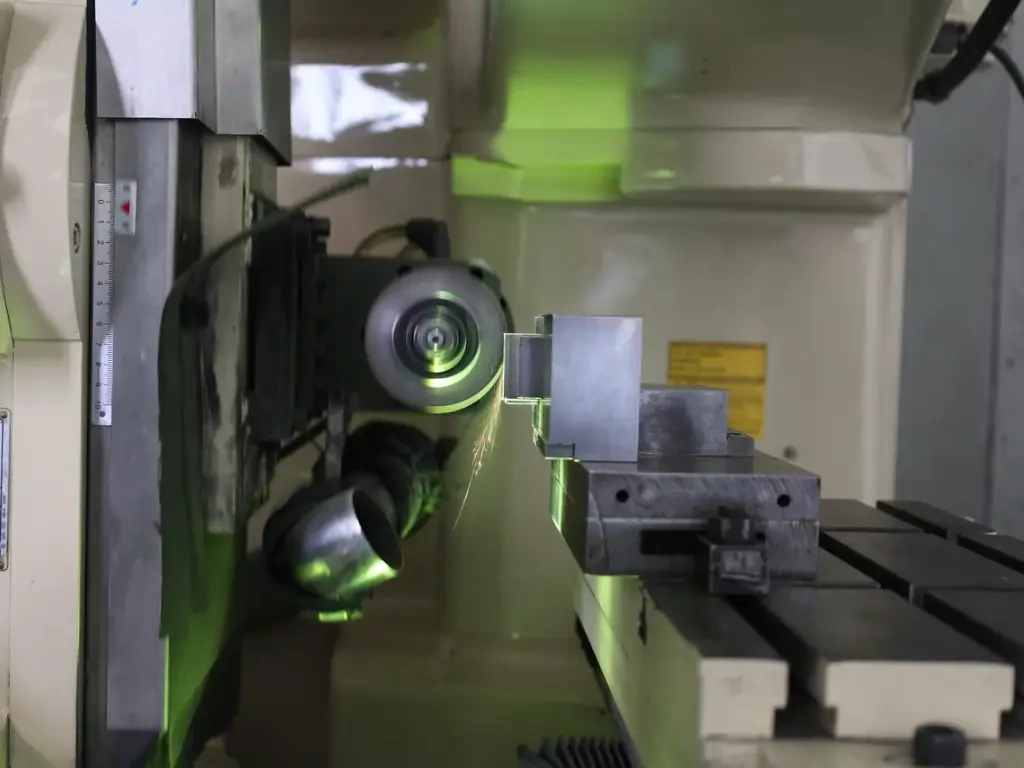
During grinding, the abrasive wheel rotates to remove material from the workpiece, which is held securely using methods such as magnetic chucks, fixtures, or clamps.
When quoting a job, shops typically focus on the amount of stock that must be removed, whether there are interrupted cuts, and whether special workholding is required. These considerations have a greater impact on grinding time and the risk of thermal damage (burn) than the total surface area alone.
Cylindrical grinding (OD/ID) for shafts, bores, and bearing fits (table: OD vs ID applications)
Cylindrical grinding controls round parts. It includes:
- OD (outside diameter) grinding for external surfaces such as shafts, journals, and bearing seats.
- ID (internal diameter) grinding for bores that must be straight, round, and stable for press fits, slip fits, or sealing.
A common reason to choose cylindrical grinding over finish turning is that grinding can be more stable on hardened materials and can better control taper and roundness when the part is stiff enough and the centers/fixturing are sound.
| Type | What is ground | Typical functional drivers | Common feasibility constraints |
|---|---|---|---|
| OD cylindrical grinding | External surfaces (journals, seats, tapers) | Bearing fits, runout control, smooth surface on hard metals | Part straightness, center holes/holding method, slenderness ratio, shoulder access |
| ID cylindrical grinding (internal grinding) | Bores and internal features | Precision fits, concentricity to OD, sealing bores | Access for wheel, bore length-to-diameter ratio, rigidity, coolant delivery, measurement access |
If a part combines both OD and ID critical features, the datum strategy matters. If the bore is the functional datum (common in housings), grinding the ID first may control later OD concentricity better. If the OD is the datum (common in shafts), the reverse can be true.
Centerless grinding for high-volume round parts and consistency
Centerless grinding supports high-volume production of round parts without using centers. The part is supported between wheels rather than clamped or held between centers. This can yield good consistency for simple cylindrical parts such as pins, bushings, and certain shaft-like components.
Centerless grinding offers high throughput once the process is properly tuned, but the initial setup and process optimization can be more sensitive to part geometry, lead-in and lead-out conditions, and the method used to feed the part.
When evaluating feasibility, the key question is whether the part’s geometry is suitable for stable through-feed or plunge grinding. Features such as grooves, large shoulders, or thin, delicate sections can complicate centerless grinding and may require special handling or adjustments.
In comparison to other grinding methods, centerless grinding can achieve higher productivity once stabilized, while cylindrical OD/ID grinding generally offers moderate throughput, and surface grinding throughput depends heavily on the surface area and setup requirements.
Specialty approaches: creep-feed and hybrid routes with additive manufacturing for complex components
Two specialty routes show up more in sourcing discussions:
- Creep-feed grinding. This is used for deeper cuts at slower feed rates, often for complex slots or profiles in hard materials. It is not a default option because wheel choice, dressing strategy, and thermal control become central. Buyers tend to consider it when milling is slow in hard metals or when the profile needs stable form control.
- Hybrid routes with additive manufacturing. Industry trend reports describe hybrid production where near-net shapes are built additively, then ground on critical surfaces. The logic is simple: additive can create complex shapes, while grinding can establish datums, fits, or surface finishes where function demands it. The risk is that additive surfaces and material conditions vary, so stock allowance and datum creation must be planned to avoid “chasing” geometry that is not stable.
In both cases, feasibility is not just “Can it be ground?” It is whether the shop can control heat and measurement on the exact surfaces that drive function.
Precision, Tolerances & Surface Finish: What to Specify
If you are buying CNC grinding services, the drawing and inspection plan determine whether the result is predictable. Grinding can produce high precision, but only if the requirements are defined in a way that matches how grinding is done and measured.
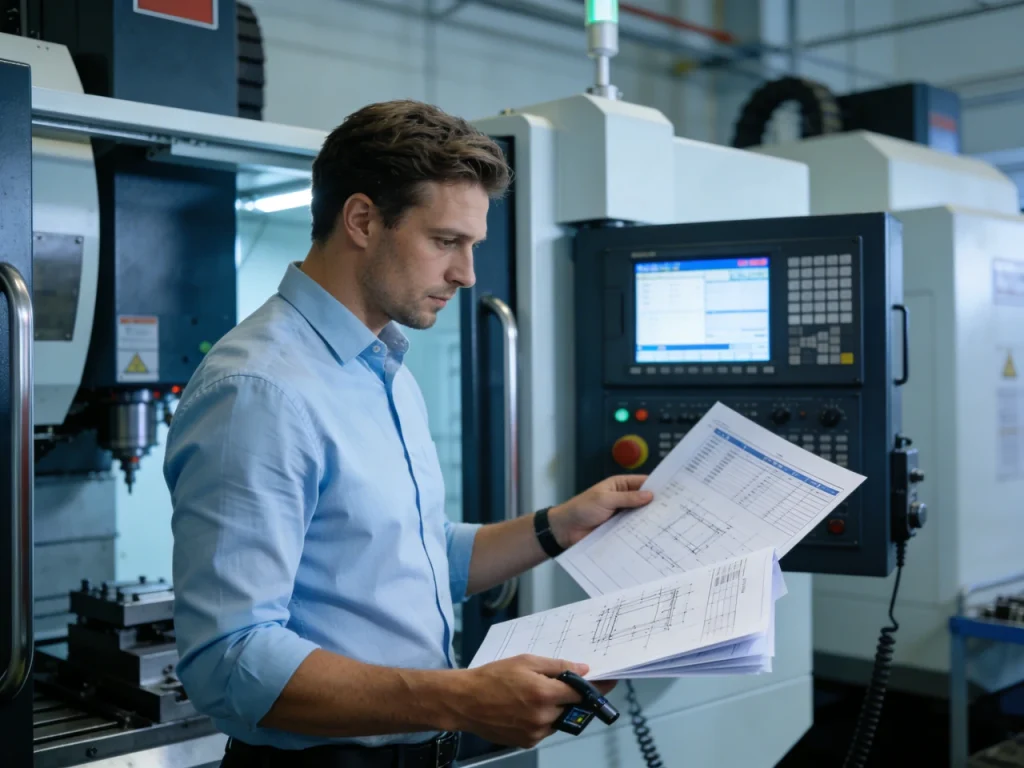
Tolerance and surface finish basics buyers must define (checklist: GD&T callouts, Ra target, datum strategy)
A grinding RFQ often stalls because the print specifies “grind all over” or lists tight limits without clear datums. The checklist below is what usually removes ambiguity, according to ASME.
| Item to define | What “good” looks like for quoting and process planning | Why it matters in grinding |
|---|---|---|
| GD&T callouts on critical features | Flatness, parallelism, cylindricity, runout, position where needed | Grinding can control size, but geometry acceptance depends on how you constrain and measure |
| Surface finish parameter and location | Ra (or other parameter) with clear surface identification | Surface finishes depend on wheel, dressing, feed, and spark-out; the shop needs the target and where it applies |
| Datum strategy (primary/secondary/tertiary) | Datums tied to functional assembly surfaces | Grinding setups reference real surfaces; unclear datums lead to rework loops |
| État des matériaux | Heat treat state, hardness callout if relevant, coating notes | Grindability and burn risk change with material condition |
| Stock allowance on ground surfaces | Enough stock after prior steps to clean up | Grinding removes small amounts of material; too little stock can leave scale or distortion errors |
| Inspection plan for acceptance | How size, form, and roughness will be checked | Measurement method can change the process choice and fixturing |
GD&T definitions and surface texture parameters are standardized, so aligning your drawing language with those standards helps avoid arguments about what “smooth” or “flat” meant after the parts ship.
How precise is CNC grinding?
CNC grinding is used when parts need tight tolerances and controlled surface finishes, especially after heat treat. The achievable precision depends on the grinding method, the part’s stiffness, wheel selection, and how the part is measured and referenced. In practice, “how precise” is not a single number; it is a system result tied to datums, stock allowance, and metrology.
Inspection and metrology for grinding: profilometers, CMM, in-process gauging
Grinding acceptance often includes both size/form checks and surface checks:
- Profilometers measure surface texture parameters (such as Ra) on specified surfaces.
- CMM (coordinate measuring machines) can verify geometry relative to datums, though roundness and cylindricity are sometimes better handled by dedicated form instruments depending on the tolerance and feature.
- In-process gauging can reduce variation by adjusting based on measured size during grinding, but it must be matched to the tolerance and part compliance.
The grinding process typically begins with machine setup, followed by in-process measurement when applicable, and adjustments to offsets or parameters based on those measurements. After grinding, post-process inspection—using tools such as CMMs, form measurement devices, or profilometers—is performed, and the results provide feedback for further setup corrections or wheel dressing. Finally, parts are either accepted, segregated, or sent for rework depending on inspection outcomes.
The feasibility of this process depends on the shop’s ability to accurately measure the features specified on the drawing. For example, if a print calls for a surface finish on an internal feature that is difficult to reach with a stylus, it may be necessary to agree on an alternative measurement method or an acceptable proxy before production begins.
Common tolerance/finish failure modes and how shops prevent them
Grinding failures often look like “it’s the right size but it doesn’t work.” That is usually a geometry, surface, or thermal damage issue rather than simple diameter error.
| Issue seen at receiving or assembly | Common underlying cause | Typical mitigation approach |
|---|---|---|
| Size drifts during a run | Wheel wear, thermal growth, unstable workholding | Controlled dressing, in-process gauging where justified, stable coolant and warm-up practices |
| Poor roundness / taper on shafts | Part deflection, incorrect support, wheel condition | Better support strategy, parameter changes, verify centers/fixturing, adjust wheel dress |
| Flatness/parallelism fails after unclamping | Part stress, thin geometry, clamping distortion | Stress relief earlier, fixture redesign, grind in steps, control stock removal balance |
| Surface finish fails (too rough) | Wheel grit/bond mismatch, dressing method, feed too aggressive | Wheel selection change, dressing adjustment, parameter tuning |
| Grinding burn / surface damage | Excess heat, insufficient coolant delivery, dull wheel | Increase coolant effectiveness, adjust wheel/dress, reduce energy input per pass, verify material condition |
From a buyer view, the key point is that most of these problems are preventable when the part is designed for grindability and when the inspection method matches the requirement.
Materials & Part Design for Grindability
Grinding is not only about machine capability. It is about how the material behaves under abrasive contact and heat, and how the part geometry responds to clamping and thermal gradients.
Material compatibility guide (table: hardened steels, carbides, ceramics, common alloys)
The table below is a compatibility guide, not a promise of results. It shows where grinding is commonly used and where process risk increases.
| Groupe de matériaux | Why grinding is used | Common challenges to plan for |
|---|---|---|
| Hardened steels | Grinding for hard metals is common after heat treat to restore size and control bearing fits | Burn risk if heat is not controlled; distortion from heat treat can require more stock |
| Stainless steels (some grades) | Finish critical sealing and wear surfaces | Can load wheels depending on grade and parameters; heat sensitivity varies |
| Tool steels | High precision grinding for dies, punches, and wear surfaces | High hardness drives wheel selection and dressing strategy; thermal damage can be costly |
| Carbides | Used where wear resistance is needed | Brittle behavior; wheel choice and process control are critical to avoid chipping |
| Céramique | Used for high wear/temperature applications | High brittleness; edge chipping and subsurface damage risk; requires specialized approach |
| Common aluminum alloys | Sometimes ground for flatness or finish, though other finishing may be preferred | Wheel loading and surface smearing risk; often needs careful wheel and coolant choices |
| Alliages de titane et de nickel | Used in aerospace and high-performance components | Heat management is central; surface integrity concerns can drive conservative parameters |
If you are sourcing across a variety of materials, ask early whether the grinding service expects the part in a specific condition (soft, hardened, stress-relieved). Material condition can matter as much as alloy family.
Heat, burn risk, and distortion control by material and geometry
Grinding concentrates energy into a small contact area. That creates two linked risks:
- Thermal damage at the surface. Excess heat can change microstructure near the surface. This is often discussed as grinding burn. It may not be visible without specific checks, yet it can affect fatigue and wear.
- Part distortion. Thin sections, long shafts, and asymmetric geometries can move during grinding because of clamping forces, thermal gradients, or residual stresses from prior steps.
Material and geometry interact. Harder materials may resist cutting but can be more sensitive to thermal effects. Ductile materials may smear or load the wheel, raising heat. Slender parts may deflect and spring back, creating taper or lobing even if the size looks right at the gauge point.
A feasibility-minded way to reduce risk is to align three items early: stock allowance after heat treat, stable datums that survive heat treat, and a grinding sequence that does not “chase” distortion from one surface to another.
What materials are best for precision grinding?
Materials commonly chosen for precision grinding include hardened steels and tool steels, because grinding can correct post-heat-treat size and control fits. Carbides and ceramics can also be ground when wear resistance drives the design, but they raise the risk of chipping or subsurface damage and may need specialized wheels and inspection. Many common alloys can be ground; the deciding factor is usually the required surface integrity and geometry, not whether the material is “allowed.”
Design-for-grinding tips that reduce cost and lead time (checklist: stock allowance, radii/edges, accessibility, datum selection)
Design choices can make a grinding quote predictable or painful. The checklist below focuses on what tends to reduce setups, special wheels, and inspection complexity.
| Design item | What to aim for | Why it helps grind parts predictably |
|---|---|---|
| Stock allowance on critical surfaces | Leave enough material after prior ops to clean up scale and distortion | Too little stock forces “spark-out only” attempts that may not correct form errors |
| Edge condition and radii | Add reasonable radii where edges would otherwise chip or burn | Sharp edges are prone to burrs, chipping (brittle materials), and localized heat |
| Accessibility for wheel and gauge | Make room for wheel approach and measurement contact | Internal grinding and shoulders can be limited by wheel geometry and probe access |
| Datum selection tied to function | Choose datums that represent how the part locates in assembly | Reduces rework loops caused by “measuring from the wrong surface” |
| Avoid unnecessary interrupted surfaces | Limit key ground surfaces that have slots/holes breaking contact | Interrupted grinding can raise vibration and reduce surface finish stability |
| Specify only the needed finish | Call out surface finishes only where function needs them | Tight surface finish requirements on nonfunctional faces add time without benefit |
When grinding is a finishing process used to obtain precise dimensions, small drawing decisions often decide whether it stays a finishing step or turns into repeated trial passes and extra inspection.
Industry Applications: Where Grinding Adds the Most Value
Grinding is used across a wide range of industries, but it adds the most value where tolerance stack-up and surface condition directly drive safety, life, or performance.
Automotive components needing repeatability at scale
Automotive programs often combine high volume with tight process capability expectations. Grinding shows up in components where repeatability and wear behavior matter: shafts, bearing journals, transmission components, and other round features that must run smoothly over long duty cycles.
The feasibility issue in automotive is often not whether a single part can be ground. It is whether the grinding solution is stable across long runs with acceptable scrap and rework risk. That pushes attention toward centerless grinding options, in-process gauging, and automation around handling and inspection, because small handling variation can show up as geometry variation at scale.
Aerospace and defense parts requiring precision and compliance
Aerospace and defense parts often carry both tight technical requirements and compliance constraints tied to documentation, traceability, and controlled processes. Grinding shows up in turbine engine components, actuators, landing gear-related parts, and precision assemblies where fits, runout, and surface integrity are linked to reliability.
For feasibility, compliance changes the sourcing conversation. Beyond geometry and surface finishes, buyers may need controlled documentation, material traceability, and quality system alignment to sector expectations. If the part falls under export controls or defense acquisition rules, that can narrow the qualified supplier pool, which then affects lead time risk and continuity planning.
Medical components where surface integrity matters
Medical components often need careful surface integrity because surfaces may interact with tissue, fluids, or wear interfaces. Even when the geometry is not extreme, the surface condition can be critical, and inspection methods must be matched to the requirement.
The sourcing risk is that “surface finish” can mean different things across teams. A drawing that specifies only a roughness number without clarifying the surface’s function can lead to mismatched process choices. In medical work, that mismatch can show up late, after validation activities, which is why early alignment on surface definition and measurement method matters.
Which industries use CNC grinding the most?
CNC grinding is widely used in automotive, aerospace/defense, and medical manufacturing because these sectors often need tight tolerances, stable fits, and controlled surface finishes. It is also used in tooling and industrial equipment where wear surfaces and reference planes drive machine performance. The common thread is that grinding is chosen when geometry and surface integrity are tied directly to function.
Technology Trends: Automation, AI & Industry 4.0
Many trend reports group grinding into broader CNC machining trends, but the themes still apply to CNC grinding machines and grinding services: less manual intervention, better sensing, and more closed-loop control.
Automation and robotics to address skilled labor shortages (Case Study 3)
One recurring case example in industry sources is the use of collaborative robots for part handling and basic inspection steps around CNC machines. The motivation is practical: grinding setups and part handling can be repetitive, and skilled labor shortages make it hard to staff around the clock.
In that example pattern, automation is less about replacing grinding expertise and more about stabilizing the “between steps” work—loading, unloading, staging, and moving parts to gauges. For buyers, the relevance is consistency and capacity planning. If a part is sensitive to nicks or handling marks, automated handling can reduce handling variation, but only if end-of-arm tooling and part presentation are designed well.
AI-driven parameter optimization and predictive maintenance benefits (Case Study 2)
Another reported trend is AI-assisted parameter tuning and predictive maintenance in CNC environments. Applied to grinding, the promise is not “automatic perfection.” It is that models can help identify parameter sets that reduce tool wear or flag machine conditions that correlate with drift.
From a feasibility view, the main benefit is earlier detection of instability. Grinding wheels wear and dress state changes. Spindle and axis conditions drift. If monitoring detects a pattern tied to scrap or rework, the shop can correct before parts fail inspection.
The buyer-side question to ask is simple: “What inputs are actually measured, and what actions are taken when the model flags risk?” Without that link, “AI” is just a label and does not reduce process risk.
Industry 4.0/IoT monitoring for real-time quality control and reduced downtime (Case Study 1)
Industry 4.0 integration in grinding services typically involves connecting machine sensors and inspection stations to centralized dashboards that display condition and quality signals. For example, in some high-volume CNC operations, implementing condition monitoring and energy tracking has enabled real-time quality control and reduced downtime.
The process begins with sensors monitoring the grinder, coolant system, spindle, and environmental conditions. The data is then collected and visualized on a dashboard, showing trends, alarms, and limit violations. Based on this information, corrective actions—such as dressing the wheel, adjusting offsets, performing maintenance, or quarantining parts—are taken. Finally, verification through inspection confirms that the corrective measures have been effective.
This kind of feedback loop is particularly valuable when continuity and lot-to-lot stability are critical. For parts that are sensitive to grinding burn or dimensional drift, correlating process signals with inspection results can significantly reduce the risk of shipping defective components.
Sustainability and energy-efficient grinding opportunities
Sustainability in grinding is not only a corporate topic. It can affect operating cost and risk. Industry reports point to energy efficiency and “green process” opportunities, often tied to better uptime and reduced waste.
A simple way to think about this is to track a few KPIs that relate directly to throughput and quality. For example, higher machine uptime typically corresponds with lower energy consumption per accepted part. This relationship arises because a stable grinding process, with fewer rework cycles and reduced occurrences of grinding burn, naturally uses energy more efficiently.
For buyers, the practical angle is that a shop focused on reducing rework and scrap often improves both sustainability and delivery stability. The same controls that prevent grinding burn and drift also tend to reduce wasted energy and material.
Costs, Lead Times & Scaling from Prototype to Production
CNC grinding services are quoted and scheduled differently than rough machining because grinding depends heavily on setup, wheel selection, and inspection. Costs and lead times are hard to generalize without the drawing because the cost drivers are not linear with part size.
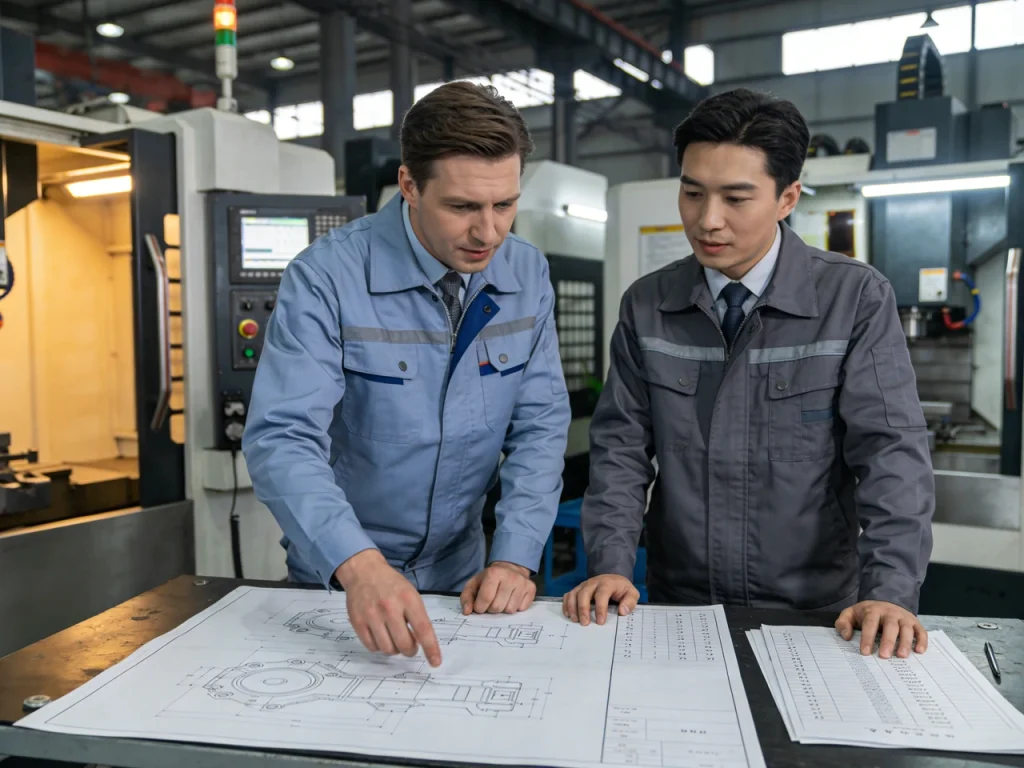
What drives CNC grinding cost: material, geometry, tolerance/finish, volume, setup (table: factor → impact)
The table below lists common drivers that change cost and risk. It avoids numeric pricing because published values vary widely by scope and part mix.
| Facteur | What changes | Why it impacts grinding cost |
|---|---|---|
| Material and heat treat condition | Wheel type, dressing frequency, burn risk controls | Harder or heat-sensitive materials can require slower, more controlled grinding |
| Geometry and access | Number of setups, special wheels, custom workholding | Shoulders, deep bores, and interrupted surfaces add complexity |
| Tolerance and surface finish requirements | Inspection intensity, process control, scrap risk | Tighter geometry and surface finishes often require more controlled passes and more measurement |
| Volume | Setup amortization, automation justification | High volume can justify centerless routes, automation, and in-process gauging |
| Setup and datum strategy | Fixturing time and repeatability | Poor datum choices drive rework and added inspection steps |
If you are comparing quotes, it helps to separate “time on the grinder” from the hidden time: fixturing, dressing, inspection, and rework risk allowances.
Typical lead-time considerations for grinding jobs
Lead time for CNC grinding is affected by factors such as queue times, the complexity of the setup, and the required inspections. The planning process typically starts with receiving the RFQ, followed by a design-for-manufacturing (DFM) review to verify datums, stock allowance, and inspection methods. Next comes setup planning, which includes selecting workholding, choosing the appropriate grinding wheel, and defining the dressing plan. The grinding operations are then performed, which may involve multiple setups depending on the part’s geometry. After grinding, the part undergoes inspection to check size, form, and surface finish as specified, and finally, it is shipped or released to the next stage in the process.
In practice, the longest delays often come from missing inputs at RFQ (unclear datums, missing material condition, unclear finish callouts) rather than from the grinding pass itself.
How much do CNC grinding services cost?
Cost depends mainly on the material condition, the number of setups required, and how tight the tolerance and surface finish requirements are. Volume also plays a role, since setup and inspection effort can be spread across more parts in production. If you want a useful estimate, most shops will need the drawing with GD&T, the material and heat treat condition, and the inspection expectations. CNC grinding services to meet these specific requirements can vary, but providing this detailed information helps ensure the quote reflects the actual work needed to deliver precise, high-quality parts.
Scaling strategy: prototype validation to high-volume runs, including automation options
Scaling grinding from prototype to production is less about “make more parts” and more about “make the same part the same way.” A common pattern is:
- Prototype phase: confirm that the datum scheme works, stock allowance is sufficient after heat treat, and inspection methods can actually verify the requirements.
- Pilot phase: stabilize wheel choice, dressing frequency, and measurement plan. This is often where hidden issues show up, like handling damage or a finish requirement that is hard to measure on an internal feature.
- Production phase: consider automation for handling and in-process gauging where it reduces variation or staffing risk, as described in industry trend reports.
If you expect a program to scale, it is worth designing the part and the inspection plan so that the grinding method does not need to change midstream. Process changes during scale-up are a common source of qualification delays.
How to Choose a CNC Grinding Service Provider
Choosing a grinding supplier is less about a generic “precision” claim and more about fit between your part requirements and the shop’s controlled processes, metrology, and documentation.
Capability checklist: process types, equipment, automation, metrology, documentation (downloadable scorecard)
Below is a scorecard-style checklist you can copy into an RFQ or supplier review. It is written to support technical comparison.
| Catégorie | Ce qu'il faut vérifier | Notes to capture |
|---|---|---|
| Process types | Surface grinding services, cylindrical grinding (OD/ID), centerless, specialty methods if needed | Match to your critical surfaces and volume expectations |
| Workholding and datum approach | Ability to fixture without distortion; experience with your geometry class | Ask how datums will be established and protected through the route |
| CNC grinding machines and maintenance | Machine capability is tied to condition and upkeep | Calibration and maintenance discipline matters for repeatability |
| Métrologie | Profilometer access, form measurement approach, CMM capability | Verify they can measure the callouts you will accept parts by |
| In-process control | In-process gauging or monitoring when justified | Useful for drift-sensitive dimensions in production |
| Documentation | Inspection records, material traceability handling, process documentation level | Align to your industry and compliance needs |
| Automation options | Handling automation for volume stability | Especially relevant when labor availability affects schedule risk |
This checklist is not about finding a “perfect” shop. It is about avoiding a mismatch where the supplier can grind the surface, but cannot prove it meets the specification in a way your quality system will accept.
Quality systems and certifications to ask for (table: certification → relevance)
Certification needs vary by industry. The table below links common systems to why buyers ask for them. Requirements should be driven by your customer and regulatory environment, not by habit.
| Certification / program | Why it may matter for grinding services |
|---|---|
| ISO 9001 | Baseline quality management system; supports consistent documentation and corrective action |
| AS9100 (aerospace QMS) | Common for aerospace supply chains; strengthens traceability and risk controls |
| NADCAP (special processes) | Often used in aerospace for controlled special processes; applicability depends on part and customer requirements |
| ITAR alignment (export controls) | May be required if technical data or parts fall under export control rules |
| Medical quality system expectations (regulated markets) | Medical supply often requires documented process control and traceability aligned with regulatory expectations |
A buyer does not need every certification for every part. The key point is to match the compliance burden to the part’s end use and to what your customer contract requires.
What should I look for in a precision grinding shop?
Look for a shop whose grinding methods match your part geometry (surface, cylindrical OD/ID, centerless) and that can measure your requirements with the right metrology. Confirm they understand your datum scheme and can describe how they will control burn, distortion, and size drift. If your industry requires it, verify quality system alignment and documentation depth before you lock the process route.
RFQ package essentials to speed quoting and reduce rework (checklist: drawings, CAD, inspection plan, material certs)
A grinding RFQ goes faster when the inputs remove ambiguity. Use this checklist to reduce back-and-forth.
| Entrée de l'appel d'offres | Ce qu'il faut inclure | Why it speeds quoting |
|---|---|---|
| Drawings | Controlled PDF with GD&T and surface finish callouts | Defines acceptance; avoids assumptions about “grind where needed” |
| CAD | Native or neutral file for context | Helps with fixturing and access planning |
| Matériau et état | Alloy, heat treat condition, hardness callouts if applicable | Drives grindability, wheel choice, and burn risk controls |
| Stock allowance intent | Identify which surfaces will be ground and what stock is available | Prevents “no cleanup possible” surprises |
| Inspection plan | What you will measure and how you will accept | Aligns metrology method and reporting needs |
| Material cert expectations | Traceability and cert package needs | Avoids delays tied to documentation gaps |
Market Outlook & Sourcing Options (On-Demand vs Local)
Market outlook matters to buyers because it influences capacity, pricing pressure, and supplier stability. The inputs provided include broad CNC market data and more specific grinding-related projections, with stated uncertainty due to scope differences.
Market growth drivers and uncertainty in projections (chart: CAGR ranges by scope)
The provided research notes consistent growth drivers: demand for high-precision components in automotive, aerospace, and medical industries, plus increased automation and customization. It also notes uncertainty because different reports use different scopes (grinding services vs. broader CNC machining).
To reflect that uncertainty, it is safer to discuss growth as a range rather than a single figure. The inputs cite CAGRs ranging from about the mid-single digits (grinding services projections) up to higher rates for broader CNC machine markets, with a separate figure noting the global CNC machining market reaching about USD 100 billion by 2025.
The projected compound annual growth rate (CAGR) varies depending on the scope of the report. For grinding services specifically, the CAGR is around 5%, while for the broader CNC machining market, it ranges from over 7.5% up to approximately 9.9%. It is important to note that these ranges are conceptual, as different reports may use varying definitions and cover different time periods.
For sourcing decisions, the practical implication is not the exact CAGR. It is that demand pressure and automation investment are expected to continue, while skilled labor shortages and high capital costs remain constraints.
Regional dynamics: North America precision demand + Asia-Pacific automation rise
The research notes North America leading regional growth tied to precision machining needs in automotive and aerospace, and rising automation in Asia-Pacific. A single-source data point in the inputs also cites the North America grinding machine market exceeding USD 1.33 billion in 2024 with projected growth into the next decade, but it is flagged as not fully verified for the broader grinding services scope.
For buyers, regional dynamics show up as different risk profiles:
- In regions with strong demand for aerospace and automotive precision work, lead times can be sensitive to capacity cycles.
- In regions with rapid automation build-out, capability may expand quickly, but supplier qualification and documentation alignment may need closer review, depending on your compliance needs.
On-demand CNC platforms vs direct-to-shop sourcing (Case Study 4) (table: pros/cons, risk trade-offs)
Industry sources describe SMEs using on-demand CNC platforms to access capacity without owning equipment. That model can also apply when sourcing grinding services, though the feasibility depends on how the platform qualifies suppliers and manages inspection and traceability.
| Sourcing route | Pour | Cons / risks to manage |
|---|---|---|
| On-demand platform model | Flexible access to capacity; may reduce overhead for variable demand | Less direct control of process details unless documentation is strong; supplier assignment can change; confirm metrology and compliance fit |
| Direct-to-shop sourcing | Direct process discussion; stable supplier relationship can support long-term control | More effort to identify and qualify suppliers; capacity constraints may be harder to buffer |
The right choice depends on whether your main risk is capacity variability (platforms can help) or process validation continuity (direct relationships often help).
Consolidation/M&A trend and what it means for buyers’ capabilities and continuity
The inputs note increased M&A activity as companies consolidate to expand capabilities in precision grinding services. Consolidation can help buyers if it creates a single supplier with broader process coverage and stronger quality systems. It can also add continuity risk if ownership changes lead to shifts in staffing, equipment, or quality practices.
A practical mitigation is to treat supplier continuity as part of feasibility: confirm how process documentation is controlled, how equipment is maintained, and how inspection records are retained across organizational changes.
At a decision level, CNC grinding services make sense when the part’s function is driven by tight geometry control, stable fits, and surface finish requirements, especially after heat treat. Feasibility depends less on the word “grind” on the drawing and more on whether the datum strategy, stock allowance, and inspection method line up with the chosen grinding process. If those inputs are clear, grinding can be a predictable finishing step. If they are not clear, grinding becomes a trial-and-error loop where cost, lead time, and acceptance risk increase.
FAQ
CNC grinding is a machining process that uses a rotating abrasive grinding tool to carefully remove small amounts of material from a workpiece. It is often used as a finishing process for parts that require extremely precise dimensions, tight surface finishes, or stable fits, especially after heat treatment. Precision grinding can be used to hone bearing seats, precision bores, crankshafts, or flat reference faces where the geometry directly impacts functionality. Beyond just size, grinding allows the surface to achieve consistent smoothness, sometimes as low as 0.0002 inches, which can’t be reliably reached with milling or turning alone. It’s also used to prepare parts for other finishing processes or to correct slight distortions caused by prior machining or thermal processes. Because the workpiece stays stationary during grinding, the process can deliver precise tolerances repeatedly, making it a cost-effective and reliable choice across applications where quality and functionality are critical.
While both milling and grinding remove material, they are suited for different purposes. Milling removes larger amounts of material using a cutting tool and is generally better for shaping complex features or roughing out forms quickly. Grinding, on the other hand, is a finishing process that uses an abrasive grinding tool, a rotating wheel, or belt grinders and angle grinders to carefully refine the surface and achieve tight tolerances. Precision grinding can be used to obtain surfaces that meet exact specifications, including fine flatness, roundness, and smooth finishes that milling alone cannot reliably deliver. Abrasive grinding may also reduce residual stresses and surface irregularities, delivering precise fit and function for parts that require exact geometry. In short, milling shapes the part, while grinding hones it to the final functional dimensions and surface quality.
CNC grinding is often used to obtain very tight tolerances, as low as 0.0002 inches and up to 0.00025 inches, depending on part geometry, the grinding method, and metrology applied. The process allows workpieces to achieve precision in both size and surface finish, which is essential for parts that require high repeatability, such as shafts, bearing journals, or sealing surfaces. Because precision grinding is a finishing process, the tolerances achievable depend on the combination of wheel selection, feed rates, cooling, and how the part is fixtured. Some grinding services also use polishing services or manual honing to further refine surfaces, ensuring the best possible performance. While there are several alternatives to precision grinding, such as lapping or manual finishing, CNC grinding is often the most cost-effective method to consistently deliver precise results across applications where tight tolerances matter.
Grinding is often chosen after milling when the milled surfaces cannot meet the required tolerances or surface finishes, particularly for parts that require high precision or stability after heat treatment. If milling leaves slight tool marks, minor distortions, or surface roughness that could impact functionality, precision grinding can be used to hone the part to the exact specifications. It’s also necessary when flatness, roundness, runout, or sealing performance is critical, as grinding allows the part to achieve tight tolerances and consistent geometry. In many cases, grinding serves as a finishing step to prepare parts for other finishing processes, such as polishing or honing. For parts with tight functional requirements, relying on milling alone may not be sufficient; abrasive grinding may be required to ensure the final dimensions, surface quality, and fit are fully compliant with the design intent.
CNC grinding services can handle a wide range of materials, including hardened steels, tool steels, stainless steels, carbides, ceramics, and some common alloys. The key is matching the grinding tool, feed strategy, and coolant system to the material’s hardness and heat sensitivity. Precision grinding can be used on workpieces that are otherwise difficult to machine, especially after heat treatment when metals become hard and tough. Abrasive grinding may also be combined with manual finishing using belt grinders or polishing services to achieve optimal surface integrity. While several alternatives to precision grinding exist, this process is often used to prepare parts for other finishing processes or to deliver precise tolerances for applications across automotive, aerospace, medical, and industrial equipment. In short, CNC grinding allows consistent, reliable results on materials that demand exact specifications and tight functional performance.
Références
https://www.asme.org/codes-standards/find-codes-standards/y14-5-dimensioning-tolerancing
https://www.acquisition.gov/dfars
https://www.ecfr.gov/current/title-22/chapter-I/subchapter-M
https://www.ecfr.gov/current/title-21/chapter-I/subchapter-H/part-820


 French
  English
  German
  Italian
  Spanish
  Polish
  Czech
Czech  Japanese