
Undercut machining refers to the process where CNC machined parts look “done” in CAD but fail on the shop floor, especially when producing undercut parts in machining that require specialized undercut cutting tools that typical straight machining tools cannot achieve. The geometry is not the problem by itself. The problem is access: the cutting edge has to reach material that sits “behind” a wall or under a lip, which is a challenge when working with CNC machining for undercut parts, especially external undercuts, and often requires specialized undercut cutting tools like lollipop cutters, in line with best practices outlined by industry standards such as those from ISO. This is where an undercut end mill offers multi-directional cutting capabilities to produce undercut features with precision. CNC undercut machining requires specialized tools and techniques to create undercuts in areas that are not reachable with standard cutters.
This article treats CNC undercut machining as a feasibility question and covers tools for undercut machining, including tips for custom CNC machining of parts with undercuts and ensuring precision when machining internal grooves CNC and other undercut parts. It focuses on what undercuts are, how to spot them quickly, which CNC platforms and special tools like lollipop cutters and undercut end mills tend to work, and where the economic and quality limits show up. It also covers CAM verification, inspection strategy, and DFM rules that prevent redesign loops.
What undercuts are and how to spot them fast
An undercut (in machining) is a recess or feature that a straight tool coming from a simple direction cannot fully reach, which is especially true when machining curved undercut shapes or T-slot milling design for creating undercuts in CNC parts. On a typical vertical mill setup, that direction is “from above.” If any surface blocks the cutter from reaching the target material without the tool shank or holder colliding, you have an undercut.
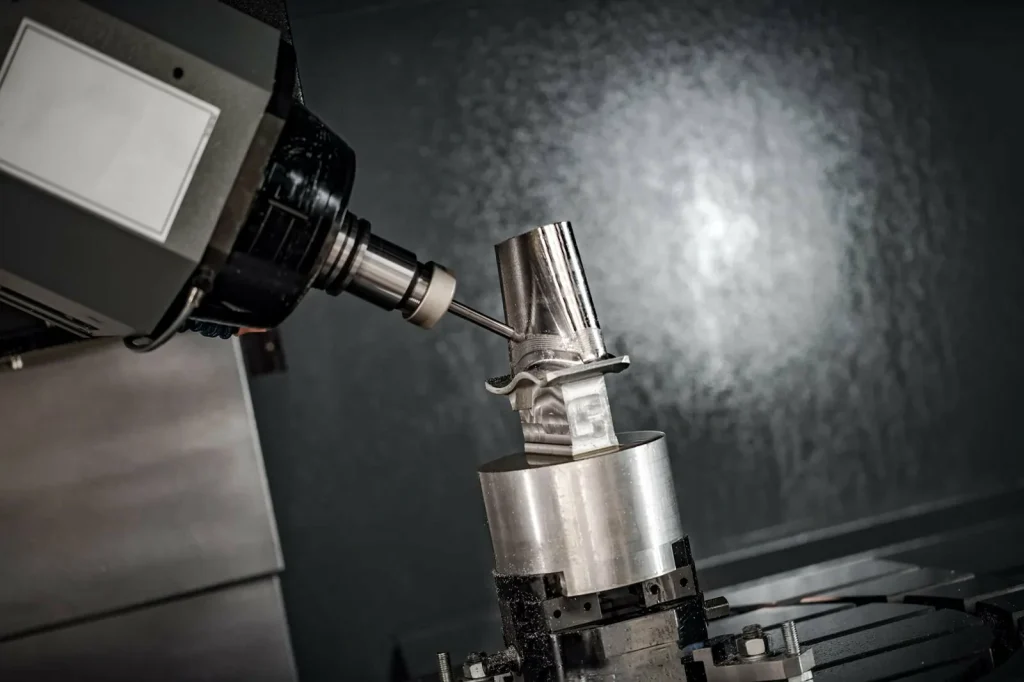
A useful mental model for CNC machined parts is “line-of-sight,” which is important to create a design that allows proper tool access for machining curved undercut shapes. If you trace a straight line from the tool tip toward the feature along the planned tool axis, any overhanging wall that blocks that line creates an undercut condition.
Undercut types in CNC parts (internal groove, dovetail, T-slot, relieved thread features)
In practice, undercuts show up in a few repeat patterns, including those seen in internal grooves CNC and T-slot milling design, requiring different machining processes for each undercut part in machining.
- Internal groove: a groove inside a bore or cavity that sits below an opening, often created using specialized tools like lollipop cutters to achieve a precise undercut in CNC machining, especially when dealing with metal and plastic design challenges.
- Dovetail: angled sidewalls that trap a mating feature; common in fixturing and slide interfaces.
- T-slot: a slot with a narrow neck and a wider undercut section below it.
- Relieved thread features: a relief at the end of a thread (or behind a head or shoulder) that needs clearance for assembly, runout, or a cutting tool.
These are not exotic “special parts.” They appear in housings, molds, rotating components, and assemblies where something must be retained without adding extra hardware.
Quick manufacturability check: tool access, line-of-sight limits, and “can your design actually be made?”
A fast manufacturability screen for undercut machining is:
- Pick the likely setup orientation. Assume the part is clamped in a vise, on soft jaws, or on a fixture plate. If you cannot name a stable orientation, that is already a risk.
- Identify the tool axis for each feature. On 3-axis, that axis is fixed. On multi-axis, it can tilt or index.
- Check line-of-sight to the cutting zone. If a wall hides the surface from the tool axis, you need a different axis, a special cutter, or a different process.
- Check the “shadow” of the holder. Many machine undercuts are reachable by the tool tip but not reachable by the tool assembly (shank + holder). This is where designs fail even on 5-axis machines.
This is what people mean when they ask, “can your design actually be made?” The CAD model may be valid, but the machine, tool, and setup must have a collision-free path to the surface.

Shallow vs deep internal undercuts: why “< 2× tool diameter” is the key economic breakpoint (Table)
Shallow vs deep internal undercuts: why “< 2× tool diameter” is the key economic breakpoint, especially when considering typical straight machining tools that cannot handle deeper cuts in undercut machining. A recurring breakpoint in undercut feasibility is the depth relative to tool diameter, especially when working with conventional machining methods or when creating the shallow undercut, as tool breakage can increase with excessive extension, especially when manufacturing some precise undercut standards that require specialized tools. Industry guidance often treats shallow undercuts as those with depth less than about 2× the tool diameter, and deep internal undercuts as those exceeding that ratio. The reason is not only cycle time. It is stiffness and access.
In the machining process, when machining undercut parts, as depth grows while diameter stays small, you need more reach (longer stickout), which can lead to tool deflection and affect surface finish, making the use of undercut cutting tools essential for precision. That increases bending and vibration risk, so finish quality and size control get harder. Machining curved undercuts in such scenarios often requires careful tool selection to mitigate these risks.Even if you “can” cut it, the part may cost more because the process window is narrow.
Table (economic breakpoint):
| Feature condition | Typical access + process outcome | What usually drives cost/risk |
|---|---|---|
| Undercut depth < 2× tool diameter | Often reachable with standard undercut tool types like lollipop cutters; fewer surprises in proving | Tool selection and holder clearance, then basic simulation |
| Undercut depth ≥ 2× tool diameter | Higher chance of deflection, chatter, or collision constraints; more CAM time | Tool extension limits, finish pass stability, verification, inspection difficulty |
This ratio does not replace engineering judgement. It is a fast way to flag features that may be feasible but not economical, especially for creating internal grooves CNC work or undercut parts requiring specialized undercut tool types.

Choosing the right CNC platform: 3-axis vs 4-axis vs 5-axis
Designing for multi-axis CNC, axis count does not “solve” undercuts by itself. What it changes is the set of tool approach directions you can use without refixturing, and how smoothly you can keep the tool engaged on contoured surfaces.
Why 4-axis and 5-axis machining are often preferred for complex undercuts (Capability comparison table)
Many undercuts can be made on 3-axis machines, but the typical path is multiple setups, which can increase the complexity of producing undercut parts with precision, making custom CNC machining services more suitable for simpler undercut shapes. For intricate undercut parts and those requiring higher precision, multi-axis CNC machining is often used in most machining services. That adds alignment error and time.
Research and industry practice commonly treat 4-axis and 5-axis CNC machining as often preferred for complex undercuts, particularly when creating intricate CNC parts with undercuts, because they can reach features that are inaccessible from a single vertical direction.
Capability comparison table (high-level):
| Platform | What it changes for undercuts | Typical limitation that still remains |
|---|---|---|
| 3-axis | Lowest motion complexity; works for open undercuts with clear top access | Many undercuts are blocked by line-of-sight; more setups to “find an angle” |
| 4-axis | Adds rotation so features can be presented to the cutter without full re-fixturing | Still limited in tool tilt; some contoured undercuts remain hard to finish cleanly |
| 5-axis | Adds tool tilt and/or part tilt; enables access and smoother engagement on complex geometry | Tool/holder clearance and tool deflection can still be the limiting factor |
A key point for technical buyers: 5-axis capability does not mean “any geometry.” It means more approach options, which often turns an impossible feature into a feasible one—until reach and clearance take over.
5-axis simultaneous motion vs indexed positioning: when surface continuity and contoured undercuts matter
Two common multi-axis modes matter for CNC undercut machining:
- Indexed positioning: the part (or head) rotates to a fixed angle, then the cut runs like a 3-axis move. This is often enough for straight undercuts, planar grooves, or features that only need access from a few discrete directions.
- Simultaneous 5-axis motion: the tool orientation changes continuously while cutting. This matters when the undercut surface is contoured and you need smooth surface continuity, such as blade-like shapes, organic recesses, or variable curvature where a fixed angle would leave cusps or mismatched blend zones.
Fewer setups with 5-axis: reducing re-fixturing error and enabling “done-in-one” undercut features
A repeat finding in academic and process studies is that 5-axis machining can reduce the number of fixture setups needed to produce complex geometry. That matters for undercuts because many undercut features are reachable only after you rotate the workpiece.
Each extra setup introduces chances for:
- small datum shifts (even if your operator is careful),
- accumulated tolerance stack between faces,
- extra proving time, because each setup is a new collision and workholding scenario.
Custom CNC machining services often focus on reducing setups to minimize re-fixturing error, a common source of variation when working with undercut parts that require precision. This is why “done-in-one” undercut features are often discussed as a benefit of 5-axis for complex parts, including undercuts and thread-related relief geometry.

Tools that make CNC undercut machining possible
Most undercuts are made with an undercut end mill designed for these specific geometries, not a standard end mill. They are made with cutters designed to put the cutting edge “around a corner,” or to cut a specific profile like a dovetail.
Undercutting tool families: lollipop/ball undercut mills, dovetail cutters, keyseat/T-slot cutters (Tool selection table)
The tool family often signals the feature intent, which is critical when selecting the right CNC undercut tool for machining specialized CNC parts with undercuts or when machining plastic design and machining questions related to precision cuts. Picking the tool early also helps you validate corner radii and clearance in CAD.
Tool selection table (typical matches):
| Undercut tool type | What it is good at | Common undercut feature match |
|---|---|---|
| Lollipop / ball undercut mill | Reaching behind a wall and finishing a small internal recess with a spherical cutting end | Internal reliefs, back-side fillets, contoured undercut areas |
| Dovetail cutter | Producing angled sidewalls under a lip | Dovetail grooves, retention profiles |
| Keyseat / T-slot cutter | Cutting a wider slot under a narrow opening | T-slot milling design, keyseat features, captive slot geometry |
This also answers a frequent question: what tools are used for internal grooves? In CNC milling, internal grooves often point to lollipop-style undercut mills, or to T-slot/keyseat cutters if the groove has a necked opening and a wider base.
Tool reach, holder clearance, and minimum corner radii: preventing collisions and uncut stock
Undercuts fail more often from “everything around the cutting edge” than from the cutting edge itself, requiring precise tips for machining and proper toolholder clearance. Three checks matter:
- Reach (stickout) to the cutting zone: The cutting end must reach the depth without the shank rubbing, which requires selecting the right undercut tool like an undercut end mill suitable for machining curved undercuts.
- Holder clearance: The holder must not collide with walls during the approach or while following the toolpath. On multi-axis, this includes clearance during tool tilt.
- Minimum corner radii: Internal sharp corners inside an undercut are a red flag. Even if the tool can fit, the radius at the cutting end and the tool’s neck geometry set a minimum inside radius. If CAD specifies a smaller radius than the tool can physically create, you will leave uncut stock or force a redesign.
Tool deflection risk grows with depth and extension: recognizing when “reach” becomes the limiting factor (Rule-of-thumb chart suggestion)
Even with the right undercut tool types, tool deflection often sets the real limit. As you extend a tool to reach a deep internal undercut, the tool becomes less stiff. Cutting forces then bend the tool, which can cause:
- undersized or oversized features (depending on direction of loading),
- tapered walls,
- poor surface finish,
- chatter marks that appear only in certain tool orientations.
Academic machining dynamics literature ties stability to stiffness and engagement conditions. In simple terms, “more reach” means “less stability,” especially for small-diameter cutters used for internal grooves.
Rule-of-thumb chart suggestion: Plot “relative risk” on the y-axis versus “depth / tool diameter” on the x-axis, highlighting the economic breakpoint around 2× tool diameter. Label the rising risk zone as “deflection and chatter dominate.”
This is why a design that seems minor in CAD, like pushing a groove deeper without changing its opening, can change a stable process into a fragile one.
CAM programming and verification for undercut toolpaths
Undercuts are CAM-intensive because many of the failures are not visible from a single view. The tool might be cutting fine, then collide during a link move, or leave unexpected stock because the tool axis is constrained away from the ideal direction.
CAM workflow for undercuts: feature recognition → tool axis strategy → rough/finish passes (Process flow diagram)
A practical CAM workflow for CNC undercut machining usually follows this sequence:
- Feature recognition / definition: Identify the undercut feature boundaries and the target surfaces. For complex parts, this may be manual selection rather than automatic recognition.
- Tool axis strategy: Decide how the cutter will be oriented to maintain contact without collision. For 5-axis work, decide whether you need continuous reorientation or can index.
- Roughing approach: Create space if needed. Many undercuts are not cut from solid; you first remove blocking material so the undercut tool can enter safely.
- Finishing passes: Plan light, controlled finishing to manage deflection risk and hit tolerance and surface expectations.
- Rest machining / cleanup: Remove leftover stock from tool diameter limits or axis constraints.
Process flow diagram: A simple left-to-right flow with decision diamonds at “indexed or simultaneous” and “clearance OK?” to show where most iterations happen.
This also answers “How do you machine an undercut with CNC?” The short version is: you pick the undercut tool, create access, set a tool axis plan that avoids collisions, then rough and finish with verification at each step.
Toolpath simulation for collision detection and stock verification (holder checks, gouge avoidance)
In practice, most shops treat simulation as mandatory for producing undercut parts, helping to detect issues like holder collisions and tool gouges. It helps catch:
- holder collisions, not just tool collisions,
- gouges from tool tilt mistakes,
- stock left behind in corners that the cutter cannot reach,
- unsafe approach and retract moves.
Industry best practices and CAM documentation consistently stress simulation because multi-axis motion can hide problems until the machine runs. With undercuts, the most expensive mistakes are often “one move” problems: a linking motion that clips a wall, or a tilt that swings the holder into a shoulder.
Stock verification matters too. An undercut tool may be able to cut the target surface, but only if earlier operations removed enough material for clearance. Simulation helps prove that the “air gap” exists where you think it exists.
Real-world workflow example: 5-axis impeller blade undercuts with tool-axis control and finishing passes
Impeller-style parts are a common reference example because the blade channels create deep, curved undercut areas with strong access constraints. A workable workflow (as shown in common industry demonstrations) tends to emphasize tool-axis control more than the cutting parameters themselves.
A typical sequence looks like this:
- Define blade surfaces and hub/shroud boundaries so the CAM system knows which faces must be protected.
- Set tool-axis limits so the tool can tilt to follow the blade without the holder colliding with adjacent walls. This step often takes iteration because small tilt changes can remove a collision but create gouge risk.
- Use a controlled finishing strategy for the blade undercuts. Finishing passes are where surface continuity is created, and also where deflection shows up as waviness or mismatch between adjacent passes.
- Run holder-aware simulation and stock verification before posting code, focusing on transitions between blades and the deepest undercut zones.
The key engineering takeaway is that complex undercuts often succeed or fail on tool orientation management, not on raw machine power.
Tolerances, surface finish, and inspection strategy for undercuts
Undercuts can be held to tight tolerances, but the inspection plan has to match the access constraints. If you cannot measure it reliably, you cannot control it reliably.
What precision looks like: CNC milling tolerances on well-supported features vs. manual machining (Benchmark table)
Industry technical reports commonly cite that CNC milling can achieve very tight tolerances on well-supported features; deep internal undercuts typically require relaxed expectations unless the feature is redesigned for access and measurement. These are benchmarks, not promises, and the real achievable tolerance depends on geometry, access, and stability.
Benchmark table:
| Method | Commonly cited precision benchmark | Why undercuts change the difficulty |
|---|---|---|
| CNC milling | ±0.005 mm | Access constraints can force long tools and complex tool axes, which increases variation |
| Manual machining | ±0.01 mm | Tool control and repeatability depend heavily on operator technique and measurement access |
For technical buyers, the useful lesson is that undercuts shift the problem from “can the machine position accurately?” to “can the tool reach and cut stably enough, especially when machining curved undercut shapes, that the accuracy shows up on the part?”
Surface finish expectations: why deep undercuts often degrade finish via deflection and access constraints (Cause/effect diagram)
Deep undercuts often show worse surface finish than open faces, even with careful programming. The causes are mostly mechanical:
- Deflection: the tool bends under load, changing effective chip thickness and leaving a variable surface.
- Vibration (chatter): long reach and partial engagement can excite unstable cutting.
- Compromised stepovers: the “best” tool orientation may be blocked, so the CAM strategy uses less ideal contact conditions.
- Limited polishing options: if the feature is buried, post-machining finishing may be limited.
Cause/effect diagram: A simple chain: “Deep access constraint → longer extension → lower stiffness → more deflection/vibration → surface finish degrades + size varies.”
This is why the “< 2× tool diameter” breakpoint matters beyond cost. Past that point, finish risk rises even if the tool can reach.
Inline probing and advanced metrology: real-time quality control for adaptive correction during machining
Undercuts create measurement challenges because conventional touch-off and external measurement tools may not reach the surface.
Two inspection approaches are often used:
- Inline probing: automated probing inside the machine can check datums and reachable surfaces between operations, which is crucial when dealing with undercut machining that involves internal and external undercuts. This is crucial for precision CNC when working with CNC parts with undercuts, ensuring that the machining process adheres to precise undercut standards.
- Advanced metrology: for complex internal shapes, measurement methods that can capture hidden geometry are often needed. The right choice depends on access, required reporting, and whether you need full surface data or just key dimensions.
The practical point is that inspection must be designed with the feature. If an undercut is critical, make sure there is a realistic way to verify it without relying on guesswork or indirect assumptions.
DFM rules for undercuts: designing for access, stability, and repeatability
When designing undercut parts, they are often “designed in” for functional reasons, and these designs often require specialized undercut machining processes, which involve advanced CNC machining tools for precision. The DFM goal is not to eliminate them by default. It is to make them reachable, stable to cut, and repeatable to inspect.
Undercut geometry guidelines: depth-to-diameter, relief needs, and avoiding impossible tool orientations (DFM checklist)
Three DFM rules catch many problems early:
- Depth-to-diameter control: If you are producing undercut parts and pushing past about 2× tool diameter in depth, expect higher cost and risk because reach and deflection dominate in the machining process.
- Add relief where the tool needs to turn or exit: Thread reliefs and groove runouts exist for a reason. If the tool has no space to transition, you force tiny tools or risky toolpaths.
- Avoid impossible tool orientations: A surface might be reachable only if the tool tilts into a wall. If the required tool axis points “through” solid material, the geometry is not machinable as drawn.
DFM checklist: Present as yes/no questions: “Is there line-of-sight for the tool tip?” “Is there line-of-sight for the holder?” “Is the minimum internal radius compatible with an undercut cutter?” “Can you measure it?”
This also addresses “How to avoid undercuts in part design?” You avoid unnecessary undercuts by changing the assembly concept (split parts, add fasteners, change retention method), or by opening access (larger openings, added relief). If you cannot measure it directly (or via agreed indirect method), consider redesigning the feature to enable access and reliable measurement.
Design-to-production handoff: preventing CAD-perfect parts that fail in the shop (DFM review framework)
A common failure mode is a CAD model that meets the functional spec but assumes impossible manufacturing moves. This shows up as rework cycles where the shop asks for changes late, after programming starts.
A simple DFM review framework for undercuts is:
- Define what is critical: Which undercut surfaces drive function (seal, retention, motion) and which are just clearance.
- Confirm datum strategy: Decide how the part will be located for machining and inspection. Undercuts that reference “floating” geometry are hard to control.
- Lock down tool access assumptions: State which faces can be used as approach openings, and whether multi-axis machining is allowed.
- Agree on verification points: Identify which dimensions will be measured directly and which will be inferred.
This helps prevent the “design-to-production gap” when designing undercut parts that appear valid in CAD but are difficult to machine due to access constraints.
When to redesign the feature: converting deep internal undercuts into machinable alternatives (Decision tree)
Some undercuts are feasible but inefficient. Others are feasible but not controllable. Redesign is often justified when the undercut is both deep and internal, and when its tolerance or surface finish matters.
Decision tree:
- If the undercut is deep relative to the tool diameter and is internal, ask whether you can open access (larger opening, added window, split line).
- If access cannot be opened, ask whether the feature can be re-specified (larger radii, less depth, different retention method).
- If the function requires the exact geometry, evaluate whether a different process (such as EDM) is a better fit than milling.
This ties to a common question: What is the limit for T-slot depth? In practice, the limit is rarely a single number. It is set by whether the T-slot cutter can reach without excessive extension and whether the neck opening gives the holder enough clearance. The depth-to-tool-diameter ratio is a practical screening metric before you get into detailed tool catalogs.
Common undercut machining problems and how to fix them
Undercuts fail in repeatable ways. The fixes are also repeatable, but they often trade cycle time for stability and scrap reduction.
Tool deflection and chatter in deep cavities: symptoms, root causes, and mitigation levers (stiffness, stepdown, strategy)
Symptoms in undercut features often include size drift, taper, poor finish, and visible vibration marks. You may also see a mismatch between opposite walls when the tool loads differently as it changes direction.
Root causes are usually:
- long tool extension needed for reach,
- weak tool geometry for the cut direction,
- unstable engagement (thin walls, interrupted cuts, or changing contact).
Mitigation levers fall into three buckets:
- Stiffness: reduce stickout where possible, or change the approach so a larger diameter tool can be used for part of the work.
- Stepdown and engagement control: reduce aggressive engagement in finishing. Finishing is where deflection shows up as error on the final surface.
- Strategy: use toolpaths that keep load consistent, and avoid sudden direction changes deep in a cavity.
Academic stability research supports the basic idea that stability improves when the system is stiffer and cutting conditions avoid excitation. In undercuts, geometry often forces poor stiffness, especially when machining complex undercut parts, so strategy choices and tool selection matter more than people expect.
Tool/holder access limitations on multi-axis machines: avoiding collisions and “bulky holder” traps (Clearance matrix table)
A frequent surprise is that a 5-axis machine can orient the tool correctly, but the holder cannot physically fit into the space. This is common in narrow cavities and near tall walls.
Clearance matrix table (qualitative):
| Constraint | What to check in CAD/CAM | Typical failure mode |
|---|---|---|
| Holder diameter vs opening | Compare opening width to holder envelope during tilt | Collision during finishing tilt even though tool tip is valid |
| Shank clearance in deep groove | Confirm necked tool geometry clears sidewalls | Rubbing, heat, poor finish, tool wear |
| Link moves between passes | Simulate approach/retract with holder | Collision on non-cutting motion |
| Adjacent features | Check nearby bosses, ribs, clamp surfaces | “One more feature” blocks the only workable tool angle |
This is why collision-aware simulation is part of feasibility, not a nice-to-have.
Scrap-prevention tactics: simulation-first programming, conservative proving, and inspection gates (Control plan checklist)
Undercuts tend to have higher scrap risk because collisions and gouges can be catastrophic, and because errors may not be visible until late.
A practical control plan usually includes:
- simulation-first programming with holder checks and stock verification,
- conservative proving (especially on the first part),
- inspection gates at points where rework is still possible (after access is created, before final finishing, and after finishing).
Control plan checklist: A short checklist format works here because the goal is to prevent predictable failure modes, not to optimize cycle time first.
Alternatives and trade-offs: when not to machine an undercut
Sometimes the best decision is not “which 5-axis strategy,” but “should we mill this undercut at all?” Two alternatives show up often: additive manufacturing for prototypes and EDM for hard-to-reach geometry.
Additive manufacturing for prototypes: eliminates undercut constraints but with rougher finish and relaxed tolerances (Comparison table)
Additive manufacturing removes the line-of-sight constraint because the part is built rather than cut from a block. That can make undercut-heavy prototypes feasible without complex tooling. The trade-offs include rougher surface finish and looser tolerances. Those numbers can be acceptable for fit checks and early functional prototypes, but they can be limiting for precision mating surfaces.
Comparison table (high-level):
| Attribute | CNC undercut machining | Additive manufacturing (prototype use case) |
|---|---|---|
| Undercut freedom | Limited by tool access and holder clearance | Undercuts are generally not constrained by tool access |
| Surface finish | Can be strong on accessible surfaces; deep undercuts may degrade due to deflection | Often rougher (50–200 µin Ra cited) |
| Tolerance | Can be very tight in CNC (benchmarks down to ±0.005 mm cited) | Often looser (±0.005″ or greater cited) |
This is not “either/or.” A common pattern is to prototype additively to prove geometry, then redesign for machining where needed.
EDM as an option for hard-to-reach undercuts: where it fits vs CNC milling (Decision matrix) — Reference: manufacturing process handbooks
Electrical discharge machining (EDM) is often discussed for features that are difficult to reach with rotating tools. Process handbooks commonly place EDM as a fit when the geometry is hard to access or when material conditions make conventional cutting difficult.
A simple decision matrix for undercut features:
| Question | If “yes,” EDM may fit better | If “no,” CNC milling may fit better |
|---|---|---|
| Is tool access blocked even with multi-axis? | Yes | No |
| Would required tool reach create major deflection risk? | Yes | No |
| Is the undercut geometry sharp or deeply trapped? | Often | Less often |
| Is surface continuity from milling tool marks acceptable? | Maybe not | Often yes |
This is not a blanket recommendation. It is a way to sort features that are “technically millable but fragile” from those that are naturally aligned with an EDM approach.
Cost and lead-time drivers: axis count, setups avoided, and why shallow undercuts are more viable (Simple cost model table)
Undercuts drive cost mainly through programming time, setup complexity, and risk controls (simulation, proving, inspection). Multi-axis machining can reduce setups, which can reduce re-fixturing error and time, but it can also increase programming and verification needs.
A simple qualitative cost model helps frame the trade:
Simple cost model table (directional):
| Driver | Tends to increase cost/time when… | Why |
|---|---|---|
| Axis count | Moving from 3-axis to 5-axis for complex undercuts | More tool-axis planning and collision checking |
| Number of setups | Many setups are needed to “reach around” features | More alignment risk and proving time |
| Undercut depth vs tool diameter | Depth grows past 2× tool diameter | Deflection risk increases; finishing gets harder |
| Inspection difficulty | Feature is buried and hard to measure | More metrology planning and iteration |
FAQs
Yes, a 3-axis CNC machine can make some undercuts, but only when the tool can reach the feature without needing tilt or rotation. In these cases, the machine works in a straightforward, linear direction. However, when features are deeply recessed or located in hard-to-reach areas, multiple setups may be necessary to access the undercut from different angles, which can lead to higher alignment risks and longer machining times. For more complex internal undercuts, 4-axis or 5-axis machines are generally preferred, as they offer better flexibility for accessing difficult-to-reach areas with fewer setups.
The choice of cutter depends on the specific undercut feature shape. Lollipop (ball undercut) mills are ideal for reaching behind walls and finishing small internal recesses, making them excellent for internal reliefs and contoured areas. Dovetail cutters are suitable for creating angled sidewalls under a lip, commonly used for dovetail grooves and retention profiles. Keyseat/T-slot cutters are the best choice for cutting wider slots beneath narrow openings, making them perfect for T-slot milling designs, keyseat features, or captive slot geometry. Selecting the right cutter is crucial for ensuring that the desired geometry is achieved without tool clearance issues.
The practical depth of an undercut is often considered in relation to the tool diameter. A common guideline is that undercuts with a depth greater than twice the tool diameter (2× tool diameter) can quickly become problematic. As depth increases, the tool requires more extension, which leads to increased risks of deflection, chatter, and reduced stability. This makes finishing more difficult, and surface quality may suffer. While such undercuts are still possible, they require careful CAM planning, more conservative finishing strategies, and a well-designed inspection plan to mitigate the increased risks of deflection and dimensional inaccuracies.
The precision that can be achieved in CNC milling for undercuts, particularly in parts with undercuts, largely depends on the geometry, access constraints, and tool stability, which may require specialized undercut machining tools. In general, CNC milling can achieve tight tolerances on well-supported features. However, deep internal undercuts typically require relaxed expectations unless the feature is specifically redesigned for easier access and reliable measurement. Inspection of undercut features is challenging due to the often inaccessible nature of the geometry. Inline probing and advanced metrology tools are often used to verify these features, especially for buried or hard-to-reach surfaces. Reliable measurement is crucial to achieving tight tolerances, as it ensures that the cut matches the design intent and functional requirements.
Machining an undercut with CNC requires several steps, primarily focused on tool access and avoiding collisions. The process begins by selecting the appropriate undercut tool, ensuring that the tool tip can reach the required feature without interference. Next, you need to determine the optimal tool axis strategy to maintain contact with the feature while avoiding toolholder or machine collisions. For deep undercuts, multiple setups or multi-axis machining may be necessary. Roughing passes are used to clear material and create space for the undercut tool, followed by finishing passes to achieve the desired surface quality. At each step, verification is crucial, with simulation and inspection used to confirm that the toolpath is clear and accurate.


 English
  German
  French
  Italian
  Spanish
  Polish
  Czech
Czech  Japanese