
Is cast aluminum strong? Cast aluminum delivers high strength-to-weight, corrosion resistance, and excellent thermal conductivity—making it a go-to for automotive, aerospace, electronics, and industrial products. This guide explains how cast aluminum is made, which alloys to choose, design rules that prevent defects, and how to source quality parts at scale.
Key takeaways
- Fast definition: Cast aluminum is aluminum alloy shaped by pouring or injecting molten metal into a mold (die, sand, permanent mold, investment).
- Why it matters: Lightweight, strong, corrosion-resistant, and thermally/electrically conductive.
- Best for: Complex, thin-walled parts with tight tolerances via aluminum die casting.
- Production at a glance: Melt (~660°C), purify (argon degassing), inject (300–50,000 psi), cool/eject (<1-minute cycles), finish (trim, shot-blast, CNC, X-ray).
- Sustainability: Recycled aluminum uses ~5% of primary energy; >75% of aluminum ever made remains in use.
- What you’ll get: Process comparisons, alloy selection, DFM rules, defect prevention, case studies, calculators, RFQ checklist.
What is cast aluminum?
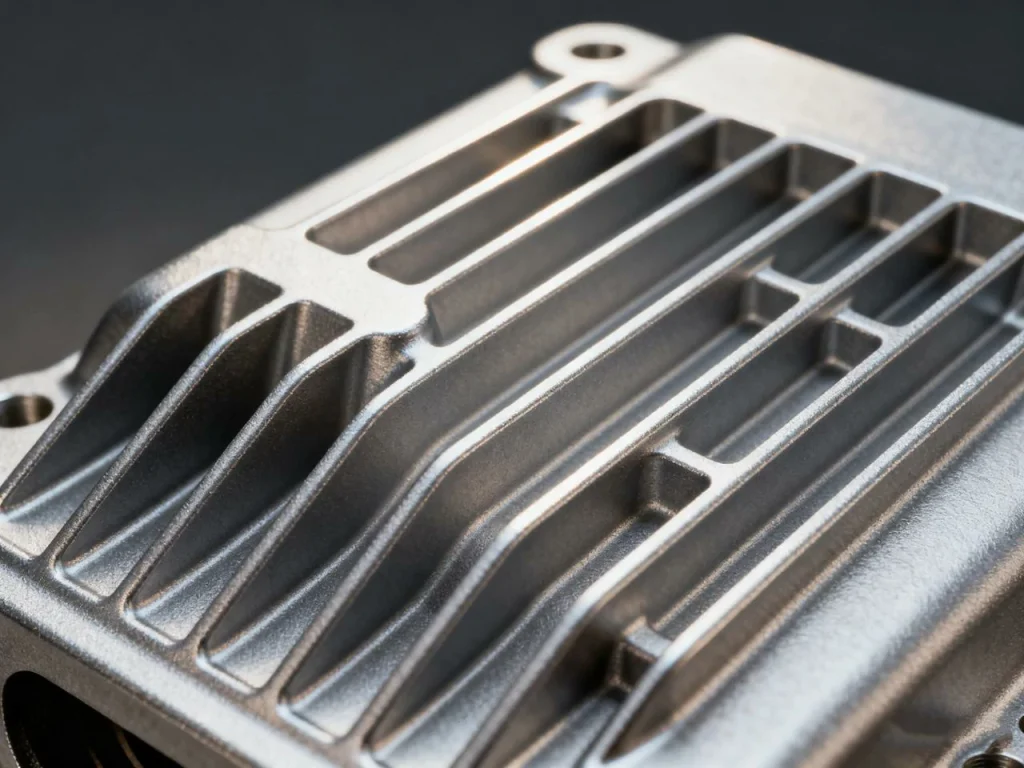
Cast aluminum is aluminum alloy that is melted and poured into an aluminum mold, where it solidifies to a net or near-net shape. Making cast aluminum in this way allows for various casting techniques. The mold may be a steel die, a sand mold, a permanent mold casting uses, or a ceramic shell for investment casting. Because the metal casting aluminum starts with liquid metal, you can form internal cavities, thin ribs, and complex geometry that would be hard or costly to machine from solid.
Common aluminum casting alloys include high-silicon grades used in die-cast aluminum (like 380/383/413) for excellent castability and fluid fill, and Al-Si-Mg grades like A356/356 that can be heat treated for strength. Typical parts range from cast aluminum bases for furniture and lighting to electronic housings, pump and motor bodies, heat sinks, brackets, and structural nodes.
How does cast vs. vs wrought aluminum compare? Cast aluminum vs aluminum in wrought form shows different advantages: wrought aluminum (extrusions, plate) is worked in the solid state (rolled, forged) and often has higher ductility and toughness. Cast aluminum’s excellent ability to form complex shapes enables near-net shapes with fewer pieces and less machining, often at lower cost of cast aluminum per unit for medium to high volumes. Similar to cast aluminum, some wrought aluminum processes like forging or extrusion also offer excellent strength but differ in design flexibility. If you need deep pockets, lattice-like ribs, or sealed cavities, aluminum casting is usually a better fit.
Core advantages of cast aluminum for modern products
When you think about EV range, aerospace payloads, and cooler electronics, lightweight and conductive materials matter. Cast aluminium offers:
- Strength-to-weight: Aluminum is a lightweight metal. The weight of cast aluminum is about one-third that of steel. This strength of cast aluminum makes it ideal for automotive and aerospace applications, according to the Aluminum Association. In many designs, a cast aluminum part can reach the needed stiffness with smart ribbing and wall thickness. This enables fuel efficiency and longer battery range.
- Corrosion resistance: Aluminum naturally forms a thin aluminum oxide layer on its surface, which protects it and enhances corrosion resistance. This natural layer protects against many environments. Add coatings or anodizing where needed.
- Thermal and electrical conductivity: Ideal for heat sinks, housings, and RF enclosures. Cast fins and pin arrays help move heat.
- Scalability: Aluminum die casting supports cycle times under a minute with tight repeatability. Tooling cost is an investment, but unit cost drops fast at volume because each cast cycle is quick.
- Design freedom: Parts with complex shapes, internal passages, and thin walls are often easier in casting than in CNC milling or CNC turning from solid.
How to cast aluminum: the die casting process
If you aim for thin walls, fine detail, and high precision, die casting is the most common casting method. Here is the simplified aluminum casting process step by step.
- Melting
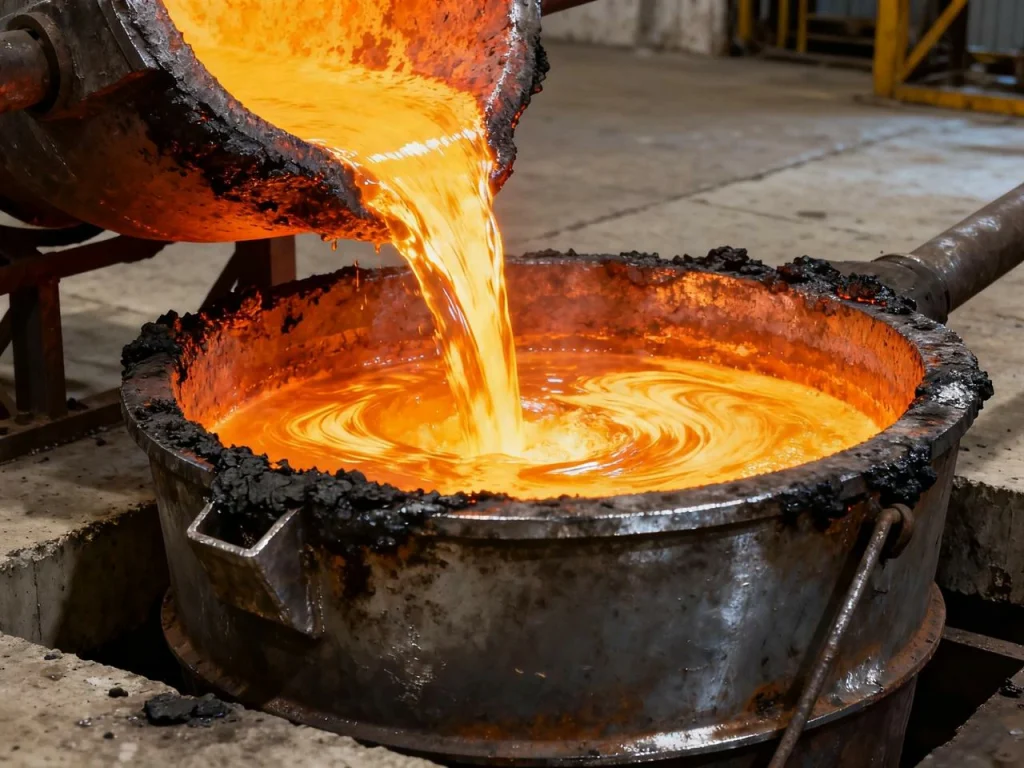
- Aluminum ingots and clean scrap are melted in a furnace. Melting point is about 660°C.
- Example capacity: a modern furnace can melt around 1.5 tons in ~45 minutes.
- Aluminum requires precise temperature control during melting to balance fluidity with minimal oxidation.
- Purification
- Molten metal is cleaned to reduce gas and oxide inclusions. Argon degassing is common to lower hydrogen, which causes porosity.
- Fluxes and filters may remove inclusions.
- Injection
- The molten aluminum cools in the cavity of a hardened steel die, and the cast aluminum part is removed automatically. Optional finishes for casting can then be performed to meet specifications.
- A piston injects the metal at high pressure—often 300 to 50,000 psi—to fill every detail and achieve a fine cast aluminum surface.
- Cooling and automated ejection
- The part cools rapidly; the die opens and ejector pins push the cast aluminum part out.
- Many cells use robots for spray, pick, trim, and palletizing.
- Typical cycle time can be less than one minute.
- Finishing and QA
- Gates, runners, and flash are trimmed.
- Surfaces may be shot-blasted. Features are CNC machined where tight tolerances are needed.
- Quality checks can include X-ray (radiography), leak testing, and dimensional inspection.
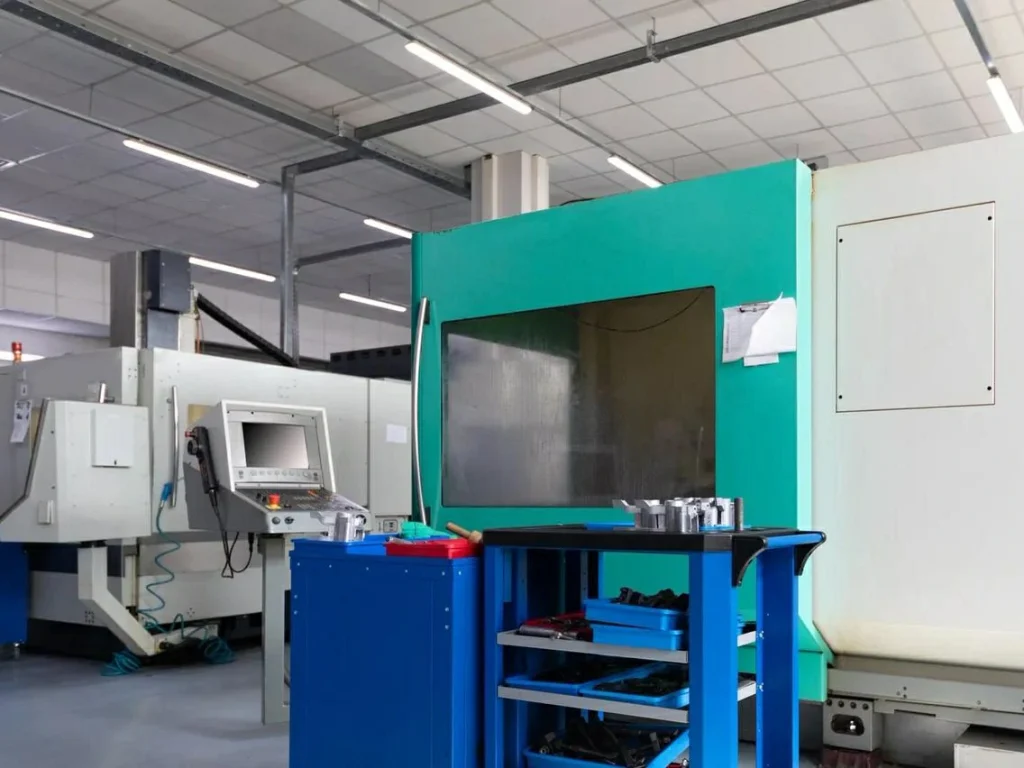
Critical faces, holes, and threads are often finished using CNC machining. For precision turning, CNC turning services can help achieve tight tolerances and smooth surfaces.
For high-quality CNC machining and precision component manufacturing, visit U-Need, a professional manufacturer specializing in CNC and parts processing for aluminum and metal components.

Types of casting processes compared (die, sand, permanent mold, investment)
There is no single “best” way for different aluminum casting or types of aluminum casting processes. The right aluminum casting process depends on size, complexity, surface finish, tolerance, and volume. Use this quick view to choose.
Comparison (typical ranges; consult your supplier for exact capability)
- Use tables only for essential specs.
| Process | Typical Volume | Tooling Cost | Wall Thickness | Tolerances (linear) | Surface Finish (Ra) | Notes |
| High-Pressure Die Casting | 5,000–1,000,000+ | High | 1–3 mm | ±0.05–0.25 mm | 1–3 μm | Best for thin walls, tight repeat, excellent cosmetics |
| Permanent Mold Casting (Gravity Die) | 500–100,000 | Medium | 3–6 mm | ±0.25–0.5 mm | 2–6 μm | Good mechanicals, better than sand for finish |
| Sand Casting | 1–10,000 | Low | 4–25+ mm | ±0.5–1.5 mm | 6–25 μm | Best for large parts, low tooling cost, flexible |
| Investment Casting | 100–20,000 | Medium-High | 2–5 mm | ±0.1–0.4 mm | 1–3 μm | Complex shapes, fine detail, slower cycle |
How to choose?
- Tight tolerances, thin walls, high volume? Choose aluminum die casting.
- Medium volume, better surface and properties than sand, not as thin as die casting? Choose permanent mold casting.
- Low volume, large parts, simple tools? Choose sand casting.
- Intricate small-to-medium parts with very fine detail? Choose investment casting.
Alloys and properties of cast aluminum
Cast aluminum alloys vary by silicon, copper, magnesium, and other elements. Depending on the alloy, mechanical properties such as strength of cast aluminum or corrosion resistance can differ, according to the USGS National Minerals Information Center. Silicon improves flow and reduces shrinkage. Magnesium enables heat treatment. Copper can boost strength but may affect corrosion.
Common casting alloys and typical uses
| Alloy (AA) | Family | Typical Use-Cases | Heat Treat | Key Notes |
| 380 | Al-Si-Cu | High-volume die casting: housings, brackets | No (as-cast) | Excellent castability, good strength, good machinability |
| 383 | Al-Si-Cu | Thin-wall die cast parts | No | Improved fluidity vs 380 for thin sections |
| 413 | Al-Si | Leak-tight components, pumps | No | Good pressure tightness and corrosion resistance |
| A356/356 | Al-Si-Mg | Structural castings, wheels | Yes (T5/T6) | Good strength after T6; good weldability |
| 319 | Al-Si-Cu | Engine components, heads | Optional | Good castability; reasonable strength and machinability |
| 535 | Al-Mg | Marine hardware | No | Good corrosion resistance; weldable |
Mechanical property snapshots (approximate; depends on process, section size, and heat treatment)
| Alloy | Condition | UTS (MPa) | Yield (MPa) | Elongation (%) |
| 380 | As-cast (die) | 310–345 | 150–180 | 2–5 |
| 413 | As-cast (die) | 240–290 | 120–160 | 3–6 |
| 356 | T6 (permanent/sand) | 240–310 | 170–230 | 3–10 |
| A356 | T6 (permanent/sand) | 275–320 | 200–240 | 3–7 |
| 319 | As-cast/T6 | 180–250 | 100–150 | 1–4 |
| 535 | As-cast | 200–240 | 90–140 | 6–12 |
What does this mean for design?
- For maximum strength in a cast part, A356/356 in T6 is a go-to.
- For ultra-thin walls at high speed, 380/383 are common in die-cast aluminum.
- For pressure-tight pump bodies, 413 is often selected.
Design for manufacturability (DFM) in aluminum casting
Smart geometry reduces cost, scrap, and risk of defects. Making it suitable for applications with tight tolerances, thin walls, and complex shapes, performed on cast components. Ask yourself: can the metal fill and feed? Will the part release cleanly? Where will it shrink?
- Wall thickness: Keep uniform where possible. Aim for:
- Die casting: 1–3 mm typical; local ribs can be thinner.
- Permanent mold: 3–6 mm.
- Sand casting: 4–25 mm depending on size.
- Draft angles: Provide draft to help ejection.
- Die casting: 0.5–1° on external walls; 1–2° on internal surfaces.
- Sand/permanent: 1–3°.
- Fillets and radii: Avoid sharp corners. Fillets reduce stress and improve flow. Typical internal radius: ≥0.5–1.0 times wall thickness.
- Ribs and bosses: Use ribs to stiffen without adding mass. Bosses should be supported by ribs to reduce hot spots.
- Gating and venting: Leave space for gates, overflows, and vents. These control flow and gas removal.
- Cored holes and undercuts: In die casting, use slides and lifters sparingly to limit tool complexity and cost.
Tolerances and surface finishes (typical)
| Process | Linear Tolerance | Flatness | Surface Finish (Ra) |
| Die Casting | ±0.05–0.25 mm | Tight, depends on size | 1–3 μm |
| Permanent Mold | ±0.25–0.5 mm | Moderate | 2–6 μm |
| Sand Casting | ±0.5–1.5 mm | Lower | 6–25 μm |
Post-processing options
- CNC machining for critical faces, holes, and threads.
- Deburring and shot-blasting for uniform appearance.
- Anodizing: Anodizing is an electrochemical process that thickens the oxide layer. It improves corrosion and cosmetic finish. Not all die-cast alloys anodize equally well; high-silicon alloys can turn gray. Clear, black, and color options exist.
- Impregnation: Resin or sealant can fill micro-porosity to improve leak-tightness.
- Coatings: Powder coat, e-coat, or plating for appearance and protection.
Can you weld cast aluminum?
- Welding cast aluminum is possible, especially with alloys like 356/A356 and 535. High-copper die-cast grades (380/383) are harder to weld and may require special filler and prep. This is a key consideration when making cast aluminum components that will later require joining. Always remove surface contamination and test first.
Quality assurance, defects, and inspection
Common defects and causes
- Porosity: Gas (hydrogen), shrinkage, or trapped air. Causes include poor degassing, turbulence, or insufficient feeding. Prevention: melt cleanliness, proper gating, vacuum assist, and controlled shot profiles.
- Cold shuts: When flows meet and do not fuse. Causes: low temperature, slow fill, poor venting. Prevention: adjust die temperature, shot speed, and runner design.
- Shrinkage: From thick sections cooling last. Prevention: uniform walls, proper risers (sand/permanent), and thermal control.
- Inclusions: Oxides or sand. Prevention: filtration, careful melt handling, and clean tools.
Inspection methods
- X-ray (radiography) checks internal voids and inclusions.
- Dye penetrant reveals surface cracks on machined or cleaned surfaces.
- CT scanning provides 3D porosity mapping for critical parts.
- Leak testing ensures pressure-tightness of housings.
Process controls
- Melt chemistry and temperature control.
- Shot monitoring (speed, pressure, plunger position) in die casting.
- Die thermal management and cooling line balance.
- In-process SPC, lot traceability, and material certs.

Cost, lead time, and scalability
What drives the cost of cast aluminum?
- Tooling complexity (slides, lifters, cavities).
- Part size and projected area (affects machine tonnage).
- Alloy choice and yield (scrap rate from runners/flash).
- Cycle time and energy.
- Secondary CNC machining and finishing.
- Quality requirements (e.g., 100% X-ray).
Typical lead times
- Die casting tools: 4–12 weeks depending on complexity.
- Permanent/sand tooling: 2–8 weeks.
- First article and PPAP: 1–4 weeks after tooling is ready, depending on testing and approvals.
Break-even thinking: casting vs CNC machining vs 3D printing
- Low volume and large parts: sand casting may beat machining from plate.
- Medium to high volume with tight repeat: die casting usually wins on unit cost.
- Complex internal channels at very low volume: additive may be best, but per-part cost is high.
Quick cost estimator (rough-order-of-magnitude)
- Inputs: part mass (kg), annual quantity, process, cycle time (s), machining minutes, scrap rate.
- Simple estimate:
- Metal cost ≈ mass × alloy price
- Casting cost ≈ machine rate × cycle time × (1 + scrap rate)
- Machining cost ≈ machining rate × minutes
- Total per part ≈ (metal + casting + machining + finishing + QA) + amortized tooling/quantity
Example (illustrative only):
- 0.8 kg 380 die casting, 30 s cycle, 100k/yr, 10% scrap, 2 min machining
- Output suggests a low per-part cost once tooling is amortized.
Sustainability and recycling in aluminum casting
Aluminum is generally a circular material. Why? It keeps its properties when recycled.
- Energy: Recycled aluminum uses about 5% of the energy of primary production.
- Longevity: More than 75% of the aluminum ever produced is still in use today, based on World Aluminium.
- Foundry practice: Many foundries run closed-loop recycling, returning gates, runners, and clean scrap to the melt. This reduces waste and carbon footprint.
- Design for recyclability: Avoid mixed materials when possible. Choose alloys that tolerate recycled content while meeting specs.
- Reporting: Buyers now ask for recycled content and emissions data. Foundries can share melt records, material certs, and energy sources.
Real-world case studies and lessons learned
High-volume pressure casting with automation
- A large European facility runs fully automated die-casting cells with robots. Cycle times sit under a minute, with in-cell trimming and online X-ray for safety-critical parts.
- Result: Scrap reduced by ~30% after optimizing degassing and shot profiles. Throughput increased ~15% by balancing die temperatures.
Complex geometry with multi-stage inspection
- An Asian supplier casting thin-walled RF housings adopted vacuum-assisted fill and added dye penetrant before machining.
- Result: Leak failures cut by ~60%, while machining scrap fell from 6% to 2%.
Community insights (from engineering forums)
- Persistent porosity often traces back to melt hygiene and poor venting.
- Cooling control matters; move the heat with better die cooling lines and thermal pins.
- Non-destructive testing (NDT) is not “optional” when parts are safety-critical.
Industries and applications for cast aluminum
Where does cast aluminum shine today?
- Cast aluminum is used in automotive/EV: motor and inverter housings, gearboxes, structural brackets, and applications like cookware. Its aluminum material properties make it suitable for applications requiring lightweight, corrosion resistance, and thermal conductivity.
- Aerospace: Structural nodes, seat components, avionics enclosures where weight and corrosion resistance matter.
- Electronics/thermal: Heat sinks and enclosures rely on aluminum’s thermal and electrical conductivity.
- Industrial and consumer: Pumps, compressors, power tools, appliances, and goods like cookware. A cast aluminum base offers stability and a clean look for stands, tables, and equipment.
- Emerging trends: Part consolidation (cast one piece instead of many), integrated cooling, and near-net-shape structures for e-mobility.

Choosing a supplier: certifications, audits, and RFQ checklist
What to ask a casting supplier
- Process capability: Die, sand, permanent mold, investment. Machine tonnage range and max part size.
- Alloy expertise: 380/383/413 for die casting; 356/A356/319/535 for permanent and sand.
- Quality systems: ISO 9001, IATF 16949 (for automotive). Ability to support PPAP and control plans.
- Inspection: X-ray, CT, leak test, CMM, SPC. Sample reports available on request.
- Post-processing: In-house CNC, finishing, and anodizing/coating.
- Traceability: Heat and lot traceability for each cast aluminum batch.
RFQ essentials (include in your request)
- 3D model and 2D drawing with GD&T, tolerances, and critical features.
- Annual and lifetime quantities, target price, and desired first-article date.
- Alloy and heat treatment (e.g., A356-T6), cosmetic requirements, and leak specs.
- Special tests (X-ray percentage, CT for first articles, salt spray for coatings).
- Packaging, labeling, and delivery terms.
A quick alloy and process selector (interactive prompt)
Answer these three questions:
- Annual volume and part size?
- Thinnest wall and key tolerances?
- Priority: cost, strength, cosmetics, or leak-tightness?
Then apply:
- If volume > 20,000/year and wall < 3 mm → Try 380/383 in high-pressure die casting.
- If medium volume and need heat-treatable strength → Try A356/356 in permanent mold casting.
- If low volume or very large → Try 319 or 356 in sand casting.
- For pressure-tight small pump parts → Consider 413.
Mini cost estimator (use with your numbers)
Step-by-step
- Enter mass (kg) and alloy cost ($/kg).
- Choose process and cycle time (s).
- Estimate scrap rate (%) and machining minutes.
- Apply:
- Metal = mass × alloy cost
- Casting = machine rate × (cycle time/3600) × (1 + scrap)
- Machining = machining rate × minutes/60
- Add finishing and QA, then divide tooling by annual quantity.
Tip: Run two cases—sand vs die—across 500, 5,000, and 50,000 units to see break-even volume.
Design checklist (summary version)
- Uniform walls, correct draft, fillets.
- Ribs for stiffness, avoid thick mass areas.
- Clear machining datums and stock.
- Defined cosmetic faces and gate locations.
- Tolerances aligned to process capability.
- Specified inspection level (X-ray %, leak spec).
- Coatings and anodizing callouts.
Overview of cast aluminum
The nature of cast aluminum enables complex, lightweight, and cost-effective cast aluminum components at scale. Its surface of aluminum can be finished in various ways, and its aluminum has excellent corrosion and thermal properties, making it suitable for applications in automotive, aerospace, electronics, and consumer goods like cookware. It pairs corrosion resistance with excellent thermal and electrical performance, and it supports sustainability through high recycling rates and low energy for secondary metal. If you need thin walls, repeatable quality, and clean surfaces, die-cast aluminum is often the right path. Use the selector and cost tools here to confirm the fit, then request a DFM review to turn your idea into a durable, production-ready cast aluminum part.
FAQs
Cast aluminum is basically aluminum that’s been melted down and poured into a mold to take a specific shape. Think of it like chocolate in a mold, but with metal. This process is super useful when you want parts that have complicated shapes—things that would be really tough or expensive to make by bending or machining a solid block. Cast aluminum is common in automotive parts, engine components, aerospace pieces, and even cookware because it’s lightweight, resists corrosion, and can handle heat pretty well.
Absolutely—if the process is done right. Like any manufacturing, quality depends on control. When the melting, pouring, and cooling are carefully managed, and each part is inspected properly, cast aluminum can meet very tight specifications. That means it’s durable, performs well under tough conditions, and can last a long time. You’ll often see cast aluminum parts working reliably in cars, airplanes, and outdoor equipment because of that. But, of course, sloppy casting can lead to problems like porosity or weak spots.
Well, nothing’s perfect. For cast aluminum:
• Tooling costs can be high, especially for high-pressure die casting. Making those molds isn’t cheap.
• Some aluminum alloys don’t weld very easily, so if your design needs welding after casting, that’s something to consider.
• Porosity can happen if the molten metal isn’t clean or the mold isn’t vented properly. Tiny gas pockets can reduce strength.
• If you need parts to stay really tough at extremely low temperatures (cryogenic), wrought or forged aluminum might be better than cast aluminum.
So while it’s great in many situations, you do need to know its limitations.
Yes, definitely. It’s very common to take a cast aluminum part and then CNC machine things like flat surfaces, holes, or threads. Basically, casting gets you the rough shape, and CNC gets you the precision you need. Just make sure your drawings include the machining stock—the extra material you’ll leave on for finishing—so the machinist knows what to work with.
Honestly, it depends on what you’re making. Different methods suit different jobs:
• Thin-walled, high-volume parts: Die casting is usually best because it’s fast and consistent.
• Large, low-volume parts: Sand casting makes more sense because it’s cheaper for smaller runs and big shapes.
• Medium volume with balanced surface finish and mechanical strength: Permanent mold casting is often ideal.
Each method has trade-offs, so the “best” way really comes down to your part size, quantity, and required properties.
Not really. Aluminum is actually one of the easier metals to cast because it flows well when molten (especially if you add silicon) and solidifies quickly. The tricky part is controlling the temperature, how you fill the mold, and managing gases, which can create bubbles. But in general, aluminum casting is straightforward and widely used in manufacturing.
Depends on what you mean by “regular.” If you mean wrought aluminum—like sheets or extrusions—then it’s really about the job:
• Casting wins when you need complicated shapes or want to make lots of parts efficiently.
• Wrought aluminum wins if you need really high ductility, bending, forming, or long, consistent cross-sections like extrusions.
So it’s not that one is better than the other—it’s which one fits your project needs.
Comparing cast aluminum and cast iron, cast iron is stiff, strong, and wears well, but it’s heavy. Cast aluminum, on the other hand, is much lighter, resists corrosion better, and is easier to machine. For many modern applications, especially where weight savings are important—like cars, bikes, and aerospace—aluminum is the preferred choice. Cast iron still shines for heavy-duty, high-wear applications, but aluminum has a big advantage when lightness and machinability matter.
References
https://www.world-aluminium.org
https://www.usgs.gov/centers/national-minerals-information-center

 English
  German
  French
  Italian
  Spanish
  Polish
  Czech
Czech  Japanese