
ABS plastic is a tough, versatile thermoplastic prized for impact resistance, ease of processing, and cost-effectiveness across automotive, electronics, and prototyping. If you need durable housings, crisp surface finishes, and scalable production—from 3D printing to injection molding—ABS delivers. This guide starts with quick answers and key data, then explores composition, properties, and processes. You’ll see real application case studies, ABS vs alternative materials, sustainability and safety realities, and a buyer’s guide with tools for pricing and supplier selection. Finish with a concise action checklist and authoritative references. Use this as your go-to, engineer-ready resource to choose, design, and manufacture with Acrylonitrile Butadiene Styrene.
Quick Answers: ABS plastic at a glance
If you are new to ABS material or just want a fast overview without diving into deep technical charts, this section gives you the essentials. From the properties of ABS like density and tensile strength to the main uses of ABS plastic across industries, here’s a compact guide that highlights why ABS is considered a versatile and cost-effective choice in the world of plastic materials.
Key facts and stats
- Density: 1.03–1.06 g/cm³
- Tensile strength: ≈ 40 MPa (typical unfilled grade)
- Impact resistance: High, especially in notched impact tests
- Structure: Amorphous thermoplastic polymer (no true melting point)
- Continuous use temperature: ≈ 80°C (grade dependent)
- Global output: >10 million tons/year (industry estimate)
When to choose ABS vs other plastics
- Choose ABS when you need impact resistance and good cosmetic finish (matte or gloss) at a reasonable cost.
- Use ABS when you plan a prototyping-to-production path: 3D print early, move to CNC machining or injection molding later.
- Choose ABS for electrical housings needing insulation and easy painting or printing.
- Consider alternatives if your part needs high heat resistance (>100°C), long-term UV exposure without stabilization, or strong solvent resistance.
Pros and cons at a glance
- Pros: Toughness, machinability, paintability, overmolding compatibility, good dimensional stability, short cycle times in molding.
- Cons: UV sensitivity without stabilizers, solvent stress-cracking risk, moderate heat limit, flammability unless FR-rated, warping risk in 3D printing.
One-screen summary + mini comparison table
| Property (typical) | ABS | PC | PVC (rigid) | HIPS |
|---|---|---|---|---|
| Impact resistance | High | Very high | Medium | Medium |
| Heat resistance (HDT, °C) | 80–100 | 115–130 | 60–80 | 70–90 |
| Transparency | Opaque (some clear grades) | Transparent | Opaque | Opaque |
| UV/weathering | Needs stabilizers | Better than ABS (still needs stabilizers) | Poor–medium | Poor |
| Cost (relative) | Low–medium | Medium–high | Low–medium | Low |
| Processability | Easy | Moderate | Easy (but thermal care) | Easy |
Note: Values vary by grade; check supplier data sheets.
What is ABS material? Composition & production
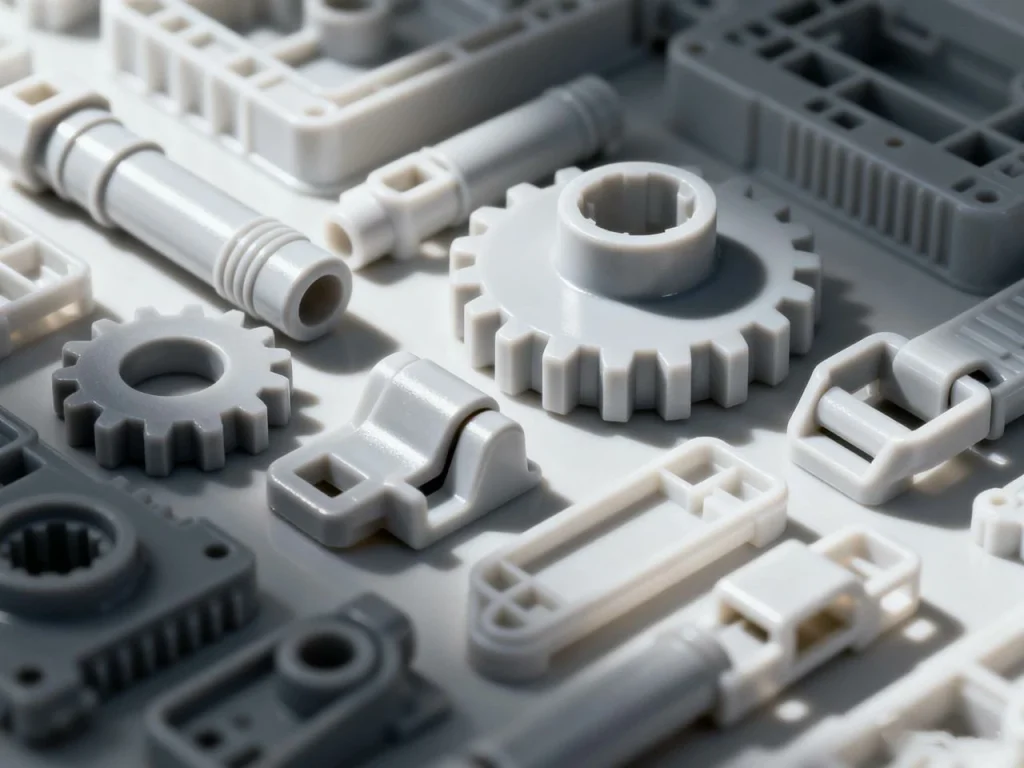
Before diving into the applications of ABS plastic, it’s important to understand ABS material meaning and how it is produced. ABS material (Acrylonitrile Butadiene Styrene) is one of the most widely used plastic materials thanks to its balanced mechanical properties, durability, and ease of processing. By looking at the roles of its monomers and the production process of ABS resin, we can see why it has become a material of choice in industries from automotive to medical devices.
Acrylonitrile–butadiene–styrene roles and morphology
ABS stands for Acrylonitrile Butadiene Styrene. Think of it as a blend where each part plays a clear role:
- Acrylonitrile adds heat resistance and chemical stability.
- Butadiene (rubbery phase) boosts toughness and impact resistance, especially at lower temperatures.
- Styrene provides rigidity, surface gloss, and ease of processing.
ABS is an amorphous polymer, meaning it has no true melting point. Instead, it softens through its glass transition temperature (Tg ~105°C). This helps with molding and thermoforming, but it also explains why ABS does not handle high, sustained temperatures as well as some crystalline plastics.
From monomers to pellets: mass/emulsion polymerization and compounding
Industrial ABS is made by polymerizing acrylonitrile and styrene in the presence of polybutadiene rubber. Two main routes are common:
- Continuous mass (bulk) polymerization
- Emulsion polymerization
During production, grafting occurs: styrene-acrylonitrile chains graft onto polybutadiene particles, forming rubber-toughened domains inside a rigid matrix. Producers then compound the base polymer with colorants, stabilizers (heat, UV), lubricants, and sometimes fibers or flame retardants. The melt is extruded and pelletized into the familiar resin pellets used in injection molding, extrusion, and 3D printing filament production.
Grades and modifiers
ABS comes in many grades to match specific needs:
- Standard (general purpose)
- FR/UL 94 flame-retardant (from HB up to V-0, grade dependent)
- Transparent and high-gloss
- Heat-resistant (higher HDT via formulation)
- Glass- or carbon-filled for higher stiffness and dimensional stability
- Platable grades (for metallizing)
- Recycled ABS and bio-ABS blends
- Additives: UV stabilizers, impact modifiers, anti-static agents, colorants
Properties & performance data
When evaluating ABS plastic material for design or production, engineers often focus on its balance of mechanical properties, thermal behavior, and electrical insulating properties. As a versatile ABS thermoplastic, it provides toughness, dimensional stability, and ease of processing, making it a material of choice for housings, enclosures, and consumer products. Understanding the properties of ABS helps determine whether it’s the right fit compared to other plastic materials such as PC, PVC, or HIPS.
Mechanical properties and design implications
Unfilled ABS sits in a sweet spot: tough yet rigid enough for housings and plastic parts such as clips, brackets, and panels. Typical values (check data sheets for your grade):
- Tensile strength: ~40 MPa
- Elongation at break: ~10–50% (wide range by grade)
- Flexural modulus: ~2–2.5 GPa
- Izod impact (notched): often >150 J/m; high-impact grades go beyond this
- Hardness: Rockwell R100–R120 (approx.)
Design notes:
- ABS is notch-sensitive. Sharp corners raise stress and can start cracks. Add fillets and radii.
- Gate location in injection molding affects molecular orientation and local properties—plan gates to avoid weak zones near snaps and bosses.
- Use ribs and bosses to stiffen thin walls without adding heavy mass.
- For tight tolerances, control mold temperature, cooling, and part ejection to limit warpage.
Thermal & electrical behavior
ABS has a Tg ~105°C. Many grades list HDT ~80–100°C, showing ABS’s ability to withstand moderate heat in long-term service (70–85°C) unless a heat-resistant grade is selected.
Thermal notes:
- CTE is relatively high compared to metals, so allow for expansion in assemblies.
- Low-temperature performance depends on butadiene content; some grades stay tough near 0°C, while others get brittle below that.
Electrical:
- ABS offers good electrical insulating properties (high dielectric strength, low dissipation). It’s common in electrical enclosures and device housings.
Chemical & environmental resistance
ABS handles many aqueous acids and bases reasonably well, but organic solvents (e.g., ketones, esters, chlorinated solvents) can stress-crack the material. That’s why acetone can be used for solvent bonding or vapor smoothing in 3D printing—but it also means avoid solvent exposure in service unless designed for it.
- UV exposure: Unstabilized ABS yellows and embrittles outdoors. Use UV-stabilized grades, coatings, or blends for outdoor parts.
- Surface finish: ABS takes paint, printing, and plating well with proper pretreatment.
- Moisture: Low water absorption relative to some nylons; good dimensional stability indoors.
What temperature can ABS withstand?
Short answer: ~80°C for continuous use in many grades; brief spikes higher are possible but risk softening and creep. For under-hood auto parts near heat sources, consider heat-stabilized ABS or PC/ABS blends.
| Material | Typical continuous use (°C) | Tg or softening indicator | Notes |
|---|---|---|---|
| ABS | 70–85 | Tg ~105°C | Heat-resistant grades higher |
| PC | 100–115 | Tg ~145°C | Clear, very tough |
| PVC (rigid) | 50–70 | Tg ~80°C | Good chemical/flame behavior |
| HIPS | 60–80 | Tg ~95°C | Lower impact than ABS |
| PLA (3D print) | 45–55 | Tg ~60°C | Stiff, low heat resistance |
Processing & manufacturing methods
The way ABS material is processed has a direct impact on part quality, dimensional stability, and performance. Thanks to its ease of processing, ABS plastic is commonly used across injection molding, extrusion, thermoforming, and even 3D printing. Whether you are designing ABS parts with tight tolerances, manufacturing consumer products, or exploring CNC machining ABS, understanding the main plastic manufacturing methods helps ensure consistent results and minimizes defects such as warping or stress cracking. For professional ABS part fabrication, CNC machining, or custom post-processing services, U-Need offers end-to-end solutions for precision components.
Injection molding essentials + 110T case study
ABS is a natural fit for injection molding. It fills well, cools quickly, and holds detail.
Typical process ranges:
- Melt temperature: 220–260°C
- Mold temperature: 60–80°C
- Injection pressure: moderate to high, depending on flow length and wall thickness
- Shrinkage: 0.4–0.8% (varies by grade, mold, fiber fill)
- Cycle time: often 20–40 s for small/medium parts
Case study: 110-ton press (110T)
- Part size: 88.3 × 81.3 × 31.2 mm
- Mold: cold runner, single or multi-cavity
- Cycle time: approx. 25–35 s, targeting balanced fill and uniform cooling
- Gate design: edge or pin gates; place gates to reduce weld lines across snap-fits and bosses
- Finishing: gate vestige trim, light bead blast or polish for desired surface, optional paint/print
Practical tips:
- Dry resin if required by the data sheet (typically 80°C for 2–4 h).
- Keep wall thickness even (e.g., 2–3 mm typical) to minimize warpage and sink.
- Add draft angles: 1–2° on walls; more for textured surfaces.
Extrusion, sheet forming & vacuum forming
ABS extrudes into profiles, pipes, and especially sheets. Heat those sheets and vacuum form them over tools to create:
- Automotive interior panels, bathtub/shower liners, appliance fronts, and pedicure tub housings.
Sheet extrusion guidelines:
- Barrel zones often set 180–230°C depending on grade and thickness.
- Keep melt uniform to avoid orange peel or surface waviness.
Thermoforming tips:
- Pre-dry sheets if specified.
- Aim for even heating; watch for sag that signals correct forming temperature.
- Use plug assists for deep draws.
- Design with radii and consistent wall to avoid thinning and splits.
3D printing (FDM/FFF): warping control and finishing
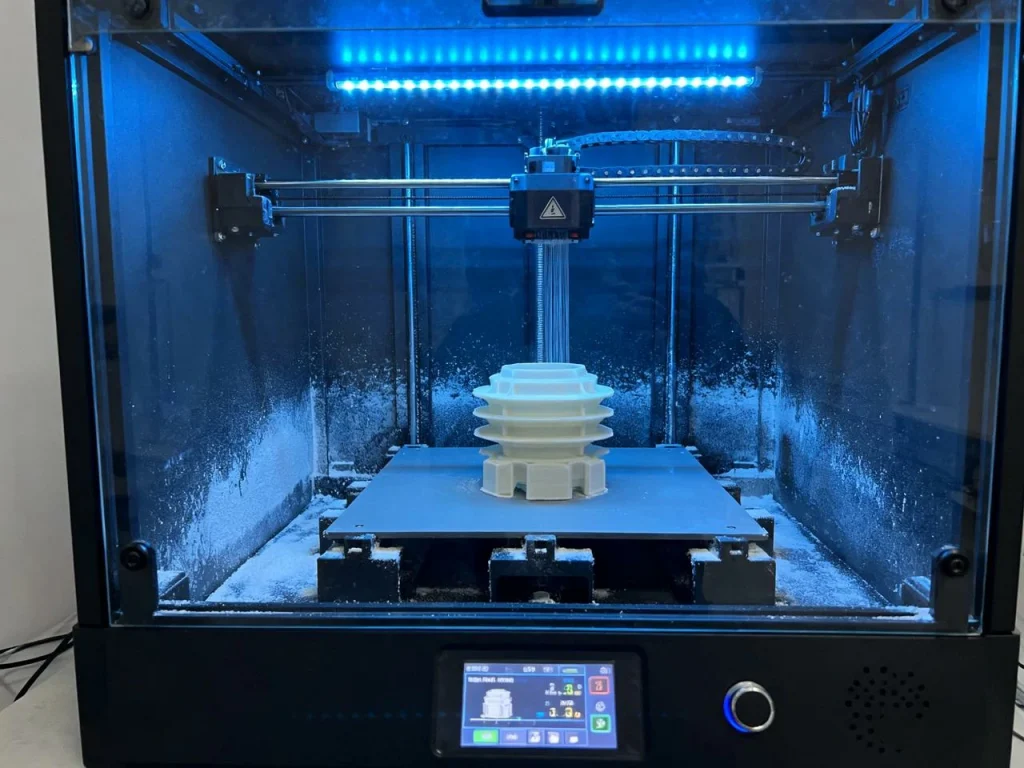
ABS plastic is a popular choice in 3D printing for functional prototypes and enclosures. But it warps if cooled too fast or unevenly. Why? Because it’s amorphous with a relatively high CTE; uneven cooling sets up stress that pulls edges off the bed.
Warping control (step-by-step):
- Use a heated bed: 90–110°C.
- Print in an enclosure to keep ambient warm and stable.
- Use adhesion aids: PEI sheet, ABS slurry, or glue stick.
- Tune first layer: slower speed, slightly higher flow, proper Z-offset.
- Reduce drafts and cooling fan speed (often off or very low for ABS).
- Set nozzle around 230–250°C (depends on filament).
- Add brims or rafts for larger parts.
- Let parts cool in the enclosure to reduce thermal shock.
Ventilation/off-gassing:
- ABS can release VOCs (like styrene) and ultrafine particles during printing. Use local exhaust, HEPA/charcoal filters, or print in a well-ventilated area.
Finishing:
- Acetone vapor smoothing for gloss surfaces (use with caution, controlled exposure).
- Light sanding, priming, and painting work well.
- Annealing low and slow can reduce internal stress, but test on scrap first.
Secondary ops & hybrid processes
- Overmolding TPE onto ABS gives grip and ergonomics for tools and consumer products.
- Ultrasonic welding makes fast, clean hermetic or mechanical joints.
- Machining (CNC): ABS cuts cleanly with sharp tools, moderate speeds, and light climb cuts; avoid heat buildup. For custom ABS part machining and hybrid processes, U-Need provides professional services for precision and production-ready components.
- Painting and priming: clean, scuff, prime; pick coatings compatible with ABS.
- Solvent bonding: acetone or MEK-based cements can fuse parts; test to avoid stress cracking.
What is ABS plastic used for? Applications & case studies
ABS plastic is used across automotive, electronics, and consumer products due to its impact resistance, dimensional stability, and ease of processing. Below are case studies that illustrate the most common uses of ABS plastic and how manufacturers apply its unique properties in real-world products.
Automotive
ABS is common in dashboards, pillar trim, consoles, and bumper fascia covers (often in blends). Why do automakers use ABS? Because it balances impact resistance, formability, and good surface finish for interior fit-and-finish. Engineers also consider NVH (noise, vibration, harshness): ABS panels, combined with foams and clips, help reduce rattles and improve cabin feel. Most interior parts hold 2–3 mm wall thickness, with tight tolerances around ±0.2–0.5 mm after molding and post-processing, depending on geometry.
Consumer electronics & power tools
For device housings, computer keyboards, battery covers, and power tool shells, ABS has the right rigidity-to-toughness ratio. It supports screw bosses, living hinges (short-life), and snap-fit features. Design snap-fits with rounded tabs and proper lead-in to reduce stress and whitening. Electrical enclosures benefit from ABS’s electrical insulation and paintability for logos and icons.

Toys & appliances
ABS’s color control and surface gloss enable crisp, repeatable parts for interlocking bricks, vacuum cleaner shells, and small appliance housings. For kids’ products, use compliant grades and ensure toy safety testing. For appliances, ABS can be metallized or painted to achieve stainless-like looks at lower cost and weight.
Prototyping & 3D printed enclosures
A common path is: rapid 3D printing → CNC machining for tighter tolerances → bridge tooling (low-cavitation mold) → full production. Key DFM checkpoints along the way: wall uniformity, draft, gate/parting line planning, and shrinkage control to hit cosmetic and dimensional targets.
Visual: Annotated gallery showing ribs, bosses, drafts, and snaps.
Material selection: ABS vs alternatives
When evaluating plastic materials, designers often compare ABS plastic with alternatives like polycarbonate (PC), PVC, HIPS, PLA, and nylon (PA). Each material offers different strengths—heat resistance, toughness, cost efficiency, or ease of processing—so knowing the differences is essential for material selection. By looking at ABS vs other plastics, engineers can decide whether ABS remains the material of choice or whether another polymer is better suited for the application.
ABS vs polycarbonate (PC)
PC is tougher and handles higher heat and transparency, compared to ABS, but it is more expensive and harder to process. ABS is easier to process, less expensive, and often stiffer at equal thickness in small parts due to morphology, but not stronger in absolute terms. Many products use PC/ABS blends to balance impact, heat, and cost.
ABS vs PVC & HIPS
- PVC (rigid): Better flame and chemical resistance; can emit HCl on burning; lower heat and impact vs PC; cost competitive. ABS is preferred for mechanical toughness, appearance, and 3D printing. For wire/cable jackets and certain chemical environments, PVC may be better.
- HIPS: Lower cost, good processability, but lower impact and weathering than ABS. Choose HIPS for simple packaging or panels where impact is moderate.
ABS vs PLA/nylon (PA) in 3D printing
- ABS vs PLA: PLA prints easier with less warp, but has lower heat resistance and can be brittle. ABS is tougher, higher heat, and acetone smoothable, but needs enclosure and ventilation.
- ABS vs Nylon (PA): Nylon offers higher toughness and wear resistance with flexibility, but absorbs moisture, needs drying, and can be trickier to print. ABS is stiffer, easier to finish, and more dimensionally stable indoors.
Decision tree + material selector
- Need highest impact and heat? Consider PC or PC/ABS.
- Need low cost and simple forming? Consider HIPS or PVC (check chemicals/flame).
- Need 3D printing with post-processing ease? Use ABS (with enclosure) or PLA for quick drafts.
- Need chemical/flame performance? Evaluate PVC or FR ABS (check UL 94 rating).
- Outdoor use? Pick UV-stabilized ABS, coatings, or consider ASA as an alternative.
Sustainability, safety & regulations
ABS thermoplastic is a material of choice for many industries due to its durability, properties of ABS, and ability to recycle ABS also. ABS plastic material is strong, versatile, and ABS is highly valued for sustainable and safe manufacturing, meeting regulatory standards across applications.
Recycled ABS & bio-ABS
Recycled ABS can perform well for many housings and non-critical parts. Expect:
- Slightly lower impact or heat in some blends.
- Color variation unless compounded.
- Benefits: lower carbon footprint, lower cost in some markets.
Bio-ABS blends (partially bio-based) exist but vary by supplier. In either case, request certifications and test critical properties for your design.
Design for disassembly:
- Use snap fits where possible.
- Avoid coatings that hinder recycling.
- Mark parts with material IDs (ABS, ABS+GF, etc.) to aid sorting.
Health & safety: VOCs/off-gassing, ventilation, PPE
Is ABS plastic safe to use?
For most consumer and industrial uses, yes, when processed and used correctly. ABS as a solid is not considered acutely toxic. But processing can release styrene and other VOCs, and printing produces ultrafine particles. Use local exhaust, respiratory protection as needed, and follow OSHA/NIOSH guidelines. In molding shops, control fumes and heat to avoid decomposition products.
Is ABS plastic safe for babies?
ABS is used in many toys and child products when it meets toy safety and chemical standards. For infant use, ensure the grade and the final product are tested and compliant with applicable rules (for example, limits on specific chemicals and small parts). Always check regulatory compliance and certificates. According to the U.S. Consumer Product Safety Commission (CPSC), materials used in children’s toys must comply with limits on specific hazardous chemicals and choking hazards to ensure safety.
Is ABS plastic recyclable and safe?
- Recyclable: Yes, ABS is mechanically recyclable. Based on the U.S. Environmental Protection Agency (EPA), plastics marked with resin identification code 7 are categorized as “Other” and may include ABS; recycling availability varies by local facilities.
- Safe: As a finished product, ABS is generally safe. During printing or molding, ventilation and PPE reduce exposure to emissions.
Compliance: RoHS, REACH, UL 94, FDA/food-contact
- RoHS/REACH: Many ABS grades comply; verify SVHC and restricted substances.
- UL 94: Fire ratings from HB to V-0 for FR ABS; choose FR when needed for electronics.
- FDA/food contact: Some ABS grades are listed for indirect food contact, but many are not. Confirm with supplier documentation and applicable FDA or regional rules.
- Labeling & traceability: Use lot tracking, material IDs, and retain COAs (Certificates of Analysis).
Sourcing guide, costs, tools, and references
Choosing ABS plastic material or ABS parts with tight tolerances requires careful material selection, supplier vetting, and cost planning. Understanding properties of ABS, manufacturing processes, and ABS resin grades helps ensure quality, reduce risk, and optimize production for industrial applications, automotive industry, and medical applications.
Vetting suppliers and molders
How do you pick a supplier for material ABS plastic or molded parts?
- Certifications: ISO 9001 (quality), ISO 14001 (environment).
- Automotive projects: Ask for PPAP, APQP experience.
- Capacity and tooling: Number of presses, tonnage range, tooling capability, lead times.
- Materials: Access to multiple ABS grades (standard, FR, GF, UV stabilized).
- Quality controls: Incoming inspection, SPC, CMM inspection for ABS parts with tight tolerances.
- Post-processing: Painting, printing, welding, assembly.
RFQ checklist (what to include):
- Grade (e.g., FR V-0, heat-resistant, UV-stabilized)
- Color (mold-in or paint), finish (SPI rating or texture spec)
- Annual volume and order size
- Critical dimensions/tolerances
- Gate/parting line preferences
- Regulatory requirements (UL, RoHS, REACH, FDA)
- Packaging and ESD needs for electronics
Sample QA terms:
- First article inspection required.
- Dimensional PPAP level as applicable.
- Material COA with each lot.
- SPC on CTQs (critical-to-quality features).

Cost drivers & market trends
What moves ABS part cost?
- Resin grade: FR, GF, or UV-stabilized grades cost more than general purpose.
- Colorants: Pre-colored resin reduces painting but may increase material cost.
- Cycle time: Thicker walls and slow cooling increase machine time.
- Tooling complexity: Slides, lifters, texture, high-polish surfaces add cost.
- Part geometry: Ribbing and bosses help reduce material while keeping stiffness.
- Volume: Higher volume spreads tooling cost and enables multi-cavity molds.
- Market: ABS resin prices can swing with styrene and acrylonitrile feedstock costs.
Tools
- Part weight & cost estimator: Input density (e.g., 1.04 g/cm³), part volume, cycle time, and cavity count to estimate material and machine costs.
- Shrinkage/tolerance calculator: Apply 0.4–0.8% shrinkage by axis; add safety for fiber-filled grades.
- Flow/gate location helper: Use estimated Melt Flow Index and flow length-to-thickness to guide gate placement.
- DFM checklist: Draft, uniform wall, rib-to-wall ratios (~40–60% of wall), boss design, and knit line avoidance.
Key takeaways
- ABS plastic is a high-impact, cost-effective thermoplastic polymer that works across automotive, electronics, appliances, and prototyping.
- It shines when you need durable housings, a quality surface, and a clear path from prototype to production.
- Watch for heat limits, solvent exposure, and UV; select grades and finishes to match your environment.
- For safety, ensure ventilation during 3D printing and molding, and follow workplace exposure rules.
- Ready to move? Define requirements, shortlist grades, request data sheets, and run sample builds to validate performance.
FAQs
Is ABS plastic good quality?
Absolutely! ABS plastic material is known for its toughness, durability, and consistent physical properties. It’s easy to process, which is why manufacturers often choose it for automotive parts, consumer electronics, medical devices, and household plastic products. Its combination of rigidity and impact resistance makes it a popular choice among other plastic materials.
Is ABS plastic safe to use?
Yes, as a solid material, ABS is generally considered safe for typical consumer and industrial applications. During 3D printing or molding, it can release VOCs like styrene and ultrafine particles, so it’s important to use ventilation, PPE, or local exhaust to reduce exposure. Following OSHA/NIOSH guidelines ensures safety during processing.
Is ABS plastic safe for babies?
When manufactured to meet toy safety standards and relevant chemical regulations, ABS can be safe for children. Always check the grade and ensure the final product is tested for compliance. Medical applications and baby products often require certified ABS grades to ensure no harmful exposure.
Is ABS plastic better than PVC?
It depends on your application. ABS vs PVC: ABS typically offers better impact resistance, dimensional stability, and is easier to finish or 3D print. PVC, however, may outperform ABS in chemical resistance and flame behavior for specific industrial or wiring applications. Choosing the right plastic material depends on whether your priority is mechanical toughness or chemical durability.
What are the disadvantages of ABS plastic?
ABS has some limitations: it’s sensitive to UV exposure unless stabilized, has a moderate heat resistance (continuous use ~80°C), can be flammable without FR additives, and is prone to solvent stress-cracking if exposed to strong organic solvents. Understanding these material properties helps avoid problems in real-world applications.
Does ABS plastic break easily?
No. ABS is highly impact-resistant and strong for everyday use. However, it can crack at sharp corners, under prolonged solvent exposure, or at very low temperatures if the wrong grade is used. For CNC machining or injection molding, designing with fillets, proper wall thickness, and avoiding stress concentrators can maximize part durability.


 English
  German
  French
  Italian
  Spanish
  Polish
  Czech
Czech  Japanese