
When discussing types of washers in industrial and mechanical applications, washers refer to precision components used with bolts and screws to distribute load, prevent loosening, and protect surfaces.
This guide focuses exclusively on hardware washers used in engineering, manufacturing, and custom CNC machining.
Hardware Washer Types (Complete Guide)
What are washers used for in hardware? In short, washers distribute the load, protect surfaces, prevent loosening, keep tension, or insulate. Washers come in various types and materials, and the right washer type depends on bolt size, load, vibration, and environment.
To answer a common question: What are the three main types of washers? Many engineers group them as:
- Plain (flat) washers for load distribution
- Spring washers for tension/flexibility
- Lock washers to resist loosening
From there, you can branch to fender, countersunk, shoulder, and specialized designs.
Major Types of Washers and Their Characteristics
| Washer Type | Characteristics & Use Cases | Materials Commonly Used |
|---|---|---|
| Flat (Plain) Washers | Flat disc with central hole to spread load and protect surfaces; used under the head of a bolt/nut or screw | Steel, stainless, aluminum, brass, plastic, rubber |
| Lock Washers | Prevent loosening due to vibration; include split (helical), toothed, serrated, external tooth lock washers | Steel, stainless |
| Spring Washers | Provide axial flexibility and maintain tension; include Belleville (conical), wave washer, dome, crescent, finger spring washers | Carbon/spring steels and alloys |
| Fender Washers | Extra‑large outer diameter to spread load on thin or soft materials | Steel, stainless |
| Countersunk (Finishing) Washers | Mate with countersunk screws for a flush, finished look | Steel, stainless, brass, nylon |
| Shoulder (Bushing) Washers | Have a collar to isolate fastener; used for electrical insulation or wear reduction | Nylon, PTFE, fiberglass, phenolic, metals |
| Specialized Washers | Keps nuts (integrated star washer), top‑hat, C‑washers (slide in without full disassembly), keyed washers, square washers | Application‑specific |
Now let’s walk through each category in plain language.
Flat (Plain) Washers
Flat washers are the most common types of washers. They spread load under a nut and bolt or screw, so the surface does not crush or deform. Use them on wood, plastic, aluminum, and softer metals to protect the base. In steel structures, they help keep the surface from galling or chipping.
You’ll see different size series like SAE washers, metric flat washers, and high‑strength washers for structural bolts. Match the inner diameter (ID) to the bolt size, and pick an outer diameter (OD) big enough to cover the hole and distribute load. A thicker washer can help with uneven surfaces.
Typical materials include steel washers (zinc‑plated), stainless for corrosion resistance, aluminum for light weight, brass/copper for electrical work, and plastic washers like nylon or polyethylene for insulation and non‑sparking needs.
Lock Washers (split/helical, toothed, serrated)
Lock washers are designed to resist loosening from vibration. The common split (helical) type bites when compressed, adding friction at the joint. Tooth lock washers (internal or external) have serrations that grip the mating surfaces. External tooth lock washers grip a wider area and are often used under bolt heads; internal teeth are common under nuts.
Use lock washers for automotive, machinery, and any assembly with frequent shock or vibration. In high‑vibration sectors, using a lock washer can cut re‑tightening needs by a large margin. For severe vibration, pair thread‑locker and a lock washer, or choose a spring washer like a Belleville where preload matters.
Spring Washers (Belleville, wave, dome, crescent, finger)
Spring washers provide axial flexibility. They add a controlled “spring” in the clamp stack so your bolt keeps tension even as parts move with heat or vibration.
- Belleville washers (also called conical washers) deliver high load with low deflection and are common where thermal cycling could relax a joint. Stacking them in series or parallel can tune stiffness and travel.
- A wave spring washer offers small deflection for light loads and damping. Wave washers and dome types act like cushions and help absorb minor vibration.
- Finger spring steel washers add compliance and help with noise and wear in rotating assemblies.
These are often used in aerospace, power equipment, and electronics where preload stability matters.

Fender Washers (large OD)
Fender washers have a large outer diameter to spread load over thin sheet metal, plastics, or wood. They help prevent pull‑through and paint damage on panels. Think automotive panels, plumbing straps, and electrical panels. If you ever noticed a standard washer denting the surface, a fender washer is your fix.
Countersunk (Finishing) Washers
Countersunk washers pair with countersunk screws to create a flush, neat look. They seat the head properly and protect the surface. Use them in furniture, fixtures, and any visible assembly where a clean finish matters.
Shoulder (Insulating/Bushing) Washers
Shoulder washers (also called bushing washers or top‑hat washers) have a collar that insulates or guides the fastener through a panel. Nylon washers and PTFE versions are common when you need electrical insulation or chemical resistance. They can also act as low‑friction bearings for light rotating parts.
Specialized Washers
You’ll also find C‑washers (slide in and out without full disassembly), keyed washers that lock orientation, square washers for slots, and sealing washers (often rubber‑bonded) to keep water or oil out of joints. When it comes to sealing washers, look for rubber or elastomer faces that compress to create a seal. In corrosive or hot environments, consider PTFE/Teflon for chemical resistance and low friction.
Materials & When to Use Them
Choosing the right washer material is as important as choosing the shape.
- Steel/Stainless Steel: strong and durable; stainless resists rust
- Aluminum: light and corrosion‑resistant; common in aerospace and electronics
- Brass/Copper: good electrical conductivity and corrosion resistance
- Plastics/Nylon/Polyethylene: insulating washers, non‑sparking, gentle on surfaces
- PTFE (Teflon): very chemical‑resistant and low friction; great in aggressive fluids or where sticking is a risk
- Rubber: for sealing washers and vibration damping
Selection Framework (5‑point checklist)
Use this quick list to match washer types to your job:
- Load and vibration: if the joint might loosen, use a lock or spring washer (Belleville for high preload).
- Substrate hardness/thickness: on thin or soft parts, choose a fender or larger OD flat washer.
- Environment: use stainless, brass, or PTFE for moisture, salt, or chemicals.
- Electrical needs: pick shoulder washers or nylon for insulation.
- Assembly method: for a flush look, use countersunk washers; for fast changes, try C‑washers.
Evidence & Use‑Case Notes
- Lock and spring solutions are widely adopted in automotive and heavy machinery to reduce re‑tightening.
- Belleville stacks help maintain preload through thermal cycles in power systems and aircraft.
- Fender washers protect panels and reduce scrap by spreading stress in sheet‑metal work.
How to Identify Washers (sizes, types, and standards)
Wondering how to tell one washer from another and pick the right washer hardware sizes? Try this simple method:
- Measure the inner diameter (ID). This should match the bolt or screw size (e.g., M8 bolt → ~8 mm ID).
- Measure the outer diameter (OD) and thickness. Larger OD spreads load more; thicker can bridge gaps.
- Look at the shape: flat, split (lock), teeth (toothed/serrated), conical (Belleville), wavy (wave), flanged (shoulder), or top‑hat.
- Check the material and finish: zinc‑plated steel, stainless, brass, nylon, PTFE, or rubber.
- If needed, match a standard (e.g., SAE/ASME for plain washers, ASME B18.21.1 for spring/lock types) so sizes are predictable across suppliers.
Which is first: flat or spring washer?
Many ask about the stacking order. In most cases, put the flat (plain) washer directly against the material to distribute the load, and place the spring or lock washer directly under the nut or bolt head. In short: nut/bolt head → lock/spring washer → flat washer → joint surface. This way, the lock action works at the fastener, and the flat washer protects the part.
What is a machined washer?
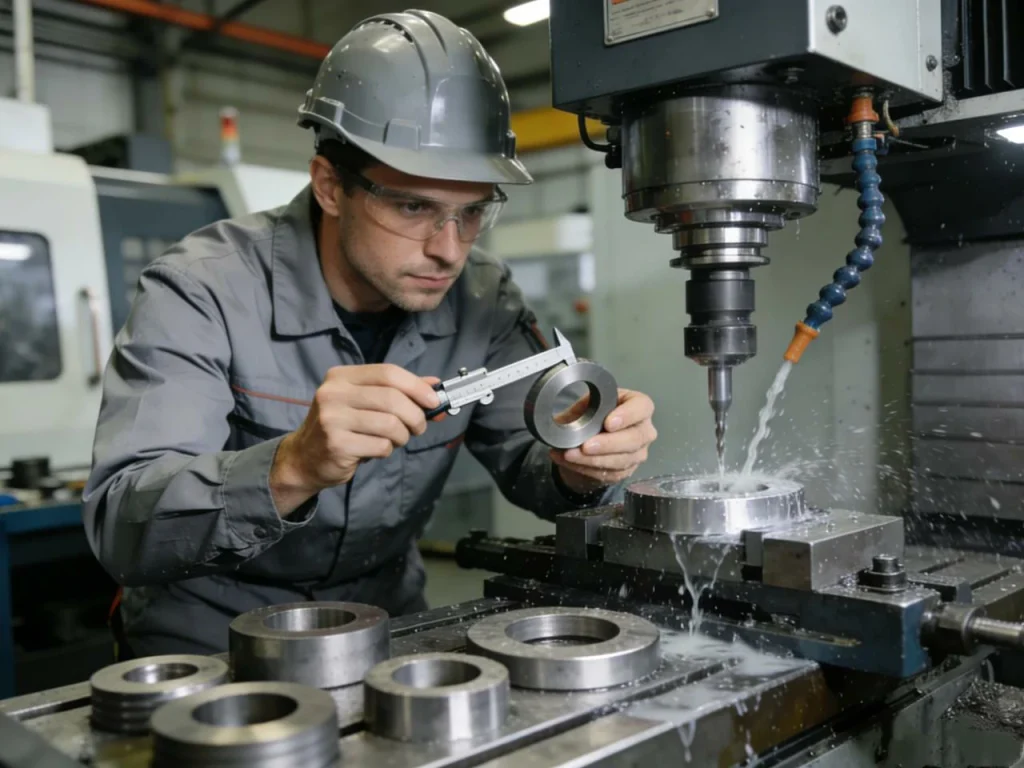
A machined washer is made by precision CNC turning or CNC milling instead of stamping. Why choose one? Stamped parts are great for volume, but custom joints often need tighter tolerances, special materials, or shapes a die can’t produce. CNC turning offers high dimensional accuracy, smooth surface finishes, and is ideal for cylindrical or rotationally symmetric washers such as shoulder or bushing types. CNC milling provides flexibility for complex shapes, slots, or non‑round profiles, allowing precise customization that stamping cannot achieve. Machined washers include shoulder/bushing, top‑hat, keyed, and square designs. They are common in aerospace, medical devices, and high‑strength washers for critical joints. If your design calls for a unique washer size, a non‑standard OD/ID, or a special surface finish, a machined part is often the right path.
Custom Washer Manufacturing Services
At Uneedpm, we provide custom washer manufacturing for industrial and precision applications, including:
- Custom outer diameter (OD), inner diameter (ID), and thickness
- Tight tolerances up to ±0.01 mm
- CNC turning and milling for non-standard washer designs
- Materials: stainless steel, aluminum, brass, PTFE, nylon
- Surface treatments: anodizing, plating, polishing
- Support for prototypes and mass production
If your project requires non-standard washers or precision components, we can manufacture based on your drawings or samples.
Lead Time
- Sample production: 3–7 days
- Mass production: 7–20 days depending on complexity and quantity
What washer to use for screws?
It depends on the screw type and the surface:
- Wood and sheet‑metal screws: use a flat washer to protect soft surfaces. For thin sheet, consider a fender washer to prevent pull‑through.
- Countersunk screws: pair with a countersunk (finishing) washer for a tidy, flush seat.
- Electrical or mixed‑metal joints: use nylon or shoulder (insulating) washers to prevent shorts and galvanic corrosion.
- Leaks or splash risk: use a sealing washer (often rubber‑bonded).
- Vibration: add a lock washer (split or toothed) for grip. For higher loads and better preload stability, consider a Belleville or wave spring washer.
Practical notes on torque and surfaces
- A washer provides a stable bearing surface. If a joint is soft (wood, plastic), a larger OD washer reduces crushing.
- Lock washers are designed to add friction, but they don’t replace proper bolt preload. Always torque to spec.
- Washers distribute the load so the joint stays tight longer. On painted or plated parts, they also reduce scratching.
- For washer standards, check ASME/SAE for consistent washer size and fit across suppliers and regions.
FAQs
When people talk about the three main types of washers, they’re usually referring to flat washers, spring washers, and lock washers. Flat washers are the most basic. They spread the load of a bolt or screw, helping protect the surface underneath and reducing the risk of damage. Spring washers add tension to the joint, which is useful when vibration or movement is expected. Lock washers are designed specifically to resist loosening by biting into the fastener or surface. From these core categories, many variations exist, such as fender washers for wider load distribution, countersunk washers for flush finishes, and shoulder washers for insulation or spacing. Understanding each type of lock washer and how it functions makes it much easier to choose the right washer for strength, stability, and long-term reliability.
Identifying washers starts with looking at their shape, thickness, and features. Flat washers are smooth and simple, while spring washers usually have a split or curved profile. Lock washers often have teeth, serrations, or a distinctive split that helps them grip. Size is also important. Measure the inner diameter, outer diameter, and thickness to match the washer to the correct fastener. Material can provide clues too, as metal washers feel rigid and heavy, while nylon or rubber washers are lighter and flexible. Surface finish, such as zinc-plated or stainless steel, can indicate corrosion resistance. Since washers are commonly used across construction, automotive, and machinery projects, learning to identify them quickly helps ensure you’re using the correct washer for safety, performance, and durability.
In most standard assemblies, the flat washer goes on first, directly against the surface being fastened, followed by the spring washer, and then the nut or bolt head. This order allows the flat washer to distribute the load evenly while the spring washer provides tension to resist loosening. If you reverse the order, the spring washer can dig into the surface, reducing its effectiveness and potentially damaging the material. While this setup works for most situations, there are exceptions depending on design standards or manufacturer instructions. In mechanical and industrial assemblies, washers are typically arranged this way to balance load distribution and vibration resistance. When in doubt, always check the fastening specification or engineering drawing for the correct washer sequence.
A machined washer is a washer that’s produced using CNC turning or CNC milling instead of traditional stamping. This method is chosen when standard washers don’t meet the design requirements. Machined washers are ideal for tight tolerances, custom dimensions, or special shapes like shoulder, bushing, or top-hat designs. They’re often used in precision equipment, electronics, or mechanical assemblies where fit and alignment really matter. Unlike stamped washers, machined versions can be made from a wider range of materials and finished to smoother surface tolerances. While they usually cost more and take longer to produce, the payoff is consistency and accuracy. In applications where washers are essential for spacing, insulation, or load control, machined washers provide a level of precision that standard options simply can’t match.
The right washer for a screw depends on what you’re trying to achieve. For general use, a flat washer is usually enough to distribute pressure and protect the surface. If the screw will be exposed to vibration, adding a spring or lock washer can help prevent loosening over time. For outdoor or moisture-prone environments, material choice matters as much as washer type. Stainless steel, plastic, or rubber washers are often used to resist corrosion or provide sealing. Rubber washers, in particular, are great when you need vibration dampening or a watertight seal. For decorative or flush-mounted screws, countersunk washers help the screw head sit neatly. In short, consider load, movement, environment, and appearance before choosing the washer that best supports your screw application.

 English
  German
  French
  Italian
  Spanish
  Polish
  Czech
Czech  Japanese