
Choosing between aluminum versus titanium should not be a guessing game. Here’s the fast, data‑backed way to pick the right material for your project and lightweight metal for performance, cost, and durability. Aluminum is extensively used across industries for its low cost and light weight. Pure aluminum and aluminum alloys typically provide good machinability and thermal conductivity. Titanium is widely used in aerospace, medical, and high-performance applications for strength, corrosion resistance, and fatigue life. Understanding the differences between titanium and aluminum is essential, especially since titanium and aluminum are two metals often used together in hybrid assemblies.
This guide starts with a quick answer and simple rules, then expands into core material properties, real‑world performance, manufacturability, cost and sustainability, and industry playbooks. You’ll also find case studies, quick calculators, and FAQs to de‑risk your choice. Use it to make confident, engineering‑grade decisions for aerospace, automotive, marine, consumer electronics, medical, and more.
Titanium vs Aluminum: Quick Answer & Decision Rules
When deciding between titanium vs aluminum for a project, understanding their complementary material properties is key. Aluminum and titanium each bring unique advantages—aluminum excels in cost efficiency, thermal conductivity, and ease of machining, whereas titanium offers superior tensile strength of titanium alloys, exceptional strength and weight characteristics, and outstanding corrosion resistance.
At‑a‑Glance Winner Table (Titanium and Aluminum by Scenario & Applications)
| Scenario | Primary constraints | Recommended metal | One‑line justification |
|---|---|---|---|
| Aerospace bracket | High strength‑to‑weight, fatigue, elevated temp zones | Titanium (Ti‑6Al‑4V) | Higher strength enables thinner geometry and long fatigue life under load cycles. |
| Bike frame | Fatigue life, corrosion, ride quality | Titanium (Grade 9/Ti‑3Al‑2.5V) | Great fatigue and corrosion resistance; thin‑wall stiffness with comfort. |
| Marine fastener | Saltwater corrosion, long service life | Titanium (Grade 2 or 5) | Titanium’s passive oxide film resists chlorides; fewer replacements. |
| Heat sink | Heat dissipation, cost, mass production | Aluminum (6061/6063) | Very high thermal conductivity and low cost; easy extrusion. |
| Phone/watch frame | Scratch resistance, thin sections, premium feel | Titanium (Grade 5 or similar) | Higher hardness and stiffness allow thinner walls with better cosmetic durability. |
| Medical implant | Biocompatibility, corrosion, fatigue | Titanium (implant‑grade) | Excellent biocompatibility and long‑term durability inside the body. |
Simple Rules of Thumb for Titanium vs Aluminum (Strength, Weight & Corrosion)
Use titanium when:
- You need high strength‑to‑weight, long fatigue life, or damage tolerance.
- Working temperatures go above ~150–200 °C.
- The environment is harsh (saltwater, body fluids, many chemicals).
- Service life and reliability matter more than upfront cost.
Use aluminum when:
- Low cost, speed, and mass production are critical.
- You need high thermal conductivity for heat sinks or housings.
- You want rapid prototyping, easier machining, and simple forming.
Hybrid designs work well too:
- Titanium fasteners with aluminum structures.
- Titanium inserts or wear plates at corrosion or abrasion hot spots.
Common Myths & Pitfalls in Choosing Between Titanium and Aluminum
A common myth is “titanium is lighter than aluminum.” By density, that is false. If you’re wondering how dense is titanium,it’s about 4.4–4.5 g/cm³; aluminum is about 2.7–2.9 g/cm³. Titanium can be lighter only when you redesign the geometry thinner, thanks to higher tensile strength.
Designers also forget thermal effects. Aluminum wins for heat dissipation. If you need a heat spreader or fin pack, aluminum is often the better choice. Another pitfall is galvanic corrosion when you mix metals. Titanium and aluminum can be in the same assembly, but you need proper isolation and drainage to avoid galvanic attack.
PAA: Is Titanium vs Aluminum Lighter for the Same Part?
Short answer: no. Titanium is denser than aluminum. The same part machined from titanium will be heavier. It can be lighter only if you optimize the shape and use less material due to its higher tensile strength.
Core Mechanical Properties & Strength‑to‑Weight of Titanium and Aluminum
When evaluating metals for engineering applications, the choice between titanium and aluminum often comes down to balancing high strength with low density. Aluminum shines where weight reduction is critical due to its low density, while titanium offers exceptional strength, hardness, and durability that let designers reduce material thickness without compromising performance. This combination of high strength and moderate density makes titanium alloys ideal for load-bearing components, aerospace structures, and medical devices, whereas aluminum’s lighter weight and superior thermal conductivity favor applications where heat dissipation and stiffness-per-cost are key. Understanding these core properties provides the foundation for making informed decisions in the next stage: selecting the right metal for specific structural and thermal requirements. For designers weighing performance trade-offs, examining titanium vs aluminum across strength, density, and corrosion data helps clarify which alloy best fits each use case.
Density, Stiffness & Strength Benchmarks for Titanium vs Aluminum Alloys
When comparing titanium vs aluminum, look at grade‑specific data. Below are typical ranges for common engineering alloys, which highlight the density of titanium metal and how it compares to aluminum.
| Property | 6061‑T6 Al | 7075‑T6 Al | Grade 2 Ti (CP) | Ti‑6Al‑4V (Grade 5) |
|---|---|---|---|---|
| Density (g/cm³) | ~2.70 | ~2.81 | ~4.50 | ~4.43 |
| Modulus E (GPa) | ~69 | ~72 | ~105 | ~110 |
| Ultimate tensile strength (MPa) | ~290–320 | ~500–590 | ~350 | ~900–1,100+ |
| Yield strength (MPa) | ~240–275 | ~430–500 | ~275 | ~830–1,000+ |
| Hardness (Vickers HV) | ~95–120 | ~130–170 | ~160–200 | ~300–360 |
| Thermal conductivity (W/m·K) | ~150–170 | ~120–150 | ~15–20 | ~6–8 |
| CTE (µm/m·K) | ~23–24 | ~23–24 | ~8.6–9 | ~8.6–9 |
Key points:
- Aluminum is about 40% less dense by volume.
- Titanium alloys can be roughly 2× stronger than high‑strength aluminum.
- Titanium is much harder and more wear resistant than aluminum.
- Aluminum conducts heat far better; titanium is not a good heat sink.
Strength‑to‑Weight vs Stiffness‑to‑Weight for Titanium and Aluminum
For strength‑to‑weight,titanium vs aluminum generally leads among structural metals used in aerospace and medical. If your design is strength‑limited (for example, a bracket near its stress limit), switching to a titanium alloy often lets you reduce cross‑section and cut overall weight even though titanium is denser than aluminum.
For stiffness‑to‑weight, the story is mixed. Titanium’s modulus is only ~1.6× aluminum’s, while its density is ~1.6×–1.7× higher. So per unit weight, their stiffness can be similar. If your part is purely stiffness‑limited (like a long beam at small deflection), aluminum may match or beat titanium on stiffness per cost, though titanium still brings better corrosion resistance and durability.
Thermal/Electrical Conductivity and CTE (heat dissipation matters)
Aluminum’s thermal conductivity is roughly 150–230 W/m·K depending on alloy. Titanium is far lower, often in the single digits for Ti‑6Al‑4V. That is why aluminum is the default for heat sinks, heat spreaders, and housings that must pull heat away fast. Electrical conductivity shows a similar gap: aluminum alloys sit around 35–40% IACS, while titanium alloys are much lower. Titanium’s coefficient of thermal expansion (CTE) is ~8–9 µm/m·K vs aluminum’s ~23–24 µm/m·K, so titanium moves less with temperature swings. In precision assemblies or mixed materials, that can help control thermal cycling stress.
Temperature Capability and Hardness/Wear of Titanium and Aluminum Alloys
Aluminum softens quickly above ~150 °C. Its mechanical properties drop, and creep risk grows under sustained load. Titanium keeps useful strength into the 500–600 °C range for some alloys. That is why titanium sits near engines, exhausts, and hot zones. On hardness, most aluminum alloys are relatively soft (tens to low hundreds HV). Titanium hardness for Ti‑6Al‑4V is roughly 300–360 HV, which improves scratch resistance and reduces denting in thin sections like wearables and tools.
Performance in Harsh Environments (corrosion, temperature, wear)
Before diving into specific corrosion scenarios, it’s important to understand how aluminum versus titanium perform under mechanical and environmental stresses. Titanium vs aluminum alloys offer a combination of high strength, tensile strength, and fatigue resistance, but titanium has a density of titanium metal significantly higher than aluminum, which raises the question: is titanium lighter than aluminum? When considering aluminium vs titanium weight, aluminum and titanium balance strength and weight differently—aluminum alloy provides low density and weight reduction, making it a lightweight metal ideal for heat-sensitive or portable components, whereas titanium alloy brings high strength and hardness that properties make it suitable for harsh conditions. Designers evaluating titanium and aluminum must account for both density and mechanical properties to optimize performance in marine, chemical, or high-temperature environments.
Corrosion Resistance in Marine/Chloride/Chemical Exposure
Titanium has excellent corrosion resistance and forms a stable, self‑healing oxide film that resists chlorides and many chemicals. Aluminum also forms a protective layer of aluminum oxide, but aluminum oxide is less resilient in harsh environments, making aluminum more prone to pitting and crevice corrosion in chloride-rich conditions.
High‑Temperature Strength, Creep, and Thermal Cycling
If your part lives near engines or exhausts, titanium tends to be safer. Aluminum loses strength and can creep under high temperature and load. Titanium maintains strength and handles thermal cycling better at elevated temperatures, which helps with fatigue and dimensional stability over time.
Wear, Abrasion, and Scratch Resistance
Titanium’s hardness is much higher than that of typical aluminum alloys. In sliding contact or abrasive environments, titanium resists scratches and dents better. Aluminum often shows galling and surface damage unless you use hard anodizing or coatings. That is why many phones, watches, and knives use titanium for cosmetic durability, while laptops and housings that need heat spreading stay with aluminum.
Galvanic Corrosion & Isolation in Mixed‑Metal Assemblies
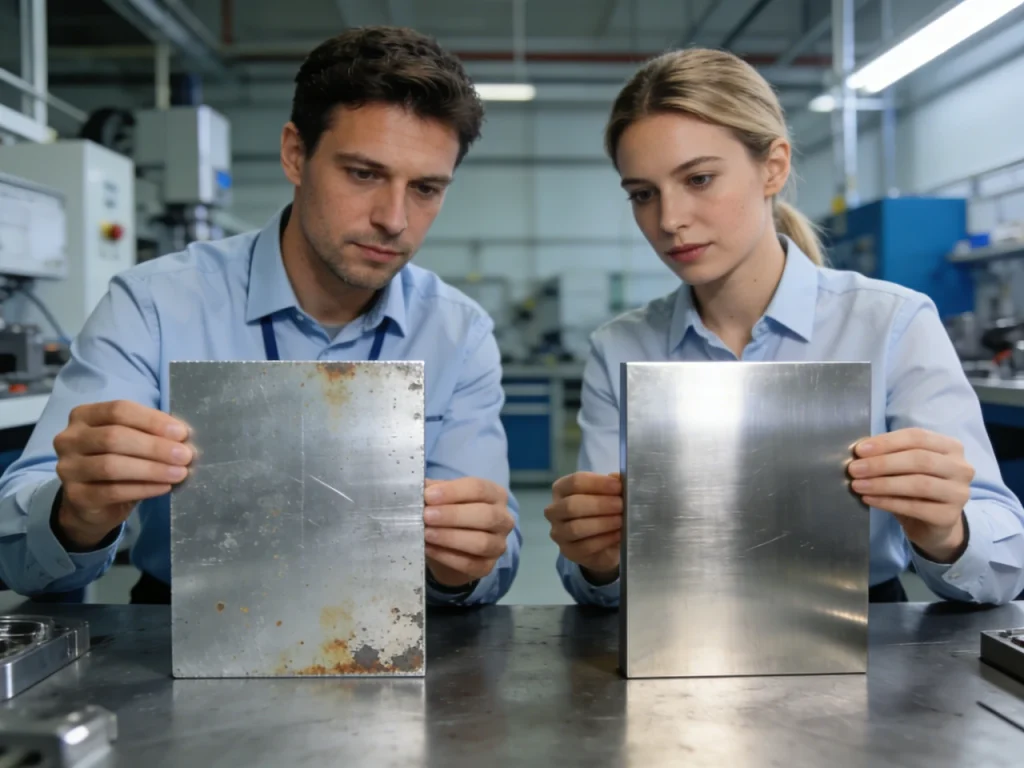
Mixing metals in the presence of moisture or salt can set up a galvanic couple. Titanium is more noble than aluminum; if you join them without isolation, aluminum can corrode faster. Reduce risk by:
- Isolating contact surfaces with non‑conductive washers, bushings, or sealants.
- Using compatible fasteners or coated fasteners.
- Designing for drainage and avoiding trapped moisture.
- Applying protective finishes on aluminum (anodize, conversion coat, paint).
Design, Manufacturability & Joining
When evaluating a choice between aluminum and titanium for manufacturing, engineers must consider both material properties and practical trade-offs. Aluminum vs titanium offers different advantages: aluminum alloys are lightweight, relatively low cost, and easy to form or machine, whereas titanium is often selected for high strength and exceptional corrosion resistance. The density of titanium makes it heavier than aluminum for a given volume, but its superior tensile strength and strength-to-weight ratio mean that thinner sections can achieve equivalent or better performance compared to aluminum. Applications of titanium and aluminum will depend on design requirements, production methods, and cost considerations. For early prototypes or projects where aluminum is a cost-effective metal, aluminum are lightweight and forgiving, whereas choosing between titanium vs aluminum may be necessary when durability, fatigue resistance, or high-temperature performance is critical. Understanding the differences between aluminum and titanium and the properties of titanium is key before committing to machining or forming processes.
Machinability and CNC Production (cutting speeds, tool wear)
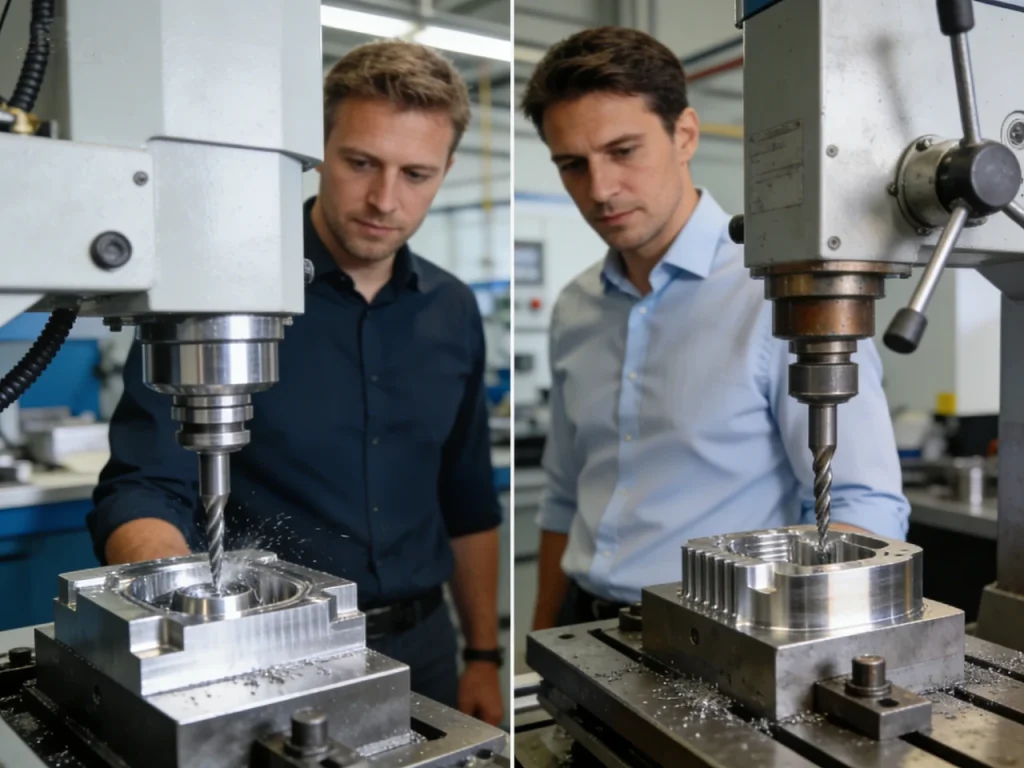
Aluminum is easier to machine. It allows higher cutting speeds, simpler chip control, and lower tool wear for both CNC milling and CNC turning, making aluminum a cost-effective metal for your project. Titanium machining, by contrast, requires specialized tooling and slower feeds, increasing cycle time and cost.
Titanium is tougher to cut. It has low thermal conductivity, so heat stays at the tool tip. That raises tool wear, calls for sharp carbide or ceramic tools, and requires lower feeds and speeds. You can absolutely CNC machine titanium with the right setup, coolant, and toolpaths, but cycle times are longer and consumables cost more.
- Is titanium harder to machine than aluminum? Yes.
- Is titanium hard to lathe? Yes, it’s more demanding than aluminum on turning. Use rigid setups, flood coolant, and conservative parameters.
Forming, Casting, Extrusion, and Prototyping Speed
Aluminum has a wide ecosystem for extrusion, casting, and sheet forming. It takes tight bend radii, has predictable springback, and is common for rapid prototyping. Titanium needs larger bend radii and can show greater springback. Warm forming or superplastic forming may be needed for complex shapes. Titanium casting and forging are more specialized, which increases cost and lead time.
For early prototypes, many teams start with aluminum to learn fast. If the final part must meet titanium performance, do a later prototype in titanium to confirm fatigue and temperature behavior.
Can you weld titanium to aluminum?
Direct fusion welding between titanium and aluminum is not recommended. It forms brittle intermetallics at the interface. If you must join them, use:
- Mechanical fasteners with proper isolation.
- Bimetallic transition joints produced by explosion bonding or friction welding.
- Advanced solid‑state joining methods via specialized suppliers.
Additive Manufacturing (3D printing) Use‑Cases
In metal AM, Ti‑6Al‑4V is a star for lattices, implants, and aerospace brackets that benefit from high strength‑to‑weight. AlSi10Mg and other aluminum AM alloys are popular for lightweight housings, heat exchangers, and parts that need heat dissipation with complex internal channels. Aluminum parts usually print faster and cost less per volume; titanium prints are used when performance per gram and lifecycle matter more.
Cost, Economics & Sustainability
When choosing between titanium and aluminum, engineers must consider not only material properties such as tensile strength of titanium alloys, density of titanium metal, and strength and weight, but also manufacturing implications. Titanium is often denser than aluminum and heavier than aluminum, which affects weight reduction strategies in design. By contrast, aluminum is a cost-effective metal that is easier to machine, supporting faster CNC milling and turning, lower tool wear, and shorter cycle times. These differences between aluminum and titanium make the choice between aluminum and titanium dependent on application requirements, production speed, and cost of titanium versus inexpensive aluminum. Understanding these factors is essential before evaluating Material Cost per kg and per Volume.
Material Cost per kg and per Volume (and what that means in practice)
In most markets, the cost of titanium is often several times higher than inexpensive aluminum by mass, whereas aluminum is a cost-effective choice for large or low-stress components. A common rule of thumb is titanium is >5–7× the price per kg compared to commodity aluminum, and the gap can be larger per unit volume because titanium is denser than aluminum. For large, low‑stress structures, that cost difference is hard to justify. For safety‑critical, corrosion‑heavy, or hot environments, the premium often pays back in service life and reliability.
Manufacturing Cost Drivers (cycle time, tooling, scrap)
For machined parts, titanium can be 3–10× the total cost of an aluminum part. Reasons include:
- Slower cutting speeds and longer cycle time.
- Higher tool wear and more frequent tool changes.
- Inert gas shielding for welding and extra fixturing for forming.
- Specialized handling and scrap segregation.
Practical tip: design for a near‑net shape to reduce stock removal in titanium. Use forgings, cast preforms, or printed blanks where possible.
Which is more cost‑effective over 10 years?
Think in total cost of ownership (TCO), not just purchase price. Consider:
- Replacement intervals due to corrosion or fatigue.
- Maintenance and downtime costs.
- Scrap and resale value.
If aluminum parts need multiple replacements in a harsh environment, titanium may be cheaper over 10 years. In mild environments with good coatings, aluminum is a cost‑effective metal and often the better financial choice.
Sustainability: Embodied Energy/CO₂ and Recycling
Producing primary titanium uses more energy per kg than producing primary aluminum. Published comparisons show titanium’s embodied energy and CO₂ per kg can be roughly 3–4× higher than aluminum. However:
- Aluminum is widely recycled with a strong global supply chain; recycled aluminum has a much lower footprint.
- Titanium recycling is more specialized but has high recovered value, especially for clean machining swarf and offcuts.
- Titanium’s longer service life can offset higher upstream impact on a per‑year or per‑use basis. Evaluate per functional unit, not just per kg.
Application Playbooks by Industry
Before diving into specific industries, it’s important to note that the choice between aluminum and titanium depends on balancing strength, weight, cost, and durability. Aluminum is lighter and more cost-effective, making it ideal for large, low-stress structures or components where heat dissipation matters. Titanium offers superior strength, corrosion resistance, and fatigue performance, which makes it the go-to for critical joints, high-stress parts, or harsh environments. Understanding these trade-offs sets the stage for how each metal is applied across aerospace, automotive, marine, and consumer products.
Aerospace & Defense (airframes, engines, landing gear)
Aluminum dominates skins and frames in many airframes because of cost, formability, and easy field repair. Titanium is chosen for high‑stress joints, landing gear, and parts near engines or de‑icing fluids where heat, corrosion resistance, and fatigue rule. Modern aircraft often carry titanium at meaningful percentages by weight where it matters most.
Automotive & EVs/Motorsport (wheels, rods, exhausts)
Aluminum is common in wheels, suspension arms, battery enclosures, and heat exchangers. It offers weight reduction at scale with low cost and easy processing. Titanium enters where performance gains pay back: valves, connecting rods, fasteners, and exhaust systems that see heat and vibration. Motorsport programs use titanium to cut rotating mass and survive high temperatures.
Marine & Offshore (hardware, structures)
For hulls and superstructures, aluminum is widely used because it’s lightweight and easier to fabricate in large panels, with coatings to fight saltwater. For subsea hardware, prop shafts, and fasteners that must last many years in chlorides, titanium is often the better long‑term choice.
Consumer Electronics & Bikes/Wearables
Aluminum rules in laptops, tablets, and many phones due to heat dissipation, anodizing, and low cost. Titanium shows up in premium phones, watches, and bike frames where scratch resistance, thin‑wall stiffness, and fatigue life are valued. Designers often thin the titanium geometry to offset its higher density and keep weight in check.
Case Studies, Calculators
To make these material choices tangible, we turn to data-backed case studies and calculators. By examining real-world examples—from aerospace brackets to marine fasteners and consumer electronics frames—we can quantify how aluminum and titanium perform in terms of strength, weight, cost, and durability. These case studies not only illustrate the trade-offs but also provide actionable insights for designers considering aluminum vs titanium in their own projects.
Data‑Backed Case Studies (concise, quantitative)
Aerospace bracket (Ti‑6Al‑4V vs 7075‑T6)
- Design case: strength‑limited bracket with equal load and safety factor.
- Baseline aluminum: volume 100 cm³, weight ≈ 270 g, UTS ≈ 550 MPa.
- Titanium redesign: wall sections reduced to ~50% volume based on ~2× strength.
- Titanium result: volume ≈ 50 cm³, weight ≈ 4.43 g/cm³ × 50 cm³ = 221.5 g.
- Outcome: ~18% weight reduction vs aluminum, plus better fatigue margin and temperature headroom. Part cost is higher, but lifecycle fatigue performance improves.
Marine fasteners (10‑year TCO)
- Aluminum fasteners: low initial cost, but at high risk of pitting and galvanic attack. Assume replacement every 2 years.
- Titanium fasteners: 5–7× higher upfront cost, but service life ≥10 years.
- Over 10 years, aluminum may be replaced 4–5 times with labor and downtime that often exceed the original part cost. Titanium typically wins on TCO in saltwater exposure.
Phone/watch frame (cosmetic durability with thin titanium)
- Aluminum frame: good heat spreading; shows scratches and denting over time.
- Titanium frame: reduce wall thickness by ~15–25% due to higher strength and hardness.
- Result: similar or slightly lower device mass, with scratch and edge dent resistance gains. Cost is higher; benefit shows up in longer cosmetic life and drop resistance at thin sections.
Mini tables (before/after snapshots)
| Case | Material | Volume (cm³) | Density (g/cm³) | Weight (g) | Notes |
|---|---|---|---|---|---|
| Aerospace bracket | 7075‑T6 Al | 100 | 2.7 | 270 | Baseline |
| Aerospace bracket | Ti‑6Al‑4V | 50 | 4.43 | 221.5 | Strength‑optimized |
| Case | Material | Replacement interval | 10‑yr replacements | TCO trend |
|---|---|---|---|---|
| Marine fasteners | Aluminum | 2 years | 4–5 | Higher over time |
| Marine fasteners | Titanium | 10 years | 0–1 | Lower over time |
Interactive Calculators & Decision Assistant
You can estimate weight and relative cost in minutes:
- Weight estimator
- Find your part volume (CAD mass properties or simple geometry).
- Multiply by density. Use 2.7 g/cm³ (aluminum) or 4.43 g/cm³ (Ti‑6Al‑4V).
- Convert to kg if needed (1,000 g = 1 kg).
- Relative material cost
- Weight × price per kg.
- Use a factor of 1× for aluminum and 5–7× for titanium to see a rough range.
- Add a machining factor: titanium CNC machining often takes 2–4× longer.
- Cost‑per‑strength check
- Divide tensile strength by density (strength‑to‑weight).
- Compare this index for your two choices; higher means better performance per gram.
Decision assistant quick cues:
- If temperature >150 °C or environment is chloride‑rich → lean titanium.
- If heat dissipation, mass production, or fast prototyping → lean aluminum.
- If it’s fatigue‑critical and safety‑critical → model a titanium redesign and check lifecycle cost.
Is titanium worth it for phones and watches?
It depends on your priorities. Titanium offers higher hardness, better dent resistance, and stiffness at thin sections. The frame can be thinner and still be strong, which helps offset its higher density. If your device gets daily knocks or sees rough use, titanium can keep it looking better longer. If you care more about cost and heat spreading, aluminum is a cost‑effective and proven choice.
References & Data Sources to Cite
See the links at the end of this article. They include USGS for market context, NASA and FAA materials resources for temperature and design considerations, NIST for physical constants, and military standards for galvanic guidance.
Summary & Actionable Takeaways
After reviewing material properties, performance trade-offs, cost implications, and real-world case studies, it’s clear that the choice between aluminum and titanium hinges on your project’s priorities—whether that’s low cost, ease of machining, and thermal performance, or strength-to-weight, corrosion resistance, and durability. The following summary distills these insights into actionable takeaways, helping you quickly identify where aluminum wins versus where titanium excels.
The Bottom Line in One Screen
- Aluminum: choose it for low cost, easy CNC machining, fast forming and extrusion, and when you need high thermal conductivity for heat sinks or housings. It provides good strength‑to‑weight at room temperature but softens above ~150 °C and is more prone to chloride corrosion without coatings.
- Titanium: When making a choice between aluminum and titanium, remember that aluminum is lighter and easier to form, whereas titanium is not a good heat conductor but offers superior strength-to-weight, corrosion resistance, fatigue and temperature performance, and thin-wall durability.
Common questions answered along the way:
- What are the disadvantages of titanium? Higher cost, tougher machining, slower lead times, and poor heat dissipation compared to aluminum.
- What is more expensive, titanium or aluminum? Titanium by a wide margin per kg (often 5–7×).
- Is titanium harder to machine than aluminum? Yes; slower feeds/speeds and more tool wear.
- Is titanium hard to lathe? Yes; use rigid setups, sharp tools, and flood coolant.
- Can titanium be CNC machined? Yes, daily—just budget more time and tooling.
- What hardness is titanium? Commonly ~200–360 HV depending on grade and heat treatment; titanium alloys like Ti‑6Al‑4V are around 300–360 HV.
Quick Design Checklist (avoid gotchas)
- Environment: chlorides, chemicals, temperature peaks, thermal cycling.
- Geometry: strength‑limited vs stiffness‑limited; can you thin the section?
- Mixed metals: plan galvanic isolation, drainage, and coatings.
- Manufacturing route: CNC milling/turning, casting, extrusion, AM; check lead time.
- Lifecycle: replacements, downtime, maintenance, and scrap value—not just purchase price.
Visual Recap
Think “where aluminum wins” vs “where titanium wins”:
- Aluminum wins: cost, machinability, heat dissipation, prototype speed, large low‑stress structures.
- Titanium wins: strength‑to‑weight, corrosion resistance, fatigue and heat, thin‑wall durability, implants and subsea.
Next Steps
- Use the quick calculators above to check weight and relative cost.
- Pick a starting grade: aluminum 6061 or 7075; titanium Grade 2 or Ti‑6Al‑4V.
- Request quotes for both to see real cost and lead time.
- Prototype in aluminum when learning fast; switch to titanium if tests show the need.
Short FAQs
Titanium sounds great on paper — it’s strong, corrosion‑resistant, and fairly lightweight — but it comes with some real downsides you should know about. For starters, the cost of titanium is often much higher than aluminum or steel because the raw material is expensive and the refining process is energy‑intensive. Machining titanium is also a challenge: it has low thermal conductivity and tends to trap heat at the cutting edge, which causes rapid tool wear and requires special tooling and slow speeds. It’s also more difficult to weld and form compared to aluminum, and its limited range of commercially available alloys can constrain design options. All this adds up to higher upfront costs and longer lead times for most projects.
When it comes to price, titanium typically costs significantly more than aluminum — both as a raw material and as a finished part. On average, titanium alloys can be several times more expensive per kilogram than aluminum alloys due to the complexity of refining titanium and its lower global availability. That difference doesn’t just show up in material cost; machinists and engineers often spend much more time and money processing titanium because it requires specialized tools and slower cutting speeds. For example, a part that costs $1,000 in aluminum might cost $3,000 – $5,000 or more in titanium, with machining time and tooling contributing heavily to the total. So if budget matters, aluminum usually wins the cost battle.
Yes — titanium is definitely harder to machine than aluminum, and that’s one reason why shops often push back on specs calling for it. Titanium’s low thermal conductivity means heat generated during cutting stays right where the tool is working, which ramps up tool wear and reduces tool life. It also tends to work‑harden as cuts are made, which increases cutting forces and makes chip control harder. By contrast, aluminum’s good thermal conductivity and softer structure make it much easier to cut at higher speeds with standard tooling. These differences mean slower feeds, specialized carbide or coated tools, and more frequent tool changes when working titanium vs aluminum.
Turning titanium — whether on a manual lathe or CNC lathe — is often described as more demanding than turning aluminum. That’s because titanium’s poor thermal conductivity keeps heat concentrated at the tool‑workpiece interface, which accelerates tool wear and can lead to chip welding on the tool. Because of that, machinists typically run at lower RPMs, use rigid setups, high‑pressure coolant, and very sharp carbide or ceramic tooling to keep things stable. On aluminum, you can often spin much faster, evacuate chips easily, and not worry as much about horsepower or vibration, which makes lathe work noticeably smoother and more predictable on aluminum than on titanium.
Absolutely — titanium can be CNC machined, and it’s done every day in aerospace, medical, and high‑performance industries — but it’s not straightforward. CNC machining titanium requires adjustments that you wouldn’t need for aluminum: slower cutting speeds, specialized tooling, rigid fixturing, and often high‑pressure coolant to manage heat buildup because of titanium’s low thermal conductivity. Tool coatings like TiAlN or ceramic inserts are common to improve tool life, and programmers often plan for more rapid tool changes and conservative feeds to avoid work‑hardening. So while CNC machining titanium is definitely feasible, it takes more expertise and planning compared to machining aluminum or other easy materials.
Titanium’s hardness varies quite a bit by alloy and heat treatment, but in general it’s harder than most aluminum alloys. For example, common aerospace titanium alloys like Ti‑6Al‑4V often measure in the range of roughly 300 HV (or 30‑35 HRC), whereas typical aluminum alloys like 6061‑T6 or 7075‑T6 are much softer. That higher hardness contributes to titanium’s better wear resistance and strength, but it also makes machining harder and tool wear faster. Harder grades and heat‑treated versions of titanium can push this even higher, further differentiating titanium from soft, easy‑to‑cut aluminum.


 English
  German
  French
  Italian
  Spanish
  Polish
  Czech
Czech  Japanese