
“CNC machining threads” sounds simple until parts hit assembly. Threads fail for a few repeatable reasons: the wrong standard or fit was specified, the machining method did not match geometry, tool deflection pushed pitch diameter out of range, or inspection did not match what the print needed.
This article focuses on feasibility decisions for CNC machined parts: how to choose a thread spec that can be made and checked, how to pick a machining method (tapping vs thread milling vs turning vs rolling), and which tolerances and controls protect joint strength.
Choose the right thread spec (standards + fit)
In CNC machining threads, selecting the correct thread spec directly impacts the quality and assembly of CNC machined parts. Understanding metric vs imperial threads, internal vs external threads, coarse and fine thread pitch, and standards like UNF/UNC helps you choose the right thread type and threading method—whether tapping vs thread milling—to machine reliable internal and external threads with stable thread diameter, consistent thread profile, and dependable thread engagement.
UNC/UNF vs metric threads: what to choose and why (include table)
UNC/UNF are Unified threads (imperial). Metric threads follow ISO conventions. Neither is “better” in a technical sense. The right choice is usually driven by the mating hardware, regional supply chain, and how your inspection plan is set up (gauges, CMM programs, go/no-go practice).
A practical rule for CNC machining threads is: match what the rest of the product already uses unless there is a clear reason to change. Mixed systems increase the chance of wrong fasteners, wrong gauges, and wrong callouts.
| Topic | UNC/UNF (Unified) | Metric (ISO) | Why it matters in CNC thread machining |
|---|---|---|---|
| Common notation | e.g., 1/4-20 UNC, 1/4-28 UNF | e.g., M6 × 1.0, M6 × 0.75 | The callout format drives what CAM/programming and inspection expects. |
| Pitch expression | Threads per inch (TPI) | Pitch in mm | Conversion mistakes can create a “near match” that still jams. |
| Fit/class language | Classes like 2A/2B, 3A/3B (per Unified practice) | Tolerance positions/grades such as common “g/6g” style notation (ISO practice) | The fit system tells you how tight pitch diameter must be. |
| When it is usually selected | Products built around imperial fasteners or legacy drawings | Products built around ISO fasteners and global supply | Helps avoid stocking two systems of taps, gauges, and mating parts. |
How to choose between UNC and UNF threads (buyer version): pick the thread series that matches the mating part and the standards your suppliers already inspect to. Use the class/fit to control looseness or tightness rather than switching systems to “fix” an assembly feel.
Coarse vs fine pitch: trade-offs for strength, vibration, and assembly (include comparison chart)
Pitch choice is about more than “coarse is easier.” Coarse and fine threads change how load spreads across the thread profile, how sensitive the joint is to damage, and how the assembly behaves under vibration.
A key point is that fine pitch can feel smoother and may allow finer adjustment, but it can also be less forgiving of contamination and damage. Coarse pitch is often more tolerant in production and field service.
Comparison chart (qualitative):
| Factor | Coarse pitch | Fine pitch | What engineers watch for |
|---|---|---|---|
| Assembly speed | Often faster to start and run down | Can feel slower and more sensitive | Matters when cycle time includes manual starts. |
| Damage tolerance | Often more tolerant | Often less tolerant | Small burrs or dents can block engagement on fine threads. |
| Vibration resistance | Can loosen if joint design is weak | Often preferred where adjustment and clamp load control matter | Joint design still matters more than pitch alone. |
| Strength & stripping risk | Depends on engagement and materials | Depends on engagement and materials | Do not assume one pitch is “stronger” without the joint stack-up. |
| Machining risk | Often easier to cut/tap | Often higher risk of tool deflection and profile error | Fine threads are less forgiving of pitch diameter drift. |
What standards define CNC thread dimensions and fits? (ANSI B1.1, ISO 965-1) (Reference types: official standards bodies; industry technical reports)
For feasibility and inspection, most CNC machined parts rely on the dimensional definitions and tolerance structures from:
- ANSI/ASME B1.1 for Unified screw threads (inch series).
- ISO 965-1 for ISO metric screw threads (tolerances and fits).
These standards define the thread form basics (such as the thread profile system), and more importantly for CNC machining threads, they define what “in tolerance” means for pitch diameter and fit classes. If a drawing references a thread but not a standard or class/fit, two suppliers can both “machine the thread” and still deliver parts that do not assemble the same way.
Thread callouts that prevent miscommunication (pitch, class/fit, internal vs external) (include annotated drawing diagram)
A thread callout needs enough information that machining, inspection, and assembly all converge on the same target. Missing one field often causes the most expensive kind of rework: parts that look right but do not gauge or do not mate.
Annotated drawing diagram (example callouts):
| Item | Internal Thread (Female) |
|---|---|
| HOLE | ⌀ (tap drill per thread spec) |
| THREAD NOTE | M10 × 1.5 – (fit per ISO) |
| ↑ ↑ ↑ | |
| size pitch tolerance/fit | |
| ALSO STATE | INTERNAL THREAD+ full thread depth requirement+ chamfer 30°–45° at entry |
| Item | External Thread (Male) |
|---|---|
| SHAFT OD | (major dia per thread spec) |
| THREAD NOTE | 1/4-20 UNC – 2A |
| ↑ ↑ ↑ ↑ | |
| size TPI series class/fit | |
| ALSO STATE | EXTERNAL THREAD+ thread length+ undercut/relief if needed |
What to include to avoid the common failures:
- Size + pitch (or TPI).
- Series/form (Unified series or metric).
- Class/fit (so pitch diameter tolerance is defined).
- Internal vs external threads.
- Any functional notes that affect machining, like chamfer expectation (30°–45° is a common entry range) and whether a relief groove is required.
Pick the best machining method for your part (tapping vs milling vs turning vs rolling)
Choosing the right threading methods is critical for CNC machining threads and high-quality CNC machined parts. Comparing tapping vs thread milling vs turning vs rolling helps you machine strong internal and external threads, control thread pitch and thread diameter, select the right threading tool, and achieve stable thread profile and thread engagement in any machining process.The best way to CNC machine threads depends on geometry (blind vs through, internal vs external threads), material behavior, and how tight the pitch diameter must hold.
Thread milling vs tapping vs single-point turning: accuracy, flexibility, and constraints (include decision matrix table)
A decision matrix helps because “best” changes with hole type, thread size, and inspection risk.
| Criterion | Tapping | Tapping | Single-point turning (lathe) |
|---|---|---|---|
| Where it fits best | Internal threads, simpler holes | Internal threads, especially where flexibility is needed | External threads (OD) and internal threads (ID) on lathes |
| Blind holes | Risk of bottoming, chip packing | Often preferred because depth is programmable | Possible, but ID threads can be vibration-prone |
| Diameter flexibility | One tap per size/pitch | One tool can cover a range (within limits) | One insert style can cover a family, but setup matters |
| Pitch diameter control | Can be good, but sensitive to tap condition | Good control with radial passes + spring pass | Good control if rigidity is high and chatter is controlled |
| Hard-to-tap materials | Higher risk | Often preferred | Possible, but forces and vibration rise fast on ID |
| Common constraints | Tap breakage, chip evacuation | Requires interpolation capability and tool clearance | Chatter risk, especially on internal threads |
Best way to CNC machine threads (decision version):
- For many internal threads with simple access, tapping can be efficient if chip control and tap life are predictable.
- For blind holes, larger diameters, or materials that are hard to tap, thread milling often reduces risk because you can control the cut with multiple passes and a spring pass.
- For external threads on turned parts, single-point turning often gives strong repeatability when the setup is rigid.
When thread milling wins: blind holes, large diameters, hard-to-tap materials (include checklist)
Thread milling often wins when you need control more than raw speed.
Checklist: choose thread milling when you have:
- A blind hole where chip evacuation and bottom clearance are a concern.
- A thread that needs tight pitch diameter control, helped by multiple radial passes and a spring pass.
- A larger diameter thread where taps are costly or risky, or where torque is high.
- A material that tends to be hard to tap, where tap breakage or poor surface finish is a repeat risk.
- A need to reduce cross-threading risk by adding an entry chamfer (30°–45°) before the helical toolpath.
When turning wins: OD threads, rigidity, and production repeatability (include process workflow diagram)
Turning is often the cleanest choice for external threads on CNC lathes because the toolpath is direct and the thread form is generated in a controlled way. Repeatability comes from rigid workholding, controlled infeed strategy, and consistent insert condition.
Process workflow diagram (high-level):
| Step | Workflow Item |
|---|---|
| 1 | Verify thread spec + class/fit |
| 2 | Prepare blank OD + add lead-in chamfer |
| 3 | Select insert geometry + infeed method |
| 4 | Program threading cycle (lead, depth, passes) |
| 5 | Cut passes + monitor chip formation |
| 6 | Spring/finish pass if needed |
| 7 | Inspect (gauge or measurement plan) |
This workflow is also used for ID threads, but ID access and holder vibration change the risk picture. That is covered in the turning section below.
Thread rolling after machining: where the “up to 300% fatigue resistance” claim applies—and what’s uncertain (Reference types: academic studies via Google Scholar; industry reports)
Thread rolling forms threads by plastic deformation instead of cutting. That can leave compressive residual stress at the surface and avoid cut marks at the root of the thread. Industry reports often cite up to 300% fatigue resistance improvement compared with cut threads.
Two cautions matter for feasibility:
- The “up to 300%” number is context-dependent. “Up to” is not the same as typical. The benefit can change with material, thread form, surface condition before rolling, and how fatigue is tested.
- Rolling is not a universal add-on. It needs the right pre-machined diameter, sufficient access, and a process that does not distort features that matter (like runout or concentricity with other diameters).
So, the difference between cut threads and rolled threads is not only surface appearance. It is also the near-surface stress state and how the thread root is formed. Rolling can help fatigue performance, but the size control and geometry requirements must be planned from the start.
Thread milling technique (helical interpolation) that holds size
Thread milling using helical interpolation is a key method for CNC machining threads, especially for precise internal threads. It ensures stable thread diameter, accurate thread profile, and reliable thread engagement by controlling helix angle, tool path, and chip evacuation. With the right threading tool, entry chamfer, radial passes, and spring pass, you can consistently machine high-quality threads for critical CNC machined parts while avoiding tool deflection and pitch errors.
Helical interpolation essentials: lead/helix control and why 0.5° deviation matters (Reference types: industry technical reports; metrology references)
In thread milling, the toolpath must match the thread’s lead. If the helix path deviates, the resulting thread flanks do not match the intended geometry. One reported risk point is that a 0.5° helix angle deviation can cause misalignment and wear. The practical meaning is simple: small angular errors can create contact on the wrong part of the thread flank, which changes load distribution and accelerates wear.
Where the deviation comes from in CNC machining threads:
- Interpolation mismatch between commanded and actual motion.
- Deflection from tool overhang or weak fixturing.
- Tool wear changes the effective cutting geometry.
- Poor entry strategy that causes a transient load spike at the start of the helix.
Proven thread milling sequence: 30°–45° chamfer cut → plunge → multiple radial passes → spring pass (include step-by-step diagram)
A stable sequence reduces burrs, improves entry, and helps size control. One commonly referenced approach is:
- chamfer cut (30°–45°)
- plunge
- multiple radial passes
- spring pass (a light final pass to reduce spring-back effects)
Step-by-step diagram (concept):
| Step | Description | Notes |
|---|---|---|
| Step 1 | Entry chamfer (30°–45°) | chamfer guides engagement, reduces burr |
| Step 2 | Plunge to start depth | controlled plunge to avoid side loading |
| Step 3 | Helical interpolation with radial passes | Pass 1: larger radial stepPass 2: smaller stepPass 3: approach target size |
| Step 4 | Spring pass | same path, light cut → improves size/finish stability |
Multiple radial passes matter when pitch diameter tolerance is tight. They reduce tool load per pass and reduce the chance that a single heavy pass pushes the tool off path due to deflection.
Entry strategy and chip evacuation: coolant use and avoiding recutting (include troubleshooting checklist)
Thread milling can fail for reasons that look like “bad geometry,” but the root cause is often chips. Recutting chips can score the thread flank and shift effective size.
Troubleshooting checklist (thread milling):
- Symptoms: rough flanks / torn surface Check chip evacuation first. Improve coolant direction and avoid letting chips pack in a blind hole.
- Symptoms: thread gauges tight at entry but loose deeper (or the reverse) Check entry strategy and tool deflection. A harsh entry can bend the tool at the start of the helix.
- Symptoms: oversize pitch diameter drift during a run Check tool wear and consider a spring pass strategy. Also check whether tool overhang crept longer after a tool change.
- Symptoms: burr at the start thread Add or adjust the 30°–45° chamfer and confirm the toolpath does not start cutting on a sharp edge.
Coolant is not only for temperature. In thread milling, coolant flow helps move chips out of the thread groove so they do not get cut again on the next revolution.
What chamfer angle should you use before thread milling? (30°–45°) (Reference types: industry tooling guides; standards references)
A common entry chamfer range used before thread milling is 30°–45°. This chamfer helps the mating fastener start square, reduces the chance of cross-threading, and reduces the burr that can form at a sharp hole edge.
The chamfer angle does not replace a correct thread spec. It is a DFM feature that makes the “thread engagement” phase smoother and reduces damage during assembly.
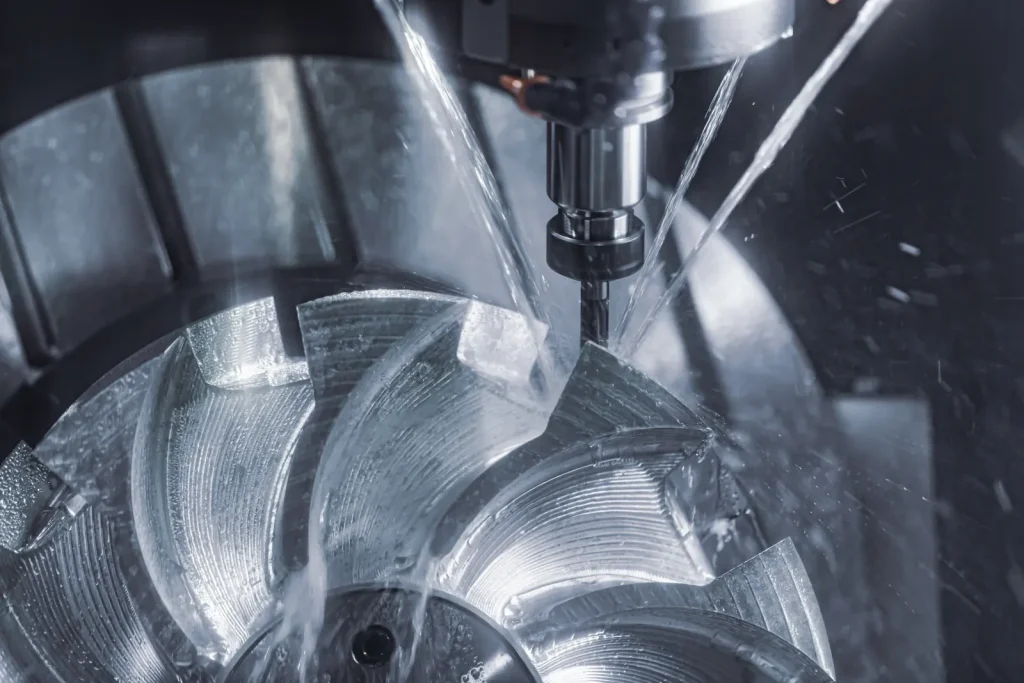
Turning threads on CNC lathes (OD vs ID) without chatter
Turning threads on CNC lathes is a reliable method for machining external and internal threads in CNC machined parts. Avoiding chatter is key to maintaining thread pitch, thread diameter, and thread profile accuracy—common issues stem from tool overhang, poor rigidity, and improper infeed strategies. The right threading tool and setup ensure smooth thread cutting, stable thread engagement, and consistent quality for both OD and ID threads.
Infeed strategy: modified flank infeed vs radial infeed for chip control and tool life (include pros/cons table)
Two common strategies are radial infeed and modified flank infeed. The difference is how the tool advances into the material across passes.
| Infeed method | Pros | Cons | Where it tends to fit |
|---|---|---|---|
| Radial infeed | Simple and common | Can load both flanks more evenly, which can worsen chip control in some cases | Often used as a default on many setups |
| Modified flank infeed | Better chip control and can improve tool life consistency | Needs correct setup and attention to clearance | Often preferred when chip evacuation and consistency matter |
Adoption varies. Radial remains common because it is familiar and easy to program, even when modified flank infeed gives better chip behavior in many screw thread cases.
Tool overhang and rigidity: how deflection shows up as pitch/geometry errors (include “rigidity audit” checklist)
In turning, overhang is a direct driver of deflection. Deflection shows up in threads as:
- Pitch diameter shift (often inconsistent along the thread length).
- Geometry error (flank angle distortion).
- Surface finish degradation, then chatter marks.
Rigidity audit checklist (turning threads):
- Is the tool stick-out minimized for the needed reach?
- Is the holder suited to the cut direction and load (no “flexy” stack-ups)?
- Is the workpiece supported to avoid bending under the thread cutting forces?
- Is the setup stable across passes (no movement in the chuck/fixture)?
- Are parameters reduced for internal threading where stiffness is lower?
- Is there evidence of vibration in the surface pattern that repeats with each pass?
This matters for both OD and ID threads, but internal threads are usually more sensitive because the tools are longer and less supported.
ID thread challenges: access limits, vibration-resistant holders, and when to add relief grooves + chamfers (include bore diagram)
Internal threads combine three issues: limited access, longer tools, and chip evacuation inside a cavity. That is why “machining internal” threads is often where prints need DFM help.
A relief groove (thread relief) and a chamfer can make ID threading more manufacturable. The groove gives the threading tool a place to run out without rubbing. The chamfer helps start the thread and reduces edge burrs.
Bore diagram (section view concept):
| Section | Description |
|---|---|
| Entry | 30°–45° chamfer |
| Middle area | internal thread (female thread) |
| Bottom area | relief groove (optional, when runout is tight) |
| Bottom position | tool exit/runout space |
Use vibration-resistant holders when possible, and reduce cutting aggressiveness for ID threads because the system stiffness is lower.
Why do internal threads chatter more than external threads? (Reference types: machining handbooks; academic machining dynamics papers)
Internal threads often chatter more because the tooling is less stiff. The tool must reach into the bore, so overhang increases and the system’s natural frequency drops. Cutting forces then excite vibration more easily, which shows up as repeated marks and pitch diameter variation.
External threads usually allow shorter, stiffer tool setups and better chip escape. That does not guarantee no chatter, but it shifts the risk in your favor.
Tolerances that matter: pitch diameter, GD&T, and joint strength
For CNC machining threads and high-quality CNC machined parts, precise tolerances directly determine thread functionality and joint strength. Pitch diameter, the core tolerance for thread fit, and GD&T controls (true position, runout) prevent misalignment, ensuring proper thread engagement, consistent thread diameter, and reliable screw thread performance—avoiding up to 40% joint strength loss from improper tolerances.
Pitch diameter tolerance targets: ±0.001” general vs ±0.0005” high-precision (ANSI B1.1 / ISO 965-1) (include tolerance table)
Pitch diameter is the effective diameter where the thread flanks engage. It is a primary control for fit.
Based on the provided standards-based guidance, typical targets used in CNC thread machining are:
| Application level | Pitch diameter tolerance target | Notes |
|---|---|---|
| General CNC threads | ±0.001″ | Often adequate when the joint is not highly sensitive and gauges confirm fit. |
| High-precision threads | ±0.0005″ | Used when assembly, alignment, or load distribution is more sensitive. |
These are not blanket guarantees. They are decision targets tied to class/fit and application criticality. ANSI B1.1 and ISO 965-1 define how fits and tolerance bands are structured.
GD&T controls for threaded features: true position and runout to prevent misalignment (include GD&T example diagram)
Threads can be “in size” but still fail function because they are not aligned to the datum structure. Two common GD&T controls used with threaded features are true position (for location) and runout (for coaxial alignment on rotating parts).
GD&T example diagram (concept):
| Concept | Description | Purpose |
|---|---|---|
| Hole Pattern (Top View) | o o o ⊕ o o o ⊕ = threaded hole | – Control: True position of threaded hole axis relative to A |
| Lathe Example (Shaft Thread) | Datum axis established by bearing journals | Runout control of threaded OD relative to datum axis |
If you only control thread size but ignore position/runout, you can create a joint that binds or frets because the load path is not axial.
Functional risk: how improper tolerances can reduce joint strength by up to 40% (Reference types: standards guidance; engineering/fastener technical reports)
Improper thread tolerances do more than change “fit.” They can reduce how many threads share the load. Poor alignment and wrong pitch diameter can concentrate load on fewer engaged threads. Provided technical reporting cites that improper tolerances can reduce joint strength by up to 40%.
Engineers often see this as:
- Early stripping in softer materials because the first threads take too much load.
- Loosening under dynamic loads because flank contact is uneven.
- Wear patterns that show contact only on part of the flank height.
This is why tolerance and inspection planning should be linked. If the functional risk is high, treat pitch diameter and alignment as first-order requirements, not finishing details.
What tolerance should I hold for CNC threads? (decision criteria by application criticality) (include quick decision flowchart)
Tolerance should be chosen by what the joint must do, and by what you can verify. A simple decision guide based on application criticality:
Quick decision flowchart:
| Decision Step | Question/Action | Outcome & Recommendation | Notes |
|---|---|---|---|
| 1 | Start | Is the thread joint safety-critical or high-load/dynamic? | – |
| 2 | Yes (to Step 1) | Target high-precision pitch diameter control (±0.0005″)+ plan inspection beyond basic go/no-go when needed | *Targets referenced from ANSI B1.1 / ISO 965-1-based guidance provided |
| 3 | No (to Step 1) | Is assembly sensitive (alignment, sealing, smooth engagement)? | – |
| 4 | Yes (to Step 3) | Consider tighter pitch diameter control and GD&T alignment controls | – |
| 5 | No (to Step 3) | General pitch diameter control (±0.001″) may be acceptable+ go/no-go gauging aligned to the print | *Targets referenced from ANSI B1.1 / ISO 965-1-based guidance provided |
Surface finish & inspection plan for high-performance threads
Surface finish and inspection are critical for high-performance CNC machining threads. Controlling surface roughness ensures stable thread profile, consistent thread diameter, and reliable thread engagement in CNC machined parts. A structured inspection plan using thread gauges, optical tools, and CMM helps verify pitch diameter, lead, and runout, while in-process probing and SPC maintain thread quality and accuracy.
Target thread surface roughness: Ra 0.4–1.6 µm and why it affects wear/load distribution (Reference types: metrology texts; industry reports)
For high-performance threads, a commonly cited target surface finish range is Ra 0.4–1.6 µm. The reason is not cosmetic. Rough flanks create high points that can wear quickly and shift the load path. They also increase friction scatter, which changes torque-to-tension behavior in bolted joints.
If you are chasing tight pitch diameter control, surface finish and size control connect. A torn surface can “gauge” differently and can also wear into a looser fit after only a small number of cycles.
Inspection toolkit: thread gauges, optical comparator, and CMM verification (include inspection workflow diagram)
No single tool answers every thread question. A thread gauge tells pass/fail for a defined standard and class, but it does not explain why a failure happened. Optical and CMM tools can help isolate lead error, flank issues, or runout.
Inspection workflow diagram (practical sequence):
| Step | Description | Purpose |
|---|---|---|
| 1) | Verify callout matches standard + class/fit | Ensure the thread callout is accurate and compliant |
| 2) | Go/No-Go thread gauge for fast pass/fail | Quickly verify if the thread passes or fails |
| If fail or high-risk application | ||
| 3) | Optical comparator to review thread profile/lead signs | Inspect thread profile and lead to detect defects |
| 4) | CMM verification for axis location, runout, and measured size | Verify thread axis location, runout, and size accuracy |
Match the inspection plan to the functional risk. If a joint is sensitive to alignment, add position/runout verification. If the risk is mostly assembly feel and basic fit, a gauge may be enough.
Pass/fail criteria that map to the print: what to measure (pitch diameter, lead, runout) (include checklist)
Inspection causes conflict when the print does not say what “good” means. For CNC machining threads, map pass/fail directly to what affects function.
Checklist: what to measure (when applicable):
- Pitch diameter (the main fit driver).
- Lead consistency (especially for thread milled features where helix control matters).
- Runout or coaxial alignment for rotating parts.
- True position for threaded holes that must align with other features.
- The surface finishes when wear or load distribution is sensitive.
In-process control options: probing + SPC to stabilize pitch diameter (include control chart visual)
For tighter threads, in-process checks can reduce drift. Two common tools are probing (to detect size or location shifts) and SPC (statistical process control) to monitor stability over time.
Control chart visual (conceptual):
| Item | Description |
|---|---|
| Upper limit | Upper control limit for pitch diameter |
| Target | Target pitch diameter value |
| Lower limit | Lower control limit for pitch diameter |
| Sample order | 1 to 10 (sequence of measured samples) |
| Goal | Data points stay centered on target with low spread |
| Action | Investigate tool wear, deflection, coolant, or setup shifts if trend drifts |
This is especially useful when you are trying to stay inside tighter pitch diameter targets (like ±0.0005″) and tool wear can move the result.

Tooling choices and CAM strategies to hit tolerance consistently
Selecting the right threading tools and adaptive CAM strategies is essential for consistent CNC machining threads. Proper tool coatings, nose radius, and stable toolpaths reduce deflection, tool wear, and chatter, helping maintain tight pitch diameter, thread profile, and surface quality. Rigid fixturing and minimized tool overhang further ensure accurate thread cutting for high-performance CNC machined parts.
Tool coatings and wear control (e.g., TiAlN) for stable size and finish (include tool life tracking table) (Reference types: tooling manufacturer data; industry reports)
Coatings like TiAlN are commonly used to manage wear and heat. The key is not the coating name by itself. The key is using a wear control plan so size does not drift until parts fail gauge.
Tool life tracking table (example fields to log):
| Job/feature | Tool ID | Coating | Material |
|---|---|---|---|
| Internal thread mill | TM-01 | TiAlN | Stainless |
| OD threading insert | TI-07 | (per spec) | Stainless |
| Tap (if used) | TP-03 | (per spec) | Aluminum/steel |
Tracking “drift sign” can be as simple as noting when go/no-go effort changes, or when measured pitch diameter trends toward a limit.
Nose radius trade-offs for stainless threads: sharpness vs strength vs cutting forces (what’s known vs uncertain) (Reference types: academic papers; tooling catalogs)
Stainless threading often fails due to built-up edges, work hardening, and chatter. Nose radius choice affects all three because it changes cutting forces and edge strength.
What is reasonably supported by the provided notes:
- Small nose radius helps cut fine pitches more sharply and can reduce cutting forces for delicate profiles.
- Larger nose radius can increase edge strength and heat dissipation, but can also increase cutting forces and risk profile errors if it is not matched to the desired thread profile.
What remains uncertain:
- There is no single agreed “best” radius per pitch across all stainless grades and setups. The balance depends on rigidity, coolant delivery, and how close the thread profile is to tolerance limits.
So for stainless steel, treat nose radius as a controlled variable. If you change it, expect to re-check size, finish, and chatter behavior rather than assuming it is a drop-in change.
Adaptive CAM + multi-axis synchronization: compensating for deflection and stabilizing feeds (include toolpath diagram)
Adaptive CAM and multi-axis synchronization are often used to keep tool load more stable. The goal is simple: reduce the force spikes that bend the tool and shift the effective pitch diameter.
Toolpath diagram (concept):
| Item | Description |
|---|---|
| Top view | A shaped toolpath showing a closed helical form |
| Side view | Axis diagram with z upward and x‑y horizontal; helix path rises by thread lead |
| Adaptive idea | Keep engagement stable across the helix so the tool deflects less and size holds more consistently |
This is most relevant when you are near the edge of what is machinable due to tool reach, hard materials, or tight pitch diameter control.
Setup fundamentals: rigid fixturing and minimized overhang (include “setup checklist”)
Most thread quality problems blamed on the cutting tool are setup problems. A setup that flexes will show up as chatter, pitch errors, and inconsistent gauge results.
Setup checklist:
- Clamp and support the part so the thread feature is not on a “springy” wall.
- Minimize tool stick-out, especially for internal thread tools.
- Confirm the datum scheme used for GD&T is the same scheme used for setup.
- Control coolant direction for chip evacuation in blind internal threads.
- Re-check overhang and offsets after tool changes when holding tight pitch diameter targets.
DFM rules for machinable threads (especially ID threads)
DFM rules are key to preventing thread machining issues early, especially for internal threads in CNC machined parts. Small design adjustments—like entry chamfers, relief grooves, and tool clearance—simplify CNC machining threads, reduce chatter and tool wear, and ensure proper thread engagement, thread depth, and thread profile while cutting tooling complexity and costs.
ID thread accessibility: minimum bore considerations, tool clearance, and why relief grooves help (include sectioned bore diagram)
Internal threads are limited by bore size and tool clearance. Even if the nominal thread diameter is large enough, you still need clearance for the tool body, the holder, and chip flow. If the tool cannot reach with acceptable overhang, the thread becomes a chatter risk.
Relief grooves help because threading tools need a place to exit without rubbing the last thread. Rubbing can damage the crest/root region and can shift functional size.
Sectioned bore diagram (concept):
| Section | Description |
|---|---|
| Bore width | The full width of the bore |
| Top area | 30°–45° chamfer |
| Middle area | Thread depth region |
| Bottom area | Relief groove that provides tool runout space |
| Required clearance | Bore ID, thread groove area, and holder shank to avoid collision |
Add entry chamfers (30°–45°) to improve engagement and reduce cross-threading (include DFM checklist)
Cross-threading is often an assembly issue, but the part design can reduce it. Entry chamfers help guide the fastener or mating external thread into alignment before flank contact becomes load-bearing.
DFM checklist (entry features):
- Add a 30°–45° entry chamfer for internal threads when assembly starts by hand or alignment is imperfect.
- Use the chamfer to reduce burr sensitivity at the hole edge.
- Confirm the chamfer does not remove the needed full thread engagement length.
- For thread milling, program the chamfer before the helical interpolation sequence.
Standardizing thread sizes/pitches to reduce tooling complexity and cost (include “standardization” checklist)
Many thread machining problems scale with variation. If each part uses a unique pitch, tools and gauges multiply, and the chance of miscommunication rises.
Standardization checklist:
- Reuse a small set of thread sizes and pitches across the assembly where possible.
- Keep thread series consistent (Unified or metric) inside one product family unless there is a strong reason.
- Align internal vs external thread pairing, so inspection tools are reused.
- Avoid mixing fine and coarse pitches without a functional reason tied to the joint.
This is not about “cheaper threads.” It is about fewer failure modes in manufacturing and inspection.
Do I need a relief groove for CNC internal threads? (when it’s recommended) (Reference types: industry DFM guides; standards references)
A relief groove is recommended when the internal threading tool needs a clean runout, or when the last thread must be fully formed close to a shoulder. It is also helpful when chatter or rubbing marks show up at the end of the thread.
You may not need a relief groove if there is generous space beyond the thread, the thread does not need to run close to a face, and the method (such as thread milling) can control the end condition without tool rub. The decision should be tied to tool access and the required thread engagement, not habit.
Case studies: what improved accuracy, finish, and throughput
These case studies highlight proven strategies to enhance CNC machining threads for CNC machined parts parts—focusing on boosting accuracy, surface finish, and throughput. From real-time monitoring and adaptive CAM to chamfer-first thread milling, rigidity-focused setups, and DFM updates, each example solves common thread machining challenges like chatter, pitch diameter drift, and tool wear.
Case study — Real-time monitoring + adaptive control to maintain micron-level pitch diameter consistency (include before/after KPI chart)
Context: High-stress threaded components needed stable pitch diameter and consistent surface finish under dynamic loads. The risk was functional strength loss if tolerances drifted.
What changed: Adaptive control was paired with coated tools (TiAlN noted), tool wear monitoring, and in-process probing with SPC.
What improved: Rework dropped and pitch diameter stayed consistent across runs, with stable Ra finishes reported in-process.
Before/after KPI chart (concept):
| KPI | Before | After |
|---|---|---|
| Pitch diameter consistency | Variable across tool life | More stable across tool life |
| Rework/adjustments | More frequent | Less frequent |
| Surface finish stability | Drift with wear | More consistent |
This aligns with the broader point: when tolerances are tight, you need both a machining plan and a control plan.
Case study — Chamfer-first thread milling to reduce cross-threading and speed assembly (include process comparison table)
Context: Precision assemblies had cross-threading events during manual starts. Threads were in size, but starts were not smooth.
What changed: A dedicated 30°–45° chamfer toolpath was added before helical interpolation, with coolant focused on chip evacuation.
What improved: Engagement improved and thread damage during assembly dropped. Assembly time improved because fewer attempts were needed to start the screw thread.
Process comparison table:
| Step | Prior process | Updated process |
|---|---|---|
| Entry condition | Sharp edge or inconsistent chamfer | Controlled 30°–45° chamfer first |
| Thread milling | Single helical path | Helical path after chamfer + better chip evacuation |
| Assembly outcome | Higher cross-threading risk | Smoother starts, less damage |
Case study — Stainless steel threading with rigidity-first setup: OD vs ID strategies and tool life/finish outcomes (include parameter table)
Context: Stainless external and internal threads showed chatter, poor chip breaking, and tool life issues, especially on ID threads.
What changed: The setup strategy diverged from OD vs ID:
- OD: reduced overhang and improved coolant delivery.
- ID: used vibration-resistant holders and reduced parameters to match lower stiffness. Tool geometry choices included using smaller nose radius for fine pitches, while balancing edge strength.
Outcome: Cleaner chip control and improved finish consistency, with longer tool life reported, without triggering visible work hardening issues.
Parameter table (qualitative, decision-focused):
| Feature | Main risk | Setup priority | Tooling note |
|---|---|---|---|
| OD threads | Chatter at higher load | Minimize overhang, support work | Nose radius matched to pitch/profile |
| ID threads | Chatter due to low stiffness | Vibration-resistant holding, conservative cut | Balance sharpness vs edge strength |
Case study — DFM updates for ID threads: chamfers + relief grooves to improve manufacturability and cost (include redesign checklist)
Context: Internal threads in turned bores were hard to machine due to access limits. Failures showed up as chatter near the end and inconsistent thread started.
What changed: The design was updated to use standard sizes, add 30°–45° chamfers, and add relief grooves where runout space was tight. The design was checked early in CAD.
Outcome: Better manufacturability and simpler tooling plans, with fewer machining exceptions.
Redesign checklist:
- Add 30°–45° entry chamfer for internal threads.
- Add relief groove when the tool needs runout near a shoulder.
- Standardize thread sizes/pitches across similar parts.
- Confirm tool clearance in the bore before release.
Ending logic (how to decide if your thread approach is suitable)
For CNC machining threads, feasibility comes down to a short chain of decisions:
- Start with a complete thread spec: standard + pitch + class/fit + internal vs external.
- Pick a method that matches geometry risk: tapping for simpler internal threads, thread milling for blind holes and control, turning for repeatable OD threads, and rolling only when the part is designed for it.
- Control what drives function: pitch diameter and alignment (true position/runout), because poor tolerances can reduce joint strength by up to 40% in reported guidance.
- Match inspection to the print: gauge for fast pass/fail, and optical/CMM checks when lead, runout, or tight pitch diameter targets matter.
- Reduce variation: rigid setup, minimal overhang, and a tool wear plan, because deflection and wear are what usually move threads out of tolerance.
FAQs
There is no universal standard depth for a tapped hole, as the depth of the thread is determined by required thread engagement, joint load, and whether the hole is blind or through. For blind holes, extra clearance must be added for tap lead and chip evacuation to ensure full, functional threads, which directly supports the functionality of machined threads in assembly.
Yes, you can create internal and external threads at a micro scale using a CNC, but feasibility depends heavily on tool access, setup rigidity, and inspection precision. Micro-threads are less tolerant of tool deflection and wear, so the threading procedure must be planned early to maintain accuracy and reliable performance.
Threads in CNC parts commonly fail due to incomplete thread assignment, pitch diameter drift from tool wear, excessive tool overhang, and chatter, especially on internal or external threads in tight spaces. Poor entry chamfers and mismatched methods for machining threads often lead to cross-threading and assembly damage, rather than simple machining error.
To choose between UNC and UNF threads, match the thread series to your mating hardware, inspection standards, and desired thread pitch for the application. UNC threads offer better production tolerance, while UNF threads suit finer adjustment needs, helping you design threads that fit your assembly without switching between imperial and metric systems.
Thread cutting involves material removal via tapping, thread milling, or turning to create the thread, while rolled threads use plastic deformation that improves surface fatigue resistance. Rolled threads enhance compressive stress near the crest of the external thread, but they require pre-machined dimensions and are not a simple replacement for cutting internal and external threads in all designs.
The best method for producing threads depends on the type of CNC and part geometry: thread milling excels in blind holes and hard materials, turning is ideal for external threads on CNC lathes, and tapping works efficiently for stable internal threads.




 English
  German
  French
  Italian
  Spanish
  Polish
  Czech
Czech  Japanese