
Looking to select the right milling cutter for higher throughput and lower cost? This guide puts the essentials first: quick selection steps, 2025–2035 data, and field-tested optimization tips. Learn which milling cutter types, coatings, and geometries fit your job, and how smart, sustainable tooling boosts tool life and finish.
Quick buyer’s checklist: tooling for milling machine
Before diving into the step-by-step selection process, it helps to have a quick overview of what matters most when choosing a milling cutter. From understanding the material you’re cutting to matching the right cutter type, checking machine capabilities, and factoring in coatings, costs, and sustainability, this checklist gives you a clear starting point. Think of it as your roadmap for making faster, smarter, and more cost-effective tooling decisions.
- Define the job: material (steel, aluminum, titanium, composites), tolerance, surface finish Ra.
- Match cutter type: end mill, face mill, shell/slab, rougher, ball nose, thread mill; indexable vs. solid.
- Confirm machine capability: spindle power, RPM, rigidity, coolant/MQL, toolholding.
- Choose substrate/coating: carbide vs. HSS; TiAlN/TiCN/DLC/CVD/PVD based on heat and abrasiveness.
- Optimize economics: insert availability, regrind potential, changeover time, life-cycle cost/part.
- Plan monitoring: digital tool data, wear tracking; aim to cut downtime 10–12% per line.
- Sustainability: coolant strategy, recycling, and regrind programs.
Milling cutter market snapshot (2025–2035)
Demand for milling cutters is rising across automotive, aerospace, medical, and general metalworking. The headline: carbide leads, coatings matter, and digital monitoring is becoming standard.
Table: Market overview (rounded values)
| Metric | 2025 | 2032–2035 forecast |
|---|---|---|
| Overall market size | $5–6.2B | $8.9–$9.6B |
| CAGR | — | ~6–6.5% |
| Indexable milling cutters | ≈ $5.2B | Larger share within total |
| Material share | Carbide ≈ 70%; HSS ≈ 30% | Similar trend with more coatings |
| Product mix | End mills 40%; Face mills 30%; Shell 15%; Slab 5%; Others 10% | Stable mix |
| Regions | APAC ~40%; NA ~25%; Europe ~25%; RoW ~10% | APAC sustained lead |
| Tech drivers | Digital integration cuts wear/downtime ~10–12% | PVD/CVD adoption +14%/yr; life + up to 25% |
What does this mean for your shop? If you choose indexable milling cutters with the right carbide inserts and modern PVD/CVD coatings, you can meet targets for cost/part and finish while using digital checks to keep uptime high.
What does a milling cutter do? And how does milling compare?
A milling cutter rotates and uses multiple cutting edges to cut and remove material from the surface of a workpiece. It is used in milling machines to shape metals and other materials precisely. Each tooth takes a chip. With the right geometry and coating, the tool can handle various milling operations efficiently, hold tight size, and leave a better finish.
What are the three types of milling? In teaching, the three big buckets are:
- Peripheral (slab) milling using the tool’s outside diameter,
- Face milling using the tool’s face at right angles to the cutter axis,
- End milling, which blends both, often used for slots, pockets, and profiles.
What is the difference between CNC cutting and milling? “CNC cutting” is a broad term for computer-controlled cutting (laser, plasma, waterjet, routing, turning, and more). CNC milling is one part of that set. It uses a rotating cutter in a milling machine to remove chips from metal or other materials with precise control of the spindle, feed, and path.
Types of milling cutters
To put it simply, milling cutters are made as rotating cutting tools in different shapes and sizes, each cutter designed to remove material efficiently from a workpiece. These milling cutters made from high-quality carbide or HSS ensure durability and precision in various milling operations. The cutter has multiple cutting edges (teeth). It removes material faster as each tooth takes a chip. In practice, you’ll pick the type of cutter based on surface area, geometry, access, and required finish.
For manufacturers or engineers seeking high-precision CNC milling and turning of metal or plastic components, U-Need provides custom CNC machining services, including milling, turning, and component fabrication using advanced cutters and tooling. Their experience with mild steel, stainless steel, and engineering plastics helps clients achieve consistent dimensional accuracy and smooth finishes across prototype and production batches.
- End mills: The go-to CNC milling tool for slots, pockets, profiles, and 3D shapes. Solid carbide for speed and wear; high-speed steel for lower cost and flexible setups. Use AlTiN/TiAlN for steels and high heat. Use ZrN/DLC and polished flutes for aluminum to reduce built-up edge.
- Face mills: Used to mill and flatten large faces with a high material removal rate (MRR). These cutters are best for stable machines and large production runs. Often indexable with multiple inserts so you swap edges fast. Good for higher feed per tooth with stable machines.
- Shell mills: Modular heads mounted on an arbor for wide slots, contouring, and medium to heavy milling in steel materials and castings.
- Slab mills (plain milling cutters): Classic cylindrical tools used to cut heavy stock along the periphery in different types of mill setups. Common in horizontal milling operations.
- Ball nose and bull nose: For 3D profiles and free-form contour milling; common in molds and dies. Their helical flute geometry helps maintain chip flow and surface smoothness. Ball nose for smooth surface transitions; bull nose adds a corner radius to strengthen the edge.
- Roughing (hoggers): Serrated teeth that split chips, lower cutting forces, and let you run deeper cuts with less chatter.
- Thread mills: For internal and external threads, often in tough alloys. One tool can do many thread sizes with a programmed radius path.
- Fly cutter: Single-point tool for very flat finishes and wide faces at low cost. Slower, but the finish can be excellent on the right machine tool.
- Form cutters: Corner rounding milling tools, convex milling cutters, concave, gear cutters, and other special profiles used in milling machines to create unique shapes in one pass. These tools are designed to shape edges and grooves in one pass.

Indexable vs. solid carbide
- Indexable: Lower consumable cost, fast insert changes, stable at larger diameter with many number of teeth. Great for face and slab milling.
- Solid carbide: Higher accuracy in small diameter cutter sizes, micro-features, and tight profile work. Can be reground to extend life.
A quick way to think about it: choose a face mill for large flats, an end mill for 2.5D/3D features, a rougher for deep stock removal, and a ball/bull nose when surface blend quality matters.
Selection guide: match cutter to job and machine
You want a repeatable way to pick a milling tool. Use this step-by-step flow. It answers the big questions—what to use, how to set it, and how much it costs per part.
Step 1: Identify the workpiece group (ISO P/M/K/N/S/H) and hardness
- ISO P: steels and low-alloy steel
- ISO M: stainless
- ISO K: cast iron
- ISO N: non-ferrous (aluminum, copper)
- ISO S: superalloys and titanium
- ISO H: hardened steel
Harder materials and high temperatures push you toward carbide with hot-hard coatings and a tough edge prep.
Step 2: Pick geometry for chip control and stability
- Aluminum and other ISO N: Use a high-helix (40–55° or higher), polished flutes, and large chip gullets. The goal is low friction and fast chip flow. DLC/ZrN coatings help avoid sticking.
- Stainless and titanium (ISO M/S): Use a variable helix and variable pitch to fight chatter. Add a light edge hone and chipbreakers to protect the cutting edge and control long chips.
- Cast iron (ISO K): Use tougher edges with neutral to negative rake inserts and robust cutter bodies. Focus on vibration damping and dry or MQL when advised.
- Steel (ISO P): A wide range works. For general steel, a mid-helix, TiAlN/AlTiN coatings, and solid carbide end mills are common choices.
Step 3: Select substrate and coating
- Substrate: Carbide grades vary in toughness vs. hot hardness. Higher cobalt = tougher; finer grain = stronger edge. High-speed steel (HSS) or cobalt HSS tools can be cost-effective in less abrasive jobs or small batch runs, and they still withstand high cutting temperatures when properly coated.
- Coatings:
- TiAlN/AlTiN for heat resistance in steels, stainless, and dry/semi-dry runs.
- TiCN for wear at lower temps; good on steels and cast iron.
- DLC or ZrN for non-ferrous to limit built-up edge.
- CVD multilayers for abrasive cast irons and long cycle time cuts.
Step 4: Check machine and holder
- Toolholding: For precision and finish, control runout. Use shrink-fit or hydraulic holders for end mills. For roughing, a strong side-lock or ER collet may be fine, but check runout and balance.
- Spindle and interface: HSK for high-speed and stiffness; BT/CAT can be robust for heavy cuts. Keep overhang short. A stiffer holder can save a job with chatter.
- Coolant strategy: Flood, air, MQL, or dry. Match to material and coating. For stainless and titanium, high-pressure coolant helps with heat and chip evacuation.
Step 5: Start speeds/feeds (use a calculator to refine)
Below are conservative baselines for solid carbide end mills at typical engagement. Always confirm with your vendor’s charts and adjust for cutter diameter, number of flutes, and holder rigidity.
Table: Baseline starting points (solid carbide end mills)
| Material | SFM (m/min) | IPT per tooth (in/tooth) | Notes |
| Aluminum (ISO N) | 800–1200 (245–365) | 0.002–0.006 | Use polished flutes, large chip gullets; air or MQL |
| Low/Medium steel (ISO P) | 300–500 (90–150) | 0.0015–0.004 | TiAlN/AlTiN; flood or MQL; avoid rubbing |
| Stainless (ISO M) | 200–350 (60–105) | 0.001–0.003 | Variable helix; strong chip control; HPC recommended |
| Cast iron (ISO K) | 400–700 (120–215) | 0.002–0.005 | Often dry or MQL; check dust control |
| Titanium (ISO S) | 150–250 (45–75) | 0.001–0.0025 | Keep heat down; constant engagement paths |
| Hardened steel (ISO H, 45–55 HRC) | 200–300 (60–90) | 0.0008–0.002 | Small radial width; consistent chip load |
Set RPM from SFM and cutter diameter, then set feed rate = RPM × flutes × IPT. Increase until you see edge wear or vibration, then back off.
Step 6: Economic lens
- For indexable: Compare $/edge, edges per insert, and changeover time. For solid: compare purchase price vs. number of regrind cycles.
- Cost-per-part method (simple):
- Tool cost per usable edge
- Machine time × hourly rate
- Setup/changeover time × rate
- Scrap/rework cost
Sum and divide by good parts. The right cutter often wins by fewer stoppages and better yield, not just lower price.

Performance optimization and troubleshooting
What is the “golden rule of milling”? On rigid CNC machines, the common rule is to prefer climb milling (down milling). It keeps the chip thick at entry and thin at exit, which reduces rubbing and heat. It also improves finish and tool life in many cases. On less rigid setups, conventional milling may help prevent tool pull-in. In short, aim for stable chip thickness and a steady feed rate.
Common failure modes and quick fixes
Even with the best milling cutters and careful setup, problems can still happen on the shop floor. Understanding the most common failure modes and knowing some quick fixes can save time, reduce scrap, and extend tool life. The following section breaks down typical issues like vibration, edge chipping, poor finish, built-up edges, and heat-related wear, along with practical tips to keep your milling process running smoothly.
Chatter: This is that annoying vibration or “shaking” you feel while cutting. To fix it, shorten overhang so the tool sticks out less—long tools act like tuning forks. Use a stiffer holder to reduce deflection, and consider increasing tool diameter for more stability. Switching to variable pitch cutters can break up harmonic vibrations, and adding a small step down with higher AE (radial width) can keep the cut smooth. Sometimes just raising the feed slightly helps the tool cut cleanly instead of rubbing and generating heat.
Edge chipping: When your cutter starts losing tiny pieces along the edge, go for a tougher grade material to resist breakage. Adding an edge hone strengthens the tip, while reducing radial engagement lowers the stress on each tooth. Chipbreakers can control the chip flow and prevent sudden edge damage. Avoid hammering reentries—use arc-in/arc-out tool paths for gentler entry and exit.
Poor finish or burrs: If your parts come out rough or with extra burrs, try raising the RPM and reducing feed per tooth for a smoother cut. Adding wiper inserts on face mills can help lift the finish. Don’t forget coolant—sometimes a different coolant or a lighter approach, like a spring pass with smaller depth of cut, can significantly improve surface quality.
Built-up edge (aluminum): Aluminum tends to stick to the cutter, forming a built-up edge. Combat this by using polished flutes and coatings like DLC or ZrN. Increasing cutting speed and applying MQL or air keeps the edge clean and prevents material from clinging.
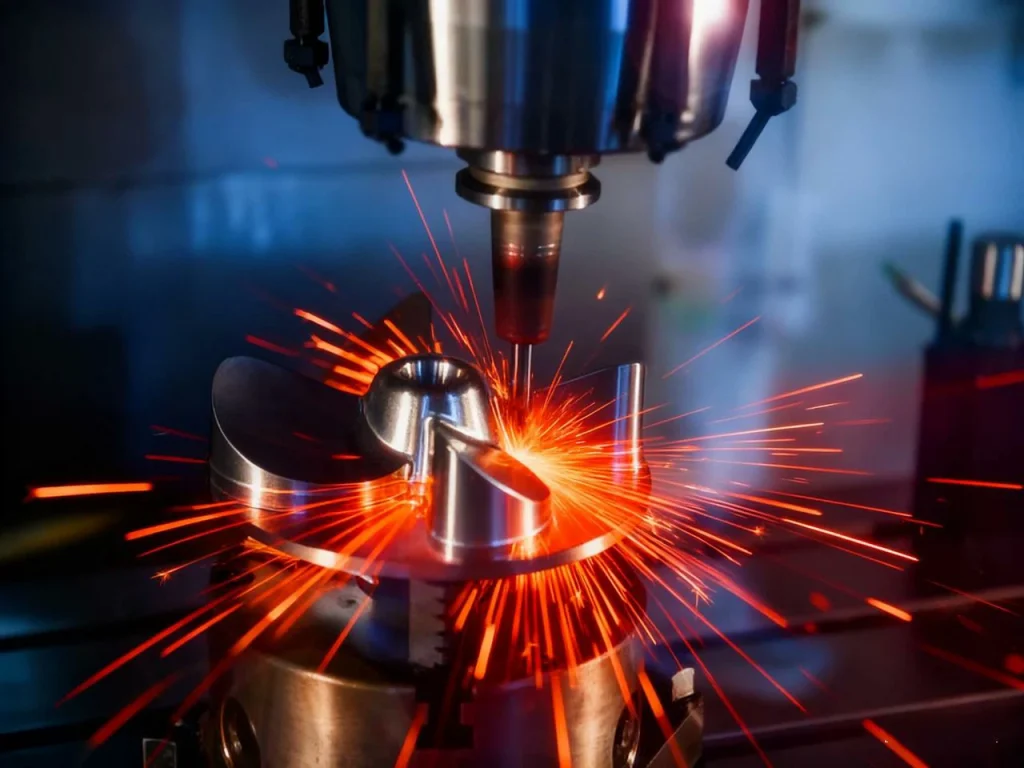
Heat/wear: Overheating or premature wear is common with tough materials. Choose heat-resistant coatings like TiAlN/AlTiN, and decide whether a dry or wet strategy fits your material and coating. Using trochoidal milling or high-efficiency milling helps stabilize the load on each tooth, reducing localized heat and extending tool life.
Tool life extension
- Use constant-engagement toolpaths (HEM). Keep chips short and flowing.
- Match coolant: air/MQL for aluminum, high-pressure coolant for steel and titanium to clear chips.
- Keep runout below 0.0002–0.0004 in (5–10 μm) for fine-finish end mills.
- Apply digital monitoring to schedule insert swaps or solid tool changes by condition, not by guess. With the right coating and toolpath, a 25% life gain is realistic. And as noted by the National Institute of Standards and Technology (NIST), data-driven maintenance and real-time tool tracking can significantly improve process reliability and reduce unplanned downtime in smart manufacturing environments.
Manufacturer and product landscape (value-driven)
What separates top milling machine cutters from the rest? You’ll see differences in carbide grain size, binder content, micro-geometry (edge hone, wiper flats), and coating stacks. Many systems also offer modular/indexable ecosystems and digital-ready holders that feed load or vibration data to dashboards.
When you select a vendor, look beyond price:
- Local support and fast insert availability
- Application engineering for tricky alloys
- Sustainability options such as regrind and carbide recycling
- Clear data sheets and recommended cutting speed and feed windows
Price vs. performance vs. lifetime cost
- Calculate cost/part, not just tool cost. A tool that holds tolerance and finish can cut scrap by a few percent, which often beats a cheaper tool.
- Count inserts without long setup delays. Fast changes are worth a premium on busy lines.
- Track tool life in hours or parts. Aim for repeatable cycles to plan maintenance and reduce unexpected stops.

Industry applications and quick case snapshots
- Automotive (~26% of indexable demand): Large-scale face mill jobs on housings need predictable insert swaps. The win is uptime and consistent Ra on sealing faces. Programs with balanced entry/exit cuts reduce tool shock, and a wiper row can lift finish at the same feed.
- Aerospace/defense (~18%): Titanium and HRSA call for multi-edge, heat-resistant coatings and constant tool engagement. Lower SFM, steady feed rate, and high-pressure coolant keep edges alive. Toolpaths that avoid full-width cuts limit heat spikes.
- General metalworking (~38%): Mixed materials require flexible milling cutters and holders. A set of end mills with common shank sizes, a couple of shell mills, and a sturdy arbor covers most jobs.
- Medical devices (growing share): Micro end mill work on small features and tight finishes. Light cuts, accurate spindle control, and low runout matter more than raw MRR.
Innovations you should watch next
- Smart cutters and sensorized toolholders: Real-time load, deflection, and vibration data improve setup and prevent tool breakage. Plants report 10–12% downtime reduction when they act on data, not alarms.
- Coating advances: Faster adoption of PVD/CVD stacks such as TiAlN, TiCN, and DLC. Multilayers can spread heat and resist wear, with up to 25% longer tool life in the right use.
- Sustainability: Smarter coolants, MQL, regrind, and circular carbide programs reduce waste and cut spend on fluids and tooling.
- Hybrid and AI-aided machining: CAM uses AI to stabilize chip thickness and pick entries that avoid chatter. Predictive maintenance flags a cutter before it fails, so you keep quality high.
Community insights and trusted resources
Practical tips from machinists are clear:
- Keep number of flutes matched to chip flow. In aluminum, 2–3 flutes clear chips. In steel, 4–6 flutes carry load better at the same cutter diameter.
- Shorten reach. A tool that sticks out too far invites chatter. Can you grip deeper in the holder?
- When you must cut in a horizontal direction on a thin wall, support it. A small step-down strategy with climb milling can save the finish.
- Plan for regrinds on solid carbide. Many shops extend life 2–3 cycles while holding tolerances.
Speed, feed, and chip control tips you can use today
- Keep chip thickness steady. If number of cutting teeth engaged changes, chip load spikes and drops, which drives chatter.
- Avoid rubbing. If you hear squeal and see shiny marks, raise feed slightly or reduce radial engagement.
- Use the shortest tool you can. A long stick-out cuts like a tuning fork.
- Match number of flutes to chip space. More flutes need smaller IPT to avoid packing chips.
- On thin parts, reduce depth of cut and climb mill with support. Think “gentle but steady.”
Sustainability and safety
- Fluids: Use coolant only when it helps tool life or finish; use MQL or air when you can. This reduces waste and mist.
- Recycling and regrind: Solid carbide tools are ideal for regrinds if the geometry allows. Many programs buy back used carbide.
- Safety: Control chips and dust (especially cast iron). Mind guarding, PPE, and fluid handling. Health and safety rules for metalworking fluids protect people and parts.
Conclusion
The milling cutter market is expanding toward $9B+ by 2032–2035, with carbide, advanced coatings, and digital monitoring setting the pace. The key is simple: choose geometry and coating by material and machine, keep chip thickness steady, and track cost/part with real data. Use the steps, tables, and quick checks above to select the right milling machine cutters—and get reliable tool life, better finish, and predictable throughput.
FAQs
A milling cutter is basically the tool that makes milling happen. Think of it as a rotating knife with multiple teeth, each one taking a tiny “bite” out of the material. As it spins, it gradually removes material from your workpiece, whether that’s metal, plastic, or composites. The cool thing is, with the right cutter geometry and coating, it’s not just about cutting—it’s about cutting faster, staying precise, and leaving a nice, smooth finish. Different cutters can handle different jobs: some are better for big flat surfaces, others for slots, pockets, or even complex 3D shapes. So in short, the milling cutter turns raw material into a finished, usable part with efficiency and accuracy.
The golden rule of milling is all about stability and chip control. On a rigid CNC machine, you usually want to go for climb milling (also called down milling). Why? Because it keeps the chip thick when it enters the material and thin as it exits, which reduces rubbing and heat—so your cutter lasts longer and the surface finish looks better. If your machine isn’t super rigid, conventional milling can help prevent the tool from being “pulled in” or deflected. Basically, the golden rule boils down to: keep your chip thickness consistent, feed steadily, and don’t fight the machine. A stable cut means less wear, fewer surprises, and a cleaner part.
There are quite a few, each designed for different tasks. The main ones you’ll see are:
• End mills: Great for slots, pockets, and 3D features. Solid carbide for speed, HSS for budget-friendly setups.
• Face mills: Big flat surfaces, often with indexable inserts so you can swap out edges quickly.
• Shell mills: Modular heads on an arbor, ideal for wider slots or medium-to-heavy milling.
• Slab mills: Classic cylindrical tools for heavy stock removal along a material’s edge.
• Ball nose and bull nose: Perfect for 3D contours and smooth transitions; common in mold and die work.
• Roughing/hoggers: Serrated teeth that handle deep cuts with less chatter.
• Thread mills: For creating internal or external threads efficiently.
• Fly cutters: Single-point tools for very flat surfaces at low cost, slower but precise.
• Form cutters: Specialized shapes like corner rounding, convex, concave, or gears.
Each type has its own “sweet spot” depending on the surface area, geometry, access, and finish you need.
When you break milling down in simple teaching terms, there are three main categories:
1. Peripheral or slab milling: Uses the cutter’s outside diameter to remove material along a surface—think long straight cuts.
2. Face milling: Uses the cutter’s face at right angles to the axis, great for flattening big surfaces quickly.
3. End milling: Kind of a hybrid, good for slots, pockets, and 2.5D or 3D profiles. End mills can handle a variety of features, from straight edges to complex shapes, making them extremely versatile in CNC work.
So really, these three types cover almost everything you need in a typical shop.
CNC cutting is a broad term for any computer-controlled process that removes material—so it could be laser cutting, plasma, waterjet, routing, turning, or milling. CNC milling is just one type of CNC cutting, and it’s all about using a rotating cutter in a milling machine to take chips off your workpiece. Unlike lasers or waterjets, milling physically removes material with teeth, giving you tight control over size, depth, and surface finish. So while all CNC milling is CNC cutting, not all CNC cutting is milling—it’s like saying all squares are rectangles, but not all rectangles are squares.
References
https://nvlpubs.nist.gov/nistpubs/SpecialPublications/NIST.SP.1500-201.pdf


 English
  German
  French
  Italian
  Spanish
  Polish
  Czech
Czech  Japanese