
Choosing between metal stamping vs CNC machining is not only a cost decision. It affects geometry, tolerances, material choice, lead time, tooling risk, and how easily the design can change later.
金属プレス is usually the better fit for simple, thin sheet metal parts made in high volume. CNC加工 is usually better for prototypes, low to medium volumes, tight-tolerance parts, thicker stock, and complex 3D geometry. The hard part is deciding where your part sits between those cases.
This guide compares both processes from a manufacturing feasibility point of view.
What Is Metal Stamping vs CNC Machining, and Why the Choice Matters
Metal stamping as a cold-forming process for sheet metal parts
Metal stamping is a cold-forming process. A press pushes sheet metal into or through a die to create the required shape. The material is not removed in the same way as machining. Instead, it is cut, bent, pierced, drawn, or formed by force.
Stamping is best suited to sheet metal parts with relatively uniform thickness. Common stamped components include brackets, clips, covers, shields, housings, panels, and flat blanks with holes or bends.
The main economic feature of stamping is the die. A stamping die can cost thousands of dollars before production starts. Example industry cost comparisons show tooling around US$5,000 in one scenario and US$6,000–$15,000 for progressive or compound dies in another. These figures are only examples, but they show the basic pattern: high upfront tooling cost, low per-part cost when volume is high.
CNC machining as a subtractive process for solid stock and precision features
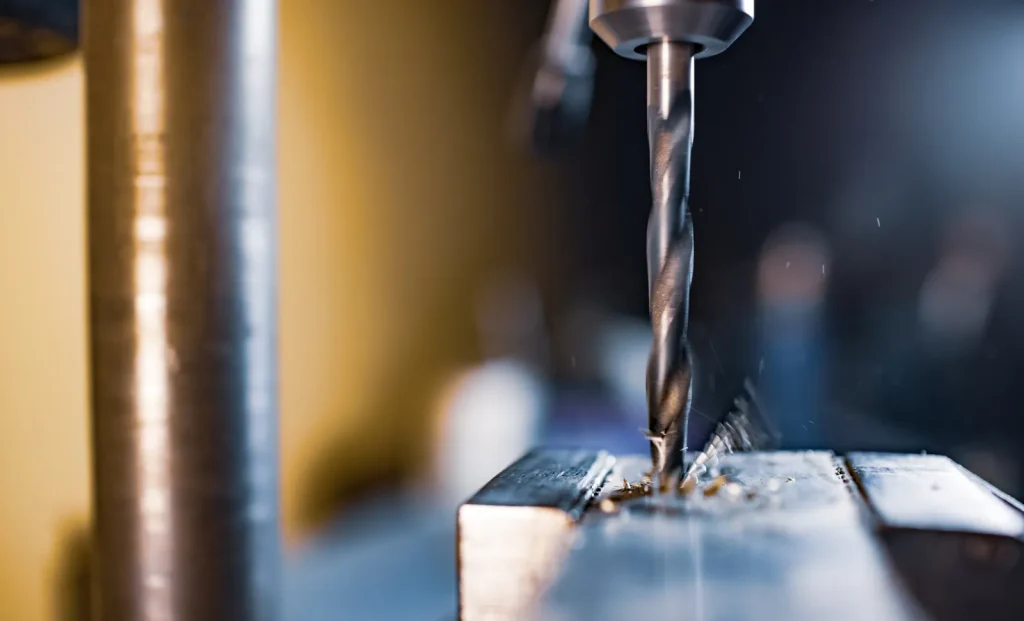
によると the NIST Manufacturing Extension Partnership (MEP), CNC machining processes are classified as subtractive manufacturing methods in which material is removed from solid stock through programmed toolpaths, cutting operations, and controlled machining parameters. The main operations include milling, turning, drilling, boring, and threading.
CNC machining is often used when the part needs complex 3D geometry, pockets, variable thickness, tight tolerance features, or details that are difficult to form in sheet metal.
The cost structure is different from stamping. CNC machining usually has much lower dedicated tooling cost. It still needs programming, setup, fixtures, tools, and inspection, but it does not require a dedicated stamping die for each design. This makes CNC machining useful for prototypes and low-volume production.
Why process choice affects cost, tolerance, lead time, and design flexibility
The wrong process can make a feasible part too expensive, too slow, or too risky.
If a buyer chooses CNC machining for a simple sheet metal bracket that later reaches high volume, the per-part cost may remain higher than needed. If the buyer chooses stamping too early, the die cost may be wasted if the design changes.
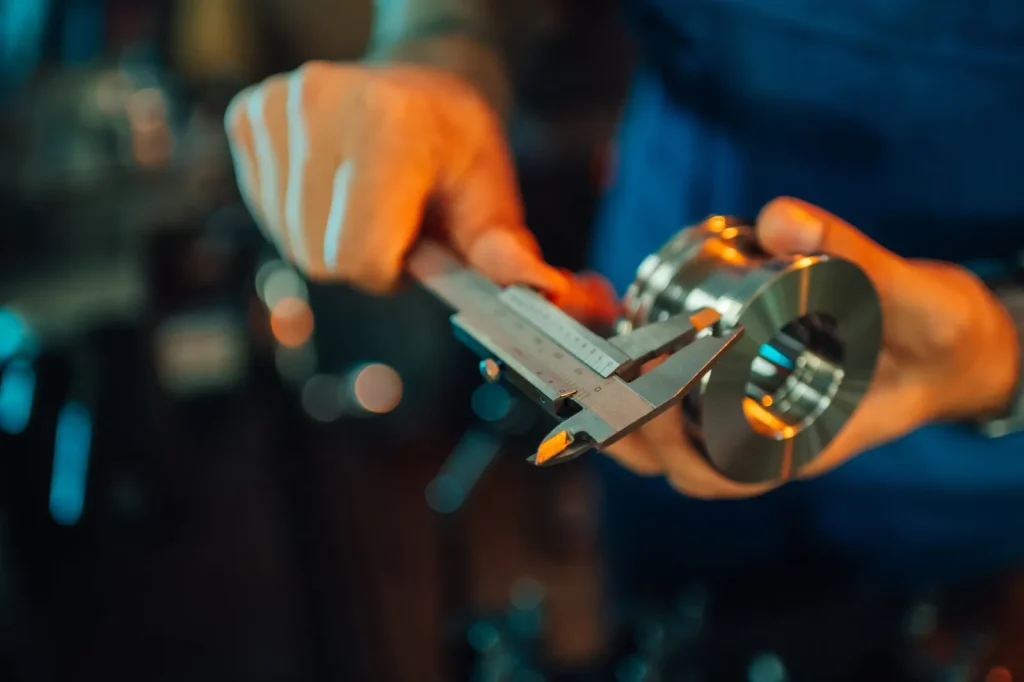
Tolerance suitability should be judged by feature type, not by the part as a whole. Separate outside profile, hole-to-hole position, formed angle, flatness, bore size, thread quality, and sealing faces when comparing stamping with machining. Stamping may suit sheet features and formed geometry, while machining is usually chosen for precision bores, threads, tight positional control, and critical mating surfaces. Capability must be confirmed with the supplier for the specific material, tool design, datum scheme, and inspection method.
Table: metal stamping vs CNC machining at a glance
| ファクター | 金属プレス | CNC加工 |
|---|---|---|
| プロセスタイプ | Cold forming and cutting of sheet metal | Subtractive cutting from solid stock |
| ベスト・ボリューム・フィット | High volume after tooling is paid for | Prototype, low volume, medium volume |
| 初期費用 | High due to die tooling | Lower dedicated tooling cost |
| Per-part cost at scale | Low when volume is high | Higher because machine time remains significant |
| Geometry fit | Flat, thin, simple, repeatable sheet parts | Complex 3D parts, pockets, shafts, precision features |
| Thickness fit | Sheet and plate parts | Thick stock, bars, blocks, varied thickness |
| 設計変更 | Costly after die build | Easier through CAD/CAM updates |
| Precision fit | Repeatable, but less suited to extreme tolerances | Better for tight-tolerance features |
| リードタイムの行動 | Longer before first part due to die design/build/debug | Faster first articles in many cases |
| Typical parts | Brackets, clips, covers, housings | Gears, shafts, aerospace parts, medical components |
Feasibility: Can Your Part Be Made by Stamping or CNC?
How part complexity affects stamping vs machining choice
Part complexity is one of the first filters. In stamping, “complex” does not only mean the part looks complicated. Progressive dies can perform many steps in one tool, including blanking, punching, bending, and forming. The limiting issue is whether the features can be created from sheet metal with forming and cutting operations.
Stamping tends to fit parts with:
- Uniform thickness
- Flat or shallow formed geometry
- Holes, slots, tabs, bends, and simple forms
- Repeatable features that can be built into a die
- Stable design requirements
CNC machining fits parts with:
- Pockets and cavities
- Variable wall thickness
- Complex 3D contours
- Threads, bores, and precision holes
- Features on multiple faces
- Critical surfaces that need controlled toolpaths
This is how part complexity affects stamping vs machining choice: stamping handles repeated sheet-metal geometry well, while CNC machining handles geometric freedom better.
Material thickness limits in metal stamping compared with machining
Material choice should be reviewed by family and condition, not by thickness alone. Low-carbon steel, stainless steel, aluminum, and copper alloys differ in formability, springback, work hardening, surface marking risk, and tonnage demand, while hardened or very high-strength alloys may push the part toward machining or another process. Grain direction and temper can also affect bend consistency and dimensional repeatability.
Material thickness limits in metal stamping compared with machining are not fixed by one universal number. They depend on material strength, part size, die design, press capacity, bend radius, and forming depth. A thin aluminum cover may be practical to stamp. A thick part with deep pockets, bosses, and threaded holes is usually more practical to machine.
If the finished part cannot be described mainly as a formed sheet metal part, CNC machining should stay in the evaluation.
Design features that are difficult to produce with stamping
Some features increase stamping risk or push the design toward CNC machining.
Design features that are difficult to produce with stamping include:
- Deep pockets or cavities
- アンダーカット
- Variable thickness regions
- Precision bores
- スレッド
- Thick bosses
- シャープな内部コーナー
- Multi-face machined surfaces
- Very tight positional tolerances on critical features
Stamping may still create the base form, but these features often require secondary machining or a process change.
A hybrid process is practical only if the stamped part can be located repeatably for machining and the datum strategy is defined in advance. Form variation, residual stress, burr condition, and available stock for clean-up machining all affect whether secondary machining will hold the required features. If locating and feature control depend on unstable formed surfaces, hybrid processing may add cost without reducing risk.
When CNC machining is better than metal stamping
CNC machining is better than metal stamping when the design is still changing, the order quantity is low, the tolerance requirements are tight, or the part cannot be made efficiently from sheet metal.
It is also better when the cost of a stamping die cannot be recovered through volume. If only a few hundred parts are needed, tooling may dominate the total cost. CNC machining avoids that sunk tooling risk and allows design changes with much less penalty.
How Each Process Works and What It Means for Design
Progressive die stamping, compound dies, blanking, punching, bending, and forming
Stamping can use different die types. A simple die may perform one operation. A compound die can perform more than one operation in a single press stroke. A progressive die moves strip metal through a sequence of stations, with each station adding a feature.
Typical stamping operations include:
- Blanking: cutting the outside profile
- Punching: creating holes or slots
- Bending: forming flanges or angles
- Forming: shaping the sheet into a 3D profile
- Piercing: cutting small openings
- Coining or local forming: creating local impressions or features
For design, this means features should be arranged so they can be made in a die sequence. The part should also account for springback, burr direction, bend behavior, and strip layout.
CNC milling, turning, drilling, toolpaths, workholding, and setup
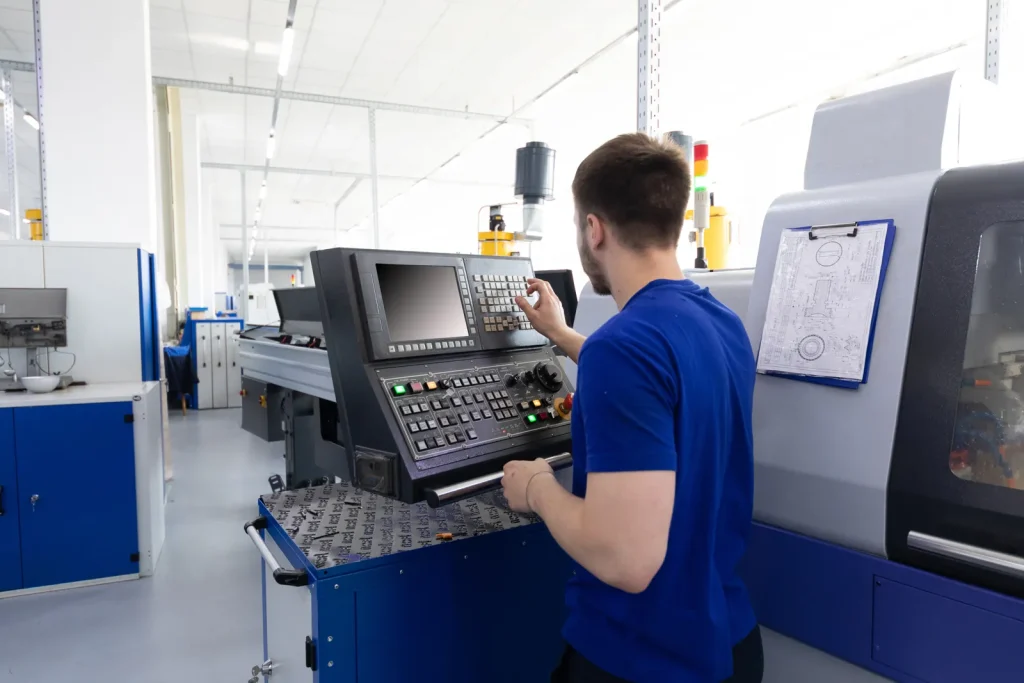
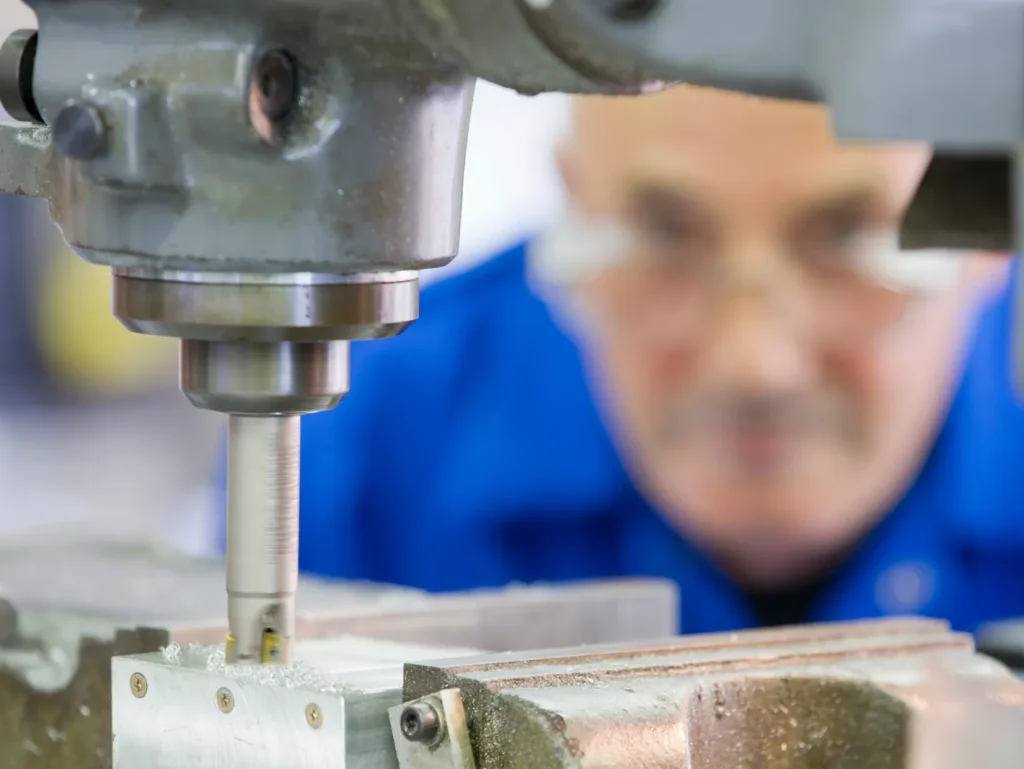
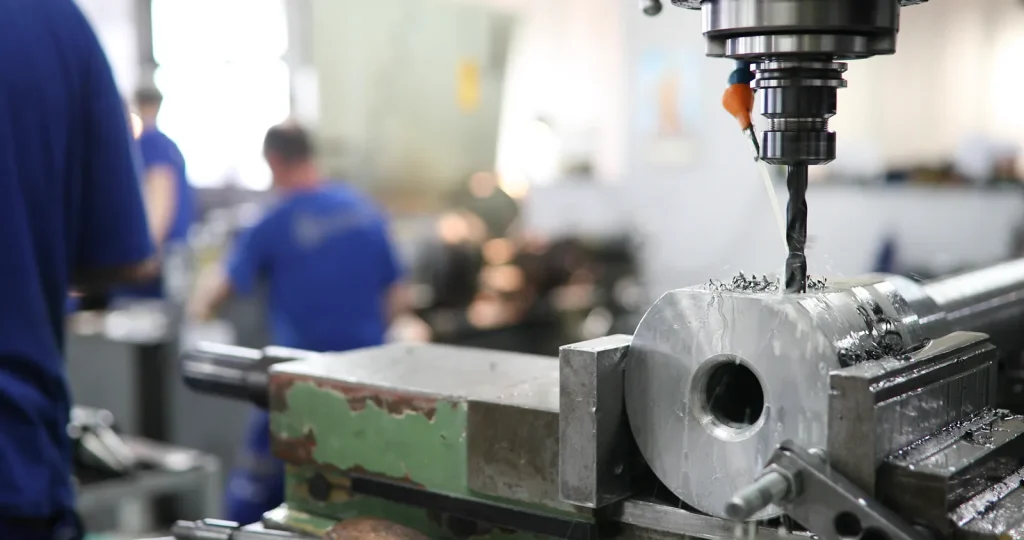
CNC machining starts with CAD/CAM programming and process planning. The supplier defines toolpaths, chooses cutting tools, plans workholding, and decides how many setups are needed.
A setup is each time the part must be located and clamped in a machine. More setups often mean more cost and more tolerance stack-up risk. A part with features on several faces may need multiple setups unless it is run on more advanced equipment.
For design, CNC-friendly parts avoid unnecessary deep narrow pockets, hard-to-reach surfaces, and extremely tight tolerances where they are not needed. Standard tool access and good workholding surfaces help reduce cost.
Burr and edge quality issues in stamped versus machined components
Burr and edge quality issues in stamped versus machined components differ by process.
Stamped edges are sheared. The edge may show rollover, burnish, fracture, and burr zones. Burr direction and edge condition affect assembly fit, insertion force, coating adhesion, sealing, handling safety, and fatigue risk. They also influence whether secondary deburring, edge break, or inspection steps are required. Buyers should confirm allowable burr condition, edge orientation, and deburring method on critical features before quoting.
Machined edges can also have burrs, especially at exits of holes, intersecting features, and sharp edges. Machined surfaces may show tool marks. If the part requires a specific appearance or sealing surface, finishing operations may be needed.
Surface finish tradeoffs between stamped and machined parts should be reviewed early. Stamping can preserve the sheet surface over large areas, but cut edges may need attention. CNC machining can create controlled surfaces, but tool marks and deburring still matter.
Process diagram: forming sheet metal vs cutting material from stock
- 金属プレス
Sheet coil or blank
↓
Die and press apply force
↓
Blanking / punching / bending / forming
↓
Stamped sheet metal part
- CNC加工
Bar / plate / billet
↓
Workholding and CNC toolpaths
↓
Milling / turning / drilling
↓
Machined solid-stock part
The process difference drives the design difference. Stamping forms a sheet into shape. CNC machining cuts away material until the required geometry remains.
Advantages and Limitations of Each Process
When stamped parts are cheaper than machined parts
Stamped parts become economical only when total program cost is compared on a like-for-like basis. Compare die cost, unit cost, scrap, deburring, inspection, plating, maintenance, fixtures, and expected engineering changes rather than unit price alone.
A simple break-even check is: break-even volume = stamping tooling cost ÷ (machined unit cost – stamped unit cost). The crossover still depends on geometry, strip utilization, secondary operations, and forecast confidence.
Limitations of metal stamping for low volume production
The main limitation of metal stamping for low volume production is tooling amortization. If the die costs thousands of dollars and only a few hundred parts are needed, the tooling cost per part can be too high.
Low volume also increases design risk. Early designs often change after test builds. With CNC machining, a CAD change can often be handled through updated programming. With stamping, a change may require die rework or a new tool.
Why tooling cost makes stamping unsuitable for prototypes
Tooling cost makes stamping unsuitable for prototypes because prototypes are used to learn. The design may need hole changes, bend changes, thickness changes, or tolerance changes after testing.
A stamping die requires design freeze. Building tooling before the design is stable can lock in mistakes. For this reason, many teams prototype with CNC machining, validate demand and function, then move to stamping when the design and volume are stable.
Surface finish tradeoffs between stamped and machined parts
Stamped parts often retain the original sheet surface on broad faces. The cut edges and formed regions are the main areas to review. Forming can change appearance, and burrs can affect fit or safety.
Machined parts can achieve controlled surfaces on specific features, but cutting leaves tool marks. Surface finish may depend on tool choice, feeds, speeds, and secondary finishing. If the part has sealing faces, sliding interfaces, or cosmetic requirements, the finish requirement should be tied to the correct process step.
Common Failure Scenarios and Decision Risks
Risks of choosing stamping for design changes
The largest risk of choosing stamping too early is design change cost. A small CAD change may be simple in CNC machining but expensive in stamping if it affects the die.
Changes that affect hole position, bend geometry, outside profile, form depth, or material thickness may require tool modification. If the change is large, a new die may be needed. This is why design stability is one of the most important stamping checks.
When metal stamping cannot meet required precision
Metal stamping cannot meet required precision when the tolerance demand is beyond what the tool, material, and press process can hold reliably. Public guidance often does not give universal stamping tolerance ranges because they are highly tool-specific.
For very tight tolerance requirements, CNC machining is usually the safer process choice because it provides more direct control over dimensional accuracy and verification.
For extremely tight tolerances, such as ±0.0005 in. on critical features, machining is generally preferred, as stamping capability is highly dependent on tool design, material behavior, and process stability.
This does not mean stamping is inaccurate. It means stamping is not always the best process for extreme precision, especially on localized critical features where tolerance control is more difficult.
What happens when volume forecasts are wrong?
Volume forecast errors can change the best process.
If actual demand is much lower than expected, stamping tooling may not pay back. The buyer may carry a high upfront cost without enough production volume to reduce unit cost.
If demand is much higher than expected, CNC machining may become expensive because machine time stays in every part. In that case, a part that started as a CNC component may need redesign for stamping or a hybrid process.
Annual volume also matters less than lifetime volume in some programs. A part made at 500 units per year for many years may justify different tooling decisions than a one-time 500-piece run.
Checklist: design stability, tolerance risk, tooling risk, and supplier review
Before choosing stamping or CNC machining, review:
- Is the design frozen or still changing?
- Is the part mainly sheet metal or solid-stock geometry?
- Are the critical tolerances compatible with stamping, or do they need machining?
- Is the volume high enough to recover die cost?
- Are there features that may need secondary machining?
- Are burr direction and edge quality important?
- Is the material thickness suitable for stamping?
- Is the lead time for die design and debugging acceptable?
- Has the supplier reviewed manufacturability before quoting production?
This checklist reduces the risk of choosing the cheaper-looking process and finding later that it cannot meet the part requirements.
コスト、公差、リードタイムの要因
Metal stamping vs CNC machining cost for high volume parts
Metal stamping vs CNC machining cost for high volume parts usually favors stamping when the part is stampable. Once the die is built, the press can produce parts quickly, and the die cost is spread over many pieces.
CNC machining remains tied to machine time, tool wear, setups, and handling. Even if programming cost is spread over more parts, each part still needs cutting time.
For high-volume flat sheet parts, this difference is often decisive.
Stamping tooling cost vs CNC setup cost
Stamping tooling cost vs CNC setup cost is a key comparison. Stamping needs a dedicated die. CNC machining needs programming, tools, workholding, and setup, but usually avoids dedicated hard tooling.
This is why stamping has a high entry cost and low unit cost at scale. CNC machining has a lower entry cost and higher unit cost when volume rises.
Production volume threshold for switching from machining to stamping
The production volume threshold for switching from machining to stamping is not universal. Research examples place the crossover in a broad range.
One comparison suggests CNC can remain cost-effective up to about 500 units, with 500–2,000 units as a gray zone, and stamping often winning above about 2,000 units. Another low-volume comparison suggests stamping may become cost-effective around 500–1,000 pieces, depending on part geometry and tool cost.
The practical range is therefore about 500–2,000+ parts for many simple parts, but the real break-even must be calculated using actual die cost, part cost, expected changes, and lifetime volume.
Tolerance differences between stamped and machined parts
Tolerance differences between stamped and machined parts come from how the processes control geometry.
Engineering drawings often use ASME Y14.5 GD&T rules to define how dimensional and geometric requirements are specified, measured, and verified in precision manufacturing. These rules are then applied across processes such as CNC machining and stamping to ensure consistent interpretation of tolerances.
Stamping controls dimensions through die geometry, material behavior, press performance, and forming consistency. It can be repeatable at high volume, but the process is less flexible when tolerances need adjustment after tooling is built.
Cost Drivers and Break-Even Evaluation
Cost drivers in progressive die stamping compared with CNC machining
Cost drivers in progressive die stamping compared with CNC machining include different types of expense.
For stamping, main cost drivers include:
- Die design and build
- Number of stations in the die
- パート・コンプレックス
- Material thickness and strength
- Press requirements
- Strip layout and scrap
- Die maintenance
- Secondary deburring, finishing, or machining
For CNC machining, main cost drivers include:
- Programming time
- Machine time per part
- セットアップ数
- Cutting tools and tool wear
- Material removal volume
- Workholding complexity
- 検査の必要性
- Deburring and finishing
A simple stamped bracket may be cheap at scale. A stamped part that needs complex forming and secondary machining may have a very different cost profile.
How annual volume impacts stamping vs machining cost
Annual volume impacts stamping vs machining cost because tooling is amortized over the expected number of parts.
If annual volume is high and the design is stable, stamping can reduce part cost quickly. If annual volume is low but the part will be produced for many years, lifetime volume should be included in the calculation.
If demand is uncertain, CNC machining may reduce risk during early production. It allows the buyer to confirm demand before committing to tooling.
Is 500, 1,000, or 2,000 parts enough to justify stamping?
A 500-piece order may justify stamping only if the part is simple, the tooling is low cost, the design is stable, and future orders are likely. A 1,000-piece order often falls into the gray zone. A 2,000-piece order may begin to justify stamping for many simple sheet metal parts, but it still depends on tool cost and part geometry.
The key point is that the order quantity alone is not enough. The evaluation should include:
- 金型費用
- CNC part price
- Stamped part price
- Expected design changes
- Lifetime demand
- Inventory risk
- Secondary operation cost
Table: example cost comparison by prototype, low-volume, and high-volume scenarios
The numbers below are illustrative examples drawn from published industry comparisons. They are not price lists.
| シナリオ | Stamping cost behavior | CNC machining cost behavior | 想定されるプロセス |
|---|---|---|---|
| Prototype, 1–50 parts | Die cost usually hard to justify | Low setup burden, easy design change | CNC加工 |
| Low volume, 50–500 parts | Tooling may dominate total cost | Example small-batch costs around US$8–$25 per part | CNC加工 |
| Gray zone, 500–2,000 parts | May be justified for simple stable parts | Can remain practical if geometry is complex | Case-by-case |
| Higher volume, 2,000+ parts | Tooling can be amortized; low unit cost possible | Machine time keeps unit cost higher | Stamping if geometry fits |
| Precision part requiring ±0.0005 in. | Often high risk for stamping | Machining is usually preferred | CNC加工 |
| Sheet base with a few precision features | Stamp base shape, machine critical areas | Used only where needed | Hybrid |
Applications and Use Cases by Part Type
Brackets, clips, covers, housings, and other stamped sheet metal parts
Stamping is widely used for brackets, clips, covers, housings, shields, panels, and similar sheet metal components. These parts often have flat profiles, holes, tabs, flanges, and bends.
For these parts, stamping becomes attractive when the geometry is stable and production volume is high enough. A bracket that costs too much to machine at scale may be a strong stamping candidate if its critical features can be held by the die or handled with secondary operations.
Aerospace, medical, gears, shafts, and precision CNC machined components
CNC machining is common for aerospace parts, medical components, gears, shafts, fixtures, and precision industrial components. These parts often need tight tolerances, controlled surfaces, complex geometry, or strong materials.
A shaft, gear, or precision housing is usually not a stamping candidate if it needs roundness, bores, pockets, threaded features, or high-accuracy interfaces. CNC machining gives more control over these features.
Flat sheet metal parts vs complex 3D components
Flat sheet metal parts often favor stamping when volume is high. Complex 3D components often favor CNC machining, especially when the geometry cannot be unfolded into a practical sheet metal form.
Some parts sit between these categories. A shallow housing may be stamped. A housing with precision bores, thick pads, or machined sealing surfaces may need CNC machining or a hybrid process.
Hybrid use case: stamping the base shape and CNC machining critical features
A hybrid process can reduce cost without giving up precision where it matters. The base shape may be stamped, then critical holes, slots, sealing faces, or datum features may be CNC machined.
This approach can work when most of the part is simple sheet metal, but some local features exceed stamping capability. It adds process steps, so it should be justified by volume, tolerance need, and total cost.
決定ガイド正しいプロセスの選び方
Decision matrix: volume, geometry, tolerance, material, lead time, and design stability
| 決定要因 | Choose stamping when… | Choose CNC machining when… |
|---|---|---|
| ボリューム | Demand is high enough to amortize tooling | Demand is low, uncertain, or changing |
| 幾何学 | Part is thin, flat, or formed sheet metal | Part has pockets, bores, variable thickness, or 3D surfaces |
| 寛容 | Requirements are moderate and repeatable through tooling | Tight precision features are required |
| 素材 | Sheet metal form is suitable | Thick stock, bar, billet, hard alloys, or specialty materials are needed |
| リードタイム | Die build and debug time is acceptable | Fast first articles or short-run delivery are important |
| 設計の安定性 | Design is frozen | CAD changes are still likely |
| Cost goal | Lowest unit cost at scale matters most | Lowest upfront cost and flexibility matter most |
This matrix is useful during early sourcing. It does not replace manufacturability review, but it helps filter weak process choices before quoting.
Should you prototype with CNC and move to stamping later?
For many new products, the practical path is CNC first, stamping later. CNC machining supports prototypes, test builds, and design iteration. Once the design is stable and volume supports tooling, the part can be redesigned or optimized for stamping.
This strategy works best when the early CNC design keeps future stamping in mind. Uniform thickness, simple bends, realistic hole locations, and limited non-stampable features can reduce redesign later.
What buyers should confirm before requesting quotes
Before requesting quotes, buyers should confirm the datum scheme, critical features, secondary operations, deburring method, flatness control plan, and whether key dimensions are made in-die or in a secondary process. Ask what first article inspection, capability evidence, sample review, and tool maintenance responsibility will apply. Also confirm whether the real alternative should be machining, stamping, or a fabrication route such as cut-and-bend sheet processing.
A quote based only on a drawing and quantity may miss process risk. The most important details are often the tolerance notes, material condition, and production forecast.
Choose stamping, CNC machining, or a hybrid process
| ステップ | 決定 | はい」の場合 | いいえ |
|---|---|---|---|
| 1 | Is the part mainly thin sheet metal with uniform thickness? | Go to Step 2 | CNC machining is likely better. |
| 2 | Is the design stable? | Go to Step 3 | CNC machining for prototype or early production. |
| 3 | Is volume likely above the 500–2,000+ part gray zone? | Go to Step 4 | CNC machining may be lower risk. |
| 4 | Are tolerances extremely tight, such as near ±0.0005 in.? | CNC machining or hybrid process. | Go to Step 5 |
| 5 | Are there local features stamping cannot make well? | Stamp base shape + CNC critical features. | Metal stamping is likely suitable. |
The best choice is rarely based on one factor. It is the result of volume, geometry, tolerance, material, lead time, and design stability working together.
For simple, stable, high-volume sheet metal parts, stamping is often the better long-term process. For prototypes, tight-tolerance parts, complex 3D components, and uncertain demand, CNC machining is usually safer. For parts that need both low-cost sheet forming and precision features, a hybrid process may give the best balance.
よくあるご質問
What is the difference between CNC and stamping?
CNC machining removes material from bar, plate, or billet to create the final shape, while metal stamping cuts and forms sheet metal with a die and press. In this article, CNC means subtractive machining from stock, not CNC cutting or punching of sheet. Stamping is usually better for stable, high-volume sheet parts, while CNC is better for complex geometry, thicker stock, and tighter feature control.
Is metal stamping profitable?
Metal stamping is economical only when the part fits sheet-metal forming and total demand is high enough to absorb die cost. The comparison should include tooling, scrap, secondary operations, inspection, and change risk rather than unit price alone. A low unit cost does not guarantee the lowest total program cost.
What are the disadvantages of stamping?
Stamping has high upfront tooling cost and is less flexible after the die is built. It is also less suitable for variable-thickness geometry, deep 3D features, precision bores, threaded features, tight burr control, and programs with likely design changes. Some parts are better served by machining, fabrication, or a hybrid route.
When is CNC machining better than metal stamping?
CNC machining is usually the safer choice when the part needs complex 3D geometry, thicker stock, feature-specific tight tolerances, or frequent design revisions. It is also preferred when precision bores, threads, sealing faces, or critical positional features would require secondary machining anyway. In mixed cases, a hybrid route may still be worth reviewing.
When should a company switch from CNC machining to stamping?
A switch usually makes sense when the design is stable, the part is mainly a uniform-thickness sheet-metal geometry, and expected lifetime volume can justify die cost. The decision depends on tooling cost, machining cycle time, strip yield, secondary operations, and whether critical features can be held in the die or need post-machining. Forecast uncertainty should be reviewed before committing to tooling.
参考文献
https://www.asme.org/codes-standards/find-codes-standards/y14-5-dimensioning-tolerancing

 Japanese
  English
  German
  French
  Italian
  Spanish
  Polish
  Czech
Czech