
In custom machining, speed, precision, and flexibility decide who wins. Buyers and engineers face rising part complexity, tighter tolerances, and volatile material prices—while lead times keep shrinking. This guide distills the latest research and shop-floor realities to help you choose the right partners, optimize design for manufacturability (DFM), and leverage automation. You’ll get market data, process deep dives, cost levers, material selection tips, sourcing frameworks, and real-world case studies. We start with the trends shaping 2025, then move into practical how-to guidance, tools, and checklists, and close with FAQs and next steps to accelerate your next RFQ.
If you’re planning prototypes and production parts, or you manage a fleet of suppliers, this is written to help you cut risk, reduce CNC machining costs, and ship high-quality parts on time.
2025 Market Snapshot and Trends Shaping Demand
The custom machining industry continues to evolve rapidly, driven by growing demand for precision, speed, and flexible manufacturing solutions. In 2025, businesses are increasingly turning to custom CNC machining services to produce high-quality parts for aerospace, medical, automotive, and electronics applications. This section provides a snapshot of key market trends, growth projections, and demand drivers, helping engineers and procurement teams understand where custom machining services are heading and how to align sourcing strategies with emerging industry needs.
Key market data and growth at a glance
Industry analysts report steady growth powered by precision machining, multi-axis CNC, and digital workflows. Here’s a simple snapshot you can use in a slide deck or internal brief.
- Global custom machining services projected to reach $142.2B by 2033 at 5.2% CAGR.
- According to the Bureau of Labor Statistics(BLS), the US machine shop industry is projected at $44.6–$48.0B in 2025 with over 230,000 machinists employed.
- North American machining market at $142B in 2024, projecting 3.4% CAGR to 2031.
- Global machine tools market growing from $81.09B (2025) to $105.11B (2032).
Selected 2025 market figures
| Metric | Value / Projection |
|---|---|
| Global custom machining services | $142.2B by 2033, 5.2% CAGR |
| US machine shop industry | $44.6–$48.0B |
| US employment | 230,218 machinists and related roles |
| Active US machine shops | 17,626 |
| Global machine tools market | $81.09B (2025) → $105.11B (2032) |
These numbers line up with what many purchasing teams see: higher spend on CNC machining service, more multi-axis CNC adoption, and a push to standardize quality systems to win regulated work.
Demand drivers by industry
- Aerospace pushes lightweight alloys and complex geometries that benefit from 5-axis CNC machining and Swiss turning. AS9100 and ITAR compliance add traceability and strong FAIR practices.
- Medical devices need biocompatible materials, burr-free finishing, and strong traceability. ISO 13485 documentation and validation are core expectations.
- Automotive and EV platforms rely on fast rapid prototyping, short-run fixtures, prototype machining, and production-intent builds. Clean GD&T and PPAP support smoother launch.
- Electronics focuses on miniaturization, tight GD&T, and heat management in housings and heatsinks—often aluminum or copper alloys with precise surface finish targets.
Constraints and risk factors to manage
- Skilled labor shortages are real. Shops are upskilling on multi-axis, CAM programming, and modern metrology (CMM, vision systems, laser scanning).
- Tariffs and material price swings impact raw material costs (steel, aluminum, titanium). Stock strategy and alternate grades matter more this year.
- Energy efficiency and sustainability pressures favor smarter toolpaths, efficient spindles, coolant recycling, and strong scrap recovery workflows.
What does this mean for you? If you care about speed and quality, optimize drawings for manufacturability, pick materials with stable supply, and choose partners with digital twin and real-time monitoring capability.
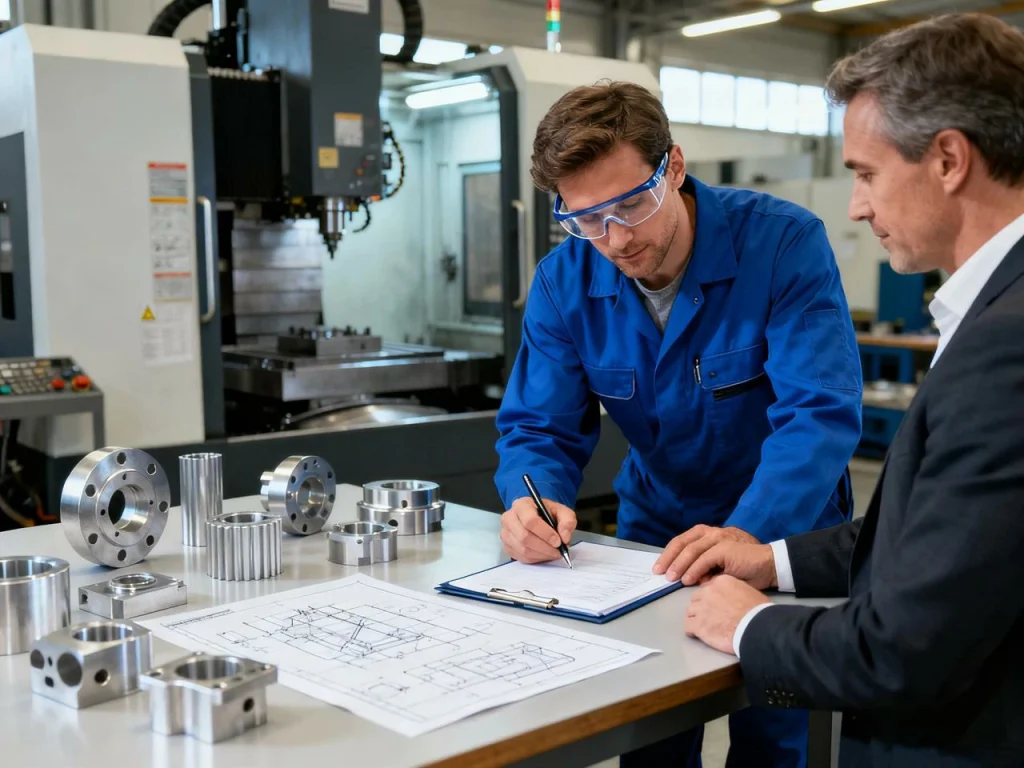
Deep Dive into Custom CNC Machining Processes
Understanding the nuances of custom CNC machining is essential for producing high-precision parts efficiently. Depending on part design, machining may involve multiple setups, various toolpaths, and hybrid workflows that combine additive and subtractive techniques. This section explores these processes in detail, helping you select the right approach for prototypes, small-batch runs, or full production parts.
CNC milling vs. turning vs. multi-axis (5-axis/Swiss)
Choosing the right process is the single biggest lever on cycle time, price, and precision.
CNC milling is a subtractive process that turns metal blocks into final parts using a rotating cutting tool. Use standard 3-axis cnc milling machine services for prismatic parts with features accessible from a few sides. Typical general tolerance is around ±0.005 in (±0.13 mm), and better on key dimensions with proper fixturing. If your design requires compound angles, undercuts, or fewer setups, a 5-axis machining center can reduce errors and speed delivery.
CNC turning is best for machine parts with cylindrical features—shafts, bushings, rings, and threaded parts. A cnc lathe cuts features concentrically and can hold tight runout and circularity with less time. CNC turning with live tooling bridges the gap with milled features in the same setup. You can reach ±0.001–0.003 in (±0.025–0.076 mm) on many features when material and fixturing cooperate.
Swiss turning shines for very small parts, long slender features, and medical or aerospace pins and screws. The sliding headstock supports the work near the tool, reducing deflection. Expect precise diameters and surface finishes with minimal burrs; it’s common in high-precision work at scale.
When do you switch to 5-axis? When multiple setups on a 3-axis will stack error, when surface blends matter, or when you need to cut complex pockets or freeform surfaces in one go. Fewer setups cut risk and often reduce inspection time too.
For high-quality custom machining, U-Need provides CNC milling, turning, and prototyping services for small to medium production runs. Their expertise in multi-axis machining ensures tight tolerances, smooth finishes, and consistent results for complex parts, making them an ideal partner for both prototyping and production-level custom CNC components.
Hybrid manufacturing and additive + subtractive workflows
Some parts are easier—and cheaper—when you mix metal 3D printing and post-machining. If your part has internal channels or lattice features for weight reduction and heat transfer, you can build the near-net shape additively, then finish critical surfaces on a mill or lathe. Hybrid makes sense for titanium brackets with internal passages, conformal cooling inserts for tooling, or copper heat spreaders with complex fins.
Pros: part consolidation, lighter weight, and shorter lead time on complex internals. Cons: powder and post-processing costs, extra planning, and repeatability challenges. For many teams, a hybrid strategy works during rapid prototyping and bridge builds, then production shifts to optimized multi-axis CNC once the design stabilizes.
The digital thread: CAD/CAM, simulation, and in-process QA
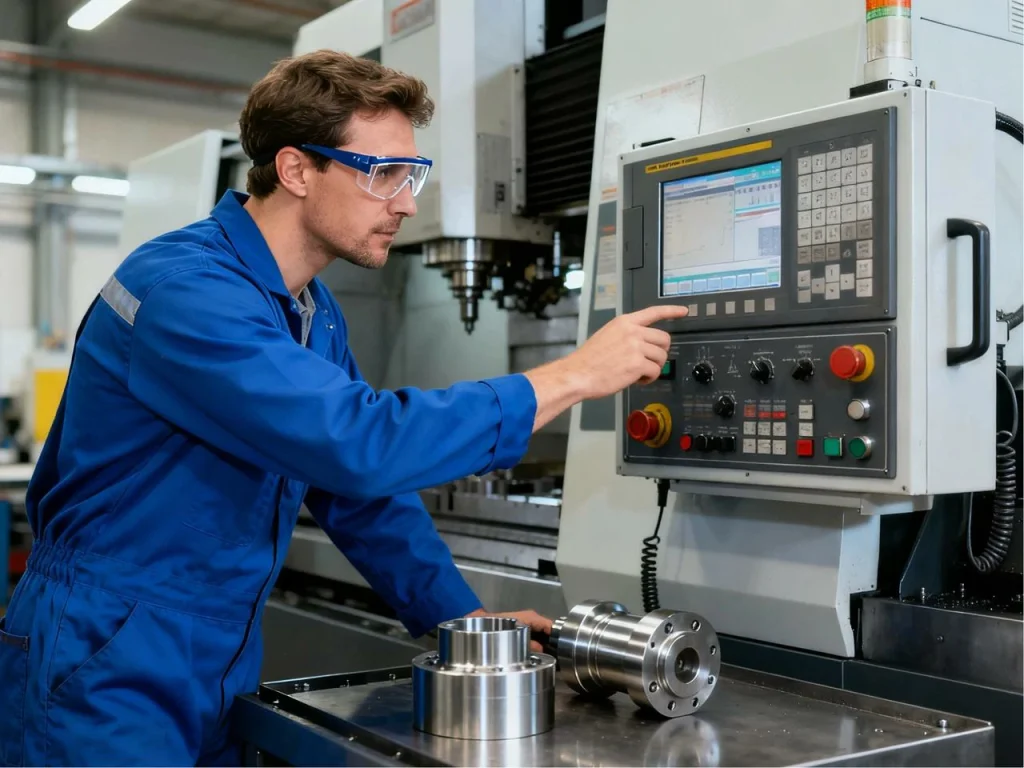
A strong digital thread links your CAD, CAM programming, simulation, setup, and in-process QA. Toolpath simulation checks collisions, verifies material removal, and estimates cycle time. During cutting, probing and in-machine verification can correct for thermal growth or tool wear. After cutting, CMM and vision systems validate GD&T and create clean reports for your quality files. Shops with closed-loop control and SPC dashboards cut scrap and spot drift early. That’s how they run faster without losing precision.
What tolerances can CNC machining achieve?
Typical ranges depend on process, material, feature size, and fixturing:
- CNC milling (3-axis): ±0.005 in (±0.13 mm) general; ±0.001–0.002 in (±0.025–0.05 mm) on key features with proper setup.
- 5-axis milling: similar or better on complex surfaces due to fewer setups; surface finish also improves.
- CNC turning/Swiss: ±0.001–0.003 in (±0.025–0.076 mm) diameters common; tighter possible on short features with stable materials.
- EDM and grinding: tighter tolerances and superior finishes when needed, at higher cost and longer cycle times.
Materials matter. Aluminum is forgiving; stainless steel and titanium push heat and tool wear; plastics can deflect. Feature size also drives tolerance. Tiny holes and deep pockets are harder to hold without rough machining plus finishing.
CNC Machining Materials and Surface Finishes Selection Guide
Picking the right cnc machining materials saves money and time. Match the environment and load to the right alloy or polymer, then plan the surface finish and quality checks.
Metals: aluminum, stainless steel, titanium, copper alloys
Aluminum is the go-to for prototypes and production parts that need good strength-to-weight, easy machining, and quick turnaround. 6061-T6 is versatile and budget-friendly. 7075 offers higher strength and is common in aerospace brackets and electronics housings.
Stainless steel (e.g., 304/316 and 17-4 PH) wins on corrosion resistance and strength in harsh environments. 17-4 PH is popular where strength and heat treatment control are key. Expect more tool wear and longer cycles than aluminum.
Titanium (Ti-6Al-4V) pushes the envelope on strength-to-weight and biocompatibility but runs hot, wears tools, and benefits from high-pressure coolant and smart toolpaths. It’s common in aerospace and medical.
Copper alloys (brass, bronze) offer great thermal and electrical properties. CNC machining bronze bushings or brass fittings is common in fluid handling and electronics. Copper can smear; sharp tools and tuned feeds help.
Plastics and composites
ABS is a general-purpose choice for housings and test fixtures. Delrin (acetal) machines well and is dimensionally stable. PEEK and Ultem are high-temperature, biocompatible options for medical and aerospace, with higher cost and stricter fixturing needs. Acrylic cnc machining is used for clear covers and optical parts; careful tools and finishing are needed to avoid haze or stress cracks.
Composites need special care: tool wear is high, delamination risk is real, and dust control is a must. Fixturing is critical to avoid crushing fibers. For holes, use step drills and backing material to reduce exit damage.
Surface finishes, tolerances, and metrology
Common finishes include anodizing (Type II for color, Type III hardcoat), passivation for stainless, bead blasting for matte texture, and electropolish for ultra-smooth stainless. Ra targets vary: consumer housings might aim for 1.6–3.2 μm; aerospace seating tracks may allow higher; medical implants often need finer finishes where tissues meet.
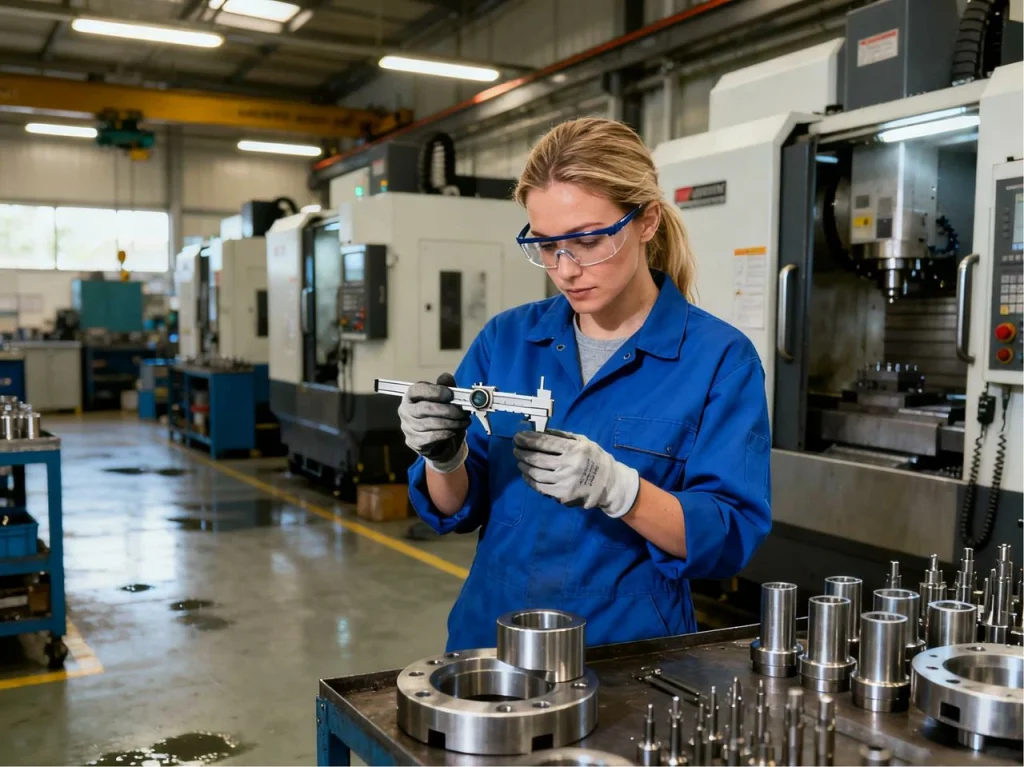
Measurement tools matter: CMM, vision systems, and laser scanning confirm tight tolerances and create digital records. If your spec calls for a 0.8 μm Ra, plan the toolpaths, cutters, and post-processing early.
Which material is best for my machined part?
Start with these factors: environment (corrosion, temperature), mechanical load, surface finish needs, regulatory demands (food contact, medical), and cost/lead time. For a lightweight bracket, 6061-T6 is often enough; if stress is high, move to 7075. For corrosive environments, 316 stainless or 17-4 PH may be better. For MRI-safe medical tools, PEEK or titanium often beat aluminum.
Material comparison (indicative, simplified)
- Aluminum 6061-T6: Easy to machine, low cost, good strength-to-weight, fast lead time.
- Aluminum 7075: Higher strength, slightly harder to machine, anodizes well.
- Stainless 304/316: Great corrosion resistance, tougher to cut, food/medical environments.
- Stainless 17-4 PH: High strength, heat treatable, aerospace/industrial use.
- Ti-6Al-4V: Strong, light, biocompatible, slower cutting, premium cost.
- Brass/Bronze: Good machinability, electrical/thermal use, smooth finishes.
- ABS/Delrin: Easy plastics, stable for fixtures and covers.
- PEEK/Ultem: High heat, biocompatible, precision parts for medical/aero.
Cost and DFM: How to Cut Price Without Sacrificing Quality
Cutting costs without compromising part quality is a key challenge in custom machining. This section explores the key levers in the machining process that directly impact price, lead time, and repeatability, helping you get more value from both CNC milling machine services and other manufacturing operations.
Pricing levers and quote drivers
Most cnc quotes break down to machine time, setups, material, tooling, and inspection. Here are the biggest drivers:
- Geometry complexity and tolerance stack-ups
- Quantity/lot size and changeover time
- Tool changes and number of setups
- Material choice, stock size, and waste
- Fixturing and programming time
- Inspection level, reports, and certifications
Small changes in drawing notes can trim hours from setup or inspection. Focus on the 20% of dimensions that matter functionally and relax the rest.
DFM checklist for machinists and design engineers
Use these steps during design and RFQ. They save time and money without hurting quality.
- Use standard hole sizes and tap depths; pick standard thread specs.
- Add generous fillets in pockets; match standard radii to common end mills.
- Avoid deep, narrow pockets; if needed, allow reliefs or split the part.
- Optimize wall thickness to reduce chatter and deflection.
- Align features for fewer setups; consider 5-axis for complex parts.
- Call out only critical surface finishes; allow as-machined elsewhere.
- Consolidate features when possible; avoid tiny embosses that add tool changes.
- Specify material alternatives to hedge supply risk.
- Provide a clean model and drawing with clear GD&T and datums.
- Define inspection scope by risk: full FAI only where needed.
How much does custom machining cost?
Short answer: simple cnc machined parts can start under $100 per unit for small runs, while complex 5-axis parts in titanium can cost hundreds to thousands each. The main drivers are part time on the cnc machine, number of setups, material, and inspection depth.
Typical ranges in the US for 2025:
- Shop hourly rate (machine + labor + overhead): $90–$150+ per hour for 3-axis; $120–$220 per hour for 5-axis or Swiss; EDM and grinding often $100–$200 per hour.
- Material premium: Aluminum is low; stainless and titanium add both material and cycle-time cost.
- Per-part pricing: Simple milled brackets in aluminum may be $25–$150 at 100+ units; tight-tolerance stainless housings might be $200–$600; complex titanium with multi-axis finishing can go $800–$3,000+.
What is the hourly rate for a CNC machine? Most shops estimate internal machine time rates roughly as above, with 3-axis work around $50–$120 for machine time alone, and total charge-out (with programmer, operator, QA, overhead) in the $90–$150+ range. What do machinists charge per hour? Individual machinist wages are different from shop rates. Many US machinists earn around $20–$35 per hour depending on region and role; shops charge more because rates include the machine, tools, software, floor space, QA, and profit.
Is CNC cheaper than laser cutting? For flat sheet and simple 2D profiles, laser cutting is often cheaper and faster. For 3D forms, contoured faces, pockets, or tapped holes, CNC manufacturing is the right tool. Many teams laser-cut blanks, then finish on a mill to reduce cnc machining time. So the cheapest option depends on part geometry and thickness.
Is CNC milling hard to learn? The basics are learnable with training and practice, especially on standard CNC machines. The hard part is process thinking: workholding, tool selection, feeds and speeds, and reading GD&T. CAM skills and safe setup habits take time to build. With modern interfaces and simulation, new talent can reach productive levels faster than before, especially for quick-turn parts and small-batch machining.
Industry Applications and Compliance Essentials
From aerospace to medical devices, every industry has its own precision standards and regulatory demands—and that’s where custom CNC parts make a difference. This section explores how different sectors apply CNC machining and the compliance essentials that keep production both efficient and certified.
Aerospace and defense
Aerospace values weight savings and reliability. 5-axis CNC machining reduces setups and improves blends on brackets and linkages. Titanium and 7075 aluminum are common. Expect FAI packages, serial numbers, and CMM reports. AS9100 quality systems, controlled calibration, and ITAR compliance are standard. Cycle-time wins often come from consolidating setups on multi-axis, using adaptive toolpaths, and automating in-process checks.
Automotive and electronics
EV powertrain components and test fixtures favor cnc turning and cnc milling services with tight GD&T. Electronics housings, heatsinks, and copper inserts focus on surface finish and thermal performance. Miniaturized features benefit from small tools, careful step-downs, and stable workholding.
Medical devices and life sciences
Medical work relies on biocompatible materials like Ti-6Al-4V, PEEK, and 316L stainless. Repeatability and burr control are key. Micro-features and burr-free finishing need sharp tools and tuned parameters. ISO 13485 documentation, lot traceability, and validation protocols help pass audits. For polymer parts, moisture control and fixturing reduce warp and size drift.

Certifications and quality systems
Look for ISO 9001 as the baseline for quality management. AS9100 adds aerospace-specific controls. ISO 13485 is needed for medical devices. Expect suppliers to provide PPAP, FAIR, CMM reports, and SPC dashboards when your program needs them.
Technology, Automation, and Sustainability in 2025
In 2025, advanced robotics, AI-driven toolpath optimization, and real-time monitoring allow shops to run faster, reduce scrap, and maintain precision without increasing labor. At the same time, energy-efficient spindles, coolant recycling, and smart material handling demonstrate that environmentally responsible practices can go hand-in-hand with high-performance custom machining. This section highlights the trends and innovations driving the future of machining operations.
AI-driven automation and robotics
Shops are running lights-out machining with robotic loading and adaptive toolpaths. AI helps schedule tools, pick feeds/speeds, and flag trends in scrap. Reported outcomes include setup time down about 30%, first-pass yield at or near 98%, and throughput doubling on standard aluminum parts. This is now accessible to midsize and even smaller shops with modular robotics and smarter CAM.
Real-time monitoring and digital twins
Sensor data feeds dashboards that show spindle load, temperature, vibration, and cycle time by job. A digital twin allows teams to simulate a setup and validate toolpaths before a single chip flies. In aerospace programs, automating inspection and reporting against GD&T speeds FAIRs and reduces rework. This is one of the fastest ways to stand out on regulated work.
Energy-efficient and greener machining
Green wins also save money: coolant recycling, dry machining where feasible, high-efficiency spindles and drives, and clean scrap recovery for value. Smart programming that shortens toolpath length and reduces air cuts can save both minutes and kWh per part. If you report ESG metrics to customers, these levers are worth tracking.
Is 3D printing cheaper than CNC machining?
For a one-off with complex internal channels, metal 3D printing can be cheaper than a fully machined part. For simple geometries, CNC is usually cheaper and faster. In many cases, the best path is hybrid: print the complex near-net shape, then post-machine critical faces and holes. For higher volumes, CNC usually wins due to faster cycle times and predictable cost.
Sourcing Strategy: Local vs. Global and Vendor Selection
Choosing the right sourcing strategy is critical for maximizing efficiency, controlling costs, and ensuring quality in custom machining. This section explores how to evaluate vendors, select partners with the right capabilities, and balance cost and risk to achieve reliable and scalable custom CNC machining services.
Global vs. local machining: cost, lead time, quality, logistics
Local sourcing can speed online cnc machining coordination, protect IP, simplify logistics, and lower risk from tariffs and shipping delays. Global sourcing can cut piece price for larger batches if the project is stable and your supplier has proven quality. For regulated work or fast design change cycles, onshore partners often win on lead time and communication. For stable production parts, offshore can work with the right inspection and shipping buffers.
Vendor evaluation checklist
A good machining company shows depth in both machining capabilities and quality. Look for:
- Materials and processes they run every week (aluminum, stainless, titanium, plastics, bronze, acrylic, etc.)
- Tolerance ranges and 5-axis capacity
- Volumes: prototype, small-batch machining, and volume CNC
- Quality systems: ISO 9001; AS9100 or ISO 13485 if needed
- CMM capacity, programmatic SPC, and clean reporting
- Traceability and document control for regulated sectors
- ERP/MES for schedule visibility and lot control
- Clear instant quote or fast get a quote workflows for online cnc machining service
RFQ best practices and documentation
What helps you get accurate, fast quotes?
- A clean STEP file and drawing with GD&T and datums
- Clear tolerance rationale; relax non-critical features
- Material and finish options that achieve the function
- Expected order quantity and release schedule
- Required inspection level and report type
- Sample acceptance criteria and any special packaging
How do I choose the right machine shop?
Match part complexity, tolerances, and compliance needs to shop capabilities. If your part needs 5-axis, pick a shop that runs it every day. If you need traceability and FAIRs, pick a shop with AS9100 or ISO 13485 and proven paperwork. For quick-turn parts, choose partners with fast cnc machining capabilities, clear calendars, and automation. Ask for similar examples and a sample report before you award.
Case Studies and Social Proof (Real-World Results)
Real-world examples demonstrate how custom machining drives efficiency, precision, and innovation across industries. This section presents tangible results and lessons learned, offering insights that engineers and procurement teams can apply to optimize their own custom machining projects.
Aerospace supplier: full automation and cloud workflow
A US aerospace supplier upgraded with AI-guided robotics for loading/unloading, linked CAM and CMM through a digital thread, and in-line inspection for critical dimensions. They report setup time reduced by about 30%, first-pass yield around 98%, and 2× throughput on standard aluminum parts. Hybrid machining allowed titanium internals with channels that were hard to produce on conventional mills alone. The lesson: automate setup and inspection first, then scale lights-out shifts.
Small shop upgrades: unattended shifts and QC automation
A small shop introduced robotic loading and an automatic tool changer to run unattended evenings. By standardizing tool libraries and inspection routines, they absorbed a 25% increase in order volume without adding headcount. They won more aerospace fixtures by committing to automated inspection and clear FAIR packages. The key step was building a stable process, not just buying a robot.
Social listening insights (forums and communities)
- Machinists share that AI and automation are now baseline for rapid machining and online cnc machining schedules. Cloud job boards help fill short-run gaps and deliver parts quickly during peaks.
- Mechanical engineers point out that multi-axis CNC cuts cycle time and setups for aerospace brackets and medical parts. Many now start designs with 5-axis in mind to remove secondary ops.
Actionable next steps
- Pick your likely material from the guide above and list one backup.
- Mark 5–10 critical dimensions and surfaces; relax the rest.
- Share your CAD, drawing, and a brief inspection plan with your RFQ.
- Shortlist vendors by complexity, tolerances, and certifications.
- Pilot a small run to lock the process, then scale to volume.
FAQs
The cost of having parts machined varies widely depending on complexity, material, and quantity. Simple aluminum pieces for low-volume runs can often be under $100 each, while complex titanium components requiring multi-axis machining can easily reach hundreds or even thousands per part. Factors that drive price include time on the CNC machine, the number of setups, material selection, and inspection requirements. When planning for budget, consider that tighter tolerances and intricate features increase machining time and tooling wear. Shops often provide quotes based on a combination of labor, machine usage, and overhead. For prototypes or small runs, using a standard alloy and relaxing non-critical tolerances can save significant cost. Overall, custom parts pricing reflects both the technical effort and precision required for your design.
Hourly rates for CNC machines depend on the type of machine, complexity of the job, and overhead costs. For standard 3-axis machines, many shops charge between $90 and $150 per hour, while more advanced 5-axis or Swiss machines can go from $120 to $220 per hour. This rate usually includes operator labor, machine depreciation, tooling, and quality assurance. The actual machine time without overhead is lower, typically $50–$120 per hour, but shops need to account for setup, programming, and inspection to cover costs. Choosing the right machine for your project can influence overall efficiency. For example, high-volume production of metal and plastic parts often benefits from the faster cycle times of a properly selected CNC machine, helping control per-part costs and lead time.
Individual machinists’ wages vary by region and experience, usually ranging from $20 to $35 per hour in the U.S. However, the rate you pay a shop for CNC services includes more than just the machinist’s labor—it covers the machine, tooling, software, inspection, and overhead. Skilled machinists can optimize the workflow, select appropriate tools, and ensure proper feeds and speeds, directly affecting the quality and speed of cnc machined prototypes or production parts. When budgeting for your project, it’s useful to differentiate between raw labor and full shop rates. Understanding this distinction helps plan for the cost of custom CNC machined parts, where precision, surface finish, and setup complexity all impact the final quote.
CNC machining and laser cutting serve different purposes, and cost-effectiveness depends on geometry and material. For flat, 2D sheet profiles, laser cutting is often faster and cheaper. But when parts require 3D pockets, threaded holes, or complex surfaces, CNC machining is the superior choice. Many shops combine methods: laser-cut blanks are then finished on a mill to save time and reduce wear. CNC machining is widely used across aerospace, medical, automotive, and electronics industries because it can produce precise, repeatable components. For custom online orders, choosing the right combination of processes ensures cost efficiency without sacrificing quality. Whether for prototypes or production runs, evaluating part complexity and material is key to deciding between laser cutting and CNC.
The basics of CNC milling are approachable with training, but mastery requires understanding the full manufacturing process, including workholding, tool selection, feeds and speeds, and reading GD&T. Modern CAM software and simulation tools significantly shorten the learning curve, allowing new operators to gain proficiency faster. CNC milling allows a wide range of finishes, from rough as-machined surfaces to high-precision CNC machining surface finishes. Machining offers flexibility to produce complex parts in metals and plastics, from single prototypes to small production runs. With practice, designers and engineers can leverage CNC to create highly accurate custom online CNC machining services parts, optimizing both cycle time and part quality while maintaining repeatability and efficiency.


 English
  German
  French
  Italian
  Spanish
  Polish
  Czech
Czech  Japanese