
High volume CNC machining is a manufacturing process designed for consistent, repeatable output across large production volumes, using computer numerical control systems and programmed instructions to ensure each part in the entire production run is identical within defined quality limits.
It is a poor fit when the design is likely to change frequently, when geometry is better formed by near-net processes, or when the real constraint is not cutting time but inspection, deburring, or downstream assembly.
The real decision is not “Can a CNC machine cut this?”
It is whether CNC machining can hold the required quality at volume, with acceptable risk from tool wear, material behavior, setups, automation fragility, and downtime.
This guide focuses on feasibility rather than hype: what “high volume” really means in CNC machining, how processes scale, where automation helps or fails, how quality drifts at volume, and how to ramp production without guessing.
What High-Volume Means (and When It Fits)
To understand where high-volume machining shines, it helps to compare it directly with high-mix low-volume approaches.
High-volume vs. HMLV: standardized parts, different optimization goals
In large-scale production, the primary optimization goal shifts from flexibility to productivity, uptime, and predictable behavior across the entire production run.
High-volume CNC machining focuses on standardized parts with low variation. “Standardized” means the CAD model, drawing, material, and critical features are not changing week to week. The economic goal is to reduce unit cost by spreading setup, programming, and process development across many identical parts.
High-mix low-volume (HMLV) machining optimizes for fast changeovers and flexibility across many different parts. Some tools overlap—multi-axis machines, simulation, better workholding—but the intent is different:
- HMLV: minimize setup and programming time per job
- High volume: maximize uptime, predictability, and controlled tool wear over long runs
A common misunderstanding is that high-volume CNC machining is just “running the same program longer.” In practice, long runs expose weak links: fixture wear, tool drift, chip evacuation issues, probe failures, coolant concentration changes, and measurement variation. CNC machines repeat behavior very well—good or bad—which is why high-volume production is far less forgiving.
How many parts is “high volume” in CNC machining?
There is no universal numeric cutoff for high-volume CNC machining. The threshold depends on cycle time, number of operations, inspection intensity, material behavior, and how much setup effort is required.
Instead of asking “Is the quantity big enough?”, a more reliable test is operational:
- Does the run last long enough that tool life, maintenance windows, sampling plans, and automation uptime determine output—not just cycle time?
- Will small sources of variation (tool wear, thermal drift, burr growth, chip packing) accumulate into a real quality risk if left unmanaged?
When those factors dominate output, the work should be treated as high-volume CNC machining, even if the absolute quantity appears modest compared to molding or casting at full-scale production levels.
Qualitative volume tiers (no “magic numbers”)
The table below is intentionally qualitative. It avoids “magic numbers” because the right tier depends on cycle time, part risk, and the nature of CNC machines and tooling.
| Tier | Typical goal | Process behavior | What matters most | Common risks |
|---|---|---|---|---|
| Prototype | Prove geometry and function | Frequent changes, learning-focused | Speed of iteration, clear feedback from inspection | Design churn, ambiguous GD&T, non-repeatable setups |
| Low production | Validate manufacturability | Some repeatability, still flexible | Setup strategy, first-article learning, stable workholding | Hidden tolerance stack-ups, inconsistent measurement method |
| Medium production | Improve throughput | Process starts to stabilize | Cycle time reduction, tool life planning, basic SPC | Tool wear drift, deburring burden, bottlenecks in inspection |
| High production | Maintain steady-state output | Standard work, repeatable automation | Uptime, preventive maintenance, closed-loop quality control, controlled change management | Unplanned downtime, fixture wear, probe failures, drift across long runs |
When CNC is the wrong choice: casting, molding, and other processes (trade-offs)
High-volume CNC machining is not a universal mass-production solution. It often loses on unit cost when a near-net process can create most of the shape directly.
CNC is usually a weaker choice when:
- The buy-to-fly ratio is high and most material becomes chips
- Thick-to-thin transitions or enclosed cavities favor molds or cores
- Plastic parts reach volumes where molding amortization dominates
However, CNC machining remains attractive when designs are still evolving. Compared with casting or molding, CNC allows faster engineering changes because updates often mean program and setup revisions, not new tooling. Many teams use CNC for early high-volume runs, then reassess near-net processes once the design and demand stabilize.
High Volume CNC Machining: Core Process Choices
Choosing the right machining process is key, as it directly impacts throughput, automation options, and overall production efficiency.
Milling vs. turning vs. mill-turn for production throughput (comparison table)
Process choice sets the ceiling for throughput. It also changes what “automation” looks like, since bar feeding, pallet systems, and robot loading fit differently.
| Process | Best for | Throughput strengths | Throughput limits | Notes for high-volume production |
|---|---|---|---|---|
| Turning | Axisymmetric parts | Continuous cutting, stable chip load, easy part handling | Secondary ops if you need flats/holes/slots | Often pairs well with bar feed and automated part catch/transfer |
| Milling | Prismatic parts | Flexible geometry, many feature types | Multiple setups, tool changes, chip evacuation on deep pockets | Palletization and fixture standardization matter a lot |
| Mill-turn | Parts needing both | Fewer transfers, fewer setups | Higher programming/process complexity | Can reduce handling and stack-up errors when well developed |
Reducing transfers and setups is often more valuable than shaving seconds from cycle time. Each transfer adds handling time and datum risk.
3-axis vs. 5-axis for complex geometries in fewer setups (pros/cons)
Multi-axis machining shows up in high-volume work when geometry is complex or when reducing setups is worth more than the added programming and fixturing effort.
| Approach | When it fits | Main advantages in volume | Main trade-offs |
|---|---|---|---|
| 3-axis | Simple access to features; stable datum scheme | Simple programming, easy verification, often easier troubleshooting | More setups for multi-face parts, more fixture dependency |
| 5-axis (or multi-axis) | Many faces, compound angles, hard-to-reach features | Fewer setups, less part handling, better feature relationships | Higher process complexity, higher dependence on simulation and probing discipline |
In high-volume CNC machining, fewer setups can mean fewer opportunities for variation. It can also mean shorter queues at secondary operations. On the other hand, a complex 5-axis process can be harder to recover when something changes, like a tool supplier revision or a material batch that machines differently. The decision should be based on where risk sits: in repeated setups and transfers, or in a more complex single process.
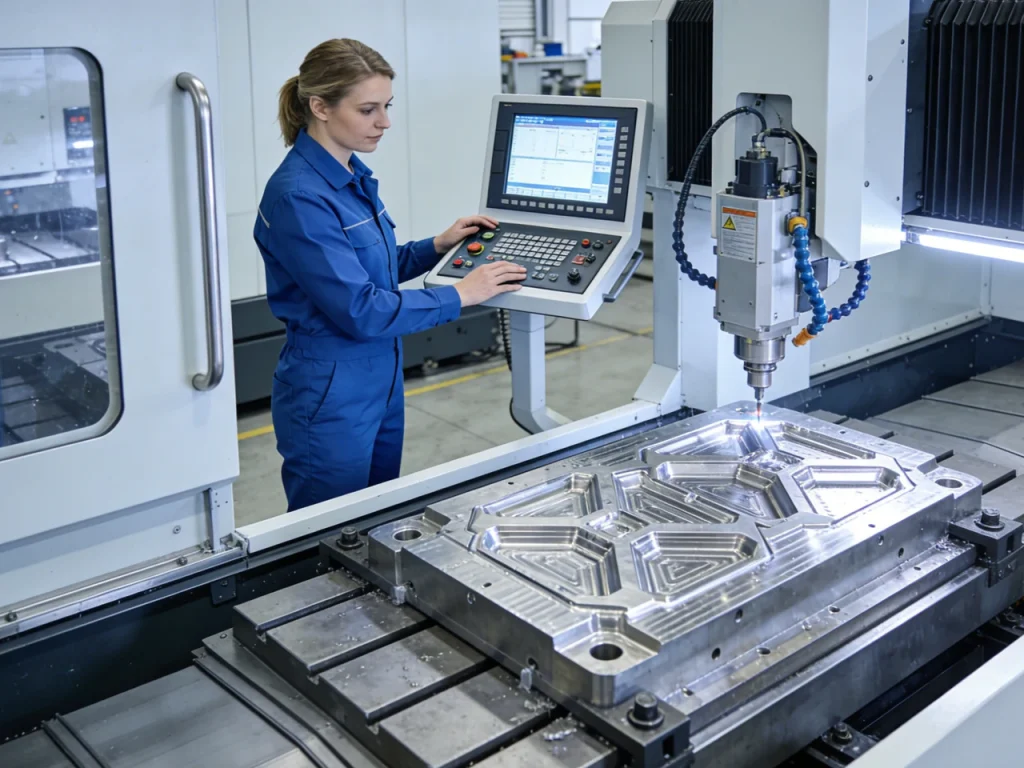
High-speed machining (HSM): throughput vs. predictability
High-speed machining (HSM) is usually described as fast spindle speeds with light cuts and high feed rates. The idea is to keep chip thickness controlled while increasing material removal rate. HSM can help in high-volume industries where cycle time pressure is intense, and where parts are often made from metals that respond well to stable, controlled cutting.
HSM helps when:
- The part has large areas of material removal where tool engagement can be controlled.
- The machine, tooling, and workholding can support stable dynamics with low vibration.
- Tool paths are designed to avoid sharp corners and sudden load changes.
Adoption can be hard because HSM is not just a parameter change. It often requires different toolpath strategies, attention to tool holding and balance, and disciplined chip evacuation. It can also raise sensitivity to small process issues. A small amount of runout, a dull tool, or a coolant delivery problem may show up faster when speeds are high. For high-volume production runs, the question is not “Can we go faster?” It is “Can we go faster while staying predictable across high volumes?”
Workflow diagram: from CAD/CAM to first article to full-rate production (diagram)
Below is a simplified workflow for high-volume CNC machining. It is a high level on purpose. The key point is the gated learning loop before you commit to full-rate production.
- CAD, Drawing, and GD&T – Start with the design, engineering drawings, and Geometric Dimensioning & Tolerancing specifications.
- CAM Programming, Tool List, and Workholding Concept – Generate CNC programs, select tools, and plan how the part will be fixtured.
- Simulation – Verify toolpaths and check the machine and fixture envelopes to prevent collisions.
- Pilot Setup and Prove-Out (Short Run) – Perform an initial setup and run a short batch to validate the process.
- First Article Inspection – Inspect the first parts, focusing on datums and critical features to ensure accuracy.
- Process Freeze – Lock in the CNC program, revisions, and baseline offsets to maintain consistency.
- Run-at-Rate Planning – Plan for full production rate, including tool life, sampling, and maintenance schedules.
- Full-Rate Production – Execute production at full rate with SPC (Statistical Process Control), in-process checks, and traceability.
- Continuous Containment/Correction Loop – Monitor for defects or drift and implement corrective actions immediately.
Automation, Robotics, and Lights-Out Production
To fully leverage automation, it’s important to understand the conditions and precautions required for lights-out CNC machining.
Lights-out CNC machining: requirements, risks, and safeguards
Unattended machining is attractive because it reduces labor cost per part and increases spindle utilization. Feasibility depends on system stability, not just the CNC program.
Typical requirements include:
- Predictable chip control and evacuation
- Planned tool life with replacement or sister tools
- Robust workholding and part presentation
- In-process detection that stops safely on bad states
Lights-out success comes from layered safeguards, not optimism. The goal is not “no people,” but a team of skilled operators focused on exceptions rather than repetitive loading and gauging. Safeguards are often layered: in-process probing (for key datums or tool checks), controlled tool life limits with offsets, detection of abnormal load or vibration, and conservative rules for when the automated cell must stop. This strategy highlights the versatility of CNC machining and its cost-effectiveness in reducing human intervention while ensuring consistent production quality.
Automation readiness checklist (loading, pallets, robots)
Automation bottlenecks are often outside cutting. A readiness checklist:
- Part handling: clear grip zones; cosmetic sensitivity defined
- Workholding: repeatable, chip-tolerant locating
- Chip management: washdown or air blast where needed
- Cycle balance: load/unload overlapped with cutting
- Exception handling: defined stop behavior for misloads
- Tool management: planned swaps aligned with unattended time
- Inspection: clear plan for probing or in-cell gauging
Automation amplifies both strengths and weaknesses. Poor edge conditions or unstable burr formation often become the real limit.
Horizontal machining centers (HMCs) for chip flow and unattended runtime (case reference)
For parts that are milled, machine orientation affects chip behavior. A commonly cited reason to move from vertical machining to horizontal machining for high-volume production is chip flow. When chips fall away from the cut and away from critical locating surfaces, the process can be more stable during unattended runtime.
In one published industry example, a move toward horizontal machining was framed as a path toward fully unattended, lights-out throughput. The claimed mechanism was not only cutting speed, but also fewer interruptions tied to chip clearing and part handling, aided by access to multiple sides of the part in one orientation.
The decision is still part-specific. Some geometries fixture well horizontally and benefit from three-sided access. Others are better on a vertical machine due to fixture height, tool reach, or visibility for manual intervention. For high volumes, the best signal is how often the process stops today because of chips, rework access, or manual cleaning.
Automation readiness scorecard for high-volume parts
Use the scorecard below to decide whether a specific part is a good candidate for automated CNC production. This is not a guarantee tool; it is a way to surface hidden effort.
| Category | Low readiness | Medium readiness | High readiness |
|---|---|---|---|
| Geometry + access | Many deep pockets; awkward reach | Mix of open and enclosed features | Open access; stable tool engagement |
| Workholding | Complex clamps; high sensitivity to chips | Repeatable but needs cleaning discipline | Self-locating; tolerant to small chip presence |
| Part handling | Hard to grip; cosmetic surfaces everywhere | Grip possible with constraints | Clear grip zones; tolerant to handling |
| Chip control | Long stringy chips; packing risk | Manageable with tuned parameters | Short chips; predictable evacuation |
| Tool life predictability | High variability by material lot | Some drift with monitoring | Stable wear pattern with planned offsets |
| Inspection method | Only manual measurement makes sense | Mix of probing and manual | In-process probing or in-cell gauging fits |
| Change frequency | Design/process changes often | Occasional ECOs | Stable revision control for long runs |
A part can be “high volume” and still be a poor automation candidate. When readiness is low, you may still run volume successfully, but expect higher staffing, more frequent checks, and lower unattended runtime.
Tooling, Fixturing, and Setup Strategy for Long Runs
A key element in maintaining productivity over long runs is reliable workholding, which ensures both precision and efficiency.
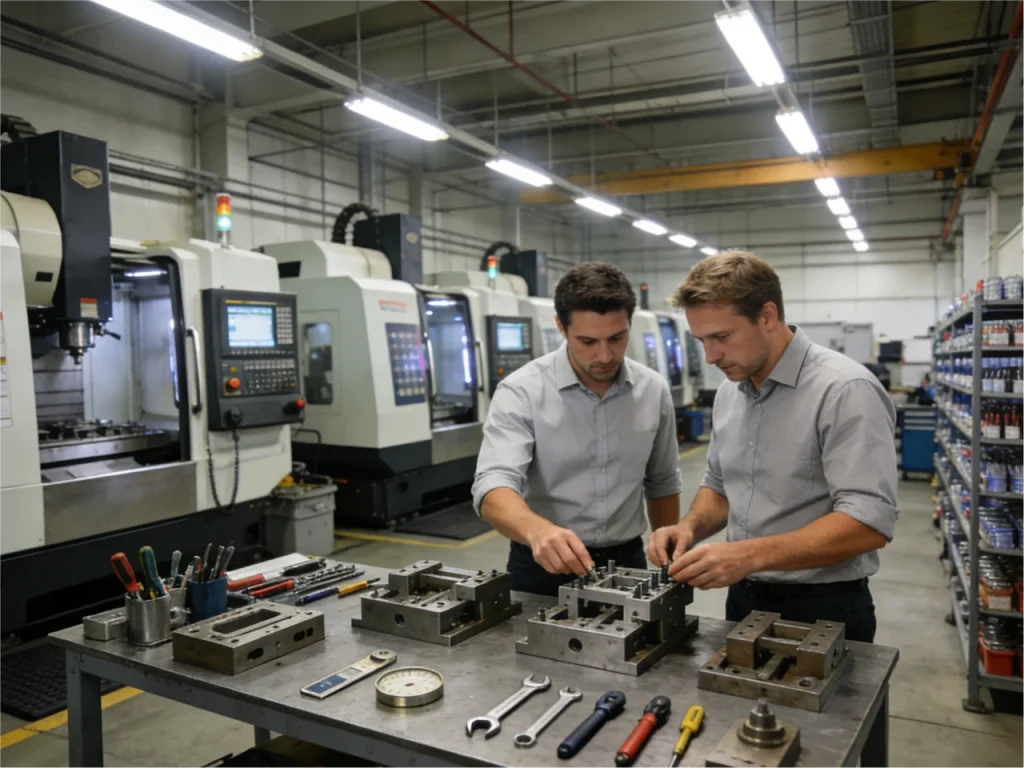
Workholding for repeatability
In high-volume CNC machining, a fixture is part of process capability. Effective workholding ensures both fast, low-error loading and consistent part constraint across setups. Checkpoints include datum alignment, constraint logic, chip tolerance, clamp force control, wear surfaces, quick verification, and standardized changeover plans. These measures improve the cost-effectiveness and versatility of CNC operations for a wide range of materials.
A fixtures checklist that maps to repeatability:
- Datum alignment: the fixture locates the part using the same datum scheme used on the drawing, or there is a clear translation plan.
- Constraint logic: the part is fully constrained without over-constraint that can distort thin walls.
- Chip tolerance: critical locating surfaces are protected or designed to shed chips.
- Clamp force control: clamping does not bend parts or shift them during cutting.
- Wear surfaces: contact points that wear are replaceable and measurable.
- Quick verification: a simple method exists to confirm the fixture is “home” after maintenance.
- Changeover plan: for families of parts, standardized setups reduce setup time and reduce operator variation.
Fast changeovers matter even in high-volume production because downtime events happen. When a fixture needs maintenance or a machine goes down, the ability to move work to a backup setup with minimal requalification can protect output.
Tool life planning: controlling wear drift
Tool wear is a hidden cost in high-volume machining. Effective planning includes defined tool lists, wear monitoring, offset rules, and replacement strategies to maintain precision. Changes in raw materials, coolant, or chip evacuation can affect wear behavior. Observing drift, applying rules, and logging changes ensures stable machining operations.
A tool life plan for high-volume production runs usually includes:
- A defined tool list with known wear drivers (finishing tools, small drills, reamers, thread tools).
- A monitoring method, which may be as simple as counting parts and applying conservative replacement rules, or as involved as in-process checks tied to tool condition.
- Offset rules that define when to adjust and when to replace, so adjustments do not become uncontrolled “operator art.”
- A replacement strategy that minimizes disruption, such as scheduled swaps during planned stops or the use of backup tools where the control supports it.
The key point is that tool wear is predictable only when the process is stable. Changes in material batches, coolant condition, and chip evacuation can shift wear behavior. High-volume CNC machining needs a closed habit of “observe drift, correct with rules, and log changes,” because otherwise each shift develops its own approach.
Simulation to prevent crashes and de-risk full-rate production
Simulation matters more as complexity and automation increase. In a prototype, a cautious operator can often catch issues early. In automated production, small programming mistakes can repeat quickly, and crashes can stop an entire cell.
A typical simulation workflow for de-risking high-volume production looks like this:
- CAM Toolpaths – Start with the generated CNC toolpaths.
- Verify Tool Engagement and Collisions – Check for any interference between the tool, holder, and fixture.
- Verify Machine Motion Limits – Ensure the machine’s axis travel and rotary limits are not exceeded.
- Verify Safe Approaches, Retracts, and Part Transfer Clearances – Confirm there’s enough clearance for automated part handling and safe movement.
- Document Revision-Controlled Outputs – Save and control the CNC program, setup sheets, and tool list for traceability.
- Prove-Out with Conservative Conditions – Test the toolpaths under cautious settings to ensure safety and accuracy.
- Lock Process Baseline Before Run-at-Rate – Finalize and freeze the process parameters before moving to full production.
The value is not just avoiding crashes. Simulation can also reduce variability by forcing clear definitions of tool lengths, holders, fixtures, and clearances. That clarity becomes important when you need repeatability across multiple machines or across long production time windows.
Reducing setups with multi-axis and standardized setups
Setup reduction in high-volume CNC machining is about reducing both time and variation. Two patterns tend to work:
One pattern is reducing the number of setups by using multi-axis capabilities so more features are cut in one clamping. This can reduce stack-up error because datums are held in one coordinate system longer. It can also reduce queues and handling damage.
The second pattern is standardizing setups across a family of parts. Standardization can mean consistent vise systems, consistent locating features, consistent tool libraries, and repeatable probing routines. The lean logic is simple: if you can make “setup” a repeatable process rather than a custom event, you reduce both downtime and risk.
A simple lean setup framework for production runs:
- Separate internal setup (machine stopped) from external setup (prepared while running).
- Standardize what can be standardized: fixtures, tool assemblies, probing macros, and program templates.
- Reduce adjustments by making location deterministic (hard stops, controlled wear surfaces).
- Add verification steps that are fast and objective, not “looks good.”
AI and Digital Optimization for Scale
To understand the practical impact of AI, it helps to look at how it optimizes toolpaths and adapts strategies during high-volume machining.
AI in CNC machining: toolpath optimization and adaptive strategies (evidence-based)
AI in CNC machining is often discussed in three buckets: toolpath optimization, adaptive strategies during cutting, and decision support around quoting and scheduling. For high-volume CNC machining, the most relevant use is where AI helps reduce variation and reduce non-cutting time.
Based on recent industry reporting, AI-driven toolpath optimization is positioned as a way to improve how tool paths manage engagement, avoid abrupt load changes, and reduce the chance of chatter or tool overload. Adaptive strategies are aimed at reacting to changing conditions, such as tool wear or material variability, by adjusting feeds or flags for intervention.
The feasibility question for a technical buyer is not “Is AI available?” It is “Is it stable in my use case?” High-volume production needs predictable behavior and clear failure modes. If a system changes cutting behavior, you need to know what it will do when sensor data is wrong, when a tool is chipped, or when the part is misloaded.
Predictive maintenance: avoiding downtime during extended production
Predictive maintenance is usually framed as using machine data to anticipate failures, so you can schedule maintenance before downtime hits. In high-volume production, downtime is expensive because it blocks a large portion of the entire production process, and it can cascade into missed assembly builds.
Trend-focused reporting points to predictive maintenance as a growing area tied to sensors and analytics. The practical constraint is data quality and actionability. If the system generates frequent false alarms, teams will ignore it. If it misses real failure precursors, it does not protect production.
For feasibility, ask what failure modes are in scope. Spindle health, way lube issues, and coolant-related faults are different problems with different sensors and time scales. A useful predictive system should connect to a maintenance playbook that defines what to check and what to replace, not just provide a dashboard.
Real-time quality monitoring and closed-loop feedback
Real-time quality monitoring in CNC machining often means in-process probing, in-cycle gauging, and automated checks tied to offsets. “Closed-loop” means measurement results change the process in a controlled way, such as updating a tool offset within a defined limit, or stopping the process when results exceed a threshold.
For high-volume CNC, the benefit is consistency across thousands of parts. The risk is that measurement systems can fail silently due to chips, temperature effects, stylus wear, or incorrect calibration. That is why closed-loop systems need safeguards: verification routines, periodic correlation to offline inspection, and clear limits on automatic correction.
Even without naming specific standards, the general expectation from technical standards bodies is traceability and method control: you need to know how a measurement was taken, with what method, and how it ties back to the drawing requirements.
Trend chart: where AI is “fringe” vs. production-ready in 2025–2026 (chart)
The chart below reflects the uncertainty described in recent trend coverage: some AI features are discussed as near-term, while others are still described as early or “fringe” for many shops.
| Area | “Fringe” use (often experimental) | Production-ready use (more common) |
|---|---|---|
| Toolpath generation | Automatic generation with minimal human review | CAM-assisted optimization with human validation and simulation |
| Adaptive cutting control | Fully autonomous feed changes based on black-box logic | Rule-based adjustments with clear limits and logging |
| Predictive maintenance | Broad predictions without clear maintenance actions | Targeted monitoring tied to known failure modes and maintenance steps |
| Quality monitoring | Full closed-loop correction without periodic correlation | In-process probing + limits + periodic offline verification |
| Scheduling/quoting support | AI deciding schedules without constraint modeling | Decision support that flags bottlenecks and capacity risks |
For high-volume manufacturing, “production-ready” usually means the system is predictable, explainable enough to troubleshoot, and stable under real shop conditions such as chip contamination and sensor noise.
Quality Control, Tolerances, and Consistency at Volume
Maintaining quality at high volumes requires understanding how materials behave and what factors can cause drift over long runs.
Material behavior and drift drivers (feasibility screen)
Some risks only emerge at high volumes. A quick feasibility screen helps identify potential issues in high speed machining setups:
| Material behavior | What tends to drift | What to control |
|---|---|---|
| Work hardening | Tool wear, surface finish | Tool geometry, replacement rules |
| Built-up edge | Size variation, burrs | Coatings, coolant, cutting strategy |
| Gummy chips | Chip packing, probe errors | Chip evacuation, guards |
| Thermal sensitivity | Size drift over time | Warm-up routines, sampling timing |
| Heat-treat distortion | Post-process geometry | Allowances, sequence control |
| Lot-to-lot variation | Wear rate, finish | Incoming material tracking |
This screen does not replace testing but flags where volume risk exists, especially for challenging materials like stainless steel and titanium commonly used in aerospace and automotive applications.
Maintaining tolerances across long runs
High-volume quality is about controlling drift, not chasing single measurements. Core elements for effective quality assurance include:
- Stable datums and workholding
- Tool wear rules
- In-process checks on drift-sensitive features
- Consistent measurement methods
Measurement inconsistency can hide real drift or create false alarms.
How do you maintain tolerances across thousands of parts?
Maintaining tolerances across high volumes comes down to controlling drift. Drift is slow movement of results due to tool wear, thermal changes, fixture wear, or material variation. In a prototype build, drift may not show up because you make only a few parts. In high-volume CNC machining, drift is the main enemy.
Teams control drift by combining:
- Stable datums and workholding so the part sits the same way every time.
- Tool wear rules that prevent “cut until failure” behavior.
- In-process checks (often probing) on key features that are sensitive to drift.
- Sampling and SPC (statistical process control) to detect trends early, before parts go out of tolerance.
The second piece is measurement discipline. If the measurement method changes from shift to shift, you can mistake measurement noise for process change, or miss real drift. Consistency requires a clear inspection plan: what is checked, how it is checked, and what triggers adjustment or containment.
SPC, sampling, and process capability expectations
SPC is a set of methods that use samples over time to tell whether a process is stable or trending toward a problem. Sampling plans define how many parts to check and how often, based on risk and criticality. In high-volume CNC, you do not inspect every feature on every part unless the part is extremely critical and the measurement method is fast and reliable.
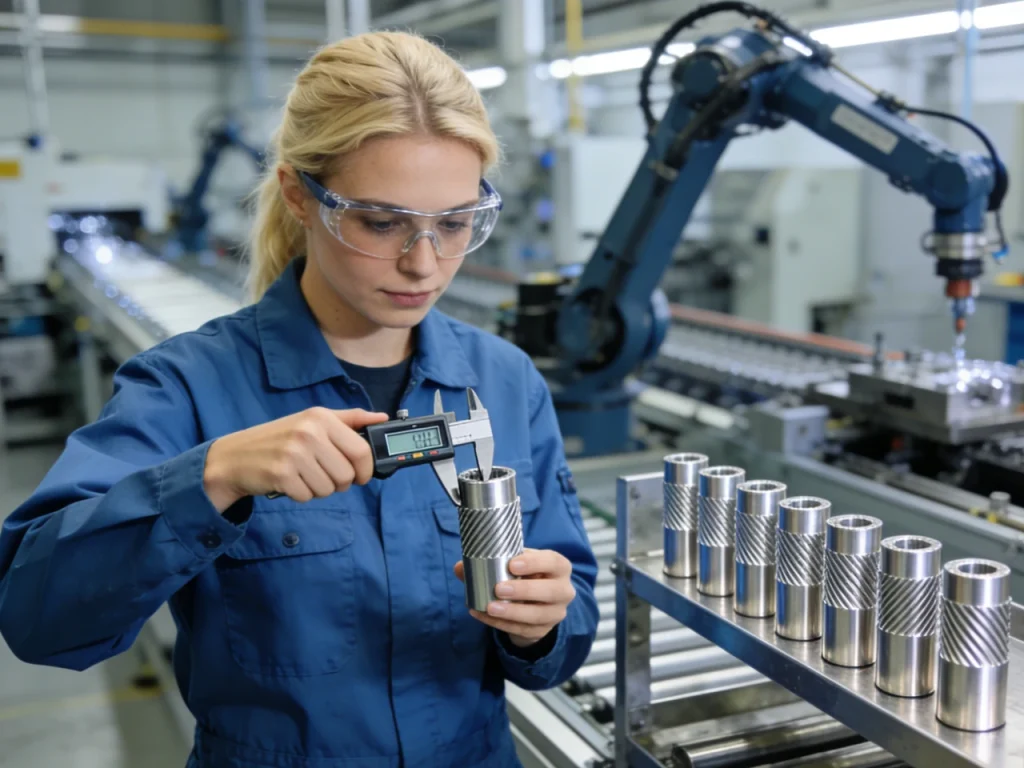
A practical table for how shops often structure checks looks like this:
| Control type | What it answers | Where it fits in high volume | Common trigger |
|---|---|---|---|
| First-piece / start-up checks | “Did we start correctly after a stop?” | After setup, tool change events, maintenance | Any stop long enough to disturb the system |
| Periodic sampling | “Is the process drifting?” | During steady-state production | Time-based or part-count-based checkpoints |
| SPC trending | “Is variation stable and centered?” | Critical dimensions with known drift modes | Trend toward a control limit or unusual pattern |
| 100% automated check (select features) | “Is a critical feature present and within a rule?” | Features measurable in-cycle (probe/gauge) | Out-of-rule triggers stop/containment |
Rather than quoting numeric capability targets, a practical expectation is that critical features are produced by a stable, centered, and monitored process.
For supplier or internal qualification, ask for:
- Evidence the process is stable on critical features
- Capability study outputs (method, not threshold)
- A documented control plan
- A reaction plan defining stop, adjust, or contain actions
Capability is not just machine accuracy—it is the ability to hold a process steady over time.
In-process probing and traceability
In-process probing and gauging can improve repeatability because it checks the part in the same coordinate frame as cutting. It can also reduce the time between a problem and detection. That matters in high-volume production runs where you want to minimize scrap and rework.
A checklist that keeps probing useful rather than dangerous:
- Clear purpose: probe critical datums and drift-sensitive features, not everything.
- Defined reaction: document what happens when a check fails (stop, alarm, offset adjust within a limit).
- Chip management: protect probing routines from chips on reference surfaces.
- Correlation: periodically compare probe results with offline measurement to confirm agreement.
- Traceability: link results to batches, machines, tool changes, and program revisions.
Traceability is less about collecting data for its own sake and more about shortening the root-cause loop. When a deviation appears, you want to know whether it tracks to a tool change, a fixture maintenance event, or a material lot.
Scrap/rework root-cause loop: containment, correction, and prevention (diagram)
In high-volume CNC machining, scrap is not just a quality metric. It is a process signal. The fastest way to lose control at volume is to keep running while debating the cause.
A simple containment-correction-prevention loop:
Detection
An issue is detected through inspection results, probe alarms, or downstream signals such as assembly fit problems.
Containment
Once detected, immediate containment actions are taken. Suspect parts or batches are stopped or quarantined, and the last-known-good point is identified to limit exposure.
Correction
The immediate cause of the issue is corrected, such as replacing a worn tool, resetting offsets, or cleaning or repairing the fixture. A short confirmation run is then performed to verify that the correction is effective.
Prevention
Preventive actions are implemented to avoid recurrence. This may include updating tool life rules or probing thresholds, revising setup standards or fixture design, and locking the updated program revision with proper documentation.
Resumption of Production
Controlled production is resumed with increased sampling or monitoring until the process demonstrates stable performance.
This loop is not bureaucracy. It is how you keep a high-volume production process from making the same mistake many times.
Cost, Lead Time, and Scaling Economics
Understanding cost and lead-time dynamics is crucial when scaling CNC operations to high-volume production.
Cost drivers in high-volume CNC machining
High-volume CNC machining cost is dominated by a short list of drivers. You do not need exact rates to reason about feasibility; you need to know what moves the needle.
| Cost driver | Why it matters at high volumes | Typical levers |
|---|---|---|
| Cycle time | Repeats on every part | Toolpath strategy, fewer setups, better chip control, HSM where stable |
| Tooling consumption | Wear accumulates across long runs | Tool life planning, stable engagement, monitoring and replacement rules |
| Labor content | Loading, gauging, deburring add up | Automation, pallet systems, better part design for handling |
| Setup + changeover | Spread across volume but still impacts uptime | Standardized setups, quick verification, fixture families |
| Scrap + rework | Small rates become large quantities | SPC, probing, containment discipline, fixture and tool control |
| Downtime | Stops the entire production process | Preventive/predictive maintenance, spare tooling, clear recovery procedures |
| Material waste | Chips are a cost and a logistics load | Near-net choices where appropriate, process choice, nesting where relevant |
The most reliable way to reduce unit cost in mass production CNC is to reduce repeat time and reduce interruptions. Many teams focus first on cutting speed, but end up finding that handling, inspection, and stoppages dominate.
Quoting inputs you must define: prints, GD&T, materials, surface finish, inspection (quote checklist)
If you want a quote that reflects real high-volume production, the inputs must support process planning. Ambiguity in drawings becomes risk pricing, or it becomes change orders later.
A quoting checklist for high-volume CNC machining services or in-house planning:
- Current drawing revision with clear datums and GD&T (geometric dimensioning and tolerancing).
- Material spec (including condition if relevant) and any allowed alternates.
- Surface finish requirements and where they apply.
- Critical-to-function features called out clearly, not implied.
- Inspection plan expectations: what features must be reported and how often.
- Special processes (heat treat, coating, passivation) and whether they affect dimensions.
- Batching and packaging needs if handling damage or traceability matters.
- Change management expectations: how revisions will be controlled during production.
If you do not define inspection expectations, suppliers may default to minimal checks, or they may assume heavy inspection and price in extra time. Either mismatch can be costly at volume.
Capacity planning: include reality, not ideals
Capacity planning for high-volume CNC is about identifying the constraint. The constraint might be machining time, but it might also be deburring, inspection, washing, or material staging. For automated CNC production, the constraint can shift again to tool changes, maintenance windows, or robot availability.
A simple calculator-style framework:
Inputs
- Demand rate (parts per time period)
- Available production time (per time period, after planned stops)
- Effective cycle time per part (including load/unload and expected minor stops)
- Yield (good parts / total parts produced)
Core relationships
- Takt time = Available production time / Required good parts
- Required run time = Required total parts × Effective cycle time
- Capacity margin = Available production time − Required run time
This is intentionally simple. The key is to include expected stops and yield in the effective cycle time model, because high-volume runs are rarely “pure cycle time” in real life. If the model assumes perfect uptime, the schedule will fail first during nights and weekends.
What affects lead time most for production CNC machining?
For production CNC machining, lead time is often driven more by readiness than by cutting time. The biggest drivers are usually:
- Process development time: proving out a stable process, especially for tight tolerances or complex geometries.
- Workholding and tooling readiness: fixture build time, tool procurement, and validation.
- Inspection method setup: gauges, probing routines, and agreement on what is measured and how.
- Capacity and scheduling: whether machines and staff (or automation) are available for sustained runs.
Cutting time matters, but many delays are in the steps needed to ensure consistent quality throughout the entire production. High-volume CNC machining ensures repeatability only when the full process—program, setup, tools, measurement, and maintenance—is defined and controlled.

In-House vs. Outsourcing High-Volume CNC
Deciding whether to keep production in-house or outsource requires balancing control, risk, and flexibility.
Decision matrix: build vs. buy vs. hybrid overflow capacity (decision matrix table)
The build-vs-buy choice is rarely just cost. It is about control, risk, and how often your production needs change.
| Factor | In-house | Outsource | Hybrid (base load in-house + overflow) |
|---|---|---|---|
| Process control | Highest direct control | Control via supplier controls and audits | Control on critical parts; flexibility on overflow |
| Capital load | High (machines, automation, metrology) | Lower capital, higher variable cost | Moderate; targeted investment |
| Engineering change response | Fast when resources exist | Can be slower due to queue and re-approval | Fast for core; managed for overflow |
| Scalability | Limited by owned capacity | Scales with supplier network | Scales while keeping critical know-how |
| Quality system alignment | Direct alignment | Requires clear deliverables and change management | Needs strong documentation discipline |
| Risk concentration | Internal downtime risk | Supplier dependency risk | Risk spread, but more coordination |
If you are making a part that is central to your product’s function and has tight tolerance relationships, in-house control can be valuable. If demand is uncertain or lumpy, outsourcing or hybrid capacity can reduce the risk of owning underused machinery.
On-demand manufacturing platforms for scalable volume (pros/cons)
On-demand manufacturing platforms are often described as a way to scale CNC machining services without owning equipment. The value proposition is flexibility: access to capacity and quoting without building a large sourcing team.
The practical pros for high-volume production include faster access to overflow capacity and the ability to respond when market demands shift. The cons are consistency and control. High-volume CNC machining depends on process stability, and stability is harder when work moves between different machines, different teams, or different measurement methods. If you use a platform approach for volume, ask how they control process consistency across production runs and how they handle change management when revisions occur.
Supplier vetting: PPAP-like, but generic
Before ramping, require evidence of control:
- Frozen program and revision control
- Baseline offsets and tool life rules
- Measurement correlation
- Control plan and reaction plan
- Traceability method
High-volume success depends on discipline, not just machine size.
Contracts and SLAs: quality, delivery, and documentation expectations
For high-volume CNC machining, contracts and service-level expectations work best when they are specific about documentation and reaction time, not just delivery dates. Agreements often define what gets reported (inspection results, traceability data), what happens when parts are nonconforming, how changes are approved, and how substitutions (materials, tooling equivalents) are controlled.
This is less about legal language and more about preventing confusion during the production process. Without clear expectations, the supplier may optimize for throughput while the buyer expects deep documentation, or the buyer may assume process changes are allowed while the supplier treats the job as frozen.
Case Studies and Practical Playbooks to Apply
Examining real-world examples helps illustrate how high-volume CNC principles can be applied in practice.
Case: setup efficiency tools that transfer from complex work to volume precision
One published example focused on HMLV machining for complex aerospace and defense-style parts, not mass production. The useful takeaway for high-volume CNC machining is the toolkit: multi-axis machining, advanced workholding, simulation, high-speed spindles, and lean setup principles aimed at reducing setup and programming time.
Even though the case was not “high volume,” the same tools matter when you scale precision. In high-volume production, setup efficiency tools translate into reduced changeover downtime, fewer setup-induced errors, and better repeatability when you need to move work between machines or recover from downtime.
The caution is that adopting these tools without standardization can increase variation. For high-volume work, the value comes when the methods are turned into stable standards: controlled fixtures, revision-controlled programs, and defined probing and offset rules.
Case: unattended/weekend production enabled by cobots and CAD/CAM integration
Another published industry example described unattended machining during extended hours, including weekends, supported by cobots for loading and unloading and tighter CAD/CAM integration. The stated goal was to keep machines running beyond staffed shifts and reduce the labor burden for large production runs.
The feasibility lesson is that unattended runtime is a system property. CAD/CAM integration helps when it reduces manual steps and reduces program handling errors. Cobots help when loading and unloading can be made repeatable and when the cell can detect misloads or bad states. If the part is sensitive to chips on datums, or if the cycle creates unpredictable burrs that affect loading, unattended production becomes fragile.
For buyers, this case supports a practical question set: what failures stop the run today, and can they be detected and contained without a person standing there?
Case: moving from VMC constraints to HMCs as a path to lights-out throughput
A third published example framed a move from vertical machining constraints to horizontal machining as a step toward lights-out throughput. The claimed advantages were better chip flow and access that supports unattended operation.
The more general lesson is that machine selection in high-volume CNC machining should follow the failure modes you see in production. If your stops are driven by chip packing, chip recutting, or manual clearing, orientation and chip evacuation design may matter as much as raw spindle power. If your stops are driven by gauging bottlenecks or deburring, changing the machine type may not move the constraint.
High-Volume Implementation Roadmap
A clear roadmap helps move from pilot runs to full production while maintaining quality and efficiency.
Pilot → First Article → Ramp → Steady State
Run-at-rate gate (do not skip):
Before full-rate production, lock:
- Program and revision baseline
- Tool life and replacement rules
- Measurement correlation
- Control plan and containment triggers
- Traceability and change authorization
Ramping before these are defined is debugging at full cost.
Diagram view:
Pilot Run
The pilot run phase is used to identify and understand early failure modes, such as chip control issues, burr formation, and fixture sensitivity. Insights from this stage are used to refine the machining process, adjust fixturing, and eliminate obvious sources of instability before formal validation begins.
First Article
During first article approval, the focus is on confirming the measurement method and datum scheme to ensure dimensional results are meaningful and repeatable. Once validated, the CNC program and revision baseline are frozen to prevent uncontrolled changes going into production.
Ramp-Up
The ramp-up phase introduces production controls, including defined tool life limits, SPC sampling plans, and in-process probing where applicable. This stage is used to verify that the process remains stable and centered over longer run times rather than just short trials.
Steady-State Production
In steady-state production, parts are run at rate under controlled change management. Long-term performance is maintained through preventive maintenance, ongoing monitoring, and a closed-loop root-cause process to address any deviations that arise.
Final Takeaway
High volume CNC machining works when the process is treated as a controlled system—program, fixture, tooling, material behavior, measurement, and maintenance working together.
CNC is powerful because it repeats behavior reliably. That reliability delivers precision at scale only when the system is designed to control drift. If any element is informal, the same automation will repeat problems just as efficiently.

FAQs
High volume machining refers to situations where the manufacturing process is treated like full-scale production rather than a one-off job. The parts are standardized, meaning each item should be virtually identical to the last. Success in this environment depends heavily on repeatability, tool life control, and minimizing cost per unit. You’ll often see automation, advanced fixturing, and detailed sampling or inspection plans put in place to ensure consistency. A key practical indicator is that processes are set up to detect deviations early—whether from tool wear, machine drift, or material variation—so adjustments can be made before scrap occurs. Essentially, high volume machining is about running large quantities of parts efficiently while keeping quality tight, making it more like a production line than a traditional job shop operation.
Scaling CNC production is all about efficiency, consistency, and control. Start by reducing the number of setups and part transfers to minimize error and non-cutting time. Standardized workholding and fixturing help ensure each part is located the same way every cycle, which makes automation more reliable. Process controls—like tool life monitoring, SPC (statistical process control) trending, and automated alerts—allow the system to detect issues before they affect quality. Automation, such as robotic loading or pallet systems, becomes essential when high volume magnifies the cost of scrap. Finally, measurement and inspection routines need to be consistent and well-documented so even minor drift or tool wear is visible early. By combining these approaches, CNC operations can scale efficiently while maintaining quality and minimizing surprises.
The primary advantage of high volume CNC services is predictable, repeatable production of precision parts—metal or plastic—without the upfront costs of molding or casting tooling. CNC machining is inherently flexible, so it adapts well to engineering changes without halting production or scrapping expensive hard tooling. You also get high control over tolerances, surface finishes, and complex geometries that might be challenging with traditional mass-production methods. Another benefit is fast response: design iterations or part updates can often be implemented with minimal downtime. Of course, efficiency depends on managing cycle time, uptime, and tool wear, so strong process discipline is essential. Overall, high volume CNC combines the reliability of traditional production with the adaptability of modern machining, making it ideal for industries where precision, quantity, and flexibility must coexist.
Reducing unit cost in mass production CNC revolves around optimizing everything that happens on every single part. This means minimizing cycle time, speeding up loading and unloading, and making tool changes as quick and predictable as possible. Reducing the number of setups and controlling tool wear prevents variation that could generate scrap. Non-cutting bottlenecks, such as inspection, deburring, or machine idle time, also need attention. Automation—pallet systems, robotic part handling, or automatic tool changers—delivers the biggest savings when it reduces manual intervention and keeps machines cutting consistently. Finally, data-driven process monitoring ensures that deviations are caught early, preventing long runs of defective parts. By systematically attacking each source of inefficiency, CNC shops can lower unit costs while maintaining quality across large production volumes.
High-volume CNC machining is essential wherever precision, repeatability, and standardized parts are critical. Automotive suppliers, for example, rely on it for consistent metal or plastic components that must meet tight tolerances. Aerospace production often uses CNC for highly standardized parts, where safety and accuracy are non-negotiable. Industrial machinery, electronics enclosures, and certain medical devices also benefit from CNC’s repeatability. Another advantage is flexibility: unlike molding or casting, CNC can accommodate design updates or engineering changes without stopping production entirely. High-volume CNC fits situations where demand is substantial, parts are critical in performance, and mistakes are costly. In short, any industry that needs large quantities of consistent, high-quality components—and occasionally adapts designs—can benefit from high-volume CNC machining.
References
https://frigate.ai/cnc-machining/understanding-iso-9001-as9100-certifications-in-machining

 English
  German
  French
  Italian
  Spanish
  Polish
  Czech
Czech  Japanese