
Grind machining—often called precision grinding—is the finishing step that makes tight parts fit, run, and last. When milling or turning get you close, grinding takes you the rest of the way. It delivers micron-level tolerances and a superior surface finish on hardened steels, superalloys, carbides, and advanced ceramics. If your parts call for tight GD&T, high repeatability, or long wear life, grinding is the method that solves what CNC milling and CNC turning can’t.
This guide gives quick, data-backed answers on when to use grinding, then moves into process selection (OD/ID, surface, centerless, tool/jig), tolerances and surface finish, materials and superabrasives (CBN/diamond), case studies by industry, CNC and automation trends, supplier selection and certifications, and cost/ROI benchmarks. Use it to reduce scrap, improve throughput, and make confident sourcing and process decisions.
Grind machining at a glance: market, benefits, when to use
Grind machining, often referred to as precision grinding. But what is meant by grinding? It’s a process where abrasive wheels remove tiny amounts of material to meet micron-level tolerances, ensuring stability after heat treatment. In industries ranging from automotive to aerospace, understanding when to use grind machining can significantly improve part quality and manufacturing efficiency.
Key 2024–2035 stats and trends
Grinding machinery is a steady-growth market driven by tighter parts, harder materials, and the need for repeatable quality. Here are the headline numbers you can use in planning.
- Market size grows from about $5.83–$6.0B in 2024 to roughly $7.69B by 2030 and ~ $10.1B by 2034 (CAGR 4.4%–5.4%).
- Asia‑Pacific leads with ~44% revenue, with strong capacity and demand in China.
- Precision grinding machines make up ~65.8% of revenues; automotive is the largest end-user.
- Diamond tool grinding machines trend at ~4.7% CAGR to about $1.1B by 2035, showing rising superabrasive adoption.
Essential LSI terms you’ll see throughout: precision grinding, abrasive machining, surface finish, micron tolerance.
Table: Selected grinding market snapshot (planning use only)
| Metric | Value (range) | Timeframe |
|---|---|---|
| Global market size | $5.83–$6.0B | 2024 |
| Forecast size | ~$7.69B | 2030 |
| Forecast size | ~ $10.1B | 2034 |
| CAGR | 4.4%–5.4% | 2024–2034 |
| APAC share | ~44% | 2024 |
| Precision machine share | ~65.8% | 2024 |
| Diamond tool grinders | ~$1.1B | 2035 est. |
What does this mean for your parts? Demand is shifting toward high-precision, automation, and superabrasives. Shops that can hold 2–5 µm and hit Ra ≤ 0.2–0.4 µm reliably will keep winning complex work across automotive, aerospace, energy, electronics, and medical.
What is grind machining vs milling and turning?
People often ask: What is grinding machining? How does grinding work? Grinding is a machining process that removes material with a rotating grinding wheel made of bonded abrasive grains. Each grain acts like a tiny cutting edge. You use it when parts need very tight size and form, smooth surface finish, and stable geometry after heat treat.
How is grinding different from “machining” with cutters? In simple terms, milling and turning use a shaped cutting tool to slice away material in bigger chunks. Grinding uses many abrasive grains to shave away tiny amounts, giving you high precision and a smooth surface with far less cutting force on delicate or hard parts.
Is grinding better than milling? It depends on the job. For high stock removal, milling and turning win. For final size, ultra-stable form, and sub‑10 µm tolerances, grinding is ideal. Grind machining requires extremely tight tolerances, often below 10 microns, according to ISO 9001 standards for quality management systems (ISO, 2024). Many workflows use both: rough with milling/turning, finish with grinding.

Quick decision guide: when grinding wins
- Use precision grinding for final sizing after heat treat, tight form accuracy, concentricity, bearing surfaces, gear accuracy, and delicate geometries that can warp under heavy cutting loads.
- It shines with hardened steels, Inconel, titanium, carbides, and ceramics, and when you need Ra 0.2–0.4 µm or better.
- Watch risks like thermal burn, chatter, and wheel loading. Control them with correct coolant strategy, dressing parameters, and vibration damping.
Table: When to choose grinding
| Need | Grinding advantage |
|---|---|
| Size tolerance under 10 µm | Stable cuts with minimal heat and force |
| Ra ≤ 0.2–0.4 µm | Fine, controlled chip thickness |
| Hardened/superhard materials | CBN/diamond handle high hardness |
| Roundness/flatness | Trued wheels and in‑process gauging |
| Concentricity/gears/bearing surfaces | Tight form control and repeatability |
Grind machining processes explained
Grinding comes in several types of grinding machines, each suited to different shapes and goals. Choosing well is the fastest way to hit tolerance with less scrap.
Cylindrical grinding (OD/ID): essentials
Cylindrical grinding works on round parts. OD grinding holds the outside diameter; ID grinding holds the bore. These are your go‑to processes for shafts, bushings, bearings, sleeves, gear blanks, and hydraulic components where concentricity and roundness matter.
- Applications: shafts and bores with shoulders, steps, and tight centerlines.
- Typical results: OD/ID dimensional 2–5 µm, roundness 1–2 µm, Ra 0.1–0.4 µm with the right grinding wheel and coolant.
- Equipment: CNC cylindrical grinders with in‑process gauging, high-speed spindles, and precise workholding reduce variation lot to lot.
Why it works: the abrasive wheel is trued and dressed so the wheel face is perfectly round and sharp. That geometry transfers to the part, so you get consistent form grinding and stable surface quality.
Surface and creep‑feed grinding
Surface grinding produces flat faces with tight flatness, parallelism, and squareness. Think precision plates, molds and dies, slide ways, and tooling blocks. You can expect flatness to about 2–5 µm and Ra 0.1–0.4 µm for the best setups.
Creep‑feed grinding is a special form of grinding that uses a deep cut with a slow feed to shape complex profiles—great for superalloys, turbine blade roots, and deep grooves. It maintains form while removing more material than conventional passes.
Key setup points to prevent burn:
- Aim directed coolant at the grinding zone with enough flow and filtration.
- Dress the wheel often enough to keep it sharp and open.
- Watch power draw and part temperature to avoid thermal damage.
When should I choose centerless grinding vs center‑type?
Centerless grinding supports the part between a grinding wheel and a regulating wheel—no centers or chucks. It is unbeatable for small-diameter parts at high volume.
- Centerless: best for pins, rollers, small shafts, bushings, dowels; very fast; excellent roundness.
- Center‑type: best when you have shoulders, steps, or long parts that need defined datums and flexible setups.
Table: Centerless vs center‑type (quick selection)
| Factor | Centerless | Center‑type (OD/ID) |
|---|---|---|
| Throughput | Very high | Moderate to high |
| Setup for varied geometry | Limited | Flexible |
| Part features (shoulders/steps) | Restricted | Full support |
| Tolerance range | 2–5 µm common | 2–5 µm common; sub‑µm with special setups |
| Best fits | Pins, rollers, small shafts | Shafts with features, complex OD/ID |
CNC tool and jig grinding for forms and micro‑precision
A tool and cutter grinder (often 5‑axis) sharpens and makes cutting tools like end mills, drills, and reamers. It’s core to tool grinding in aerospace and medical because edge quality and form accuracy drive cutting performance.
Jig grinding is used for internal grinding of holes, contours, and pockets to sub‑micron positional accuracy relative to datums. If your drawing calls for very tight true position or roundness on a bore after heat treat, jig grinding is the finishing step that gets you there.
In a modern setup, think of the system as four parts working together: the wheel–workpiece interface, coolant delivery, dressing system, and CNC control. When these are tuned as one, you hold high precision and accuracy with less trial and error.
Tolerances, surface finish, and material compatibility
Achieving the right tolerances, surface finish, and material compatibility is essential for ensuring part performance and durability. These factors guide the choice of machining process, whether grinding, milling, or turning, to meet both functional and aesthetic requirements.

Typical tolerances and surface finish by process
Table: Typical performance ranges (best‑practice shops)
| Process | Typical dimensional tolerance | Form (roundness/flatness) | Typical Ra |
|---|---|---|---|
| Cylindrical OD/ID | 2–5 µm | Roundness 1–2 µm | 0.1–0.4 µm |
| Surface grinding | 2–5 µm flatness | Flatness 2–5 µm | 0.1–0.4 µm |
| Centerless | 2–5 µm | Roundness 1–3 µm | 0.1–0.4 µm |
| Tool/jig grinding | ≤1–2 µm positional | Excellent form accuracy | 0.05–0.2 µm possible |
Real outcomes vary by part size, material, wheel, and environment. Use in‑process gauging and stable fixtures to keep your manufacturing process repeatable on long runs.
Materials and superabrasives (CBN/diamond)
Grinding excels on difficult materials—after all, abrasive machining was made for parts where conventional cutting struggles. Wheel choice is the key.
Table: Wheel selection matrix (quick guide)
| Material | Abrasive | Bond type | Notes |
|---|---|---|---|
| Hardened tool steels (HRC 58–64) | CBN | Vitrified | Highest productivity and form stability |
| Through‑hardened steels (HRC 50–58) | CBN or AlOx | Vitrified/resin | CBN for speed; AlOx for cost control |
| Stainless steels (300/400) | AlOx or CBN | Vitrified/resin | Use sharp, friable grains; good coolant |
| Superalloys (Inconel, Ti) | CBN | Vitrified/resin | Control heat; frequent dressing |
| Tungsten carbide | Diamond | Resin/metal | Use oil; avoid ferrous reaction heat |
| Ceramics | Diamond | Metal/vitrified | High stiffness and coolant focus |
Coolant strategy matters as much as the size of the grinding wheel:
- Oil gives better lubrication and finish on carbides and tools.
- Water‑based emulsions work for steels and general work; use high filtration and temperature control.
- Direct, laminar flow nozzles at the grinding zone reduce burn and stabilize size.
Metrology and inspection for precision grinding
Inspection is part of the grinding operation, not an afterthought. Best practice is to combine:
- In‑process gauging for real‑time size control.
- Post‑process gauging and air gauges for critical diameters and bores.
- CMM for GD&T features like cylindricity, true position, and concentricity.
- Roundness testers and profilometers for roundness and surface roughness (Ra/Rz).
Use clear datums in your drawing. Align your grinding process with those datums so the workpiece surface and features relate the way the print intends.
Industry applications and case studies
Understanding how different machining processes are applied across industries can provide valuable insights into their real-world effectiveness. In this section, we’ll explore case studies that highlight successful applications of these techniques, demonstrating how they solve specific challenges in various sectors.
Automotive precision: crankshafts, camshafts, gears, bearings
High‑volume production lines lean on production grinding to hit takt time. With CNC grinding equipment, in‑line monitoring, and adaptive control, many plants see 20–30% throughput gains over manual setups. Optimized grit and coolant can also cut tool wear by ~15%. On rotating parts like crankshafts, camshafts, gears, and bearing races, concentricity and surface finish affect vibration, noise, and life. Grinding holds these tight while keeping heat low.
A simple improvement story: a team moved from stand‑alone grinders to networked CNCs with in‑process gauging. They reduced changeover scrap, improved Cp/Cpk, and stabilized Ra on critical journals. The result was fewer warranty returns and smoother line balance.
Aerospace and energy: turbine blades and shafts
When you work with superalloys and tight form/finish, grinding is central. Creep‑feed grinding shapes blade profiles without losing root form, and OD/ID grinding keeps shafts straight and concentric under stress. The payoffs are longer fatigue life and better efficiency. These programs also demand strict traceability, controlled processes, and certifications such as AS and special process approvals.
Electronics and medical: wafers, dies, surgical tools
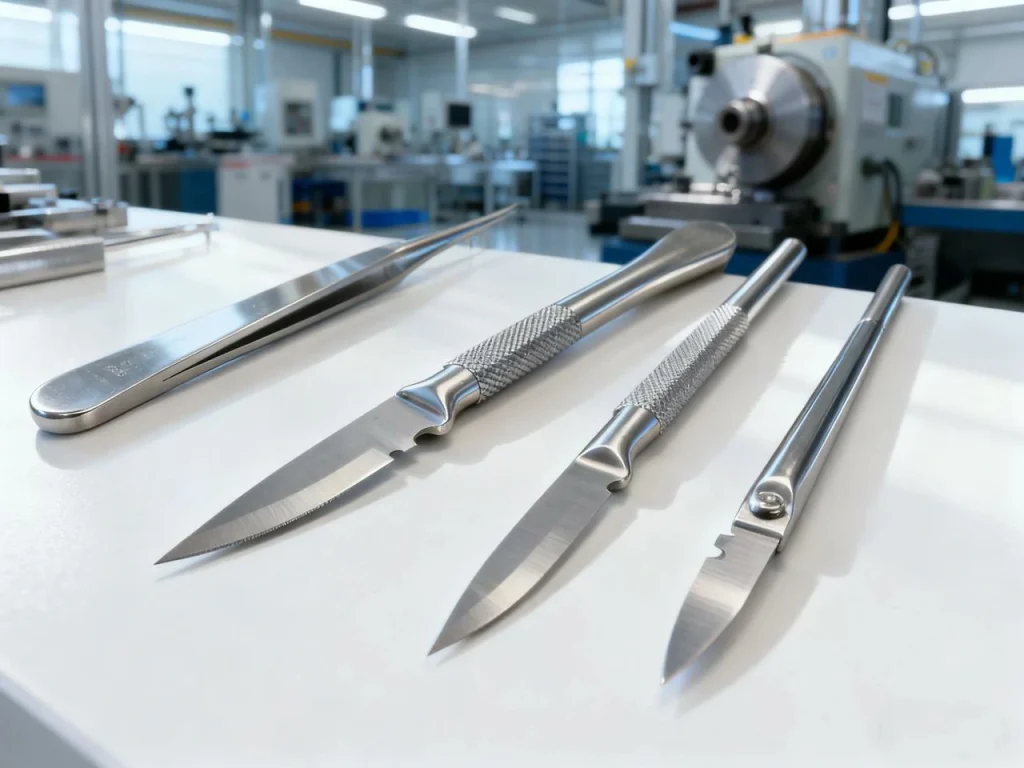
Micro‑grinding of ceramics and carbides supports semiconductor wafers and tooling with edge integrity intact. In medical, grinding helps produce burr‑free, smooth edges on instruments in stainless steels like 17‑4 and 316L, improving cleanability and patient safety. Tool and cutter grinding enables sharp, consistent cutting tools for orthopedic and dental work.
KPI snapshots often seen:
- Setup time cuts from ~60 minutes to ~12 minutes with robotic loading.
- Improved Cp/Cpk on size and roundness with SPC and in‑process gauging.
- Lower coolant consumption with upgraded filtration and directed nozzles.
Technology trends: CNC, automation, Industry 4.0
The manufacturing landscape is rapidly evolving with the integration of CNC machining, automation, and Industry 4.0 technologies. In this section, we’ll explore how these trends are shaping the future of machining and improving production capabilities.
Smart grinding: in‑process gauging and adaptive control
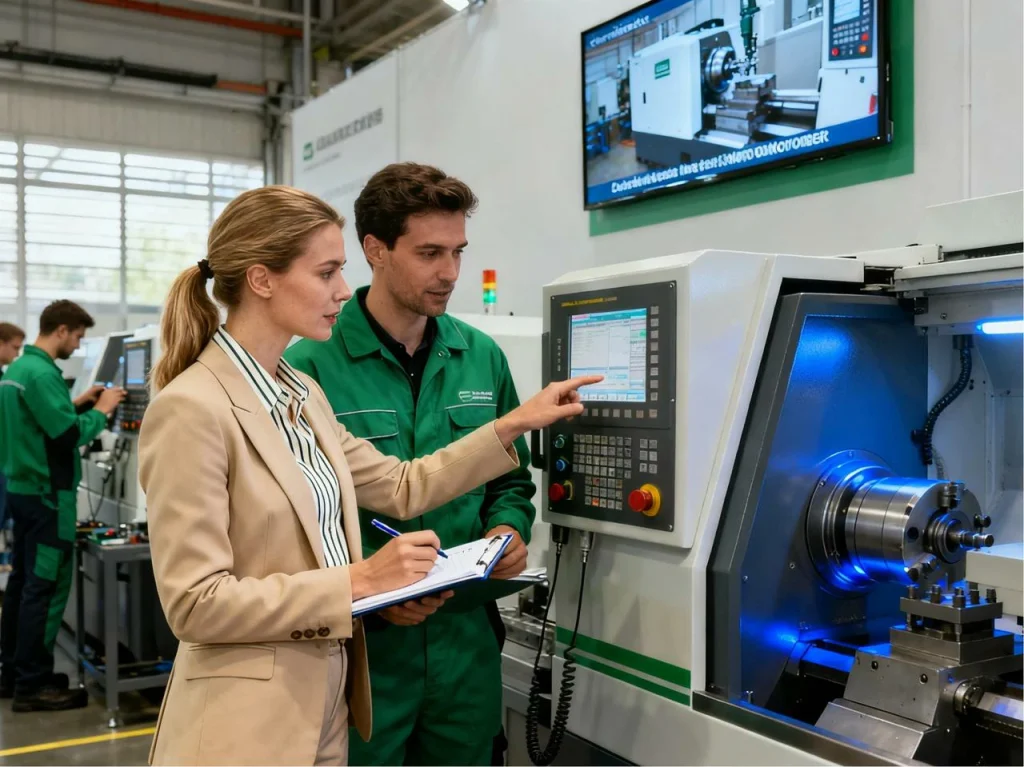
Modern CNC grinding machines can adjust size as they work. With in‑process gauging, the machine reads the part and tweaks offsets to hold target size, saving time and scrap. Add adaptive control, and the machine adjusts feeds and speed based on load, keeping the cut stable. Shops link this to MES/SCADA so teams can see OEE, alarms, and energy use in dashboards. This “closed‑loop” approach boosts quality consistency and uptime.
Shops also integrate CNC milling and CNC turning processes with CNC grinding for a seamless workflow—where rough machining is done with CNC milling or CNC turning, and finishing is carried out with CNC grinding. This approach allows for precise control over all machining stages, ensuring tight tolerances and high-quality surface finishes. Furthermore, linking this “closed-loop” system to MES/SCADA helps teams monitor OEE, alarms, and energy use via dashboards, boosting quality consistency and uptime.
For manufacturers seeking high-precision CNC machining and grind machining services, U-Need offers advanced CNC milling, turning, and grinding solutions for custom metal and plastic components. Their expertise in tight-tolerance machining, surface finishing, and production optimization helps clients achieve superior dimensional accuracy and repeatable quality across industries such as automotive, aerospace, and medical devices.
Hardware advances: spindles, damping, coolant delivery
Stiffness and damping are everything in grinding. Today’s machines rely on:
- High‑speed spindles with quality bearings for smooth rotation.
- Hydrostatic ways and heavy bases to kill vibration.
- Optimized coolant nozzles that feed the zone at the right angle and speed.
- Automated wheel dressing to keep form and surface quality consistent.
- Energy‑efficient drives that cut power use without losing performance.
Is automation worth it for small batches?
Many think robots only pay off at high volume. But flexible robotic loading, quick‑change tooling, and smart fixtures can make a strong case even for small batches. If you switch jobs often, reduce changeover to ~12 minutes per batch and keep spindles cutting. The ROI comes from less idle time, lower scrap during setups, and steadier throughput. A simple rule: more uptime for the grinder and less manual handling usually equals lower cost per part.
Sustainability and EHS in grinding
Cleaner grinding is good for people and profit. Focus on:
- Coolant recycling with filtration to extend fluid life and reduce disposal.
- Mist extraction to protect operators.
- Lower energy use through efficient pumps and drives.
- Extending grinding wheel life with better dressing and coolant targeting, which also reduces waste.
How to choose a grind machining service
Selecting the right grind machining service is crucial to achieving the precision, quality, and efficiency required for your parts. In this section, we’ll explore key considerations and best practices for choosing a reliable grind machining service that can meet your production needs and deliver consistent results.
Which certifications matter for grinding suppliers?
Certifications reduce risk by proving process control and traceability.
- ISO 9001: covers quality management systems—documents, corrective actions, audits.
- AS9100D (for aerospace work): builds on ISO with added requirements for risk, configuration control, and traceability.
- Special process approvals (industry‑specific): confirm controlled methods for heat treat, coatings, and sometimes grinding.
- Calibration programs traceable to national standards show inspection tools are reliable.
These certifications do not guarantee your results, but they make stable outcomes far more likely.
Capability checklist and audit tips
Ask suppliers to show:
- Processes: OD/ID, surface, centerless, tool/jig grinding.
- Tolerances held in production, not just in lab trials.
- Material expertise in hardened steels, Inconel, titanium, carbides, ceramics.
- Inspection assets: in‑process gauging, air gauges, roundness and surface testers, CMM.
- Capacity/load and preventive maintenance logs.
- Sample parts and SPC data for similar work.
- Process control plans and dressing/coolant strategies for your material.
RFQ best practices and data package
A clear RFQ stops surprises. Include:
- Prints with GD&T, material, heat treat, and surface finish targets.
- Volumes and lot sizes, expected delivery windows.
- Inspection plan and any required FAI/PPAP or traceability.
- Notes on packaging, cleaning, or special handling.
- If possible, provide a target tolerance/cost trade‑off band to guide proposals.
Templates your team can use:
- Supplier scorecard: processes, tolerances, certifications, capacity, on‑time rate.
- Audit checklist: machines, gauges, maintenance, coolant management, training.
- RFQ checklist: drawing set, tolerance bands, Ra targets, inspection plan, volume, delivery.
Costs, lead times, and ROI benchmarks
When evaluating grind machining services, understanding the associated costs, lead times, and potential return on investment (ROI) is essential for making informed decisions. In this section, we’ll break down these key factors to help you manage costs, optimize lead times, and assess the long-term value of your investment in grind machining services.
Cost drivers and how to reduce them
Grinding cost is a combination of cycle time, consumables, and assurance.
- Cycle time: feeds/speeds, in‑process gauging, automation.
- Wheel: abrasive type, bond, grit, dressing frequency.
- Fixturing/setup: quick‑change systems, standardized wheel packs.
- Inspection time: clear plans and in‑process checks reduce post‑work sorting.
- Scrap/rework: vibration control, coolant strategy, and dressing save dollars fast.
Tips to lower cost:
- Standardize wheel packs across families of parts.
- Use quick‑change tooling and presetting to cut changeover time.
- Improve coolant filtration and temperature control to stabilize size and finish.
- Track vibration and power draw; fix root causes of chatter and burn early.
Benchmark ranges and research hooks
Lead time depends on process and volume. Here are planning ranges that many teams see (your numbers may vary by region and queue).
Typical lead time ranges
| Process | Prototype lead time | Production lead time |
|---|---|---|
| OD/ID grinding | 1–2 weeks | 2–6 weeks |
| Surface grinding | 3–10 days | 2–4 weeks |
| Centerless | 1–2 weeks | 2–6 weeks |
| Tool/jig grinding | 2–3 weeks | 3–8 weeks |
How much does CNC grinding cost per part?
Costs vary by geometry, tolerance, Ra, material, and batch size. Use these ballpark figures to model options.
Table: Indicative cost ranges (low‑to‑mid volume)
| Feature/process | Tolerance band | Ra target | Low volume (1–50) | Mid volume (100–1,000) |
|---|---|---|---|---|
| Simple OD clean‑up | ±10–15 µm | ≤0.8 µm | $8–$25 | $3–$10 |
| Tight OD with shoulders | ±2–5 µm | ≤0.4 µm | $20–$60 | $8–$25 |
| ID bore finish | ±3–5 µm | ≤0.4 µm | $25–$80 | $12–$35 |
| Centerless small pins | ±3–5 µm | ≤0.4 µm | $0.30–$1.50/pc (per thousand) | $0.15–$0.80/pc (per thousand) |
| Surface grind plate | Flatness ≤5 µm | ≤0.4 µm | $15–$60 | $8–$25 |
| Jig grind precision hole | ≤1–2 µm position | ≤0.2–0.4 µm | $60–$200 | $30–$120 |
Volume lowers cost by spreading setups and stabilizing cycles. Ra targets tighter than 0.4 µm, special materials, or complex forms increase both cycle time and inspection.
Tools to embed on your site or spreadsheet:
- Tolerance impact estimator: cost vs ±µm band and Ra.
- Cost/throughput calculator: models cycle time changes from dressing, coolant, or automation.
- Payback calculator: robot or in‑process gauge ROI from setup time and scrap savings.
Conclusion and next steps
Grinding is a process that uses an abrasive wheel to make parts that run quieter, last longer, and meet strict prints. When your parts need precise grinding—micron tolerance, smooth surface finishes, or stable forms after heat treat—grinding delivers what turning and milling can’t. The key is picking the right process (OD/ID, surface, centerless, tool/jig), the right wheel (AlOx, CBN, diamond), and a shop with the controls and inspection to back it up.
Key takeaways and 30‑60‑90 day action plan
- 30 days: Define your real tolerance and surface finish needs. Shortlist suppliers that can prove capability on your material.
- 60 days: Run pilot parts with in‑process gauging. Dial in wheel specs, dressing, and coolant. Collect SPC to verify stability.
- 90 days: Add robotic load/unload if the numbers support it. Connect grinders to dashboards. Lock in capacity windows and Kanban rules with your suppliers.
FAQs
Grinding machining is a process that removes material from a workpiece using a rotating grinding tool. The tool is typically made up of abrasive grains that act like small cutting edges, allowing it to remove tiny amounts of material with extreme precision. This method is mainly used when parts need fine surface finishes, tight tolerances, or when working with hard materials that are difficult to machine using other methods like milling or turning. It’s especially useful for precise grinding, where maintaining geometric stability after heat treatment is crucial. For example, a surface grinder is commonly used for finishing flat surfaces with micron-level accuracy, making grinding essential in many industries like aerospace, automotive, and medical device manufacturing.
Machining and grinding are both processes used to shape and finish materials, but they differ in how material is removed. Machining generally refers to processes like turning and milling, where a sharp cutting tool removes material in larger chunks. These methods are faster for rough cuts or heavy stock removal. On the other hand, grinding uses grinding techniques that involve many small abrasive grains working together to remove fine amounts of material. This makes grinding perfect for tasks that require high precision, such as profile grinding for tight tolerances and smooth finishes. While machining may be quicker for removing large amounts of material, grinding excels in creating fine surfaces and intricate shapes, particularly on harder materials like steel, titanium, and ceramics.
For certain tasks, grinding is indeed better than milling, especially when it comes to achieving tight size, smooth surface finishes, and form accuracy on hard materials. Milling and turning are faster when it comes to heavy stock removal, but for precise grinding and fine surface finishes, grinding is the ideal choice. If you’re working with tough materials like hardened steel or superalloys, grinding can give you a much finer finish (often Ra ≤ 0.4 µm) that milling can’t achieve. That said, many workflows use a combination of milling or turning for rough cuts and grinding for finishing. A surface grinder or profile grinding tool would typically handle the final details to ensure the part meets the exact specifications.
Precision grinding is used to achieve extremely tight tolerances and superior surface finishes that other machining methods can’t provide. It’s ideal for parts that require micron-level accuracy, such as gears, shafts, and bearings, which are commonly found in industries like automotive, aerospace, and medical. A surface grinder is often used in precision grinding, where it helps achieve a high-quality finish with minimal tolerance variation. This process is also essential for parts that will undergo further processes like assembly or heat treatment, where dimensional stability is critical. Used for grinding components made from hard or brittle materials, this technique ensures that parts fit and perform reliably even in demanding environments.
The three main benefits of precision grinding are tight dimensional tolerances, superior surface finishes, and enhanced part stability. First, it allows for micron-level accuracy, ensuring parts fit together with minimal variation. This is crucial in industries like aerospace or automotive, where components must meet stringent standards. Second, precision grinding produces extremely smooth surfaces, often achieving surface finishes as fine as Ra ≤ 0.4 µm. Finally, it ensures that parts maintain their shape and geometry, even after processes like heat treatment, making it ideal for materials that are prone to distortion under stress. Profile grinding is an example of a technique used to achieve these benefits, particularly when complex shapes or intricate features are involved.
In the grinding process, the grinding tool is made up of countless abrasive grains that act like tiny cutting edges. As the grinding wheel spins, sharp grains cut into the workpiece to remove material, while worn grains break off and are replaced by fresh abrasive grains. The wheel needs to be regularly “dressed” to keep it sharp and true, ensuring that it continues to work efficiently and accurately. Depending on the application, different types of grinding might be used, including surface grinding, cylindrical grinding, or centerless grinding. This process is particularly effective when dealing with hard materials or when a high degree of precision is needed, making it crucial for parts that require stable geometry after heat treatment or other processes.
Grinding work comes with a few risks, including thermal burn, chatter, taper, and wheel loading. Thermal burn happens when too much heat is generated during grinding, damaging the material. Chatter occurs when vibration from the machine leads to an uneven surface finish. Taper, a variation in part geometry, can arise from improper alignment or cooling. Lastly, wheel loading happens when debris accumulates in the grinding wheel, reducing its efficiency. To reduce these risks, it’s important to control the cooling system, dress the grinding wheel regularly, and manage vibration. Proper use of a grinding tool and careful attention to the setup can prevent these issues and ensure optimal grinding performance.
Grinding in CNC refers to the use of Computer Numerical Control (CNC) technology to automate the grinding process. This method allows for precise control over the grinding operation, ensuring that parts meet exact specifications and tight tolerances. CNC grinding machines use programmed instructions to move the grinding wheel and workpiece, making the process highly accurate and repeatable. The machine adjusts parameters like speed, feed rates, and position in real-time to achieve the desired precision and surface quality. Whether it’s for finishing or complex grinding tasks, CNC technology enables high productivity with minimal manual intervention. In the manufacturing industry, CNC grinding is crucial for producing parts with intricate shapes or ultra-fine finishes, particularly in industries such as aerospace, automotive, and medical device production. This technology significantly improves efficiency, reduces scrap, and allows for consistent results across high-volume production runs.

 English
  German
  French
  Italian
  Spanish
  Polish
  Czech
Czech  Japanese