
Aluminum Association noted that billet aluminum is the go-to material when high strength, precision, and reliability matter. If you’re weighing billet vs forged or fabricated aluminum, choosing between alloys like 6061-T6 and 7075-T6, or trying to understand extrusion, porosity, and heat treatment, this guide gives you clear answers fast. We start with what billet aluminum is and why engineers choose it, then move into manufacturing steps, alloy selection, applications with real data, quality standards, and sustainability. You’ll see head-to-head comparisons, market trends, and practical buyer tools, including an RFQ checklist and costing pointers. Use this as your reference for selecting, machining, and sourcing aluminum billets that meet performance, cost, and lead-time targets across automotive, aerospace, robotics, and more.
Billet Aluminum at a Glance: Definition, Benefits, Fast Facts
What is billet aluminum?
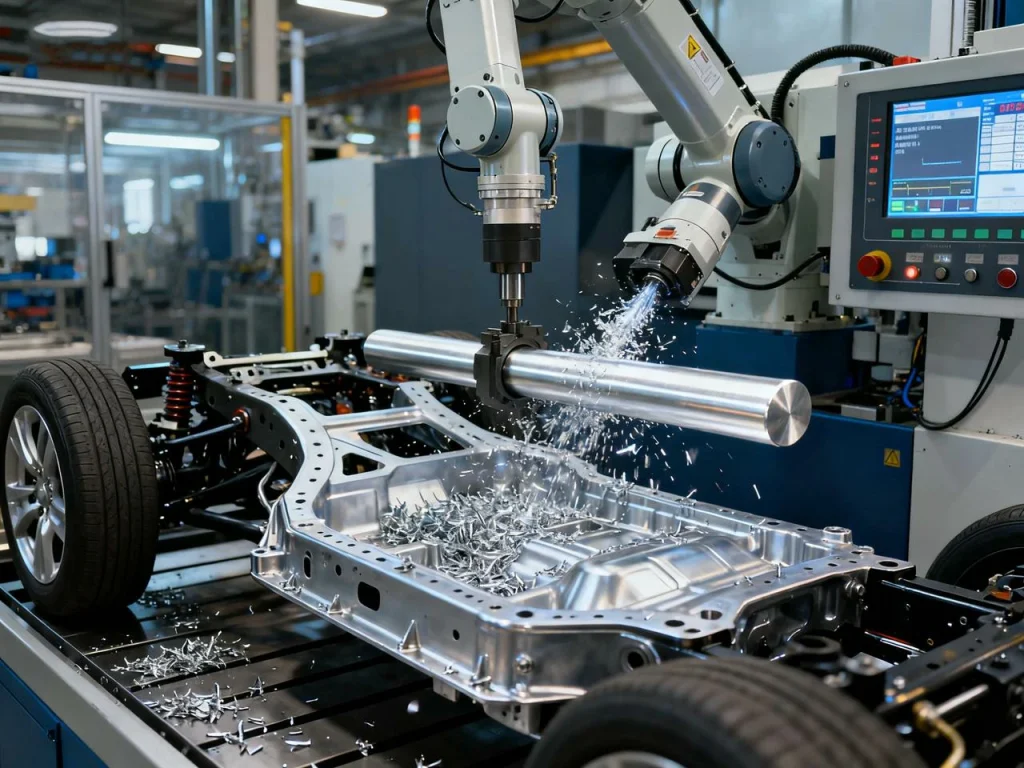
Billet aluminum is a solid block of aluminum made as a semi-finished product. It is produced by melting and alloying aluminum, then forming it into a solid bar, rod, or log through casting process. This billet stock is then cut and machined into final parts using CNC milling or CNC turning. Because the material is formed under controlled conditions, it shows a uniform internal structure and low porosity, which helps parts hold tight tolerances and predictable mechanical properties. If you’ve ever heard the phrase “machined from billet,” it means the part was CNC machined from a solid block rather than poured into a mold.
Why choose billet vs forged or cast ?
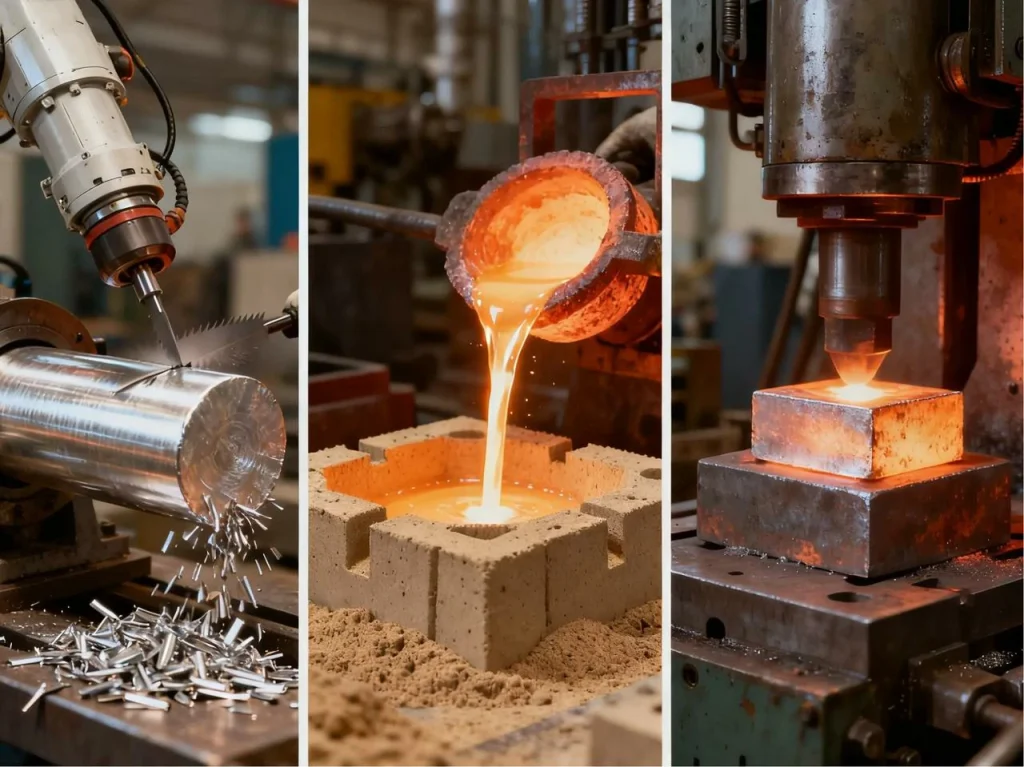
Engineers pick billet aluminum when they need clean internal structure, repeatable strength, and strong machinability. Compared with cast aluminum, billet tends to have lower porosity (often under about 2% vs cast that can exceed about 8% in non-critical work). The result is fewer hidden defects that can trigger fatigue cracks. Billet also machines well, which suits complex features and last-minute design changes. On the other hand, forged aluminum, which is formed by high pressure that aligns grain flow, is often the top choice for impact and fatigue resistance, such as in high-shock parts. The trade-off is cost and shape limits. Billet often sits in the middle: stronger and cleaner than many cast options, easier to make complex than forgings, but usually more expensive than cast and sometimes below forged for impact toughness.
Fast stats engineers care about
- According to Urostat, global billet output is on the order of tens of millions of metric tons per year, with a large share going to transportation. A sizable slice—often cited near a quarter—serves automotive needs tied to lightweighting and electrification.
- Aluminum extrusion presses that shape billets into profiles frequently run in the range of about 3,000–6,500 tons of force.
- Billets are preheated to around 480°C before extrusion; aluminum’s melting point is above 660°C.
- Market chatter and shop quotes often show billet components priced roughly 30–50% higher than comparable cast parts, reflecting lower porosity, higher machining time, and reduced hidden defect risk.
How Billet Aluminum Is Made (Step-by-Step Process)
Raw material selection and alloy design
Great billet starts with the right mix. Producers balance primary aluminum and recycled scrap to hit targets for strength, ductility, and corrosion resistance and good machinability. Alloying elements such as magnesium (Mg), silicon (Si), and copper (Cu) are added based on the need. For example, the 6xxx series (like 6061 and 6082) uses Mg and Si to produce solid, weldable parts with excellent corrosion resistance and moderate strength. The 7xxx series (like 7075) uses zinc and copper for very high strength, often in aerospace. Some alloys are designed to achieve corrosion resistance and moderate strength, providing a balance between durability and performance. The aim is to get a chemistry window that will deliver the needed mechanical properties after heat treatment.
Melting, alloying, and casting/extrusion controls
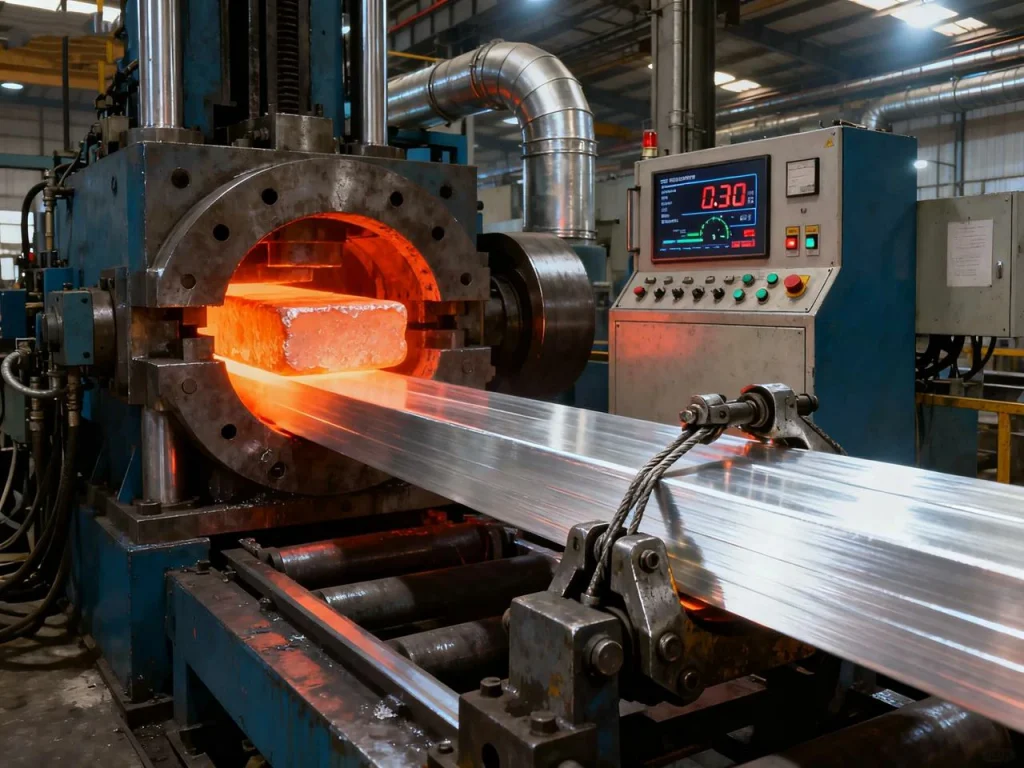
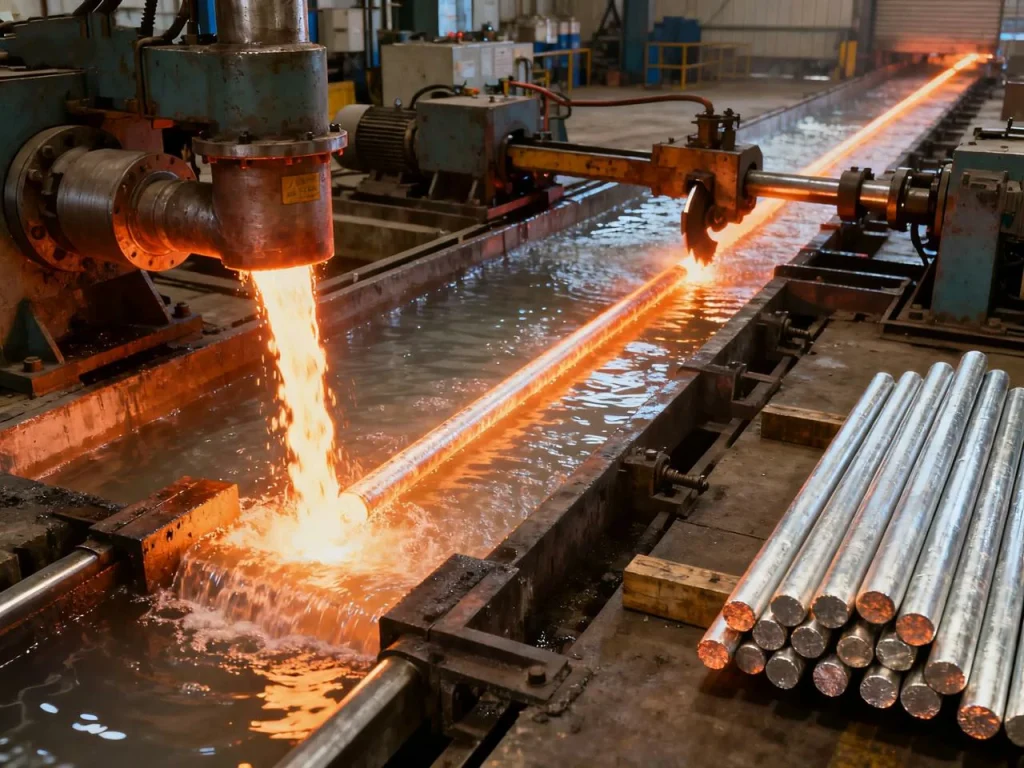
Aluminum is melted above its melting point (over 660°C). The melt is degassed and filtered to remove hydrogen and inclusions, which reduces porosity and improves fatigue life. Molten aluminum is cast into logs or smaller billets using controlled solidification methods that limit defects and improve surface finish. Many billets are then extruded: a heated billet (often around 480°C) goes into a press and is pushed through a die with thousands of tons of force to create a long bar, rod, tube, or profile. Cooling—by air or water—locks in structure and prevents unwanted grain growth. Throughout, tight controls on temperature, speed, and quench rate drive the final grain structure and machinability.
Finishing and machinability
After casting and extrusion, billets are cut to length and often stretched. Stretching improves straightness and can relieve stress. Heat treatment follows when needed. For 6xxx and 7xxx billets, solution heat treat, quenching, and aging set the final temper (such as T6 or T651). This has a big impact on yield strength and fatigue resistance. The result is a stable, predictable piece of billet stock ready for CNC machining, drilling, welding (best with 6xxx), and surface finishing like anodizing. Because billet has a uniform internal structure, it tends to machine cleanly with good chip control and dimensional stability.
For precision CNC machining and billet aluminum part manufacturing, visit U-Need, a trusted supplier specializing in high-accuracy component production and end-to-end machining services.
Alloys, Tempers, and Specifications
Common alloys and mechanical properties
Below are typical room-temperature properties; actual values vary by producer, size, and heat treatment.
| Alloy/Temper | Typical Yield Strength | Typical Tensile Strength | Elongation (typical) | Weldability | Notes |
|---|---|---|---|---|---|
| 6061-T6/T651 | ~240–290 MPa (35–42 ksi) | ~290–320 MPa (42–46 ksi) | ~8–14% | Good | Balanced strength, great machinability, widely used |
| 6082-T6 | ~250–310 MPa (36–45 ksi) | ~310–340 MPa (45–49 ksi) | ~8–12% | Good | Strong structural alloy; popular for extrusion |
| 7075-T6 | ~480–510 MPa (69–74 ksi) | ~540–590 MPa (78–86 ksi) | ~5–11% | Poor | Very high strength; aerospace-grade; careful with corrosion management |
How to specify a billet (engineer’s checklist)
- Alloy and temper (e.g., 6061-T651, 6082-T6, 7075-T6)
- Form, diameter/width, and length (or cross section if extruded profile)
- Dimensional tolerances (including straightness and roundness)
- Surface finish requirements (as-extruded, machined, anodized)
- Ultrasonic or eddy-current inspection level
- Mechanical test requirements (yield, tensile, elongation)
- Certification (material test report with heat/lot traceability)
- Special notes (grain direction for critical parts, NDT on cut lengths, stress-relief condition)
Heat treatment, tempers, and grain structure
Heat treatment is the lever that tunes strength and toughness in many aluminum alloys. For 6xxx and 7xxx series, the common path is solution heat treatment to dissolve alloying elements, a fast quench to trap them in solution, and artificial aging (like T6) to form fine precipitates that raise strength. T651 means the T6 condition plus stretching to relieve stress; this improves dimensional stability during CNC machining. Proper quench rate and aging temperature control grain size and precipitate distribution, which drive fatigue resistance and machinability.
Applications and Case Studies by Automotive and Aerospace Industries
Automotive and motorsport (lightweight, high-stress)
Billet aluminum is common in brackets, wheel hubs, suspension arms, and housings that see high loads. The low porosity and uniform grain reduce the risk of crack starters, which supports longer fatigue life. When teams test billet hubs vs cast hubs, they often find fewer defects and tighter balance after machining, which helps ride and durability. In performance builds, billet versions of engine covers, intake parts, and mount points are chosen for predictable behavior in CNC machining and the ability to hold thread engagement without pull-out. In research comparisons, magnesium additions in billet alloys have shown meaningful gains in yield strength compared to standard cast grades, which is one reason billet is favored for parts that must take consistent stress cycles.
Aerospace and defense (structural reliability)
Airframes and payload structures often rely on billet or plate machined parts for spars, ribs, brackets, and housings. The absence of shrinkage voids lowers the chance of premature fatigue failures. High-strength 7xxx alloys deliver strong stiffness-to-weight for critical areas, while 6xxx alloys offer weldable frames and mounts. Billet’s compatibility with tight QC (such as ultrasonic and tensile testing by heat lot) helps meet rigorous certification requirements. For systems exposed to vibration and thermal cycling, billet’s stable microstructure is a strong fit.
Billet vs Cast vs Forged: Selecting the Right Route
Side-by-side comparison
| Factor | Billet | Cast | Forged |
| Strength (typical) | High (alloy/temper dependent) | Moderate | Very high |
| Fatigue/impact | Good | Lower (porosity risk) | Best (grain flow) |
| Complexity | High via CNC | High via mold features | Moderate; shape limits |
| Lead time | Short to moderate | Moderate (mold build) | Longer (die build) |
| Cost per part | Moderate–high | Low–moderate | High (better at volume) |
| Tooling cost | Low | Medium–high | High |
| Revisions | Easy (update toolpath) | Hard (new mold or core) | Hard (new forging die) |
| Best fit | Tight tolerance, prototypes, moderate volumes | High-volume complex shapes | High-load, safety-critical, impact-prone parts |
When billet wins (framework)
Choose billet aluminum when:
- You need low porosity and predictable properties.
- Tolerances are tight and design may change.
- Volumes are moderate, or you want fast development.
- You can machine away extra material to achieve complex internal features without waiting on new molds or dies.
Is billet aluminum stronger than cast? Than forged?
Compared to cast aluminum, billet is often stronger and more reliable because it has fewer internal pores and defects. Compared to forged aluminum, billet usually has lower impact and fatigue resistance because forging aligns the grain flow in the direction of stress. If you ask “what is stronger, billet or forged aluminum,” the answer for impact and fatigue is typically forged. For static strength, a high-strength billet alloy like 7075-T6 can exceed many cast grades and even some forged shapes depending on design and heat treatment.
Cost, lead time, and risk trade-offs
Billet parts often cost 30–50% more than similar cast parts because of longer CNC time and premium material. But the lower porosity can cut rework, scrap, and warranty risk, especially in high-stress components. Forged parts demand expensive dies and longer lead times; they shine in safety-critical, repetitive production runs. Billet offers a middle path: fast to market, strong and clean structure, and flexible for changes.
Quality, Standards, and Testing
Specifications and certifications to know
- ASTM standards for wrought aluminum (context examples include B221 for extruded bars, rods, and profiles and B209 for sheet/plate; the exact spec depends on your form and alloy).
- ISO 9001 (quality management) and ISO 14001 (environmental management).
- Aerospace quality (AS9100) when required for flight hardware.
- Chain-of-custody and sustainability certifications such as those from industry stewardship groups when buyers seek documented low-carbon and recycled content.
NDT and QC methods
Buyers often specify ultrasonic testing (UT) to screen for internal voids and segregation. Eddy current checks for surface and near-surface defects. Mechanical tests—tensile, yield, elongation—verify heat treatment. Hardness testing offers a quick shop-floor indicator of temper consistency. Some programs include microstructure checks for grain size and indications of porosity or inclusions. Dimensional inspection confirms diameter, straightness, and surface finish.
Tolerances and straightness
Stretching after extrusion helps control straightness and residual stress. Tempers like T651 include controlled stress relief so the part moves less during milling. For long bars and big diameters, ask for straightness limits and UT class to avoid surprise runout or chatter during CNC turning.
How do you verify billet quality?
- Require material test reports (MTRs) with heat/lot traceability.
- Ask for UT results to your level (e.g., full-length, specific sensitivity).
- Confirm mechanical test values for the temper, size, and orientation you need.
- Check dimensional inspection and straightness.
- Verify certifications (ISO, aerospace quality, and sustainability as needed).
Market, Supply Chain, and Top Producers
Production volumes and demand segmentation
Global aluminum billet production is in the tens of millions of metric tons per year. Transportation, including automotive and commercial vehicles, often takes a large share. Growth drivers include electric vehicles, light but durable structural components, and energy infrastructure. Extrusions cut from billets serve frames, battery trays, heat exchangers, and crash structures. With steady demand, regional mills prioritize large consistent runs and value-added alloys.
Major producers overview
The supply base ranges from integrated miners and smelters to regional remelters and extrusion specialists. Primary producers cast large log diameters for high-throughput extrusion lines. Secondary producers focus on recycled billet with tight chemistry windows and certified recycled content. Regional clusters exist in North America, Europe, the Middle East, and Asia. Many offer low-carbon products through renewable power, smart heat recovery, and scrap optimization. When sourcing, look at capability by diameter, alloy range (6xxx vs 7xxx), NDT ability, and proximity to your machining site to control lead times and freight.
Pricing drivers and regional dynamics
Several factors move aluminum billet price:
- Energy costs (electricity drives smelting and remelt economics)
- Scrap availability and quality (affects recycled billet supply)
- Alloy surcharges (for magnesium, silicon, copper, zinc)
- Logistics and regional demand (local extrusion press capacity and freight)
- Trade policies (tariffs, sanctions, or quotas) Because billet is a semi-finished input, the price of aluminum billets tracks global aluminum indices, then adds regional premiums and alloy/processing adders. For machined billet parts, cycle time, tool life, and scrap recovery are big cost levers.
Sustainability and Recycling (Circular Aluminum)
Primary vs recycled billet performance
ASI said that recycled billet can match many mechanical properties of primary billet with good process control, especially in 6xxx series. The keys are chemistry control, low inclusion content, and proper heat treatment. Impurities like iron must stay within tight limits to preserve ductility and weldability. For structural components, mills blend scrap streams and use filtration and degassing to keep porosity and inclusions low. Many buyers now specify recycled content targets without sacrificing machinability or strength.
Carbon footprint and certifications
Aluminum can be recycled with a fraction of the energy required for primary production. This offers a strong path to lower embodied carbon in parts. Certifications and declarations—like environmental product declarations (EPDs), chain-of-custody, and quality system approvals—help document environmental performance. Producers lower carbon by using renewable power, heat-recovery systems, and efficient remelt furnaces. Buyers can ask for certified recycled content and carbon disclosures during RFQ.
Process innovations improving quality/efficiency
Advanced melting, filtration, and degassing reduce hydrogen and inclusions that cause porosity. Modern direct-chill casting reduces hot tears and improves surface finish. Smart cooling and quench control fine-tune grain size and reduce residual stress. On the extrusion side, better die design and process monitoring improve surface finish, dimensional control, and throughput. These innovations make recycled billet more consistent and help deliver lower-defect billets across diameters and alloys.
Does recycled billet affect strength or machinability?
Not if chemistry and process are controlled. Strength, fatigue resistance, and machinability depend on alloy composition, cleanliness, and heat treatment. If impurity levels stay inside spec and the billet is properly cast, quenched, and aged, recycled billet can perform on par with primary billet in many applications.
Buyer’s Toolkit: Selection, Costing, and Engineer FAQs
RFQ checklist (copy/paste)
- Alloy and temper (e.g., 6061-T651, 6082-T6, 7075-T6)
- Form and size (diameter/width x length or profile drawing)
- Tolerances (dimensional, straightness, roundness)
- NDT level (ultrasonic/eddy current) and sampling plan
- Mechanical test requirements (yield/tensile/elongation)
- Surface condition (as-extruded, machined, anodized)
- Certification (MTR with heat/lot traceability; quality/environmental certifications)
- Quantity, delivery window, and destination
- Special notes (grain direction, stress-relief temper, UT after cut-to-length)
Costing levers and MOQs
If billet parts feel pricey, start by attacking machining time and yield. Increase blank size accuracy to reduce roughing, use near-net extrusions if possible, and review toolpath strategies for higher material removal rates. Optimize stock size to cut drops and improve cut-to-length yield. Consider a more machinable alloy if your strength margin allows. Batch parts to hit supplier MOQs and press schedules. Ask for scrap-return programs or credit for your chips. For high-volume parts, compare billet machining vs cast tooling vs forging dies to find the best total cost of ownership.
DFM tips for machining and welding
- Use generous corner radii to allow larger end mills and faster CNC milling.
- Maintain uniform wall thickness where possible; avoid sharp internal corners to reduce stress.
- Plan clamping and tool access; reduce long overhangs to avoid chatter in CNC turning and milling.
- For 6xxx welds, pre-clean and choose filler wire that matches corrosion and strength needs. Avoid welding 7xxx alloys when possible; if required, get expert weld procedures and corrosion mitigation.
- Prepare surfaces for anodizing with suitable finishes; control grain direction and avoid smeared material to get even color.
Interactive tools
- Cost/performance calculator: Compare billet vs cast vs forged given quantity, lead time, and failure risk.
- Machining time estimator: Enter removal volume, feeds/speeds, and tool diameters.
- Cut-to-length yield calculator: Maximize parts per bar and minimize drops.
Closing Thoughts
Billet aluminum sits at a useful intersection: strong, clean, and adaptable. It’s the fast path when you need tight tolerances, quick revisions, and predictable performance without the tooling burden of casting or forging. If your parts carry cyclic loads or safety risk, step through the alloy/temper choice, NDT plan, and machining strategy with care. Use this guide as your working playbook: match alloy and temper to the job, spec the right inspection, and compare billet vs cast vs forged with your real volumes and risks. That way, you’ll ship parts that meet strength, cost, and lead-time goals—without surprises on the bench or in the field.

FAQs
Aluminum is an excellent material for corrosion resistance because it forms a natural oxide layer that protects the surface. Alloys with magnesium and silicon (6xxx series) offer very good corrosion resistance, making them ideal for structural and industrial applications. Using aluminum billets in parts requiring exposure to moisture or outdoor conditions helps maintain long-term durability. Additional surface treatments like anodizing or coating can further improve resistance. Compared with cast aluminum parts, billet aluminum offers a uniform grain structure and lower risk of corrosion-related failures, making it high-quality for structural and functional components.
Yes. Billet aluminum offers good weldability if the alloy is suitable. For example, 6xxx alloys weld well, whereas 7xxx alloys are stronger but more challenging, sometimes requiring specialized procedures. When producing aluminum structures using aluminum billets, welding must account for stress and strain to avoid cracks. Proper air cooling or water quenching after welding can preserve metallurgical properties. Compared with forged aluminum wheels or cast and billet components, welding billet aluminum enables flexibility in applications of aluminum billets requiring complex joins and high-quality assemblies.
Pick T651 if you want extra stress relief for better dimensional stability during machining and parts requiring precision. T6 is suitable when stress relief is less critical. The difference lies in metallurgical properties and the ability to withstand stress and strain. Using aluminum billets with T651 ensures that the alloy retains its uniform grain structure and desired shape during CNC milling or forming. For applications that require high-quality, consistent performance, T651 provides better tolerance control compared with T6. Both tempers are widely used in aluminum manufacturing for structural and functional parts.
Billet is the feedstock for extrusion. Heated aluminum is brought past its melting point and pressed through a die to achieve the desired shape, forming bars, rods, and complex profiles. Using aluminum billets allows manufacturers to produce high-quality parts with uniform grain structure and superior metallurgical properties. After extrusion, air cooling or water quenching stabilizes the material. Extruded billet aluminum is ideal for structural applications and parts requiring tight tolerances, providing better performance than some cast aluminum parts. Applications of aluminum billets include aerospace, automotive, and precision machinery.
Not always. Forging aligns grain flow, giving forged aluminum wheels and other parts higher impact and fatigue resistance, which is ideal for safety-critical applications. However, billet aluminum offers flexibility for complex CNC parts, fast design changes, and moderate-volume production. Differences between billet and forged aluminum lie in strength distribution, machinability, and ability to withstand stress and strain. For applications that require precise tolerances or unique shapes, using aluminum billets can be higher-quality and more versatile, though often more expensive than cast aluminum, while maintaining better reliability than some cast and billet hybrid parts.
Usually yes. Billet parts are expensive than cast aluminum because they require CNC machining from a solid block instead of molding. However, billet aluminum offers high-quality, uniform grain structure, superior metallurgical properties, and lower defect risk. The higher cost is offset by reduced scrap, better performance in parts requiring precision, and applications that require durability under stress and strain. When producing aluminum components, using aluminum billets is ideal for structural parts, aerospace fittings, and automotive applications where the investment in aluminum materials is justified by long-term reliability and consistency.
Aluminum is much more forgiving than steel and responds well to high spindle speed with sharp tools, provided chips clear properly. Using aluminum billets for parts requiring precise dimensions benefits from fast milling because billet is formed with uniform grain structure, allowing predictable chip behavior. Proper coolant or mist and control of air cooling or water quenching are essential to maintain metallurgical properties. Applications of aluminum billets that require tight tolerances, complex features, or high-quality surfaces perform better with fast surface speed than slow passes, reducing tool wear and cycle time while maintaining low cost relative to defects.
CNC billet aluminum refers to parts machined from solid billets using CNC milling or turning. This approach ensures uniform grain structure, metallurgical properties, and the ability to achieve the desired shape for high-quality components. Compared with cast aluminum parts, billet aluminum offers better stress and strain handling, precise tolerances, and suitability for structural applications. Using aluminum billets in CNC machining is ideal for applications of aluminum billets that require durability, complex geometry, or quick revisions, making it excellent for aerospace, automotive, robotics, and consumer electronics, even if billet is more expensive than cast aluminum.

 English
  German
  French
  Italian
  Spanish
  Polish
  Czech
Czech  Japanese