
6061-T6 is a heat-treatable aluminum alloy loved by engineers because it mixes strength, corrosion resistance, and workability in one easy-to-source grade. If you need an alloy that machines cleanly, welds with standard MIG or TIG processes, and stays stable in structural applications, 6061-T6 is often the right pick. This guide gives quick facts first, then explains the composition, T6 temper, mechanical properties, manufacturing, and real-world uses. You’ll also see how it compares with 6082, 7075, 6005A, and common composites, and you’ll get practical steps for machining, welding, and finishing. Along the way we answer common questions, like “What is 6061-T6 used for?” and “What’s the difference between 6061 and 6061-T6?” so you can choose and design with confidence.
6061-T6 at a Glance (Fast Facts for Engineers)
When engineers talk about aluminum 6061-T6, they often want quick numbers first. This alloy is known for its balance of strength, corrosion resistance, and machinability. If you’re evaluating whether 6061-T6 properties fit your design, the following snapshot gives you a solid starting point.
Key specs snapshot
If you just need the numbers to set initial design allowables, this is the quick view of typical room-temperature data for al 6061-T6.
Table: One‑page datasheet snapshot (typical values; check your MTRs)
| Property | Typical Value |
| Ultimate tensile strength | 290–310 MPa (42–45 ksi) |
| Yield strength (0.2% offset) | 240–270 MPa (35–39 ksi) |
| Elongation at break | ~10% |
| Brinell hardness | 93 HBW |
| Fatigue strength (rotating beam) | 96 MPa (14 ksi) |
| Shear strength | ~210 MPa (30 ksi) |
| Elastic modulus | ~69 GPa (10 × 10⁶ psi) |
| Density | 2.7 g/cm³ (0.0975 lb/in³) |
| Thermal conductivity | ~167 W/m·K |
| Coefficient of thermal expansion (20–100°C) | ~23 µm/m·K |
| Electrical conductivity | ~40% IACS |
| Typical tempers | T6, T651, T6511 |
These values are a starting point. Actual numbers vary with product form, thickness, temper, and supplier. Always verify with certified test data for your part.
Corrosion resistance, weldability, and typical temper options (T6, T651, T6511)
Many engineers often ask about aluminum 6061 T6 vs T651 vs T6511. 6061 aluminum has very good corrosion resistance in most environments, especially when compared with high-copper or high-zinc alloys. It anodizes well for extra protection. Weldability is good with GTAW (TIG) and GMAW (MIG). Do note the heat-affected zone (HAZ) will lose strength relative to the T6 base metal. If needed, you can re-heat-treat the whole assembly or design around the lower HAZ yield values. Common 6061 tempers include:
- T6: solution heat-treated and artificially aged; the baseline for many designs.
- T651: T6 plus stress relief by stretching (plate/bar) for better dimensional stability in CNC machining.
- T6511: T6 plus stress relief for extrusions (light cold work allowed).
Understanding the difference between 6061 T6 and T651 and T6511 helps you pick the right temper for your design, whether it’s a machinable component, welded structure, or anodized profile.
Best-fit applications: aerospace structures, extrusions, frames, bridges, marine
Because 6061 balances strength, toughness, and machinability, it appears in aircraft structures, rotor and skin panels, automotive parts, truck frames, rail coaches, marine fittings and hull parts, bridges, towers, and heavy extrusions such as I-beams and channels. It’s also a mainstay for bicycle frames, camera rigs, robotic arms, and many electronics enclosures.
“Is 6061‑T6 right for this?” decision checklist
Is this alloy a match? Ask:
- Do I need a weldable aluminum that also machines well?
- Are moderate tensile (≈300 MPa) and yield strength (≈250 MPa) enough for the load case?
- Will anodizing or paint meet the durability and surface finish needs?
- Is plate or extrusion in T651/T6511 available in the sizes I need?
- Do I need higher strength (7075) or better extrusion response (6082) instead?
If you answer “yes” to the first four and “no” to the last, 6061‑T6 is likely a good fit.
Composition & Temper Science (Al‑Mg‑Si, T6 Heat Treatment)
Understanding the composition and heat treatment processes behind 6061-T6 aluminum is essential if you’re evaluating its mechanical behavior and suitability for CNC machining or welding. The balance of alloying elements and the role of precipitation hardening directly shape the well-known 6061 T6 properties, including its yield strength and machinability.
Chemical composition ranges and alloying elements (Al, Mg, Si, Fe, Cu, Cr, Zn, Ti, Mn)
6061 is an Al‑Mg‑Si alloy with modest amounts of Cu and Cr. The key hardening phase is Mg2Si. Here are typical composition limits (mass %):
Table: 6061 composition (typical limits)
| Element | Composition Range |
| Al | Balance (~95.8–98.6%) |
| Mg | 0.8–1.2 |
| Si | 0.4–0.8 |
| Cu | 0.15–0.40 |
| Cr | 0.04–0.35 |
| Fe | ≤0.7 |
| Mn | ≤0.15 |
| Zn | ≤0.25 |
| Ti | ≤0.15 |
Magnesium and silicon are the major alloying elements. Copper and chromium tweak strength and corrosion behavior. Iron and manganese are kept low to avoid brittle intermetallics.

What T6 means: solution heat treatment, quench, artificial aging (precipitation hardening)
The T6 temper means the material is:
- Solution heat‑treated: heated high enough for Mg and Si to dissolve into the aluminum lattice.
- Quenched: cooled fast to trap a supersaturated solid solution.
- Artificially aged: reheated to a moderate temperature so fine Mg2Si precipitates form.
These fine particles block dislocation motion, raising yield strength and tensile strength. That is why 6061‑T6 shows a typical yield of 240–270 MPa and tensile of 290–310 MPa.
Microstructure and property links: Mg2Si precipitates, strength vs. ductility trade‑offs
When Mg2Si particles are small and evenly spaced, they hinder slip and boost strength and hardness. As they coarsen (from over‑aging or high service temperatures), strength goes down and ductility may go up. This is the classic strength vs. ductility trade‑off in precipitation‑hardened aluminum. The T6 condition aims for a fine, dense precipitation state, which is why it’s the go‑to temper for structural uses.
T6 vs. T651 vs. T6511: stress relief by stretching, dimensional stability for machining
The small extra code after T6 tells you about stress relief:
- T6: solution heat‑treated and aged. Good for many structural uses.
- T651: T6 plus controlled stretching to reduce residual stress in plate/bar. This improves flatness and repeatability in precision machining.
- T6511: T6 plus stretching suitable for extrusions. It also allows light cold work straightening.
If you machine pockets, thin walls, or tight bores, 6061‑T651 often warps less than T6 during CNC work. If you need long extruded profiles that hold size, T6511 helps for that.
6061‑T6 Properties & Datasheet
When evaluating aluminum 6061 – T6, engineers typically look first at its mechanical and physical performance. This alloy is valued because it balances strength, corrosion resistance, and ease of machining, making it one of the most widely specified grades for aerospace, transportation, and CNC precision parts. Below is a quick datasheet overview of the most important 6061 T6 properties.
Mechanical properties: tensile, yield, elongation (~10%), shear, fatigue, hardness
At room temperature, 6061‑T6 exhibits an ultimate tensile strength of around 290–310 MPa (42–45 ksi) and a yield strength of 240–270 MPa (35–39 ksi). Its elongation at break is about 10%, providing a reasonable combination of strength and ductility. For hardness, it sits around 93 HBW, with shear strength approximately 210 MPa (30 ksi) and a fatigue strength of 96 MPa (14 ksi).
Engineers often ask, “What is the yield stress of aluminum 6061‑T6?” You can start with 35–39 ksi (about 240–270 MPa). Always confirm with supplier data and consider thickness effects.
Physical/thermal properties: density (2.7 g/cm³), elastic modulus (69 GPa), CTE, conductivity
Key physical and thermal properties:
- Density: 2.7 g/cm³
- Elastic modulus: ~69 GPa
- Poisson’s ratio: ~0.33
- Coefficient of thermal expansion: ~23 µm/m·K (20–100°C)
- Thermal conductivity: ~167 W/m·K
- Specific heat: ~900 J/kg·K
- Electrical conductivity: ~40% IACS
These support the material’s lightweight, durable performance and good thermal conductivity for electronics housings, heat sinks, and automotive parts near heat sources.
Corrosion behavior and anodizing response (Type II/III), surface durability
Compared to copper‑rich and zinc‑rich aluminum grades, 6061 has very good corrosion resistance in fresh water and most atmospheres. In marine splash zones or salt fog, a thick anodize (e.g., Type II for color, Type III hardcoat for wear) plus sealing and proper coating practice gives long life. Pay attention to galvanic coupling with stainless or carbon steel. Use isolators, sealants, or anodize to prevent pitting at contact points.
Manufacturing & Processing (Machinability, Weldability, Forming, Finishing)
When it comes to manufacturing with aluminum 6061-T6, engineers value its balance of strength and workability. The alloy is highly machinable, responds well to CNC machining, and supports reliable welding techniques with the right filler. Its ability to handle both heat treatment processes and finishing options makes it one of the most versatile choices in aerospace, automotive, and precision pipe or component production. Understanding how 6061-T6 behaves during cutting, forming, and joining ensures better efficiency and product quality.
For professional CNC machining, custom cutting, welding, or post-processing of 6061-T6 aluminum parts, U-Need provides end-to-end manufacturing solutions from prototype to production.
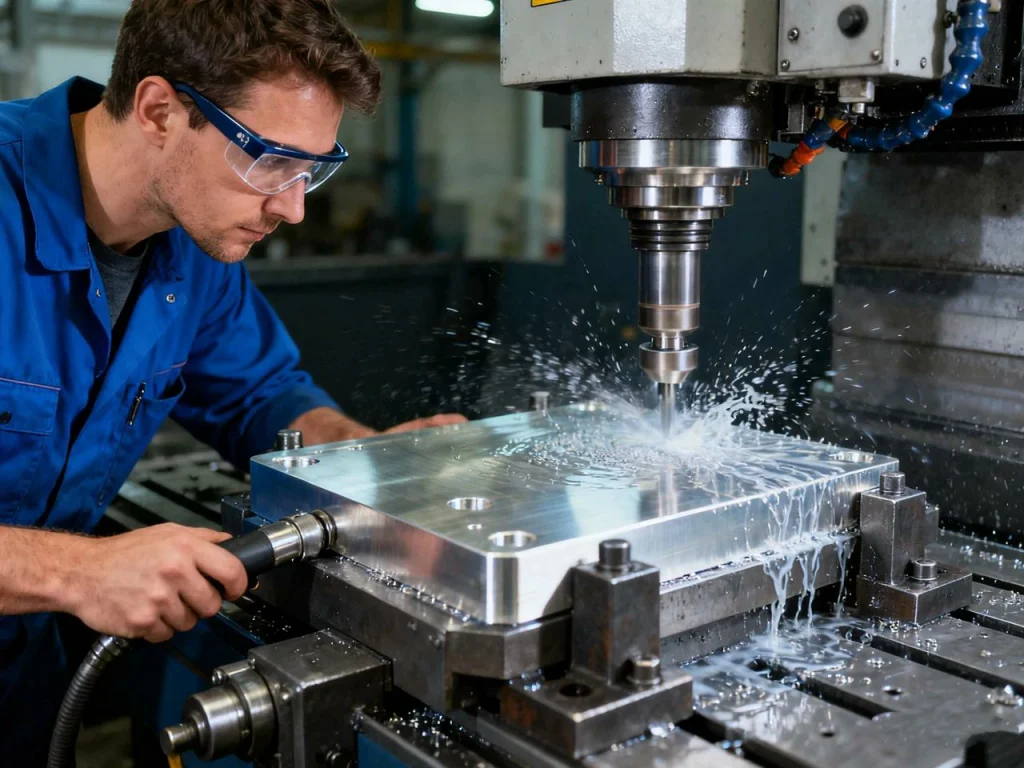
CNC machining guidelines: tool materials, chip control, speeds/feeds, burr reduction
6061‑T6 is machinable and friendly to CNC milling operations. For round, rotational parts, CNC turning achieves excellent surface finish and tight runout. To reduce built‑up edge, control burrs, and increase tool life, use these steps. For engineers looking to outsource precision CNC parts from 6061-T6 aluminum, U-Need provides expert machining services with high-quality standards and fast turnaround.
Step‑by‑step machining setup (typical guidance; adjust to your machine and toolmaker data):
- Use sharp carbide end mills or inserts with high positive rake for aluminum. Uncoated or polished Al‑specific coatings help chip flow.
- Target surface speeds of 150–900 m/min for milling (500–3,000 sfm), with moderate chip loads (0.05–0.25 mm/tooth). For drilling, 60–180 m/min with proper coolant.
- Apply flood coolant or mist to reduce welding on the cutting edge and control temperature.
- Use chipbreakers and avoid rubbing; depth of cut should be above the edge hone.
- Deburr with light chamfers, brushes, or thermal methods if geometry allows.
- For tight bores and thin walls, choose 6061‑T651 plate for lower distortion and add balanced roughing to keep stresses even.
- If chatter appears, shorten stick‑out, add tool support, and adjust spindle speed to move away from resonance.
These practices reduce tool wear, limit chatter, and improve surface finish for both prototype and production runs.
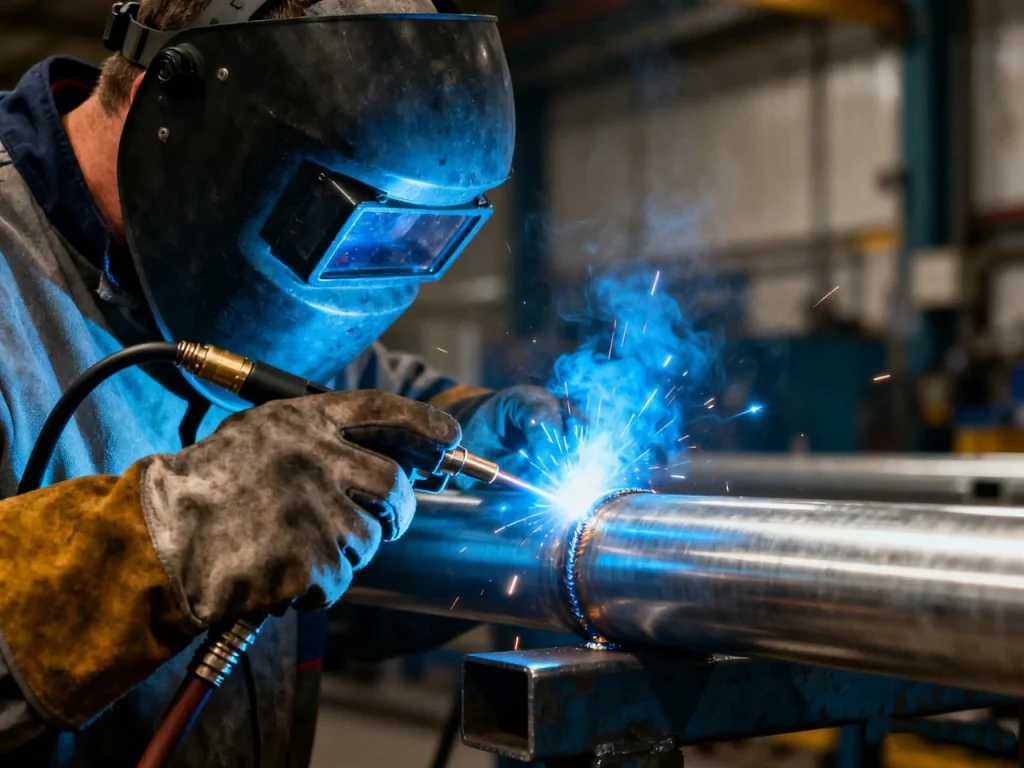
Welding practices: GTAW/GMAW, heat‑affected zone softening, post‑weld considerations
Weldability is a strong point for 6061. Common tips:
- Use GMAW (MIG) for speed and GTAW (TIG) for detail work.
- Pick a filler that fits your needs: ER4043 often gives lower crack risk and nice flow; ER5356 can provide higher as‑welded strength and better color match after anodize.
- Expect HAZ softening. The HAZ near the weld can drop toward T4‑like strength. Design joints so the lower yield in the HAZ is acceptable.
- If you need to recover T6 strength, a full solution heat treatment, quench, and artificial aging of the welded assembly may be possible if the geometry and tolerance allow.
- Clean before welding: remove oxide with stainless wire brush and degrease with compatible solvent to reduce porosity.
Forming/bending: limits in T6, when to use T4/T6 sequence for complex shapes
T6 aluminum has limited cold formability. Tight bends may crack, especially across the grain. For complex shapes, many shops:
- Order 6061‑T4 or 6061‑O (anneal), form the part, then perform solution heat treatment and artificial aging to reach T6.
- Use a larger bend radius. As a simple rule, try ≥2–3T (T = thickness) to start for 6061‑T6 bends and test your exact geometry.
- Bend in the “easier” direction (with the grain) if possible, and apply tooling radii that support the material to reduce local thinning.
Surface finishing: anodize, painting, passivation; achievable appearance and protection
6061 responds well to anodizing:
- Type II (sulfuric acid anodize) for color and corrosion protection.
- Type III (hardcoat) for wear resistance and thicker oxide layers.
- Seal pores (hot water, nickel acetate, or other methods) for best durability.
- Painting and powder coating both adhere well to properly pretreated 6061. Chromate‑free pretreatments are available if you want lower environmental impact.

Applications & Case Studies (Aerospace, Transport, Extrusions)
The versatility of aluminum 6061-T6 makes it a preferred material across industries where strength, corrosion resistance, and cost efficiency matter. Thanks to its excellent strength-to-weight ratio, solid machinable nature, and reliable performance under heat treatment processes, it is widely used in aerospace, transportation, structural extrusions, and even consumer products like bicycles and sports equipment. These real-world case studies highlight why 6061-T6 is a popular choice compared to other alloys when balancing performance with manufacturability.
Aerospace and transportation: rotor skins, airframes, truck frames, rail coaches, marine
What is aluminum 6061‑T6 used for? You’ll find it in aircraft structures, rotor skins, satellite brackets, truck frames, rail coaches, motorboats, masts, pylons, and towers. In many aerospace and transport projects, it is the “workhorse” aluminum because it is weldable, machinable, and predictable in fatigue. For critical high‑stress airplane parts where welding is not needed, higher‑strength alloys like 7075‑T6 may be chosen instead.

Structural extrusions per ASTM B308/B308M‑20: I‑beams, H‑beams, channels, tees
For bridges, walkways, platforms, and frames, shops often buy 6061‑T6 extrusions made to ASTM B308/B308M. Common shapes include I‑beams, H‑beams, channels, angles, and tees. These shapes carry structural loads well while keeping weight low, and they resist corrosion if finished and detailed correctly.
Bicycle frames and sports equipment: strength‑to‑weight, fatigue, field results
6061‑T6 is a favorite for bicycle frames because it combines strength‑to‑weight with good fatigue behavior and clean welds. Many sports and outdoor products choose 6061 for the same reasons. If you have a frame that must be both durable and lightweight, and you want a neat surface finish, this grade is a smart baseline.
Process flow from billet to finished part
Typical production flow for a 6061 component:
- Cast billet is homogenized and scalped.
- Billet is heated; for extrusions, it is pushed through a shaped die.
- Solution heat treatment and quench.
- Artificial aging to T6 (or T651/T6511 for stress relief).
- CNC machining to final shape.
- Weld (if needed), then post‑process as required.
- Anodize or coat for appearance and protection.
- Inspection and packaging with full certifications.
6061 vs. Alternatives (6082, 7075, 6005A, Composites)
Designers often compare aluminum 6061-T6 with alloys like 6082, 7075, and 6005A—or even modern composites—to balance cost, performance, and manufacturability. Each option has unique strengths: higher yield strength or tensile capacity, better strength-to-weight ratio, improved fatigue resistance, or superior extrusion behavior. Understanding the difference between 6061-T6 and T651, and how 6061-T6 properties stack up against alternatives, helps engineers choose the right material for aerospace, automotive, tooling, and structural applications.
| Material / Grade | Ultimate Tensile Strength (UTS) | Yield Strength (YS) | Weldability | Corrosion Resistance | Notes |
|---|---|---|---|---|---|
| 6005A‑T6 | 260–300 MPa | 230–260 MPa | Good | Very good | Strong candidate for thin extrusions |
| 6061‑T6 | 290–310 MPa | 240–270 MPa | Very good | Very good | Balanced properties; broad availability |
| 6082‑T6 | 300–340 MPa | 250–310 MPa | Good | Very good | Often edges out 6061 in strength for extrusions |
| 7075‑T6 | 510–570 MPa | 430–500 MPa | Poor | Lower | High strength-to-weight; popular in aerospace where welding is not required |
| Carbon-fiber composite (laminate) | N/A (E 50–140 GPa) | N/A | N/A | Excellent | High stiffness-to-weight; different joining/tolerance rules |
Strength‑to‑weight, fatigue, and corrosion comparisons (scenario‑based picks)
- Choose 6061‑T6 when you need a broad balance of machinability, weldability, and corrosion resistance with yield strength around 240–270 MPa.
- Choose 6082‑T6 when you want slightly higher extrusion strength while keeping decent weldability.
- Choose 7075‑T6 for very high tensile strength when welding is not needed, and you can manage corrosion with coatings or cladding.
- Choose 6005A‑T6 for lighter extrusions where moderate strength and thin‑wall extrudability matter.
- Consider carbon‑fiber composites for very high specific stiffness and low density when your design supports bonded joints and different tolerance schemes.
Cost, availability, machinability, and weldability trade‑offs in production
6061 is widely available, easy to source in plate, bar, sheet, and extrusions, and friendly on CNC setups. 6082 and 6005A are also common, especially in extrusions. 7075 is costlier and less weldable but offers top strength. Composites demand different tooling and joint design but cut weight further. Think about supply chain, standard sizes, and rework complexity before switching.
6061‑T6 vs. 7075‑T6 vs. 6082‑T6: when to choose for aerospace, automotive, tooling
- Aerospace: Use 7075‑T6 for very high static loads and fastened joints. Use 6061‑T6 for welded brackets, fairings, housings, and non‑critical airframe parts. 6082‑T6 can help with strong extrusions.
- Automotive: 6061‑T6 is often best for frames and chassis parts that need welding and machining. If a part is bolted and needs higher strength, consider 7075 but watch corrosion and cost.
- Tooling and fixtures: 6061‑T651 plate machines stable and flat. For clamps and jigs that hold tight tolerances, T651 is a smart default.
6061‑T6 vs. HX5/composites: stiffness, weight, tolerance, sustainability considerations
Compared with composites, 6061 aluminum alloy offers isotropic properties, easier tolerance control, fast machining, and simpler recycling. Composites can deliver lower weight and higher specific stiffness, but need different joining methods, careful environmental controls, and more complex repair plans. When your design favors drilled holes, tapped threads, and weldable frames, 6061 keeps manufacturing simple and sustainable.
Standards, Compliance & Sustainability
When specifying 6061-T6 aluminum, it’s important to align with global standards like ASTM, AMS, ISO, and EN to ensure consistent quality, machinability, and structural reliability. Engineers often review cross-references such as UNS A96061 or EN AW-6061 to confirm compliance. Since 6061-T6 properties—including its yield strength, corrosion resistance, and weldability—make it a popular choice in aerospace, transport, and CNC machining, proper certifications, MTRs, and environmental documentation are critical for regulated industries and sustainable manufacturing.
Relevant specifications: ASTM (B209, B221, B308/B308M‑20), AMS, ISO, EN equivalences
Common standards for 6061 products include:
- ASTM B209: aluminum and aluminum‑alloy sheet and plate.
- ASTM B221: aluminum and aluminum‑alloy extruded bars, rods, wire, profiles, and tubes.
- ASTM B308/B308M: standard structural profiles (e.g., 6061‑T6 I‑beams and channels).
- SAE/AMS specs: cover many aerospace forms and heat‑treat conditions.
- UNS: A96061 (chemical designation).
- EN: EN AW‑6061; also shown as AlMg1SiCu in some European listings.
- ISO: wrought aluminum sheets/plates and general designation frameworks.
Product forms and tolerances: plate, sheet, bar, extrusions; MTRs and certifications
Expect 6061 in plate, sheet, bar, tube, and extrusions. Check tolerances from the relevant standard and confirm with your mill or distributor. For regulated projects (aerospace, defense, transportation), get MTRs (mill test reports), traceability, and any required AMS or ASTM certifications. If your part is aircraft grade, coordinate with your quality team and certifying body so the material pedigree aligns with your process approvals.
Environmental profile: recyclability, energy footprint, circularity in aluminum supply
Aluminum is highly recyclable, and using recycled feedstock saves significant energy compared with primary smelting. Closed‑loop programs and scrap segregation can cut both cost and footprint. 6061 fits well in circular programs because its composition is common and it’s easy to remelt. Finishes like anodize or powder coat can also support long service life, which reduces total material use.
Compliance checklist (simple summary):
- Verify alloy and temper per drawing.
- Align product form with relevant ASTM/AMS standard.
- Confirm MTRs and mechanical property tests.
- Check heat‑treat and stress relief requirements (e.g., T651).
- Confirm coating or anodize specs, and seal if needed.
Failure Modes & Troubleshooting (Quality & Reliability)
Even well-characterized 6061-T6 aluminum can show issues if not handled correctly. From yield stress of aluminum 6061 T6 concerns to welding cracks or machining chatter, understanding common failure modes ensures parts—whether pipes, extrusions, or CNC components—meet design specs. This section highlights practical fixes and best practices for applications of 6061-T6 aluminum, helping your parts consistently exhibit strength around 290 MPa.
Welding defects: hot cracking, porosity, softened HAZ—prevention and fixes
- Hot cracking risk is managed with correct filler (often ER4043) and good joint fit‑up.
- Porosity comes from moisture and contamination. Clean thoroughly, remove oxide, and use dry shielding gas.
- HAZ softening is expected. Either design for the reduced yield strength in the HAZ, or plan a full heat‑treat cycle after welding if allowed.
Machining issues: built‑up edge, chatter, tool wear—tooling and coolant strategies
- Built‑up edge (BUE): use polished, sharp tools; raise cutting speed and provide lubrication.
- Chatter: shrink tool overhang, change spindle speed to avoid resonance, or use variable pitch cutters.
- Tool wear: control chip load to avoid rubbing; use flood coolant or minimum quantity lubrication; keep chips clear.
Heat treatment pitfalls: over‑aging, quench distortion, residual stress management
- Over‑aging lowers strength. Follow the correct time‑temperature path for T6.
- Quench distortion: support parts, quench fast and uniformly, and consider T651 material if your geometry is very thin‑walled.
- Residual stress: choose T651/T6511 forms when you need tight flatness and minimal movement during CNC machining.
Corrosion risks: galvanic coupling, pitting—material pairing and coating practices
- Avoid galvanic pairing with carbon steel or copper alloys in wet areas. Use isolators, sealants, or anodize.
- For marine use, prefer hardcoat anodizing plus sealing, and keep up with rinse and maintenance to limit salt deposits.
- Add drain paths and avoid crevices to reduce stagnant moisture and pitting risk.
Tools
Engineers and designers often need quick references when working with 6061-T6 aluminum. These tools help you check 6061 T6 properties, estimate yield stress of aluminum 6061 T6, or plan CNC machining setups. Whether calculating weight, comparing alloys, or reviewing bend and machinability guidelines, these resources support practical applications of 6061-T6 aluminum. Use them as a starting point, but always verify specifics through supplier data or online resources.
- A one‑page 6061‑T6 datasheet with mechanical properties, thermal data, and bend guidance.
- An alloy selector comparing 6000‑series and 7000‑series grades by yield, tensile, weldability, and corrosion.
- A weight calculator using density (2.7 g/cm³) to estimate mass by volume.
- A speeds/feeds quick card for CNC machining of aluminum with aluminum‑specific cutters
Final takeaways
- 6061‑T6 gives a dependable strength band near 300 MPa tensile and ~250 MPa yield, with good weldability and excellent machinability for most CNC operations.
- The difference between 6061 and 6061‑T6 is the temper: T6 means solution heat treatment plus artificial aging for higher strength.
- If you need tight‑tolerance machining, 6061‑T651 or T6511 helps control distortion.
- For aircraft structures, 6061‑T6 is widely used where its weldability, corrosion resistance, and fatigue performance fit the job.
- When you need extra strength, compare 7075‑T6 and 6082‑T6, and consider coatings and joining methods before you switch.
See our German technical guide on 6061-T6 Aluminium Eigenschaften.
FAQs
When people say “6061,” they’re usually referring to the alloy itself, meaning its chemical composition of aluminum, magnesium, and silicon. Adding T6 tells you it’s been solution heat-treated and artificially aged, giving it significantly higher strength compared to untreated 6061. So if you care about 6061 t6 properties like yield strength (~240–270 MPa) and tensile (~290–310 MPa), T6 is the version to look at.
The “T” in 6061-T6 refers to a heat treatment temper that defines the condition of the aluminum after processing. Specifically, T6 means the alloy has been solution heat-treated, quenched quickly, and then artificially aged. This controlled thermal cycle encourages the formation of very fine Mg₂Si precipitates, which act as microscopic barriers to dislocation movement inside the metal’s structure. The result is a noticeable boost in strength, hardness, and fatigue resistance, making 6061-T6 one of the most widely specified grades for structural applications.
6061‑T6 is widely used in aircraft structures, aerospace brackets, and support frames, but “aircraft grade” isn’t just about the alloy—it also depends on certification, traceability, and design allowables. For the absolute highest-strength critical parts, engineers often choose 2024 or 7075 alloys. That said, 6061‑T6 is common, reliable, and accepted for welded or general structural components when it meets the program’s standards.
Yes! 6061-T651 aluminum has virtually the same tensile and yield strength as 6061-T6, but it goes through an extra stress-relief step by stretching after quenching. This added process reduces residual stresses inside the material, which means it’s much more dimensionally stable during CNC machining. For machinists, this is a big advantage—parts made from T651 plate, bar, or extrusion are less likely to warp, twist, or move out of tolerance when they’re being cut.
Both share the same heat treatment, but T651 indicates the material—often plate or bar—was stretched after quenching to relieve residual stress. This reduces warping, improves flatness, and helps maintain precise dimensions during machining. For anyone designing CNC-machined 6061 parts or considering applications of 6061-t6 aluminum in structural or transport projects, T651 is often the better choice for stability.
References
https://www.astm.org/Standards/B209.htm


 English
  German
  French
  Italian
  Spanish
  Polish
  Czech
Czech  Japanese