
If you need a high-strength, tough, and fatigue-resistant alloy at a reasonable cost, 4140 steel is a smart pick. This chromium-molybdenum (chromoly) steel can be quenched and tempered to a wide range of strengths, it machines well in the annealed or prehard state, and it stands up to cyclic loads common in gears, shafts, and heavy-duty parts. But to get the most from it, you must choose the right grade variant, condition, and heat treatment, and you need the right machining and welding practices. This guide gives quick answers first—composition, typical strength, hardness, and when to choose 4140—then moves into metallurgy, processing, case studies, equivalents, sourcing, and expert FAQs. The goal: help you hit spec on the first try and avoid expensive rework.
Quick Answer: What Is 4140 Steel? The Essentials
According to ASTM A29/A29M-20,4140 is a medium-carbon, low-alloy steel grade that offers a unique combination of high tensile strength, impact resistance, wear resistance, and fatigue strength. These properties of 4140 make it suitable for components that face repeated stress and harsh conditions. In practice, based on SAE J403-2014, 4140 steel Rockwell hardness can reach about 55 HRC when fully hardened, yet it can also be tempered to more moderate hardness for balance and machinability.
Fast facts and spec snapshot
One-page cheat sheet for fast decisions and quick quoting.
| Item | Typical/Standard Value | Notes |
|---|---|---|
| Chemical composition (wt%) | C 0.38–0.43; Cr 0.80–1.10; Mo 0.15–0.25; Mn 0.75–1.00; Si 0.15–0.30 | AISI 4140 range; balance Fe with residuals |
| Yield strength | 415–770 MPa (60–112 ksi) | Condition and section-size dependent |
| Tensile strength | 655–1000 MPa (95–145 ksi) | Quench/temper drives range |
| Typical hardness (common HT) | ~250–275 HB | Often used range for shafts/gears |
| Max achievable hardness | Up to ~55 HRC | Thin sections, proper quench/temper |
| Fatigue strength | ≈ 50% of UTS (rotating bending) | Useful rule of thumb |
| Density | ~7.85 g/cm³ | Design mass and inertia |
| Thermal conductivity | ~42.6 W/m•K | Thermal gradients, tooling heat |
| LSI/synonyms | 4140, AISI 4140, 4140 chromoly, 4140 alloy steel, quench and temper, prehard | Common search terms |
In short, this steel has high tensile strength, fatigue resistance, and wear performance, making it ideal for automotive, aerospace, and heavy machinery applications.
Typical industries and parts
4140 steel is widely applied in applications requiring high strength, toughness, and fatigue resistance. This steel is used for gears, axles, shafts, and other high-stress components. The steel is known for its excellent combination of wear resistance and machinability. Oil & gas and heavy machinery components also benefit from 4140 steel’s unique properties, such as higher strength and durability and its suitability for CNC machining.
What makes 4140 steel different from carbon steel?
- Alloying: 4140 has added chromium and molybdenum; plain carbon steels do not. These raise hardenability, improve tempering response, and help wear and fatigue performance.
- Through-hardening: 4140 hardens deeper through the section; plain carbon steel may not harden well in thicker parts.
- Fatigue: 4140’s fatigue strength is typically higher for the same hardness range, especially after quench and temper.
- Weldability: Many plain carbon steels weld easier; 4140 needs preheat and low-hydrogen practice to avoid cracking.
When to choose 4140 vs. other alloy steels
- Pros (choose 4140 when): strong need for strength and toughness, good fatigue resistance, moderate wear resistance, broad hardenability (to ~55 HRC), and predictable quench and temper response.
- Cons (watch-outs): only fair weldability; it needs preheat and often post-weld heat treatment; not ideal for deep carburizing compared with low-carbon case-hardening grades.
- Common alternatives:
- 4130 steel: better weldability, slightly lower strength potential.
- 4340 steel: higher toughness and deep hardenability for thick sections, often higher cost.
- 8620 steel: designed for carburizing and deep case depths with a tough core.
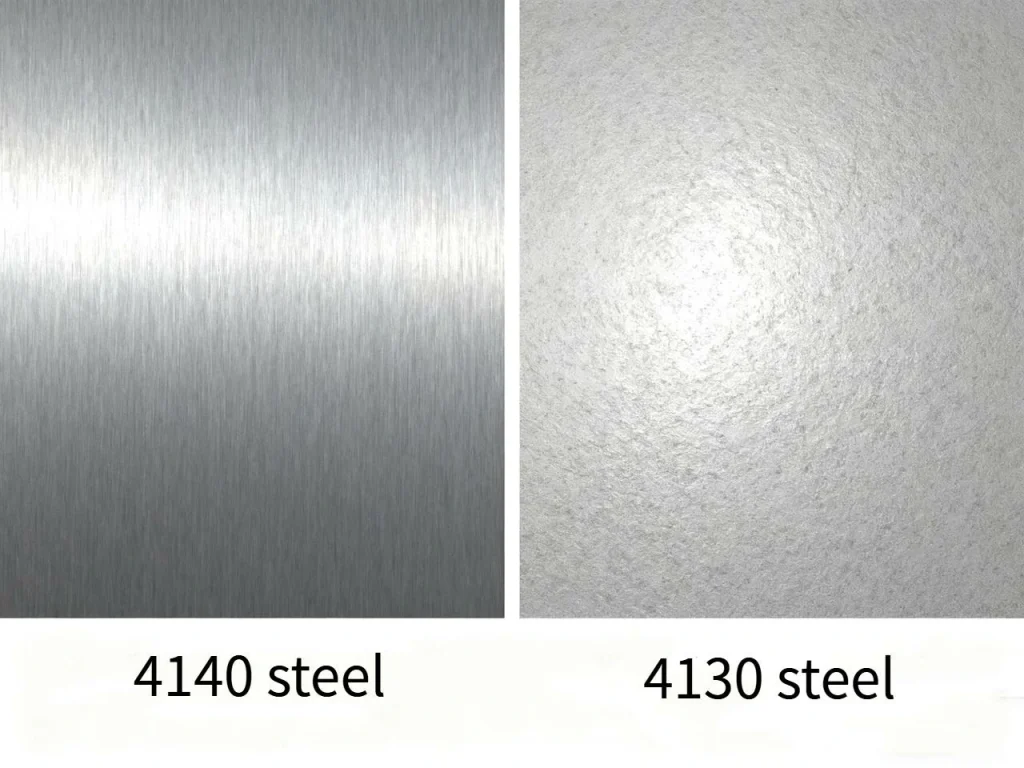
So, which is stronger: 4130 or 4140 steel? In most conditions, 4140 is stronger because of its higher carbon content and hardenability. But 4130 is easier to weld and can be a better match for welded assemblies or tubular structures.

4140 Steel Properties and Metallurgy
Understanding the metallurgy of 4140 helps you choose the right condition and avoid pitfalls during machining, welding, and heat treatment.
Chemical composition, microstructure, and phases
The chemical composition of 4140 balances strength and toughness. Carbon (~0.40%) enables high hardness after quench. Chromium (0.80–1.10%) raises hardenability and improves wear. Molybdenum (0.15–0.25%) controls tempering response and reduces embrittlement risk. Manganese and silicon aid deoxidation and strength.
Microstructure depends on condition:
- In the annealed state, expect spheroidized carbides in a ferrite/pearlite matrix. It’s easier to machine but much softer.
- In the quenched and tempered (QT) state, expect tempered martensite, which gives the familiar blend of high strength and toughness.
- In prehard (for example ~28–32 HRC), it is partially tempered for a good balance of machinability and strength.
For fatigue-critical parts (like rotating shafts and gears), inclusion cleanliness matters. Specify clean steel practices and consider ultrasonic testing for larger sections. Cleaner steel reduces crack initiation sites and improves life under cyclic loads.
Mechanical properties by condition
Because 4140 steel properties vary with condition and section size, treat these as typical ranges, not guarantees. Always verify with the mill cert or test coupons from your part.
| Condition | Approx. Hardness | Yield Strength | Tensile Strength | Notes |
|---|---|---|---|---|
| Annealed | ~197 HB (≈ 92 HRB) | ~415 MPa (60 ksi) | ~655 MPa (95 ksi) | Best for machining, lowest strength |
| Prehard (common) | ~28–32 HRC | ~655–830 MPa (95–120 ksi) | ~860–1035 MPa (125–150 ksi) | Good for CNC machining + assembly |
| QT to ~30 HRC | ~30 HRC | ~760–895 MPa (110–130 ksi) | ~895–1030 MPa (130–150 ksi) | Balanced strength and toughness |
| QT to ~40 HRC | ~40 HRC | ~965–1100 MPa (140–160 ksi) | ~1100–1240 MPa (160–180 ksi) | Higher strength; watch toughness |
| QT to ~50–55 HRC | 50–55 HRC | High but brittle if over-tempered | Very high; section-size limited | Use with care for small, thin parts |
Mini conversion (approximate):
- 250 HB ≈ 25–26 HRC
- 300 HB ≈ 31–32 HRC
- 350 HB ≈ 37 HRC
- 500 HB ≈ 50–51 HRC
These are ballpark guides to help with hardness and tensile strength links during QA.
Fatigue, impact toughness, and wear
For shafts and gears under rotating bending, fatigue strength is often about 50% of the ultimate tensile strength. In simple terms, if your tensile strength is 1000 MPa, your rotating-bending fatigue limit might be near 500 MPa. Of course, surface finish, notch sensitivity, residual stresses, and size all matter.
There is a trade-off:
- Higher hardness gives better wear and contact fatigue resistance (gear tooth flanks), but reduces impact toughness.
- Lower hardness raises toughness, but you give up some wear resistance and static strength.
You can add surface treatments without changing core properties:
- Induction hardening of gear teeth or shaft journals creates a hard case over a tough core. Expect case depths from ~1.5 to 6 mm depending on power and geometry.
- Nitriding forms a thin, hard nitride layer with minimal distortion. Typical equivalent case hardness is about 58–64 HRC with case depths around 0.2–0.6 mm. It helps both wear and fatigue.
Thermal and physical properties
| Property | Typical Value | Why it matters |
|---|---|---|
| Density | ~7.85 g/cm³ | Weight, rotor inertia, balance |
| Thermal conductivity | ~42.6 W/m•K | Heat flow during service and machining |
| Coefficient of thermal expansion | ~12 x 10⁻⁶ /K (20–100°C) | Tolerance planning under heat |
| Modulus of elasticity | ~205 GPa (29.7 Msi) | Deflection and vibration |
If your part sees thermal gradients (brakes, turbine couplings), plan for expansion and thermal stress. For CNC machining, use steady cooling and consistent coolant to control thermal growth and keep tolerances tight.
Heat Treatment and Surface Hardening (How-To + Pitfalls)
Understanding the heat treatment of 4140 is essential. Processes like quenching, tempering, and annealing involves heating the steel to achieve target hardness. These procedures make 4140 alloy steel suitable for high-strength applications, and ensure the material is properly heat treated. Your choice depends on geometry, size, and final mechanical properties.
Annealing, normalizing, quench and temper basics
- Annealing (to improve machinability):
- Heat to about 1550–1600°F (845–870°C).
- Hold for 1 hour per inch of thickness (minimum 1 hour).
- Furnace cool slowly to ~1000°F (540°C), then air cool. Result: soft structure, machinability ≈ 65% (relative scale).
- Normalizing (to refine grain before hardening):
- Heat to 1600–1700°F (870–925°C).
- Air cool to room temperature. Result: more uniform response to quench.
- Quench and Temper (the workhorse):
- Austenitize at ~1525–1600°F (830–870°C).
- Quench in oil or polymer; water is risky and can cause quench cracking.
- Temper at the chosen temperature to hit target hardness/toughness. Result: tempered martensite with tunable strength and toughness.
Tempering response and hardness control
Tempering temperature sets hardness. Lower temper = higher hardness; higher temper = lower hardness but better toughness. A practical approach:
- Aim for ~28–32 HRC for prehard machinability.
- Aim for ~30–40 HRC for balanced strength and durability in shafts and gearing.
- Up to ~55 HRC for thin parts that must be very hard, with care on toughness.
Avoid temper embrittlement. For Cr-Mo steels, long holds or slow cooling through roughly 700–1070°F (370–575°C) can raise ductile-to-brittle transition temperature. If you must temper in that band, avoid long soaks and cool quickly. A re-temper at a higher temperature can reverse it.
Surface hardening options
- Induction hardening: Ideal for local hard cases on gear teeth or bearing journals. It’s fast and creates compressive residual stress that helps fatigue. Control scan speed and quenchant for case depth and minimal distortion.
- Nitriding: Great for wear and fatigue with minimal growth. No austenitization means little shape change. Typical case hardness translates to roughly 58–64 HRC, with thin cases around 0.2–0.6 mm. Perfect for precision shafts or slides that can’t move after finish machining.
Common heat-treatment risks and mitigation
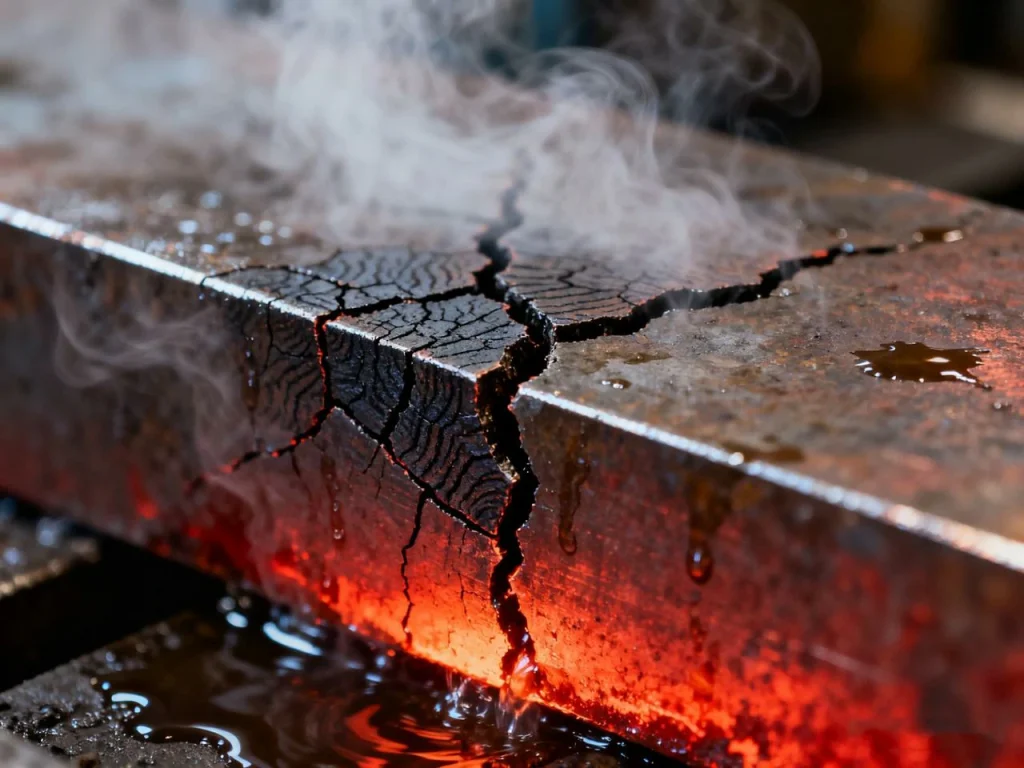
- Quench cracking: Comes from high thermal stress and high severity quench. Use oil or polymer quench, rounded corners, and proper agitation. Avoid water unless qualified for the geometry.
- Distortion/warping: Use uniform heating, controlled quench, stress-relief cycles, and proper fixturing. Temper promptly.
- Retained austenite: If hardness is low and stability is poor, a sub-zero treatment or proper temper can help.
- Decarburization: Protect surfaces during heat (controlled atmosphere, wraps). Remove decarb layer before service for accurate hardness and fatigue performance.
How do I prevent cracking in 4140 during quenching?
- Use oil or polymer quench (not water), design with generous radii, preheat thick or complex parts for uniform temperature, quench promptly after austenitize, and temper right away. Keep hydrogen out of the process (dry quench media and clean surfaces).
Machining, Welding, and Forming Best Practices
Working with 4140 steel—whether for CNC-machined components, shafts, gears, or structural parts—requires understanding how its condition, hardness, and alloying affect machinability, weldability, and forming. Here’s a detailed, practical guide.
Machining 4140 (annealed vs. prehard)
In the annealed condition, 4140 alloy steel exhibits good machinability, approximately 65% on standard scales. Prehard 4140 steel at ~28–32 HRC can still be machined effectively using coated carbide or CBN tools and consistent coolant, making it a versatile type of steel for precision components. At >35 HRC, use coated carbide or CBN for hard turning and keep cuts positive to avoid rubbing.
Practical tips for CNC machining of 4140 steel:
- Use sharp, coated carbide with positive rake and controlled chip breakers.
- Keep a steady feed to avoid work hardening on the surface. While 4140 doesn’t work harden like austenitic stainless, it can glaze if the tool rubs.
- Apply consistent coolant. Avoid cycling coolant on/off, which can shock hot tools and promote edge chipping.
- For deep holes, use high-pressure coolant and peck cycles. For threads in prehard, consider thread milling for size control.
Welding 4140 like a pro
Welding 4140 can be challenging because 4140 steel requires preheating and post-weld heat treatment to avoid hydrogen-induced cracking. Proper preheating and post-weld heat treatment ensures toughness and reduces hardness in the HAZ. You must use preheating and low-hydrogen procedures.
- Typical preheat: 400–600°F (205–315°C), higher for thicker sections.
- Use low-hydrogen electrodes/fillers. Match tensile strength (for example 80–120 ksi class) or use a slightly lower-strength filler to reduce crack risk when toughness is critical.
- Control interpass temperature (often 450–600°F).
- After welding, use post-weld heat treatment (PWHT) to temper the HAZ and reduce hardness. A common PWHT is 1100–1200°F (595–650°C), with hold time by thickness.
Forming, forging, and stress relief
- Forging/hot working: Work at ~1600–2200°F (870–1200°C). Do not work below ~1500°F (815°C). Slow cool after forging to avoid cracking.
- Cold working: Limited due to strength; heavy cold bends need large radii and may need an intermediate anneal.
- Stress relief: After heavy machining, stress-relieve at 1050–1250°F (565–675°C) to improve dimensional stability before final finishing.
Troubleshooting quality issues
- Signs of hydrogen cracking after welding: delayed cracking near HAZ, especially at toes of welds, often within 48 hours. Keep joints dry and preheated; consider bake-out.
- Hardness variability: Confirm uniform heat treatment; check for decarb on surfaces.
- HAZ problems: If HAZ is too hard/brittle, increase preheat and/or add a PWHT cycle.
What is 4140 Steel Used For? Applications and Case Studies by Industry
When it comes to choosing a steel that balances strength, toughness, and wear resistance, 4140 steel often tops the list. Its versatility and relatively reasonable cost make it a go-to alloy steel for parts that must endure repeated stress, torque spikes, or harsh operating conditions. Let’s break down its main applications by industry and share some real-world examples.
Automotive and EV drivetrains
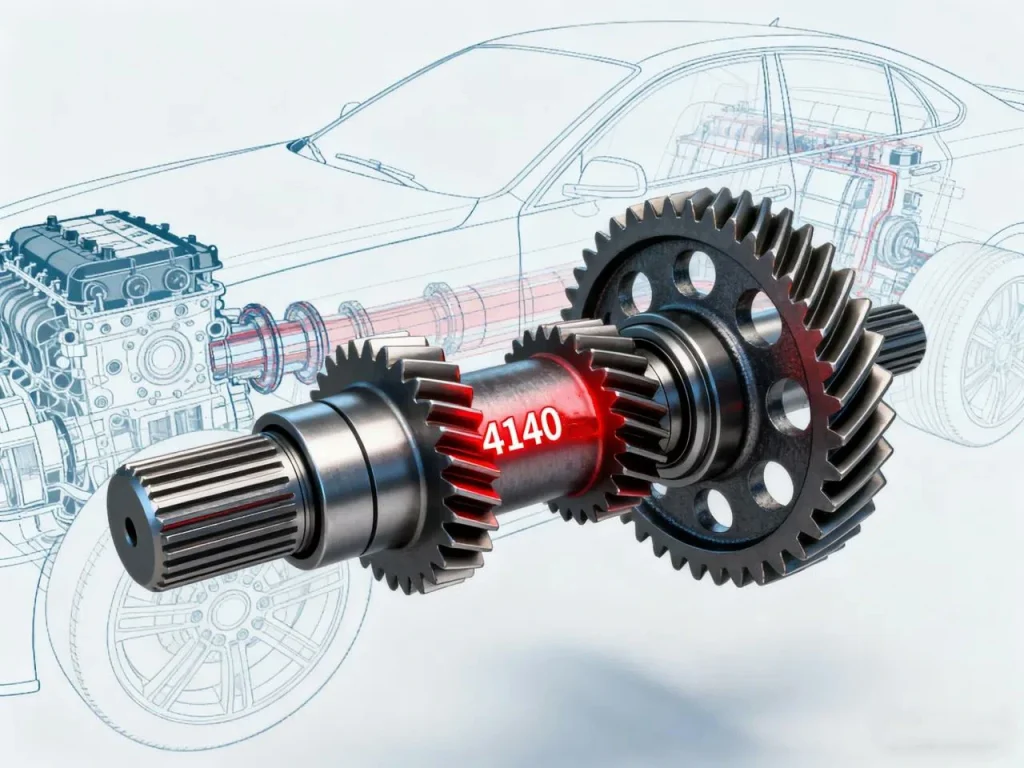
4140 is a go-to for gears, axles, and transmission shafts. These parts see fluctuating torque, misalignment, shock from shifting, and millions of cycles. When properly quenched and tempered to 30–40 HRC, the balance of strength and toughness helps prevent tooth root fractures and shaft failures. For gear tooth pitting, induction hardening or nitriding improves surface hardness while keeping a tough core.
Aerospace structures and hardware
In aerospace, weight and reliability matter. 4140 appears in landing gear components, turbine shafts, and high-strength fasteners, often with strict traceability and test requirements. In thicker sections, consider whether 4340 or a higher-hardness variant is needed, but for moderate thickness with strong fatigue needs, QT 4140 holds up well and is cost-effective.
Oil & gas and heavy machinery
Oil patch drill collars, downhole tools, tool joints, and heavy dies/punches benefit from 4140’s hardenability and fatigue performance. Operators like its ability to take a beating and still resist wear when treated properly. In harsh environments, add coatings or corrosion protection; remember 4140 is not stainless and will rust without protection.
Case study: 4140 vs. 4130 in impact and wear
In plant trials and field repairs, parts swapped from 4130 to 4140 in impact or abrasion service often show longer life due to higher achievable hardness and tensile strength. On the other hand, complex welded frames and tubular assemblies still favor 4130 for easier welding and lower crack risk. The key is the use case: if you need higher strength and wear, pick 4140; if you need long weldments or thin-wall tubes, 4130 often wins.
Equivalents, Standards, and Substitutions
When working with 4140 steel, it’s important to know that there are international equivalents and alternative grades that can fit your project, depending on location, availability, and specific mechanical requirements. While 4140 is widely recognized in the US under the AISI/SAE designation, engineers around the world often encounter different names for similar alloys.
International equivalents you should know
| System | Grade | Notes |
|---|---|---|
| AISI/SAE | 4140 | US/International designation |
| EN | 42CrMo4 | Very close composition; common in EU |
| DIN | 1.7225 | Material number corresponding to 42CrMo4 |
| JIS | SCM440 | Widely used in Asia-Pacific |
These are not always one-to-one replacements for every spec. Check chemical composition and mechanical property requirements for your standard and form (bar, plate, forging).
Standards and specifications
Common standards referenced for bars, plates, and forgings include general steel bar standards and aerospace/automotive specs. For purchasing and QC, reference:
- Chemical composition and supply condition standards (for example, general bar standards such as ASTM A29/A29M).
- Application or product standards from aerospace and automotive bodies (for example, SAE or AMS specifications for particular forms).
- Welding procedures and welder qualifications from AWS codes.
Ask for Material Test Reports (MTRs), heat numbers, and where needed, NDT results.
Smart substitutions: 4130, 4340, 8620, 4150
Use this quick selection matrix to match to your needs.
| Grade | Weldability | Strength potential | Toughness in thick sections | Case hardening | Typical use |
|---|---|---|---|---|---|
| 4130 | High | Medium | Good | Fair (shallow) | Welded structures, tubing |
| 4140 | Medium (needs preheat/PWHT) | High | Good (moderate sections) | Fair (thin case or nitriding) | Shafts, gears, tool holders |
| 4340 | Medium (needs care) | Very high | Excellent | Fair | Thick, high-strength parts |
| 8620 | Medium-High | Low core | Good core | Excellent (deep carburize) | Gears, cams needing deep hard case |
| 4150 | Medium | Higher than 4140 | Good | Fair | When extra hardness is needed vs. 4140 |
4130 Steel vs 4140 Steel: Detailed Comparison
4130 steel properties include moderate tensile strength, good weldability, and reasonable fatigue resistance. When deciding between 4130 steel and 4140 steel, it helps to break down their differences across several key categories. Each steel offers distinct advantages depending on your application requirements.
Chemical Composition and Alloying
4140 steel contains slightly higher carbon and carefully balanced chromium and molybdenum, which enhances its hardenability and tensile strength. 4130 steel has lower carbon but similar Cr-Mo content, making it more forgiving during welding and fabrication. The alloying differences directly affect the achievable hardness, wear resistance, and fatigue strength of each steel.
Mechanical Properties (Strength and Hardness)
4140 steel can reach higher hardness and tensile strength after heat treatment, making it suitable for shafts, gears, axles, and components under repeated stress. 4130 steel achieves moderate hardness and strength, sufficient for welded structures and assemblies that do not face extreme loading. The trade-off is clear: 4140 excels in strength-critical applications, while 4130 favors fabrication flexibility.
Weldability and Fabrication
Welding 4140 steel requires preheating and post-weld heat treatment to prevent hydrogen cracking, particularly in thicker sections. 4130 steel, on the other hand, welds more easily, tolerates complex joints, and is often chosen for tubing, frames, and welded assemblies. For projects where ease of assembly and crack prevention are priorities, 4130 is usually preferred.
Heat Treatment and Surface Hardening
4140 steel is highly versatile when it comes to heat treatment. Quenching and tempering can tune its hardness, while induction hardening or nitriding provides a wear-resistant surface with a tough core. 4130 steel can also be heat treated but is usually kept at moderate hardness levels; surface hardening is less common due to its lower carbon content.
Applications and Use Cases
4140 steel is best for components that endure high stress, impact, or cyclic loading, such as automotive and aerospace shafts, gears, axles, and tool holders. 4130 steel is often used for welded frames, structural tubing, roll cages, and assemblies where fabrication simplicity and weld integrity are more important than maximum strength. Selecting the right steel depends on the balance between performance needs and manufacturing constraints.
Machining and Cost Considerations
4140 steel, when hardened, can be more challenging to machine than 4130 steel and may require specialized tooling and coolant practices. Heat treatment and surface hardening also add cost. 4130 steel is easier to machine, weld, and fabricate, making it cost-effective for projects that do not demand extreme hardness or wear resistance.
Summary: Choosing the Right Steel
- Choose 4140 steel when higher strength, hardness, impact resistance, and wear resistance are critical.
- Choose 4130 steel when welding, fabrication, and crack prevention are more important than maximum hardness.
- Understanding each steel’s properties ensures optimal performance, manufacturability, and longevity of your components.
Sourcing, Quality, and Specification Checklist
Working with 4140 steel—whether for CNC-machined components, shafts, gears, or structural parts—requires understanding how its condition, hardness, and alloying affect machinability, weldability, and forming. If you need professional parts machining services to meet precise specifications, U-Need offers CNC machining and custom component solutions.
How to write a rock-solid RFQ/spec for 4140
- Identify the grade and standard: “AISI 4140” plus the sourcing standard (for example, bar standard like ASTM A29/A29M).
- Form and size: bar, plate, forging; diameter/width/thickness and length.
- Condition: annealed, prehard (state target HRC), or quenched and tempered (state target HRC or strength).
- Heat treatment details: austenitize temperature, quench media, temper range, hardness/strength targets, and test method/locations.
- Quality requirements: MTR with chemistry and mechanicals, NDT if needed (UT/MPI), decarb limits, grain size if applicable.
- Surface: finish class, scale removal, straightness, surface protection (oil, wrap).
- Tolerances: per drawing or standard class.
- Quantity and delivery: lot size, part count, need date, and packaging.
Include a note on traceability for safety-critical parts and specify PWHT if the part will be welded.
Forms, sizes, and common conditions
| Form | Common Supply Conditions | Notes |
|---|---|---|
| Round bar | Annealed, Prehard (~28–32 HRC), QT to spec | Most common for shafts |
| Plate | Annealed, QT | Profile cut and machined for tooling |
| Forgings | As-forged, Normalized, QT | Best for large or shaped parts |
Price and availability drivers
- Alloy surcharges and raw material markets (chromium, molybdenum).
- Heat-treatment cost and load size.
- Lead times for large diameters and forged shapes.
- Testing requirements (NDT, charpy, microcleanliness) add cost and time.
Compliance and sustainability
- Ask for ISO 9001 quality management where relevant.
- Request MTRs for traceability.
- 4140 steel is recyclable; scrap streams are well established.
- For coatings and processes, consider REACH/RoHS and local environmental rules.
- Plan safe handling for heat treatment and welding per occupational safety rules.
FAQs
What are the disadvantages of 4140 steel?
Well, 4140 steel is a really strong and tough alloy, but it’s not perfect. One of the main drawbacks is weldability—it’s only fair, not easy. If you’re planning to weld it, you usually need to preheat the steel properly and often follow up with post-weld heat treatment (PWHT) to prevent cracking, especially in thicker sections. Another thing is that it’s not stainless, so it can rust if left exposed to moisture or salty environments. Also, if your project requires very deep carburized surfaces, 4140 isn’t the best choice—you’d be better off with a case-hardening steel like 8620, which can handle deep surface hardening while keeping a tough core. So basically, 4140 is amazing for strength and durability, but you need to handle it carefully when it comes to welding and corrosion protection.
Does 4140 steel rust easily?
Yes, like most carbon steels or low-alloy steels, 4140 will rust if exposed to humid air or salty conditions. Its chromium content isn’t high enough to make it stainless, so don’t expect it to resist corrosion on its own. To keep it safe, people usually use a light oil coating, paint, plating, or other conversion coatings. Basically, if your part is going outdoors or in a humid environment, you need some kind of protection; otherwise, it’ll develop rust spots over time.
Is 4130 or 4140 steel stronger?
When it comes to strength, 4140 usually wins. Thanks to its higher carbon content and ability to respond to quench and temper heat treatment, it can reach higher Rockwell hardness and tensile strength. That makes it ideal for parts that need to resist impact, torque, or repeated loads, like shafts or gears. 4130 steel, on the other hand, is a bit softer and doesn’t reach the same hardness, but it’s much easier to weld. So if your project involves complex welds or thin tubular structures, 4130 might actually be the smarter choice.
What is 4130 steel good for?
4130 steel is really handy when you need welded frames, tubing, or assemblies that see moderate stress. It’s strong enough for most structural applications and has good toughness, but its real advantage is ease of welding. You don’t need complicated preheating or post-weld treatments like you do with 4140. So if your project involves weld-intensive assemblies where convenience and fabrication speed matter, 4130 is often the go-to steel alloy.
Does 4130 steel work harden?
Yes, it can strain harden a bit under cold working, but not nearly as much as austenitic stainless steel. If you’re machining it, be careful not to rub your cutting tool on the surface for too long, because that can cause glazing and make the surface harder to finish. Otherwise, for most typical fabrication and welding tasks, 4130 behaves predictably and is easy to work with.
What is 4140 chrome moly steel?
It’s basically the same as AISI 4140. People often call it chrome-moly or chromoly steel because it’s a chromium-molybdenum alloy steel with about 0.40% carbon. That combination gives it a nice balance of high strength, toughness, and fatigue resistance, which is why it’s popular for shafts, gears, axles, and other high-stress parts.
Is 4140 chrome moly steel better than stainless steel?
It really depends on what you need. 4140 can achieve higher strength and hardness than many stainless steels at a lower cost, which is great for mechanical or structural parts. Stainless steel, on the other hand, is much better at resisting corrosion. So if you’re building something for a wet, salty, or outdoor environment, stainless might be better. But if your priority is impact resistance, high tensile strength, and wear resistance, 4140 is often the smarter choice.
Does 4140 chromoly steel rust?
Yes, without any protective coating or oil film, 4140 chromoly steel will corrode just like other low-alloy or carbon steels. People usually apply oil, paint, plating, or conversion coatings to prevent rust, especially for parts exposed to the elements. Keep in mind that the chromium in 4140 isn’t enough to make it stainless, so corrosion protection is essential for long-term durability.

 English
  German
  French
  Italian
  Spanish
  Polish
  Czech
Czech  Japanese