
Choosing between 3-axis and 5-axis Frezowanie CNC is less about owning a more advanced machine and more about whether part geometry, tolerance risk, and setup strategy justify additional motion. Both approaches are well-established machining processes and can deliver accurate results when applied correctly.
The real differences between 3-axis and 5-axis machining become clear when evaluating tool access, the number of required setups, and how many faces or angles must be machined without re-clamping the part.
If you are an engineer, technical buyer, or manufacturing decision-maker, the core question is usually straightforward:
- Can a simple 3-axis process hit the geometry and datums you need with reasonable setups?
- Or does the part demand access, orientation control, and stability that only a 5-axis CNC machine can realistically provide?
This guide focuses on engineering feasibility rather than marketing claims, outlining the practical advantages and disadvantages of each approach.
3-Axis vs 5-Axis CNC Milling: Which Machine to Choose for Precision and Performance
Before diving into the specific advantages of 3-axis milling, it’s helpful to understand when this machine excels and why it often suffices for simpler, mostly flat parts.
If your parts are mostly flat/2.5D: why 3-axis is often suitable
If most features can be machined from one primary direction (tool approaching roughly normal to a main face), 3-axis cnc is often the simplest and most predictable solution. In practice, that means parts that are 2d and 2.5d: flat faces, pockets, slots, drilled hole patterns, and simple contours. 3-axis milling moves along three axes (three linear axes) and is well suited to straightforward machining tasks.
Advantages of 3-axis for simple parts include:
- Fewer setup variables (less chance of datum shift between operations)
- Simpler programming and verification
- Easier fixturing and more predictable inspection planning
If you are controlling risk on mostly planar parts, 3-axis often offers the “least moving parts” approach in both machinery and manufacturing capabilities.
If your parts require undercuts or compound angles: when 5-axis may be beneficial
When features require the cutting tool or workpiece to tilt or rotate to maintain access, 5-axis CNC provides more practical options.
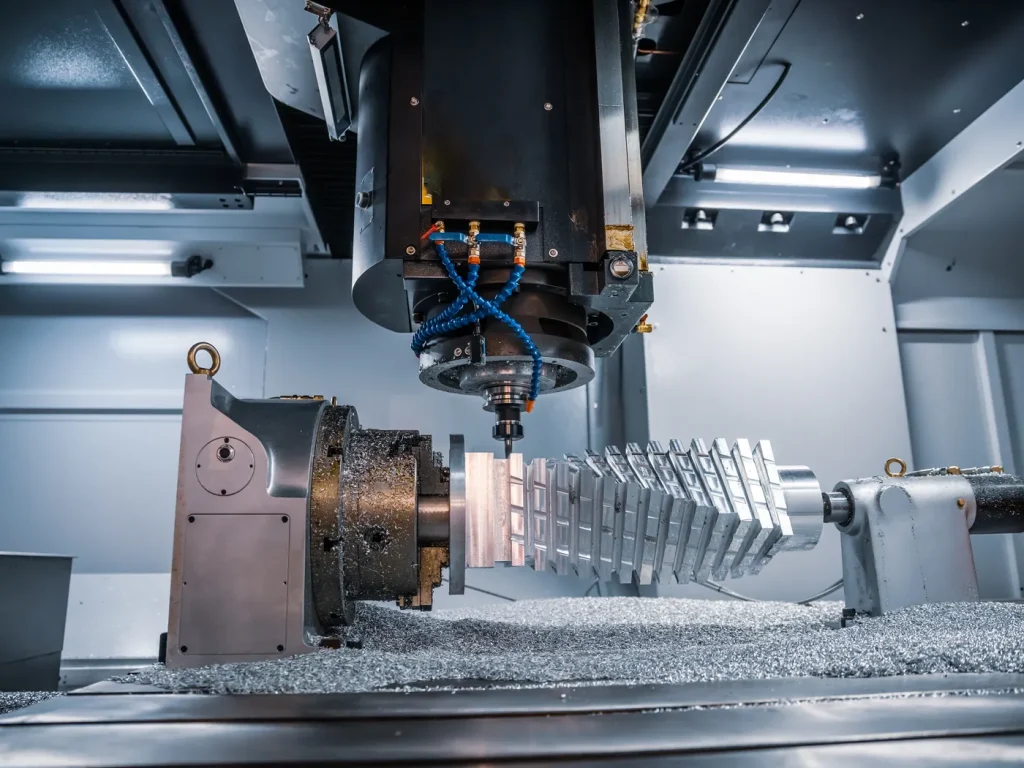
5-axis machines add two rotational axes on top of X/Y/Z (commonly A/C or B/C, depending on machine kinematics). This allows tool access to multiple faces, compound angles, curved surfaces, and undercuts with often fewer setups.
From a feasibility standpoint, “worth it” generally means at least one of these conditions applies:
- Multiple faces with tight relationships must be machined
- Geometry is hard to reach without special cutters or fixturing
- Quality is sensitive to small alignment errors that can accumulate across setups
Myth check: 5-axis is not automatically faster or better for all jobs. It can reduce setups and improve tool engagement, but may increase programming, simulation, and operator effort. Simple 2D/2.5D parts may still run faster on the 3-axis.
Myth check: Is 5-axis always faster or “better” for every job?
No. The axis count does not automatically make a job faster, cheaper, or more accurate.
A 5-axis process can reduce total time when it removes multiple setups, simplifies tool access, or improves tool engagement. But it can also add time in programming, simulation, prove-out, and operator attention. Multiple sources and user discussions highlight the same misconception: 5-axis is often excessive for simple projects, and it can be programming-heavy when the geometry does not need it.
So the right comparison is not “cycle time on the spindle” alone. It is total job time and total risk, including setup, inspection, and rework exposure.
Decision Snapshot Table: Part Geometry → Recommended Machine Type
| Part geometry / requirement (typical triggers) | What usually drives the choice | Recommended starting point |
|---|---|---|
| Flat faces, pockets, slots, hole patterns, simple contours (2D/2.5D) | Tool approaches from one direction; minimal reorientation | Frezowanie 3-osiowe |
| Mostly simple, with a few angled holes or chamfers | Often achievable with one extra setup or simple indexing | 3-axis (or 3+2 if available) |
| Multi-face machining with tight face-to-face relationships | Setup count drives tolerance risk | 5-axis (or 3+2 if simultaneous not needed) |
| Undercuts, deep cavities with hard-to-reach walls, compound angles | Tool access becomes the main constraint | Frezowanie 5-osiowe |
| Curved surfaces where blends matter | Continuous tool motion affects surface quality | Jednoczesna praca w 5 osiach |
Axis Motion in 3-Axis and 5-Axis CNC Machines
To fully grasp the differences in machining capabilities, it helps to first break down how each axis moves in 3-axis and 5-axis CNC machines.
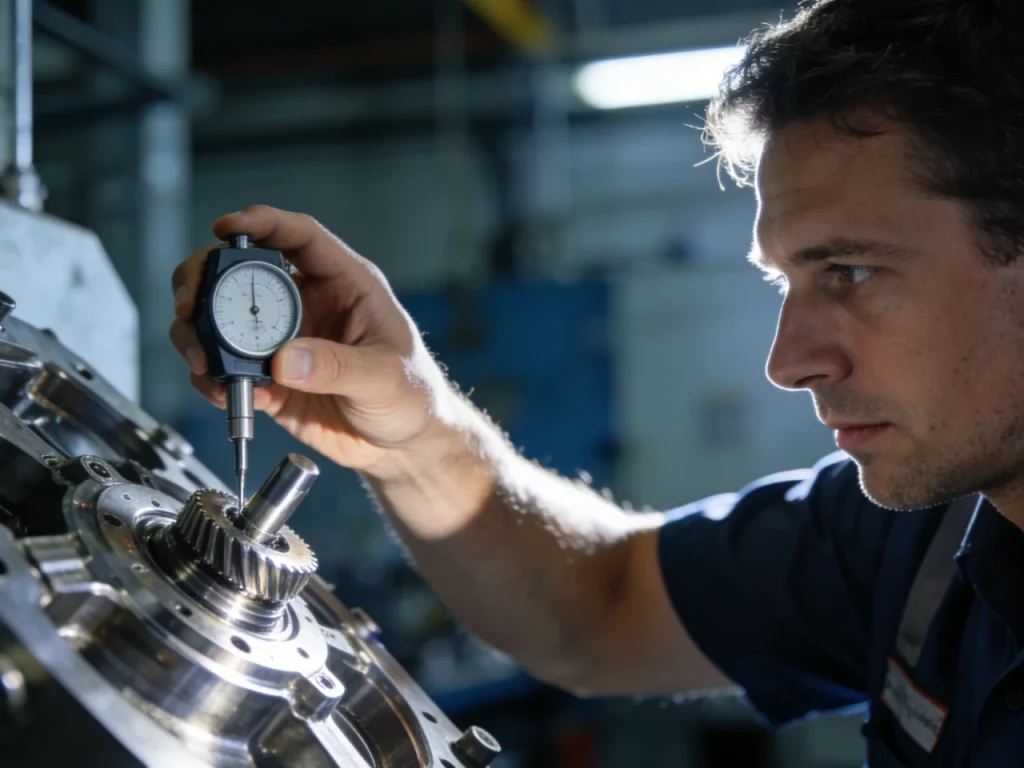
3-axis fundamentals: linear travel on X, Y, Z (three linear axes, three directions)
- X/Y move the cutting tool along two horizontal directions
- Z moves the tool vertically (z axes)
5-axis fundamentals: adding two additional rotational axes
- Two rotational axes (A/C or B/C) rotate the workpiece or tool head, depending on machine kinematics.
- Benefits include:
- Access to multiple faces in one clamping
- Machining of complex geometries and undercuts
- Better control of tool engagement angles
Note: Claims of “single-setup machining” are qualified: some parts may still require 2+ setups depending on envelope, collision avoidance, and fixture constraints.
Diagram: side-by-side axis motion graphic + labeled machine configurations
Text diagram concept (side-by-side):
- Left panel: 3-axis
- X ↔ (table left/right)
- Y ↕ (table front/back)
- Z ↧↥ (spindle up/down)
- Note: tool axis stays fixed (usually vertical)
- Right panel: 5-axis
- X, Y, Z (same as above)
- Plus rotation about A (tilt about X) and B (tilt about Y) or C (rotation about Z)
- Note: either the table tilts/rotates or the head tilts/rotates
This graphic is useful because many feasibility errors start with an assumption that “5-axis means faster.” The more reliable statement is: 5-axis changes reach and orientation, so it changes how many setups you need and what surfaces are practical to cut cleanly.
Common 5-axis Configurations and Practical Implications
| Configuration | Co porusza | Feasibility notes |
|---|---|---|
| Trunnion/table-tilt | Cutting tool or workpiece rotates/tilts on table | Strong for multi-face work; part size may limit tilt |
| Swivel/head | Tool head tilts/rotates | Keeps large parts stationary; head kinematics affect reach/collision |
| Table-rotate + head-tilt | Both move | Flexible, but planning more sensitive to limits |
Where 3-Axis CNC Machines Excel
Now that we’ve reviewed the basics of 3-axis motion, let’s explore the types of parts and features where 3-axis CNC machines truly excel.
Best-fit features: flat faces, slots, pockets, basic contours, straightforward production runs
Best-fit features: flat faces, slots, pockets, basic contours, straightforward production runs.
Constraints arise with:
- Angled features
- Podcięcia
- Deep cavities
- Obróbka wielopłaszczyznowa
Even if a 5-axis CNC machine could cut the same pocket, it may not be the fastest path from drawing to good parts. This is why engineers often see 3-axis machining benefits on simple brackets, plates, panels, and enclosures where most work is reachable from one or two orientations.
Why 3-axis can be faster for simple parts: fewer complexities in programming/workholding
For simple geometry, the “speed” advantage of 3-axis often comes from everything around the cut:
- Workholding is simpler to design and repeat.
- Programs are easier to prove out and modify.
- Fewer axes reduce the number of motion limits, collision cases, and post-processor edge cases.
Even if a 5-axis machine could cut the same pocket, it may not be the fastest path from drawing to good parts. If you do not need rotation, you may be paying for it in planning time.
This is why engineers often see 3-axis winning on simple brackets, plates, panels, and enclosures where most work is reachable from one or two orientations.
Constraints: angled features, undercuts, deep cavities, and why extra setups add risk
The 3-axis constraints become important when the part asks for multiple angles or “hidden” surfaces:
- Angled features: chamfers, angled holes, or sloped faces may need the part reclamped at an angle.
- Undercuts: features that sit behind a wall or lip can require special cutters and careful clearance.
- Deep cavities: long tools can be needed to reach down into a cavity, which increases deflection risk and limits cutting parameters.
- Multi-face machining: if five faces need machining, a 3-axis approach can mean many setups.
Each extra setup adds risk because it introduces another chance for:
- Datum shift (the part is not seated the same way)
- Stack-up error across faces
- Inconsistent surface transitions
- Longer inspection loops (you may need to re-establish datums each time)
You can still make many of these parts on a 3-axis CNC machine. The key is whether your tolerance scheme and functional surfaces can tolerate the extra setup variation.
Can a 3-axis CNC machine make angled features or undercuts?
Yes, sometimes. Angled features can be machined by adding setups (reclamping the part at an angle) or by using fixtures that present the angle to the tool. Undercuts can sometimes be reached with special cutters, but clearance and tool rigidity become the limiting factors, and the process can get sensitive to small setup errors.
Where 5-Axis CNC Machines Excel: Complex Geometry, Reduced Setups, and Aerospace Industry Applications
5-axis CNC often reduces setups for machining complex parts.
Advantages include:
- Optimized tool angles improve contact and reduce deflection
- Better chip evacuation, coolant access, and tool life
- Reduced datum transfers and setup-driven error risk
Important: Benefits are qualitative and depend on geometry, tooling, and process plan. No absolute guarantees.
Single-setup machining: reducing repositioning for multi-face parts and complex contours
The most practical 5-axis advantage is not “more accuracy by default.” It is that you can often machine more of the part in one clamping.
For parts that need features on many faces—common in aerospace components, engine components, complex housings, and similar geometries—5-axis can reduce or remove the need to:
- Flip the part multiple times
- Re-indicate datums repeatedly
- Carry positional relationships across setups
Multiple sources and case examples describe this as a path to fewer errors and shorter lead times on complex parts, even when the machine rate is higher. The mechanism is straightforward: fewer setups means fewer places where the part can be mislocated.
Quality advantages: smoother finishes and accuracy benefits from optimized tool angles
5-axis also changes how you can present the cutting tool to a surface. When the tool can be tilted, you can often:
- Maintain a better contact angle on contoured surfaces
- Avoid cutting with the least stable part of the tool
- Reduce the need for extremely long reach tools in some geometries
For surface quality, continuous orientation changes can help avoid visible transitions that appear when the part is indexed and re-cut from a new direction. That matters most on parts where the surface is functional (seal faces, flow paths) or cosmetic.
None of this removes the need for good programming and inspection. It just gives the process more options to manage tool engagement and access.
Materials and process advantages: chip evacuation, coolant access, and tool life considerations
Some machining references note that 5-axis can help with challenging materials because tool orientation can improve:
- Chip evacuation (chips exit the cut more cleanly when gravity and tool angle work with you)
- Coolant access (easier to aim coolant at the cutting zone when the part is oriented for it)
- Tool life (because engagement and heat can be more stable when the tool is presented correctly)
These advantages are real in principle, but they are not guaranteed. They depend on geometry, tooling, and how the toolpath is built. The safe takeaway for feasibility is: if a material is difficult and the geometry is also difficult, 5-axis gives more process options to manage chips and heat.
Visual: “multi-setup vs single-setup” workflow diagram (setup count, risk points, inspection points)
Text workflow diagram concept:
- 3-axis, multi-setup path
- Setup 1 (Datum A): machine top features → inspect
- Setup 2 (re-clamp): machine side features → re-establish datums → inspect
- Setup 3 (re-clamp): machine opposite side → re-establish datums → inspect
- Risk points: each re-clamp can shift location; each datum transfer can add uncertainty.
- 5-axis, single-setup path
- Setup 1 (single clamping): rotate to faces as needed → inspect key datums once (then verify features)
- Risk points: fewer datum transfers, but higher need for collision checking and toolpath verification.
This is the main reason axis choice affects lead time: lead time is often dominated by setups and verification, not only by cutting time.
3+2 (Indexed) vs Simultaneous 5-Axis CNC
| Podejście | Axis motion | Najlepiej dopasowana geometria | Surface behavior |
|---|---|---|---|
| 3-osiowy | X/Y/Z only | Flat/2.5D, simple contours | Limited access, fewer orientation transitions |
| 3+2 (indexed) | Rotary axes reposition between cuts | Multi-face parts, angled features | Blend lines may appear at indexed boundaries |
| Jednoczesna praca w 5 osiach | All axes move continuously | Compound curves, undercuts, complex shapes | Smoother blends, better cusp control |

What 3+2 means: positional indexing, strengths for tolerance control, and where blend lines appear
“3+2” (also called indexed 5-axis or positional 5-axis) means the machine uses the two additional rotary axes to position the part (or head) at a fixed angle, then performs cutting with three-axis motion. So the tool cuts, stops, indexes to a new angle, then cuts again. This approach is useful for machining operations on complex vs simple parts.
From a feasibility view, 3+2 is often attractive because:
- It can reduce the number of setups like 5-axis technology does.
- It keeps cutting motion simpler (3-axis toolpaths), which can help with predictability.
- It is often easier to control certain tolerances because the cut itself is a stable 3-axis move at a fixed orientation (enable the cutting tool).
The trade-off is at transitions: when a surface must flow smoothly through multiple orientations, indexing can leave blend lines or subtle cusps at the boundaries if the toolpaths do not merge perfectly, especially on intricate shapes like impellers or turbine blades.
What simultaneous 5-axis adds: continuous motion, improved blending, cusp control, and surface quality
Simultaneous 5-axis technology means the machine moves all five axes at the same time during cutting. This supports toolpaths where the cutting tool along five or the automatically rotate the workpiece to maintain an optimal orientation relative to the surface.
In the sources provided, simultaneous 5-axis are linked to:
- Better blending on complex vs simple parts, especially on curved surfaces like turbine or impeller shapes.
- Improved surface quality where transitions matter, thanks to continuous milling.
- More precise machining capabilities for multi-face or multi-angle components.
It also raises the bar for programming, simulation, and machine configuration. Even if the part “can” be cut with indexed positions, simultaneous motion may be what makes the surface acceptable without heavy secondary finishing.
What’s the difference between 3+2 machining and simultaneous 5-axis?
3+2 machining indexes the part or head to a fixed angle, then cuts using standard 3-axis motion. Simultaneous 5-axis moves the rotary and linear axes together while cutting, so the tool angle changes continuously. Simultaneous motion tends to help most on blended, contoured surfaces where transitions and cusp control matter.
Visual: comparison table (3-axis vs 3+2 vs simultaneous 5-axis) + example surfaces/transition zones
| Podejście | Axis motion during cutting | Najlepiej dopasowana geometria | Common surface transition behavior |
|---|---|---|---|
| 3-osiowy | X/Y/Z only | Flat/2.5D, open pockets, simple contours | Limited access, fewer machining operations |
| 3+2 (indexed) | X/Y/Z cutting, two additional rotational axes position between cuts | Multi-face parts, angled features, prismatic shapes | Possible blend lines at indexed boundaries, sensitive on intricate shapes |
| Jednoczesna praca w 5 osiach | X/Y/Z + rotation along the x axis and around the y axis move together | Compound curves, undercuts, produce complex shapes (e.g., turbine blades, impellers) | Smoother blends, better cusp control with multi-axis machining operations |
Example transition zones (concept):
- Indexed: surface A cut at tilt 1 → index → surface B cut at tilt 2 → possible visible line at join.
- Simultaneous: tool stays engaged with a changing tilt → transition can be smoother.
Cost, Lead Time, and ROI Considerations
Remove numeric guarantees: equipment cost, programming burden, and operator skill are qualitative factors.
Focus on:
- Liczba ustawień
- Fixture complexity
- Programming and verification time
- Inspection loops
Using 5-axis technology can increase hourly cost but may reduce total job risk by lowering multiple setups and repositioning. Continuous milling of intricate shapes like turbine or impeller components can reduce wear and tear on tools while maintaining machining capabilities.

Cost structure comparison: equipment, maintenance, programming time, and operator skill requirements
Across multiple sources, the cost differences are described consistently but mostly in qualitative terms:
- 3-axis tends to have lower equipment and maintenance burden because there are fewer moving assemblies and less complex kinematics.
- 5-axis tends to carry higher operating and maintenance costs and requires more programming effort and higher operator skill, especially for simultaneous toolpaths.
For feasibility, the more useful model is not machine price. It is the cost structure of the whole job:
- How many setups do you need?
- How complex is the fixture?
- How much programming and verification time is needed?
- How much inspection effort is needed to confirm multi-face relationships?
A 5-axis quote can look expensive per hour but still reduce total job cost if it removes enough setups and inspection loops on complex parts.
Cycle time reality: why 3-axis often wins on simple parts but 5-axis can reduce total time on complex parts
Sources and user discussions agree on the pattern but do not provide verified numeric breakpoints:
- For simple parts, 3-axis often wins because it is fast to program, fast to fixture, and fast to run repeatedly.
- For complex parts, 5-axis can reduce total time because it reduces setups, rework risk, and time spent re-establishing datums.
This is also where lead time is affected. If a part needs multiple setups on a 3-axis machine, each setup can require new inspection steps and can create scheduling delays (waiting for the next fixture, waiting for CMM time, waiting for an experienced setup person). A 5-axis plan that keeps the part in one clamping may shorten the critical path even if the cut time is similar.
Is 5-axis machining more expensive than 3-axis?
Often yes on an hourly basis, because the machine, maintenance, and programming requirements are higher. But on complex parts, 5-axis can still be cost-effective if it reduces setups, fixture complexity, and inspection steps. The cost difference is project-specific, and the sources available describe it mainly in qualitative terms rather than verified numbers.
Interactive tool idea: “setup-count breakeven estimator”
A practical way to compare cost of 3-axis vs 5-axis without guessing hourly rates is to estimate process burden.
Estimator inputs (concept):
- Setup count (3-axis plan vs 5-axis plan)
- Average time to complete and verify a setup (include indicating and datum touch-off)
- Number of inspection events needed (in-process checks + final verification)
- Tool change complexity (special undercut tools, long reach tools)
- Expected rework exposure (qualitative risk score tied to setup count)
Output (concept):
- Total “non-cutting time burden” comparison
- Qualitative risk flag if setup count is high relative to tolerance scheme
This does not produce a universal answer, but it forces the right discussion: if you save two setups and an inspection loop, that can be more valuable than shaving seconds off cutting time.
Reference types to consult for benchmarks: industry cost surveys, technical trade reports, academic manufacturing studies
Because the available sources do not provide verified, cross-checked numeric benchmarks, the safest path for numbers is to consult:
- Industry cost surveys (methodology matters)
- Technical trade reports that publish assumptions
- Academic manufacturing processes studies and benchmarking papers (often discoverable via scholarly databases)
If you need numeric ROI justification, you want sources that document: part type, material, setup strategy, toolpath type, and inspection method. Without that context, numeric claims are easy to misuse.
Accuracy, Surface Finish, and Repeatability
Key drivers:
- Fewer re-clamps reduce cumulative errors
- Continuous tool orientation can improve surface finish
- Indexed 3+2 methods may leave visible transitions; simultaneous 5-axis often smoother
Inspection considerations: datum strategy and verification complexity remain critical for overall performance and efficiency.
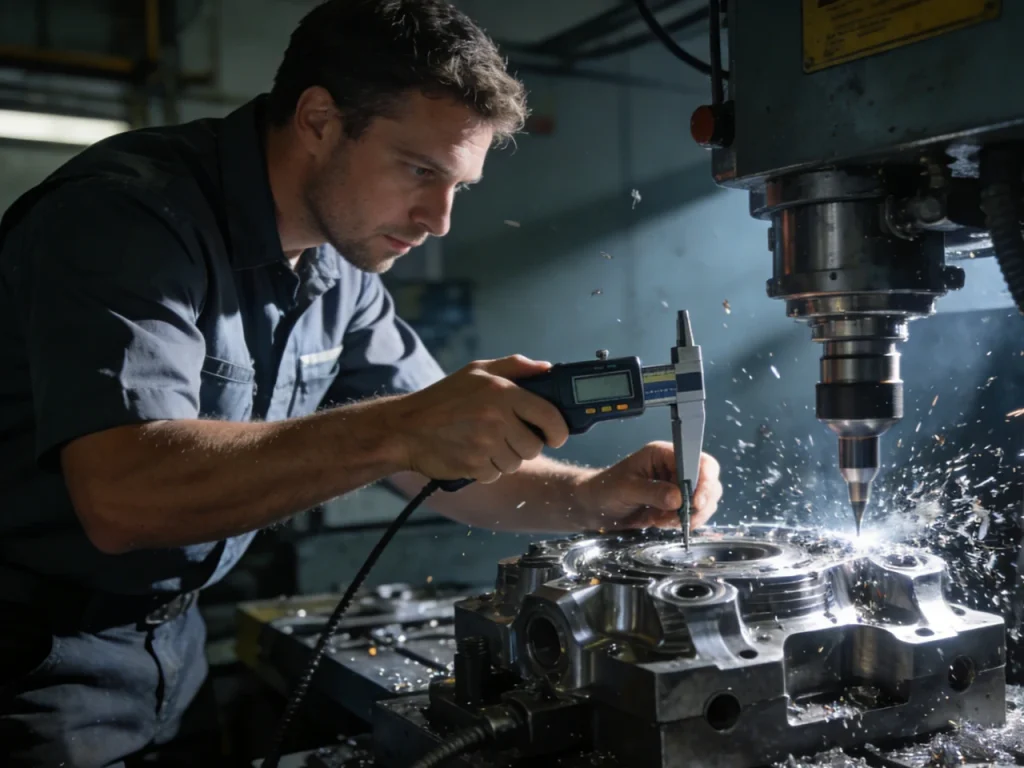
Practical accuracy drivers: fewer re-clamps, reduced cumulative error, better tool engagement angles
In practice, the accuracy discussion in 3-axis and 5-axis komputerowe sterowanie numeryczne (CNC) is often confused by a hidden variable: setup count.
A 5-axis machine is not automatically “more accurate” in all directions. What it often does is reduce:
- The number of times the part is removed and re-located
- The number of datum transfers needed to relate one face to another
Fewer re-clamps can reduce cumulative error (small location shifts that add up across operations). On certain contoured surfaces, the ability to control tool angle can also improve tool engagement and reduce deflection risk. These effects are described qualitatively in machining references: reduced setups can improve accuracy outcomes on complex parts.
Surface finish drivers: continuous toolpath vs indexed transitions (where visible lines can occur)
Surface finish is influenced by toolpath choice and tool engagement. In the 3-axis vs 5-axis milling comparison, one common separator is the differences between 3-axis and 5-axis:
- A continuous tool orientation to maintain a consistent cut
- Or can tolerate indexed transitions between orientations
Indexed (3+2) methods can produce excellent results on many geometries, but blend lines can appear at transitions, especially on flowing surfaces. Simultaneous 5-axis moves the cutting tool along five different axes, which can reduce these transition artifacts when the toolpath is designed to maintain smooth motion and consistent scallops (cusps).
The key point is not that one is always better. It is that surface requirements should drive the axis strategy, not the other way around.
Inspection implications: datum strategy and verification complexity across multi-face parts
Inspection can be the hidden cost driver in choosing CNC milling type or lathe operations.
- With multiple setups, you may need to verify that features machined in different orientations maintain their relationships (position, angularity, parallelism, or profile requirements depending on your drawing).
- With single-setup 5-axis machining, you may reduce datum transfers during machining, but inspection still needs a clear datum strategy that matches how the part was clamped and machined.
For multi-face parts, it often helps to define datums that are realistic to fixture and measure. If the drawing datums fight the manufacturing approach, you may pay for it through extra setups or complex inspection plans.
Chart concept: “error risk by setup count” (qualitative model) + reference types (metrology standards bodies, academic papers)
Chart concept (qualitative):
- X-axis: number of setups (1, 2, 3, 4+)
- Y-axis: relative error risk (low → medium → high)
- Curves:
- “Prismatic parts with loose inter-face relationships” rises slowly
- “Multi-face precision relationships” rises faster
This kind of chart should be supported using:
- Metrology standards bodies (for measurement and datum practice guidance)
- Academic papers on machining error stack-up and fixturing repeatability
The goal is not to claim a numeric error per setup. It is to make the risk visible so the team can choose where to spend complexity: in machining, in inspection, or in both.
Real-World Examples and Case Studies (How Shops Decide in Practice)
To see these principles in action, let’s examine real-world examples where shops weigh 3-axis versus 5-axis approaches for complex parts.
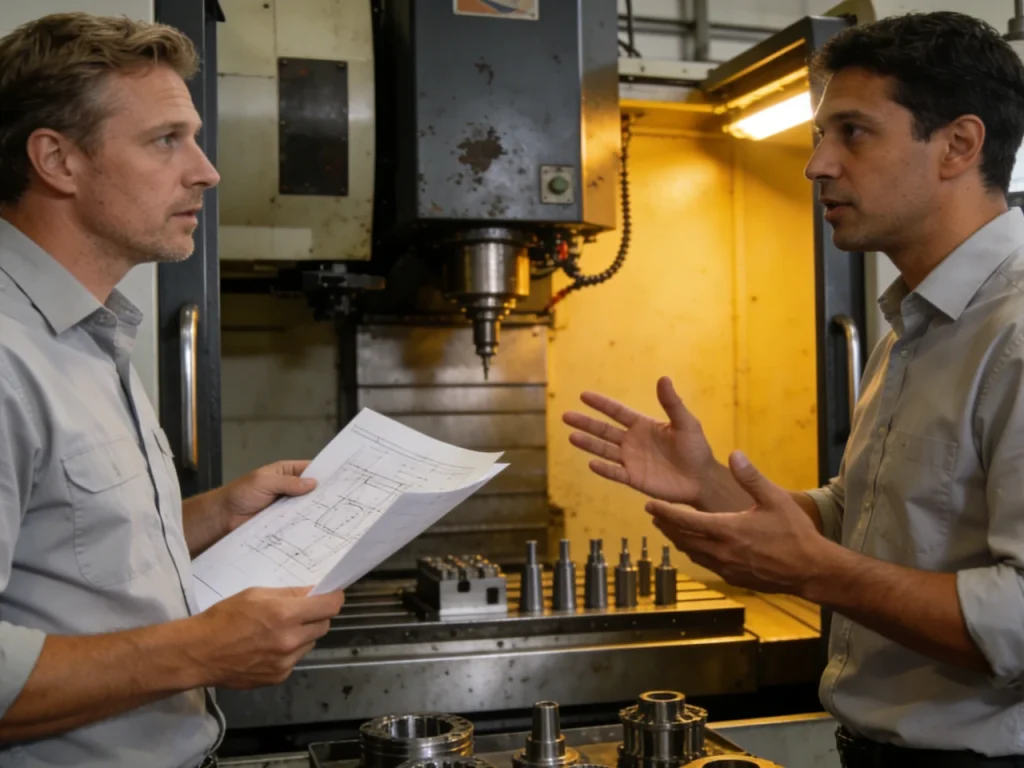
Case Study: Defense and aerospace-style enclosures—3-axis multi-setup vs 5-axis single-setup outcomes (industry association examples)
One industry association example compares machining of defense and aerospace-style enclosures and components using computer numerical control lathe and milling machines.
- With 3-axis, the complex contours and undercut-like access needs forced multiple setups.
- With 5-axis, more of the part could be completed in a single setup.
The reported outcome was qualitative but consistent with the mechanics: fewer setups reduced error opportunities, improved precision outcomes, and shortened lead times even though the 5-axis cnc machine approach had higher rate implications. For feasibility, the lesson is that multi-face enclosure geometry often shifts the decision toward 5-axis, mainly to control setup-driven risk.
Case Study: Mold, medical, and aerospace applications — 3+2 vs full 5-axis for blending, cusp control, and tolerances
A CAM software provider’s discussion compares 3+2 and full simultaneous 5-axis cnc machines for industries such as mold, medical, and aerospace where intricate surfaces and tight requirements are common.
The core point was not that indexed machining is “bad.” It was that:
- 3+2 can hold good tolerances with positional indexing, but
- Simultaneous 5-axis cnc machine improves blending and cusp control on complex surfaces, which can matter for functional or high-visibility surfaces.
From a decision standpoint, this helps separate two different needs:
- “I need access to more faces without re-clamping” (often solved by 3+2 or a 3-axis machine)
- “I need continuous surface quality across compound curves” (often pushes toward simultaneous 5-axis cnc machine)
Case Study: Small-shop buckles—debating real gains vs investment and programming overhead (industry forum discussions)
A machining forum thread about milling buckle-like parts captures a common buyer concern in plain language: “How much would I gain cutting this on a 5-axis cnc machine versus my 3-axis cnc machine?”
The discussion reflects two realities:
- Better access can reduce handling and may speed up certain operations on the workpiece.
- The gains are not automatic, and the programming and investment overhead can outweigh benefits for small jobs or simple geometry.
For a technical buyer, this is a useful reminder: even when 5-axis is feasible, it may not be the best process choice unless the part family truly benefits from reduced setups, better access, or improved surface transitions.
Examples and Case Summaries (Neutralized)
Example 1: Aerospace-style enclosures – 3-axis cnc machine multi-setup vs 5-axis cnc machine single-setup
- Multi-face workpieces reduced setups with 5-axis cnc machines, lowering error risk and improving precision.
Example 2: Mold/medical surfaces – 3+2 vs simultaneous 5-axis cnc machine
- 3+2 can achieve positional tolerances; simultaneous 5-axis improves surface blending and cusp control.
Example 3: Small prismatic parts – practical trade-offs
- Gains from 5-axis cnc machines are often marginal; programming and investment overhead may outweigh benefits.
| Typ części | Main constraint | Machine choice | Observed benefit |
|---|---|---|---|
| Multi-face enclosures | Liczba ustawień | 5-osiowy | Fewer errors, improved accuracy |
| Mold/medical surfaces | Blending/cusp control | Jednoczesna praca w 5 osiach | Better surface continuity |
| Small prismatic parts | Cost/programming | Often 3-axis | Gains debated |
Decision Framework: Choosing Axis Count
Checklist: geometry triggers
- Undercuts or deep cavities
- Compound angles
- Multi-face relationships
- Controlled tool angle surfaces
Checklist: production realities
- Batch size, repeatability
- Part mix variability
- Fixturing complexity
- Inspection strategy
Simple rule:
- Mostly 0 scores → start 3-axis cnc
- High setup or complex geometry → evaluate 3+2 or 5-axis cnc machine
- Surface blending critical → consider simultaneous 5-axis cnc machine
Checklist: geometry triggers (undercuts, deep cavities, multi-face machining, compound angles)
If you are deciding between 3 axis vs 5 axis milling, start with geometry. These are common triggers that push away from simple 3-axis setups:
- The part has undercuts that cannot be reached with standard tools from a top-down approach.
- The part needs compound angles (not just a single angled face).
- The part needs machining on many faces where relationships matter (for example, multiple sealing faces).
- The part has deep cavities where tool length becomes extreme, or where side walls need clean finish and good access.
- The part includes complex shapes where the tool must maintain a controlled angle to the surface (impeller-like or turbine-like flow surfaces, complex medical implant surfaces).
A single trigger does not force a 5-axis. It signals that you should at least compare the setup plan.
Checklist: production realities (batch size, part mix variability, fixturing complexity, inspection strategy)
Next, look at production and process constraints:
- Batch size and repeat demand: simple parts in steady volume often suit 3-axis repeatability and simpler staffing.
- Part mix variability: a wide mix of complex geometries can favor 5-axis because it reduces custom fixturing and repeated setup development.
- Fixturing complexity: if the 3-axis approach requires angle plates, custom wedges, or difficult re-clamping, that is a cost and risk signal.
- Inspection strategy: if critical features land across multiple faces, consider how many times you will need to re-establish datums and how you will verify the relationships.
This is where axis count affects lead time in a real way. A 3-axis plan with many setups can be feasible but scheduling-heavy, while a 5-axis plan may simplify the critical path by reducing setup and inspection loops.
When should you use 5-axis machining instead of 3-axis?
Use 5-axis when the part’s geometry forces multiple setups on 3-axis, especially for multi-face machining, undercuts, deep cavities, or compound angles. It is also a strong option when surface blending across curves matters and indexed transitions would leave visible lines. If the part is mostly 2D/2.5D and reachable from one direction, 3-axis is often the cleaner and lower-burden choice.
Visual: printable decision matrix + simple scoring rubric (complexity, setups, finish needs, tolerance risk)
Scoring rubric (concept): rate each category 0–2.
| Kategoria | 0 | 1 | 2 |
|---|---|---|---|
| Złożoność geometrii | Mostly flat/2.5D | Some angles, limited side features | Compound curves, undercuts, deep cavities |
| Setup burden (3-axis plan) | 1 setup | 2–3 setups | 4+ setups or difficult re-clamps |
| Surface finish sensitivity | Transitions not critical | Some visible/functional surfaces | Blends and cusps critical across curves |
| Tolerance relationship risk | Features mostly on one face | Some cross-face relationships | Many cross-face relationships sensitive to re-clamp shifts |
How to use it (simple rule):
- If most scores are 0: start with 3-axis.
- If setup burden or geometry scores trend to 2: compare 3+2 and 5-axis.
- If surface sensitivity is 2 and geometry is complex: consider simultaneous 5-axis early.
This matrix does not replace a process review, but it prevents the most common mistake: choosing an axis count before you count setups.
Ending section
Summary:
- 3-axis cnc / 3-axis machine: linear X/Y/Z axes, best for top-down or planar features, low setup burden.
- 5-axis cnc machine: adds two rotational axes, improves access, reduces setups, handles complex surfaces, and increases precision on multi-face workpieces.
Choice depends on: setup plan, part geometry, tolerance scheme, surface requirements, pros and cons of axis count, programming and inspection burden, and the differences between 3-axis and 5-axis.
Najczęściej zadawane pytania
The main difference comes down to how the tool moves relative to the part. In 3-axis milling, the cutting tool can only move along the X, Y, and Z directions. Essentially, the tool approaches the workpiece from a fixed angle, so you often need multiple setups to reach all sides or complex features. On the other hand, 5-axis milling adds two rotational axes—commonly called A and C or B and C depending on the machine setup—which allows the tool to tilt and rotate around the part. This extra freedom makes it much easier to reach multiple faces, angled surfaces, or intricate geometries without constantly repositioning the workpiece. It’s particularly useful for parts with complex contours, deep cavities, or unusual angles, where a 3-axis machine would struggle or require additional setups, making production slower and less precise.
3-axis milling is still the go-to option for a lot of projects, especially when parts are relatively simple. If you’re dealing with flat surfaces, pockets, or 2D and 2.5D features, a 3-axis machine is usually faster, easier to program, and more cost-effective. It’s also ideal for high-volume production runs where repeatability matters and part complexity is low. Choosing 3-axis can save both time and money, because you avoid the extra programming and setup checks that 5-axis requires. Basically, if the part doesn’t have steep angles, undercuts, or intricate 3D contours, sticking with a 3-axis machine keeps things straightforward, efficient, and reliable. For many shops, this balance of simplicity, speed, and precision is more than enough for everyday machining needs.
Not necessarily. While 5-axis milling can handle more complex shapes and reduce the number of setups needed, it comes with a trade-off: programming and setup verification are more complicated, and the machines themselves are often more expensive. For parts that are mostly flat or have simple pockets, 3-axis milling can actually be faster and more practical. Think of 5-axis as the solution for tricky, multi-surfaced components rather than a universal upgrade. You’ll benefit from 5-axis on parts with compound angles, deep cavities, or intricate contours, but for straightforward jobs, 3-axis keeps costs down and production simple. So “better” depends on the part’s geometry, project budget, and how comfortable your team is with advanced programming.
Some designs are almost impossible—or extremely inefficient—to make on a 3-axis machine. This usually includes parts with deep undercuts, compound angles, or complex contoured surfaces that require the tool to approach from multiple directions. On a 3-axis machine, you’d need multiple setups, special fixtures, or angled tooling to reach these features, which increases risk and production time. 5-axis milling can handle these in a single setup because the tool can rotate and tilt freely, maintaining optimal cutting angles across all surfaces. This makes it essential for aerospace components, medical implants, intricate molds, or turbine blades—essentially, any part where precision, surface quality, and complex geometry intersect.
The number of axes impacts lead time mainly through setups and inspections. With 3-axis machines, reaching complex geometries often requires multiple setups, which means repositioning the part, verifying alignment, and sometimes performing additional test cuts. Each setup adds time and potential sources of error. 5-axis machines can reduce the number of setups because the tool can access more features in a single orientation. However, programming and verifying a 5-axis operation can be more time-consuming upfront. The net effect on lead time depends on the part: simple designs see little difference, but for complex geometries, 5-axis often shortens production, reduces handling, and improves consistency, even if initial programming is more detailed.
The key difference is how the axes move during cutting. In 3+2 milling, the part or tool is indexed to a specific angle, and the cutting occurs using standard 3-axis motion at that fixed orientation. It’s a hybrid approach that simplifies programming while allowing access to multiple faces without multiple full setups. Simultaneous 5-axis, however, moves all five axes together continuously during cutting. This allows for smoother surface transitions, better cusp control, and higher accuracy on complex contours. While 3+2 is often sufficient for moderately complex parts, simultaneous 5-axis shines when perfect surface quality is needed, such as on aerospace components, sculpted molds, or intricate medical devices. It’s more demanding in terms of programming but gives superior results on challenging geometries.

 Polish
  English
  German
  French
  Italian
  Spanish
  Czech
Czech  Japanese