
Precision CNC milling services are used when parts that require controlled geometry, repeatable dimensions, and documented inspection. For engineers and technical buyers, the main question is not only whether a shop can cut the material. The harder question is whether the part can be milled accurately, inspected with confidence, and repeated at the required volume without unstable cost or lead time.
CNCフライス加工 is a subtractive process. A rotating cutting tool removes material from a fixed or moving workpiece under computer numerical control. In precision work, the process depends more on the machine. CAD model quality, material behavior, fixturing, tool wear, cutting strategy, finishing, and inspection all affect the final result.
This guide focuses on feasibility and sourcing decisions for industrial components. It explains where precision CNC milling works well, where risk increases, and what buyers should check before moving from prototype to production.
What Precision CNC Milling Services Are—and Why They Matter
Precision CNC milling services produce machined parts with controlled dimensions, surfaces, and geometric features. The term “precision” usually means the part has tolerances, surface requirements, or feature relationships that need planned process control. It does not mean every feature is automatically held to the tightest possible limit.
A practical precision milling job starts with a clear drawing or CAD model. The machinist or manufacturing engineer then plans how to hold the workpiece, which tools to use, which features to machine first, and how to inspect the finished part. Small choices can change the result. For example, cutting a deep pocket before finishing thin outside walls may reduce stiffness and cause movement. A later finishing pass may then remove material unevenly.
Precision milling matters when parts must assemble correctly, seal, guide motion, transfer load, manage heat, or meet regulated quality expectations. Aerospace brackets, medical device components, tooling inserts, housings, manifolds, and stainless steel parts are common examples. In these cases, the buyer needs more than a machined shape. They need process capability, material experience, and inspection evidence.
Market demand also reflects this shift. The provided research estimates the global 精密CNC加工 services market at USD 76.2 billion in 2024, with a projected value of USD 142.4 billion by 2033 at a 7.1% CAGR. Growth is linked to multi-axis machining, automation, medical customization, aerospace parts, high performance components, and advanced materials such as titanium alloys and composites.
Precision CNC milling vs turning for precision parts
The choice between CNC milling vs turning for precision parts depends mainly on part geometry.
Milling is best suited to prismatic features: flat faces, pockets, slots, bosses, holes, complex contours, and angled surfaces. The cutting tool rotates, and the workpiece is positioned so the tool can remove material from selected areas.
Turning is best suited to round parts. In turning, the workpiece rotates while a cutting tool shapes the diameter, face, grooves, or threads. Shafts, bushings, spacers, and cylindrical housings often start on a lathe. Some parts need both milling and turning, especially when a round part has flats, cross-holes, bolt patterns, or milled slots.
Manual milling can produce useful parts, especially for repair work, fixtures, and simple one-off components. CNC milling is different because tool movement is programmed. This improves repeatability and allows complex toolpaths that would be difficult or inconsistent by hand. For tight-tolerance or repeated parts, CNC control also makes inspection feedback easier to apply to later parts.
What makes milling “precision”: geometry, repeatability, inspection, and tolerance control
Precision in milling is a system result. The machine must be accurate enough, but the machine alone does not define the outcome. Geometry, repeatability, inspection, and tolerance control all matter.
Geometry covers the shape of the part and the relationship between features. A hole pattern may need correct spacing. A sealing face may need flatness. A bearing pocket may need size and position control. These are different problems, and each one may need a different machining and inspection plan.
Repeatability means the process can produce the same result over multiple parts. A prototype may be adjusted by hand after measurement. A production batch needs a more stable plan, because repeated adjustment slows lead time and adds risk.
Inspection confirms whether the part meets the drawing. For precision CNC milling services, inspection may include dimensional checks, surface checks, and verification of critical features. The key point is that the inspection method must match the tolerance. If a feature cannot be measured reliably, the tolerance is not well controlled in practice. Measurement capability depends on datum access, fixturing repeatability, feature accessibility, and method selection such as CMM, manual gaging, or optical inspection. In-process probing can help maintain alignment during machining, but final acceptance still depends on a repeatable inspection method with suitable uncertainty for the requirement. For repeat work, first-article results and ongoing statistical checks are more meaningful than a single pass/fail result.
Tolerance control depends on the full process. Important factors affecting CNC milling tolerances include material movement, tool deflection, thermal growth, workholding, tool wear, machine condition, setup count, and finishing steps.
Where 3-axis, 4-axis, and 5-axis milling fit in precision machining
A 3-axis mill moves the tool or table along a defined number of axes. It delivers strong milling capabilities for plates, brackets, housings, pockets, and features reachable from one or more flat setups. Many precision parts can be made well on 3-axis equipment if the geometry is accessible and the setup plan is stable.
A 4-axis mill adds rotation around one axis. This helps with features on multiple sides of a part, indexed machining, cylindrical features, and reduced manual repositioning.
A 5-axis mill can position the tool against the part from many angles. The main value is access. It can reduce the number of setups, improve alignment between features on different faces, and allow shorter tools in some deep or angled features. The topic of 3-axis vs 5-axis milling for complex parts is mainly a question of geometry, setup risk, and cost. If a part can be made in one or two stable 3-axis setups, 5-axis may not add enough value. If it needs many angled features, undercuts, or tight relationships across multiple faces, 5-axis can reduce risk.
Table: CNC milling vs turning vs drilling for part features, tolerances, and materials
| プロセス | Best-fit features | Precision considerations | Common material fit | Main limitations |
|---|---|---|---|---|
| CNCフライス加工 | Flats, pockets, slots, contours, bosses, hole patterns, angled faces | Sensitive to tool deflection, fixturing, setup count, and material movement | Aluminum, stainless steel, brass, plastics, titanium alloys, and selected composites | Deep internal corners, very thin walls, and inaccessible features can be difficult |
| CNC旋盤加工 | Diameters, faces, grooves, tapers, threads, round parts | Strong fit for concentric features when held in one setup | Metals and plastics suitable for rotating workpieces | Non-round features need live tooling or secondary milling |
| 掘削 | Round holes, through-holes, pilot holes | Hole position, straightness, burr control, and tool wear are key | Most machinable metals and plastics | Deep holes, angled holes, and tight positional requirements may need special planning |
Feasibility: Can the Part Be Milled Accurately?
Feasibility depends on whether the required geometry, material, tolerance, and inspection method can work together. A part may be easy to model but hard to machine. Another part may be simple to machine but hard to inspect. Precision CNC milling services should be evaluated against both conditions.
A useful feasibility review checks four areas: feature access, part stiffness, material response, and tolerance stack-up. Feature access asks whether the tool can reach the surface without collision. Part stiffness asks whether the workpiece will move under clamping or cutting force. Material response asks whether the material will cut cleanly or distort. Tolerance stack-up asks whether separate setups or finishing steps may shift important features.
How CAD model quality affects CNC machining results
CAD model quality has a direct effect on machining results. A clean model gives clear feature locations, surface definitions, radii, and hole geometry. Poor model quality can cause wrong toolpaths, unclear edges, missing draft or fillets, and mismatches between the 3D model and 2D drawing.
The issue is not only file format. The design intent must be clear. If the model shows sharp internal corners where a rotating cutter cannot create them, the machine shop must either add a radius or use another process. If the drawing gives tight tolerances on every feature without identifying critical functions, cost and inspection effort increase.
How CAD model quality affects CNC machining results becomes most important when parts have complex surfaces, thin walls, close feature spacing, or mating interfaces. A good CAD package does not make a part manufacturable by itself. The model must reflect cutter access, tool diameter, workholding zones, and inspection needs.
How material choice affects CNC milling accuracy
Material choice affects cutting force, heat, tool wear, burr formation, and stress release. These effects change accuracy.
Aluminum is often selected for plastic and metal prototypes, housings, brackets, and heat-related parts because it is generally machinable. Stainless steel can be more difficult because it may work-harden and generate more heat during cutting. Titanium alloys are valued in high-performance parts, but titanium milling limitations in precision machining include heat control, tool wear, and lower process forgiveness. Composites may add challenges related to dust, delamination, and tool selection.
Plastics can be CNC milled, but they may move under clamping, heat, or moisture. Brass and other machinable metals may cut well, but the exact grade still matters.
The key point in how material choice affects CNC milling accuracy is that tolerance is not separate from material. The same geometry may maintain high precision and accuracy in one alloy and unstable in another. Buyers should confirm that the service provider has experience with the specific grade, not only the broad material family.
Risks of machining thin-walled parts
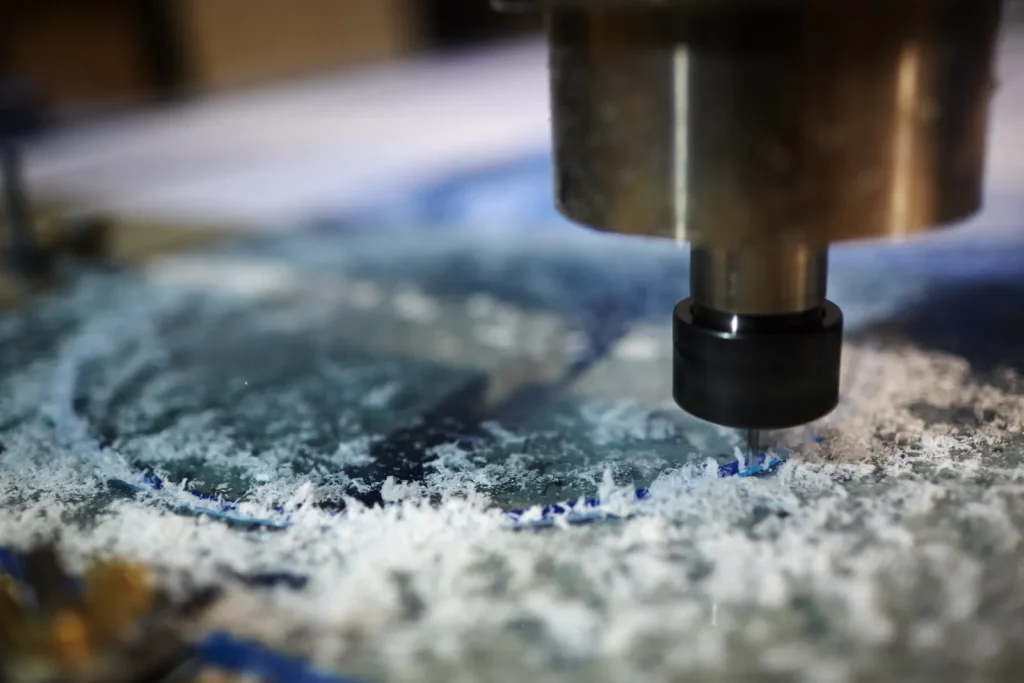
Thin-walled parts are a common source of accuracy problems. Walls can bend during clamping, vibrate during cutting, or relax after material is removed. Even if the machine follows the programmed path correctly, the wall may move away from the cutter and spring back later.
The risks of machining thin-walled parts increase when walls are tall, unsupported, or connected to heavy sections. Deep pockets, large material removal, and aggressive cutting can make the problem worse. Finishing passes can help, but they cannot always correct movement caused by poor stiffness or poor workholding.
The main failure mode is not only cutting force during the pass but elastic movement during machining followed by spring-back after unclamping. Once material is removed, stress redistribution can shift the wall or floor so a finishing pass may only follow the moved condition rather than restore the intended geometry. Material state also matters because rolled, cast, hardened, or stress-relieved stock can respond differently.
Designers can reduce risk by adding temporary stock, using larger radii, increasing wall thickness where function allows, and avoiding tight tolerances on flexible non-mating surfaces. For production, the process may need custom fixtures, staged roughing, stress-relief steps, or revised machining order.
When CNC milling is not suitable for tight tolerances
CNC milling is not suitable for tight tolerances when the required feature cannot be reached, held, cut, or measured reliably. This can happen with very deep narrow features, extremely sharp internal corners, flexible walls, unstable materials, or features that depend on multiple difficult setups.
When CNC milling is not suitable for tight tolerances, the issue is often not the machine brand or axis count. It is the mismatch between design intent and process physics. A rotating cutter has diameter. A slender tool deflects. A thin part moves. A stressed material may change shape after cutting.
In some cases, another process or a process combination may be better. Turning, grinding, EDM, additive manufacturing followed by finish machining, or a design change may reduce risk. The decision should be based on function. Tight tolerances should be applied where they control assembly, motion, sealing, or safety—not where they add no value.
Risk rises quickly with deep pockets, narrow slots, small internal radii relative to cutter size, thin unsupported walls, and hole locations tied to multiple faces. If a feature needs a sharper internal corner than a cutter can produce, milling alone is the wrong process and EDM or a design change should be considered. Grinding is often a better choice when the main requirement is very tight flatness or a finer finish than milling can hold consistently.
How Precision CNC Milling Works in Practice
Precision CNC milling follows a controlled sequence. The sequence can vary by part, but the core steps are similar: review design data, create toolpaths, prepare setup, machine the part, finish critical features, inspect the result, and feed inspection data back into the process.
From CAD/CAM to setup, toolpath strategy, machining, finishing, and inspection
The process starts with CAD and drawing review. The manufacturing team checks feature access, tolerances, materials, surface finish notes, and any special requirements. CAM software is then used to create toolpaths. Toolpaths define cutter movement, cutting depth, stepovers, speeds, feeds, and machining order.
Setup is the stage where the raw stock is held in a vise, fixture, pallet, chuck, or custom workholding device. Setup quality is critical. If the datum surfaces are not stable, the rest of the part may be wrong even if toolpaths are correct.
Toolpath strategy controls cutting force and accuracy. Roughing removes bulk material. Semi-finishing brings the part closer to size. Finishing produces final surfaces and dimensions. Finishing operations that affect dimensional accuracy include deburring, polishing, coating, heat treatment, and secondary machining. Even a light finishing step can change an edge, hole, or sealing surface if not controlled.
Inspection closes the loop. The part is checked against the drawing. If a feature is outside tolerance, the cause must be traced. It may be tool wear, setup error, wrong offset, material movement, or measurement error.
3-axis vs 5-axis milling for complex parts
The choice between 3-axis and 5-axis milling is not only about complexity. It is also about datum control and setup count.
A 3-axis process may need several setups to machine all sides of a complex part. Each setup can introduce small alignment differences. If the part has loose relationships between sides, this may be acceptable. If it has tight position requirements across many faces, extra setups increase risk.
A 5-axis process may reach several faces in one setup or with fewer setups. This can improve feature-to-feature alignment and reduce handling. It can also allow the use of shorter tools by tilting the part or tool, which can reduce deflection. On the other hand, 5-axis programming, simulation, fixturing, and machine time can raise cost and planning effort.
For prototypes, 5-axis is worth considering when it avoids risky rework or multiple custom fixtures. For simple flat parts, they may not be needed.
How cutting tool wear impacts milling accuracy
Cutting tool wear impacts milling accuracy because the cutter edge changes during use. A worn tool may cut oversize or undersize, leave a rougher surface, generate heat, or push material instead of shearing it cleanly. Tool wear can also increase cutting force, which affects thin walls and small features.
Wear is influenced by material, cutting speed, coolant, tool coating, chip evacuation, and cutting length. Stainless steel and titanium alloys can accelerate tool wear if parameters are not controlled. Abrasive materials and composites may also shorten tool life.
In precision work, tool wear is managed through tool life tracking, inspection between operations, offsets, and replacement rules. Automation and real-time monitoring are growing in this area. The provided research notes that AI, data analytics, and smart manufacturing are being used for real-time monitoring, predictive maintenance, and autonomous inspection. These systems can help, but they still need validation because wrong decisions can damage parts.
Process diagram: CAD file to inspected machined component
CNC Milling Workflow Process
- CAD model + engineering drawing
- Manufacturability review – Feature access, material compatibility, tolerances, inspection requirements
- CAM programming – Tool selection, toolpath generation, cutting strategy setup
- Setup planning – Fixturing, datum definition, workholding arrangement, stock allowance allocation
- Rough machining – Bulk material removal
- Semi-finish & stress-control steps – Shape stabilization, datum refinement
- Finish machining – Achieve final dimensions and surface profiles
- Deburring & secondary finishing – Edge conditioning, surface finish compliance
- Inspection – Dimensional verification, geometry check, critical feature validation
- Final outcome – Approved part acceptance or process adjustment & rework
Advantages vs Limitations of Precision CNC Milling
Precision CNC milling is valuable because it can produce complex metal and plastic parts directly from digital data with repeatable control. It supports prototypes, small batches, and production parts. It can machine a wide range of materials and create features that casting, forming, or additive processes may not produce accurately without secondary work.
The limitations are just as important. Milling removes material by force. That means stiffness, cutter access, heat, and tool geometry shape the process. The best decision is often not “Can it be milled?” but “Can it be milled with acceptable risk, inspection effort, lead time, and cost?”
When 5-axis milling is worth the cost
When 5-axis milling is worth the cost, the part usually has one or more of these conditions: complex geometry, angled features, tight relationships across multiple faces, deep features that benefit from shorter tools, or high setup risk in 3-axis machining.
The main economic value of 5-axis milling often comes from reducing setups and scrap risk. The provided research notes rising demand for 5-axis milling because it can machine intricate geometries from multiple angles while reducing setup time and scrap. This is especially relevant in aerospace and medical applications, where parts may combine complex shape with strict inspection needs.
However, 5-axis is not a cure for poor design. It does not remove the effects of material movement, tool wear, or unclear tolerances. It also requires more advanced programming and verification. For simple parts, the added cost may not improve the result.
Limitations of vertical machining centers for complex geometries
Vertical machining centers are common in 3-axis CNC milling. They are effective for many plates, brackets, housings, and pocketed parts. Their limitations appear when geometry requires tool access from many angles or when multiple setups make datum control difficult.
Limitations of vertical machining centers for complex geometries include poor access to undercuts, deep side features, compound angles, and features on many faces. Long tools may be needed to reach deep areas, which can increase deflection and chatter. Repositioning the part can also add alignment error.
A vertical machining center can still produce precise parts when the design fits the process. The buyer should check whether the proposed setup plan can hold the critical datums and whether inspection can verify the features after machining.
Titanium milling limitations in precision machining
Titanium alloys are common in demanding applications because of their performance properties, but they are difficult to machine compared with easier materials. Titanium milling limitations in precision machining include heat concentration, tool wear, and sensitivity to cutting parameters.
Because titanium can reduce tool life, process stability matters. Tool selection, coolant strategy, chip evacuation, and conservative cutting conditions may be needed. These choices can increase machining time and cost. Thin titanium parts can be even more difficult because cutting forces and heat may affect shape.
For buyers, the main check is material-specific experience. A shop that mills aluminum well may not have the same process stability in titanium. Inspection planning is also important because tool wear can shift dimensions during a run.
What are the main benefits of 5-axis CNC milling?
The main benefits of 5-axis CNC milling are reduced setup count, better access to complex geometry, improved feature alignment across multiple faces, and possible use of shorter tools. These benefits can improve accuracy when the part geometry would otherwise require many repositioning steps.
5-axis milling also supports complex aerospace and medical parts where contours, angled surfaces, and multi-face features are common. Automation and robotics can add value by improving handling consistency and reducing idle time in repeat work.
The trade-off is higher planning complexity. A 5-axis job needs careful simulation, collision checking, fixture design, and inspection planning. Buyers should treat 5-axis as a process option, not as a quality guarantee.
Common Failures, Quality Risks, and Surface Finish Problems
Precision milling failures often come from small causes that build into visible defects. A part may pass some dimensions and fail others. A surface may look acceptable but not meet a functional requirement. A hole pattern may be correct in one setup and shifted after a second setup.
The best control method is prevention. Clear drawings, realistic tolerances, stable setups, material-specific cutting data, and inspection feedback reduce the chance of failure.
Common tolerance issues in high-precision CNC machining
Common tolerance issues in high-precision CNC machining include feature shift between setups, hole position error, out-of-flat surfaces, tapered walls, oversize or undersize pockets, and variation across a batch.
Setup-related error is common when a part must be flipped or re-clamped. If datums are not repeated correctly, features on different sides may not align. Tool deflection can create taper or uneven wall thickness. Thermal growth can change size during long cycles. Material stress relief can move surfaces after roughing.
A good tolerance review separates critical features from noncritical ones. This helps control cost and inspection time. If every dimension is treated as critical, the process may become slow and expensive without improving part function.
Causes of poor surface finish in CNC milling
Causes of poor surface finish in CNC milling include tool wear, chatter, incorrect feeds and speeds, poor chip evacuation, insufficient rigidity, material behavior, and unsuitable toolpath strategy.
Chatter is vibration between the tool, workpiece, and machine. It can leave repeating marks and reduce dimensional accuracy. Tool wear can smear or tear material. Poor chip evacuation can cause recutting, which damages the surface and heats the workpiece. Stainless steel CNC milling challenges often include heat control, work-hardening, and burr formation, all of which can affect finish.
Surface finish should be specified where it matters. A cosmetic finish, a sealing surface, and a sliding surface may need different controls. If finish is critical, the drawing should define the required area and inspection method.
Finishing operations that affect dimensional accuracy
Finishing operations can improve part function, but they can also change dimensions. Deburring can break sharp edges and slightly alter small features. Polishing can remove material from surfaces. Coating can add thickness. Heat treatment can move the part. Secondary machining can shift datums if the part is re-held.
Finishing operations that affect dimensional accuracy should be planned before quoting and before process design. If a hole must be accurate after coating, the drawing should make that clear. If a sealing face must remain flat after deburring, edge treatment must be controlled.
Buyers should avoid treating finishing as an afterthought. In precision milling, finishing is part of the dimensional process.
Checklist: inspection points before accepting precision-milled parts
| Inspection point | チェックポイント | なぜそれが重要なのか |
|---|---|---|
| Critical dimensions | Sizes and positions tied to function | Confirms fit, assembly, sealing, or motion |
| Datum features | Surfaces or holes used for alignment | Errors here can shift many other features |
| Wall thickness | Thin or flexible sections | Confirms material movement did not distort the part |
| Hole quality | Diameter, position, burrs, thread condition | Prevents assembly and fastening problems |
| Surface finish areas | Specified sealing, sliding, or cosmetic faces | Confirms function-specific surfaces are acceptable |
| Edge breaks and burrs | Deburred edges and small features | Prevents assembly issues and handling risk |
| Material and revision | Correct grade, drawing revision, and process notes | Avoids using a correct-looking but wrong part |
| Inspection records | Measurement method and acceptance data | Supports traceability and repeat orders |
Cost, Tolerance, and Lead Time Factors in Precision CNC Milling Services
Cost, tolerance, and lead time are linked. A tighter tolerance can require slower cuts, better fixtures, more inspection, and more scrap control. A difficult material can extend machining time and tool changes. A complex part may need more setups or 5-axis equipment.
Buyers often ask how much CNC milling costs per hour. A useful answer cannot be reduced to a single rate without knowing the machine type, material, geometry, tolerance, setup needs, inspection level, and location. Hourly rates also do not show the full cost. A higher-rate machine that finishes a part in fewer setups may cost less per accepted part than a lower-rate process with more handling and scrap risk.
Cost drivers in custom CNC milling services
Cost drivers in custom CNC milling services include material type, raw stock size, material removal volume, setup count, machine axis requirement, tool wear, tolerance level, surface finish, inspection, finishing, and batch size.
Buyers should separate one-time and repeat-order cost elements when comparing quotes. Setup planning, fixturing, first-article work, inspection documentation, and outside processing may dominate early orders, while repeat work may shift cost toward cycle time, tool wear, and yield. A higher-rate machine can still lower accepted-part cost if it reduces setups, handling, queue time, and scrap exposure.
Material cost matters, but machining time often matters more. A part that removes a large amount of material from a solid block may take much longer than a part near net shape. Harder or more difficult materials can increase tool wear and reduce cutting speed. Complex parts may need custom fixtures or multi-axis programming.
Tolerance has a direct cost effect. Tight tolerances may need semi-finishing, rest periods, extra inspection, controlled environments, or slower finishing passes. Buyers can reduce cost by applying tight tolerances only to functional features.
Factors affecting CNC milling tolerances
Factors affecting CNC milling tolerances include machine condition, tool length, tool wear, cutting force, workholding stiffness, material stress, heat, inspection method, and operator setup practice.
Size, position, flatness, parallelism, and profile do not carry the same level of machining risk even when the numeric limit looks similar on a drawing. A simple, well-supported size feature is usually easier to control than a multi-face positional relationship transferred across setups. Prototype success also does not prove by itself that the same control method is suitable for repeat production.
Geometry also matters. Deep pockets, small tools, thin walls, long unsupported features, and tight internal radii all increase risk. Multi-face parts add datum and setup concerns. Surface finishing and post-processing can shift final dimensions.
The buyer’s drawing affects tolerance success. Clear datums, realistic tolerances, and defined critical features help the process. Unclear drawings create interpretation risk and may lead to over-processing or wrong inspection.
Lead time factors for custom machined parts
Lead time factors for custom machined parts include material availability, drawing completeness, programming time, fixture needs, machine capacity, inspection load, outside finishing, and revision changes.
Prototype lead time may be driven by programming and setup. Production lead time may be driven by material procurement, tooling, quality planning, and inspection throughput. If the part needs titanium, stainless steel, special plastics, or composites, material sourcing may affect schedule.
Revisions are a common delay source. If the CAD model and drawing do not match, the job may pause for clarification. Buyers can reduce lead time by sending complete files, material specifications, quantities, critical tolerances, and finish requirements at the start.
What information is needed for an accurate CNC milling quote?
An accurate quote needs more than a 3D model. The supplier needs the CAD file, 2D drawing, material grade, quantity, finish requirements, inspection requirements, tolerance requirements, and target delivery needs. If the part has critical features, those should be identified.
The quote should also reflect whether the job is prototype, small-batch, or production. A prototype may accept more manual setup and inspection. A production part may need stable fixtures, documented inspection, and process control.
A competent response should identify critical datums, likely setup count, inspection method for key features, and any assumptions about finish machining or outside processing. It should also make clear whether the quoted approach is prototype-oriented or intended for repeat production control. If critical features are difficult to access or verify, that should appear in the quote discussion rather than after release.
If the buyer asks only for the lowest unit cost, key risks may be missed. A better quote process checks manufacturability, tolerance risk, material behavior, and inspection needs before pricing is final.
Applications: Where Precision CNC Milling Is Commonly Used
Precision CNC milling is used where controlled geometry and repeatable part quality matter. It is common in aerospace, medical devices, industrial equipment, electronics housings, automation components, tooling, and custom fixtures.
The best process for prototype vs production CNC parts depends on design maturity. Prototypes need fast learning, design-for-manufacturing feedback, and flexible setup. Production needs repeatability, inspection planning, material control, and cost stability. The machining method may be similar, but the control plan is different.
Challenges in machining aerospace components
Challenges in machining aerospace components include complex geometry, difficult materials, tight feature relationships, traceability needs, and high inspection expectations. Parts may have thin walls, pockets, ribs, and weight-reduction features. These shapes can move during machining if the process is not staged correctly.
Aerospace parts often benefit from multi-axis machining when features are spread across several faces or when setup reduction lowers alignment risk, adhering to engineering codes from アメリカ機械学会. The provided research describes aerospace use of tailored 5-axis milling with automation to reduce setup time and scrap for intricate parts.
For buyers, the main checks are material experience, setup strategy, inspection capability, and quality system fit. A part that looks simple in CAD may be difficult if it has thin ribs, deep pockets, or tight datum relationships.
Medical device CNC machining tolerance requirements
Medical device CNC machining tolerance requirements vary by function. Surgical tools, implant-related components, housings, and instrument parts may need precise fit, surface control, and documented inspection. Some parts are produced in small batches or customized forms, which makes process planning important.
The provided research notes growth in medical customization and small-batch production through precision CNC milling. In this context, DFM support matters because design iterations can be frequent. A prototype process should reveal tolerance and finishing risks before a design is frozen.
Buyers should check material compatibility, inspection records, finishing effects, and revision control. Medical parts often need careful documentation, even when the machining operation itself is not unusual.
Stainless steel CNC milling challenges
Stainless steel CNC milling challenges include heat generation, work-hardening, tool wear, burr formation, and surface finish control. These problems can affect both accuracy and appearance.
Stainless steel is used when corrosion resistance, strength, or cleanability is needed. But it is less forgiving than easier-cutting metals. Poor tool selection or cutting parameters can harden the surface and make later passes less stable. Burrs can also add inspection and finishing work.
For stainless parts, buyers should confirm the exact grade, surface requirements, edge requirements, and whether any passivation or finishing step will be applied after machining. These steps can affect final acceptance.
Best process for prototype vs production CNC parts
The best process for prototype vs production CNC parts depends on the goal. A prototype process should test fit, function, manufacturability, and tolerance risk. It may use simpler fixtures or more manual inspection because the design may change.
A production process should reduce variation. It may need dedicated fixtures, defined tool life rules, stable inspection plans, and batch records. A part that was successful as a prototype may still need process changes before production.
The decision should consider design maturity, quantity, tolerance risk, and material. If the part is complex and still changing, flexible CNC milling may be useful. If the design is stable and volumes rise, the process should be reviewed for setup reduction, cycle stability, and inspection efficiency.
Technology Trends Affecting Precision CNC Milling Decisions
Technology trends are changing how precision CNC milling services are planned and controlled. Multi-axis machines, automation, robotics, AI monitoring, and hybrid manufacturing are all influencing decisions. These tools can improve capability, but they do not remove the need for good design and process planning.
CNC equipment dominates new machine tool installations globally, according to the provided research, with multi-axis systems leading adoption for high-precision applications. The same research notes rising demand for 5-axis milling, advanced materials, and smart manufacturing in aerospace and medical sectors.
Automation and robotics in high-precision milling workflows
Automation and robotics can improve consistency in loading, unloading, pallet transfer, and repeated production. They can reduce idle time and help machines run with less manual handling. This may support tighter process control because parts are handled in a more repeatable way.
Automation is most useful when part families, fixtures, inspection steps, and material flow are planned. It is less useful when every job is a one-off with unclear drawings and changing requirements. Setup costs can be a barrier for small shops and low-volume work.
For buyers, automation should be viewed as a production-control factor. It may help with repeat work, but it does not replace inspection or material-specific machining knowledge.
AI, real-time monitoring, and predictive maintenance in CNC milling
AI, real-time monitoring, and predictive maintenance are being used to track machine condition, cutting loads, tool wear, and process stability. The provided research notes that AI-adaptive control can adjust parameters in real time and support predictive maintenance to improve uptime and precision.
These systems can help detect drift before parts fail. For example, changes in spindle load or vibration may suggest tool wear or chatter. Monitoring can also support tool replacement decisions.
The limitation is validation. Smart systems must be tested against real parts, materials, and inspection data. A monitoring system that flags problems too late, or changes parameters without good limits, can still produce scrap. Buyers should ask how monitoring data connects to inspection and quality control.
Hybrid CNC milling and additive manufacturing for complex parts
Hybrid approaches combine additive manufacturing with CNC milling. Additive manufacturing can create near-net shapes or internal forms that are hard to machine from solid stock. CNC milling can then finish critical surfaces, holes, and datums.
The provided research describes hybrid CNC-additive integration as an emerging approach for complex parts beyond traditional subtractive methods. It may be useful when a part has complex internal geometry, material waste concerns, or features that are difficult to mill from a block.
The trade-off is process complexity. Hybrid parts need design rules for both additive and subtractive steps. They also need inspection plans that account for internal features, material properties, and final machined surfaces.
References: industry reports, standards bodies, and academic sources
Decision-makers should separate market trend data from process qualification data. Market reports can show demand for CNC machining, multi-axis equipment, automation, and medical or aerospace growth. Standards bodies and academic sources help define measurement, quality systems, and process research.
For procurement, the most useful references are usually the part drawing, material specification, inspection standard, and quality requirements that apply to the program. General market growth does not prove a supplier can make a specific part. Capability must be checked against the actual geometry, tolerance, material, and inspection needs.
How to Evaluate and Choose a Precision CNC Milling Partner
Choosing a precision CNC milling partner should start with the part, not the supplier list. The right partner for a simple aluminum prototype may not be the right partner for a titanium aerospace component or a stainless medical device part.
The evaluation should compare capability, material experience, inspection methods, quality systems, lead time risk, and engineering support. Buyers should also look at how the supplier handles unclear drawings and tolerance feasibility. A supplier that asks useful technical questions early may reduce risk later.
Capability checklist: axis count, materials, inspection, certifications, and DFM support
| 能力エリア | 何を確認すべきか | なぜそれが重要なのか |
|---|---|---|
| 軸数 | 3-axis, 4-axis, or 5-axis fit for the geometry | Confirms tool access and setup strategy |
| Material experience | Specific grade experience, not only material family | Reduces risk in stainless steel, titanium, plastics, and composites |
| 検査能力 | Methods for critical dimensions and surfaces | Ensures tolerances can be verified |
| 品質システム | Certifications or documented controls required by the industry | Supports repeatability and traceability |
| DFM support | Feedback on radii, wall thickness, tolerances, and setup risk | Helps correct problems before machining |
| Finishing control | Deburring, polishing, coating, heat treatment, or passivation planning | Prevents post-process dimensional shifts |
| Production readiness | Tool life control, fixtures, batch inspection, revision control | Supports repeat orders and stable output |
Decision matrix: prototype, small-batch, and production milling requirements
| 必要条件 | プロトタイプ | Small-batch | 製造 |
|---|---|---|---|
| 主な目標 | Verify fit, function, and manufacturability | Produce usable parts with controlled variation | Repeat parts with stable cost and quality |
| Fixture strategy | Flexible or simple workholding | More stable fixtures if repeat orders are expected | Dedicated fixtures or standardized setups |
| Tolerance review | Focus on critical features and design learning | Confirm repeatability across the batch | Control process variation and inspection load |
| 検査 | First-article style checks may be enough for learning | Critical feature checks and records | Defined inspection plan and traceability |
| Cost focus | Avoid over-engineering before design is stable | Balance setup cost and batch size | Reduce cycle time, handling, and scrap |
| ベストフィット | Early-stage designs and design changes | Low-volume functional parts | Stable designs and recurring demand |
What should buyers check before selecting a CNC milling service?
Buyers should check whether the supplier can explain how the part will be held, which features drive risk, and how critical dimensions will be inspected. Axis count and machine list are useful, but they are not enough. The process plan matters more than equipment labels.
Supplier fit should match the job type, not only the machine list. A prototype-focused shop may be suitable for fast iteration, while repeat production may require stronger fixture control, documented first-article results, calibrated gaging, and process discipline for critical features. Regulated or traceability-sensitive work may also require stronger material certification and inspection record control.
Material experience is important. Stainless steel, titanium, plastics, and composites behave differently during milling. A supplier should understand the specific grade and finishing requirements.
Buyers should also check drawing interpretation. If the supplier does not ask about unclear tolerances, missing datums, surface finish, or revision conflicts, the risk may move into production. Good technical communication is part of precision machining capability.
Table: evaluation criteria for tolerance capability, material experience, lead time, and quality control
| Evaluation criterion | Strong sign | Risk sign | Buyer action | Main limitations |
|---|---|---|---|---|
| Tolerance capability | Explains setup, tooling, inspection, and critical features | Claims tight tolerance without process details | Ask how each critical tolerance will be made and measured | Deep internal corners, very thin walls, and inaccessible features can be difficult |
| Material experience | Discusses grade-specific cutting and finishing risks | Treats all materials in a family the same | Request examples by material type and process route | Non-round features need live tooling or secondary milling |
| リードタイム | Identifies material, programming, fixturing, inspection, and finishing constraints | Gives timing without reviewing files | Provide full CAD, drawing, material, finish, and quantity data | Deep holes, angled holes, and tight positional requirements may need special planning |
| 品質管理 | Uses documented inspection and revision control | Inspection plan is unclear or only visual | Define required records and acceptance criteria | |
| DFM support | Flags thin walls, sharp corners, deep pockets, and tolerance risk | Quotes without technical review | Request manufacturability feedback before release | |
| Prototype-to-production support | Explains what changes for repeat production | Uses prototype method for all volumes | Review fixture, tool life, and batch inspection plans | |
| Production readiness | Tool life control, fixtures, batch inspection, revision control | Supports repeat orders and stable output | ||
| Inspection records | Measurement method and acceptance data | Supports traceability and repeat orders |
Precision CNC milling services are suitable when the part geometry is accessible, the material can be controlled, the tolerances match the process, and the inspection method can verify the result. They are less suitable when the design depends on unreachable features, sharp internal corners, unstable thin walls, unclear datums, or tolerances that cannot be measured with confidence.
よくあるご質問
What is precision CNC milling?
Precision CNC milling services represent computer-controlled milling used to make parts with defined dimensional, geometric, and surface requirements. It combines CAD/CAM programming, controlled setup, toolpath planning, finishing, and inspection to deliver consistent high-quality results for industrial components. This subtractive manufacturing process relies on rotating cutting tools to shape workpieces under precise digital control rather than manual operation. It balances machine accuracy, material behavior, and process planning to meet strict functional and regulatory part specifications.
How much does CNC milling cost per hour?
There is no reliable single hourly cost without knowing the machine type, material, geometry, tolerance level, inspection need, and setup effort. For buying decisions, cost per accepted part is usually more useful than hourly rate because scrap risk, setup count, and inspection time also affect total cost. Additional variables such as batch size, finishing operations, and material sourcing further impact overall pricing for precision custom milled parts and complex machining projects. Comparing only hourly rates often misleads buyers, as higher-tier machines can lower total expense by reducing setups and production scrap.
どのような材料がCNCフライス加工できますか?
Common CNC-milled materials include aluminum, stainless steel, brass, plastics, titanium alloys, and selected composites. Each material affects accuracy differently through heat, tool wear, cutting force, burr behavior, and dimensional stability during the milling process. Harder alloys like titanium demand specialized tooling, while stainless steel precision milled components require strict coolant management and controlled cutting parameters. Softer metals and plastics offer easier machinability but need careful workholding to avoid distortion under clamping and cutting pressure.
What is the difference between manual and CNC milling?
Manual milling depends on direct operator control of machine movement to shape simple parts and one-off repair components. CNC milling uses programmed toolpaths, which improves repeatability and supports complex geometry, especially for production parts or precision features with tight specifications. The choice between 3-axis vs 5-axis milling directly impacts setup count, feature alignment and overall machining flexibility for intricate designs. This automated approach also simplifies inspection feedback and makes it easier to replicate identical parts over long production runs.
What are the tolerances for precision milling?
Precision milling tolerances depend on feature type, material behavior, setup count, tool reach, and how the result will be inspected. A simple, well-supported size feature is easier to hold than deep pockets, thin walls, long tools, or multi-face positional relationships. Professionals follow high-precision CNC milling standards to regulate dimensional limits, surface finish and inspection protocols for industrial batches. Understanding core CNC milling tolerances helps designers set realistic specs and avoid unnecessary manufacturing cost and production risk.

 Japanese
  English
  German
  French
  Italian
  Spanish
  Polish
  Czech
Czech