
Sourcing CNC machining in China in 2026 is less about finding the “cheapest shop” and more about building a supply chain that can hit your drawing, stay stable across batches, and support change without turning every revision into a delay.
This guide is written for engineers, technical buyers, and informed purchasers who need to decide if CNC Machining China is feasible for their part and program, and what to validate before they commit. It focuses on what tends to work, what often fails, and how to reduce avoidable risk using evidence, not assumptions.
CNC Machining China: what’s changed in 2025–2026
Over the past two years, china cnc machining has quietly shifted from a price-led outsourcing option to a more system-driven manufacturing choice. Many manufacturers now operate with tighter specs, more computer-controlled equipment, and stronger in-house capabilities covering both milling and tournant of metal and plastic parts. For buyers in aerospace and medical, electrical, and other high-precision industries, the conversation has moved beyond whether China can machine to ±0.01 mm. The real challenge is whether a supplier can do it repeatedly, at volume, with certified processes, skilled technicians, and documentation that holds up worldwide. This change sets the context for how buyers now evaluate CNC partners—and what they actually optimize for when sourcing in 2025–2026.
What buyers want now: cost + speed + repeatable precision + lower risk
Most sourcing teams still start with unit price. In practice, the decision is rarely won by the lowest quote. It is won by the supplier who can keep precision stable, provide clear inspection proof, and react to issues without weeks of back-and-forth.
What buyers tend to optimize for now looks more like this:
- Cost that holds after shipping, duty, packaging, inspection, and rework risk are counted (total landed cost).
- Speed that does not trade away verification steps like first article inspection (FAI).
- Repeatable precision, because prototype success does not guarantee production stability.
- Lower risk, including IP handling, drawing control, and resilience planning when schedules tighten.
This is why “low cost machining China” searches have shifted. Many purchasers are not asking whether China can cut metal. They are asking if a Chinese CNC machine shop can support their tolerance stack-up, revision cadence, and documentation needs without surprises.
The shift from labor advantage to automation + AI/IoT quality control (Industry/technical reports)
China’s CNC ecosystem still benefits from scale, but the more important change in 2025–2026 is the move from labor-driven pricing to automation and data-driven control. Based on JSMT, CNC machining in 2025–2026 increasingly leverages robotic tending, in-line inspection, and AI-assisted planning and compensation loops to improve repeatability and reduce operator-dependent variation.
That matters because labor advantage is easy to copy and easy to lose. Automation changes the slope: it can reduce operator-to-operator variation, extend run hours, and produce more consistent quality records. It also changes how you should evaluate a supplier. You are not only buying machining time on a machine. You are buying the supplier’s ability to control variation and prove it.
Is CNC machining in China still about low cost, or quality too?
It can be both, but only when the supplier has strong process control and you verify it. Many buyers still find attractive pricing, yet the differentiator is whether the shop can show consistent inspection results, controlled revision handling, and stable fixturing and probing methods for your machined parts.
A useful way to think about it is: China can offer cost and speed, but quality is earned per supplier and per part family. You do not “buy quality” by choosing a country. You buy it by validating systems, measurement capability, and how the supplier responds when something drifts.
Visual: “then vs now” comparison table (labor-driven vs automation-driven)
| Sujet | Then (labor-driven) | Now (automation-driven) | What buyers should check |
|---|---|---|---|
| Cost advantage | Lower wages, more manual steps | Higher utilization via automation | What assumptions are in cycle time and setup time |
| Quality control | End-of-line inspection heavy | In-process sensing + data capture | Evidence of in-process checks, traceability, and reaction plans |
| Scheduling | Manual planning, email-based | CNC connected to planning systems in some factories | How the shop confirms capacity and updates dates |
| Répétabilité | Depends on operator skill | More consistent when probing and compensation are used | Measurement system capability and consistency across shifts |
| Engineering changes | Slow iteration loops | Faster if CAD/CAM pipeline is mature | Revision control, file exchange, and DFM turnaround |
Cost & total landed pricing: build a quote you can trust
When teams compare CNC quotes, the instinct is often to line them up against a domestic CNC counterpart and assume the difference is mainly labor. In reality, modern computer numerical control machining—whether fraisage CNC or other subtractive processes—has made cost structures more complex, especially for high-quality parts and high-volume production. The real question is no longer who is cheapest per unit, but which partner can explain where the numbers come from, protect the parts through finishing and packaging, and support the client through rapid iteration when designs evolve. Understanding these dynamics is what turns a quote from a price tag into a decision tool, and it sets up the cost drivers buyers should explicitly request and compare.
Cost drivers to request in quotes: machining time, material, finishing, inspection, packaging, logistics
If you want a quote you can defend internally, ask for the quote to be broken into the cost buckets that drive variation. A single line-item price hides risk because you cannot see where assumptions sit.
For china precision machining, the cost structure usually depends on:
- Machining time assumptions (cycle time, number of setups, tool changes).
- Material type, form, and yield loss (especially if the blank is not near-net).
- Finishing steps (surface treatment, deburr expectations, cosmetic handling).
- Inspection level (basic dimensional checks vs structured FAI + sampling).
- Packaging method (part protection drives damage and rework risk).
- Logistics plan (shipping mode, Incoterms, consolidation).
You are not asking for internal secrets. You are asking for the minimum transparency needed to compare suppliers on the same basis.
Hidden costs & trade-offs: rework risk, iteration loops, communication overhead, compliance paperwork
For sourcing CNC parts from China, landed cost swings are often driven by factors that do not appear in the quote:
Rework risk is the obvious one. If the supplier has weak feedback loops, the first batch may “pass enough” to ship but fail at assembly or downstream finishing. For programs that combine CNC machining with emboutissage de métaux, this risk can compound because errors in stamped components affect downstream assembly. That creates a second wave of costs: sorting, rework, re-inspection, and the schedule slip that follows.
Iteration loops are another driver. If you expect multiple design revisions, your real cost includes the time to resolve drawing questions, update CAM, and re-run inspection. A supplier who asks precise questions early can be lower cost than a supplier who stays silent and ships the wrong interpretation.
Compliance paperwork can also be real work. If your program needs material certs, inspection records, serialization, or controlled document handling, you should treat those as part of the manufacturing scope, not “free extras.”
Simple interactive tool: total landed cost estimator (inputs: qty, material, tolerance, lead time, shipping)
Below is a simple estimator template you can copy into a spreadsheet. It is not meant to “predict” pricing. It is meant to force the same assumptions across supplier quotes.
| Entrée | Your value | Notes to align suppliers |
|---|---|---|
| Quantity (pcs) | Include expected repeats and ramp plan | |
| Matériau | Specify grade and acceptable equivalents | |
| Tolerance / GD&T criticals | Highlight features that drive setups and inspection | |
| Surface finish / coating | Define cosmetic vs functional surfaces | |
| Required inspection level | FAI? sampling plan? measurement report format? | |
| Target lead time | Separate manufacturing time from shipping time | |
| Shipping mode | Air vs ocean changes schedule risk and packaging needs |
| Élément de coût | Fournisseur A | Fournisseur B | Fournisseur C | Notes / assumptions |
|---|---|---|---|---|
| Machining (setup + run) | Ask what drives setups and whether 5-axis reduces them | |||
| Matériau | Confirm material form and cert requirements | |||
| Finition | Confirm masking, edge break, Ra callouts if any | |||
| L'inspection | Confirm FAI scope and measurement method | |||
| Emballage | Define part separation, corrosion protection, labels | |||
| Logistics + duty + fees | Include customs handling and delivery terms | |||
| Expected rework/iteration allowance | A planning line-item, not a guess after failure | |||
| Estimated total landed | Compare on the same scope |
Visual: cost breakdown table template for comparing suppliers side-by-side (Industry pricing surveys)
Use the same table above as your side-by-side template. The key point is not the formatting. It is the discipline: if two quotes are far apart, you should be able to point to the assumption that explains it, like inspection scope, number of setups, or shipping mode.
Quality & precision verification: tolerances, inspection, and proof
Among the top CNC shops, precision is no longer justified by claims or machine lists, but by how tolerances are defined, protected, and proven—often starting from a shared 3D model and ending with documented inspection results. For parts that require surface integrity, corrosion resistance, or post-processing standards such as ASTM A967, Rectification CNC is often used to achieve the necessary surface finish, and verification must extend beyond dimensions to how parts are handled, inspected, and protective packaged before shipment. Many buyer frequently asked questions around Chinese CNC sourcing ultimately come back to this point: not whether tight tolerances are possible, but how a supplier demonstrates they can be held consistently and shown with evidence.
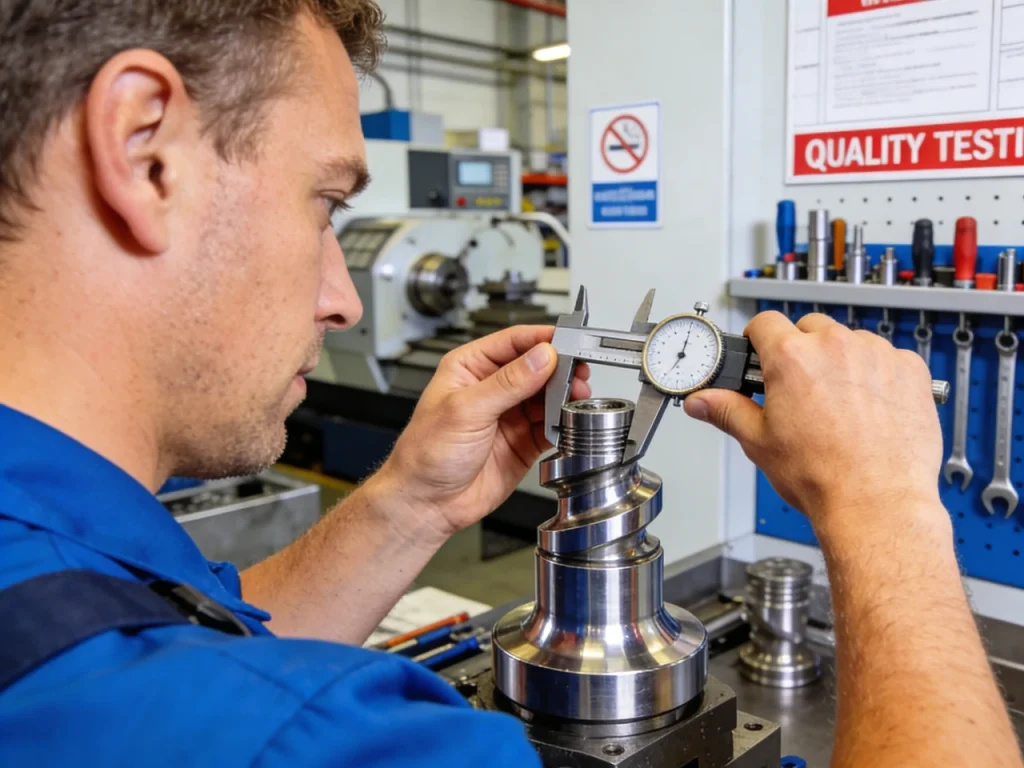
What tolerances can Chinese CNC shops reliably hold for production?
There is no single tolerance level that is “safe” across all chinese cnc machine shop options, machines, materials, and geometries. Some suppliers can hold very tight requirements on certain features when the part is designed for manufacturability and the measurement plan is clear. Others struggle on the same print because they rely on end-of-line inspection instead of controlling drift during machining.
A more useful sourcing question is: Which tolerances on this specific part drive risk, and how will the supplier control and measure them? If a drawing has a few tight positional features and the rest is loose, you want the supplier to treat those features as process-critical and show the control plan.
Also separate “can hit it once” from “can repeat it.” Production reliability depends on fixturing, probing, thermal behavior, tool wear control, and measurement discipline, not only on the machine model.
Buyer-side verification steps: drawings, GD&T notes, first article inspection (FAI), in-process QC expectations
If you want repeatable precision, you need to specify how the supplier should interpret the drawing and what proof you need back. Many cross-border failures come from “reasonable assumptions” that were not aligned.
At minimum, your buyer-side verification package should include:
- A controlled drawing with revision history and clear units.
- GD&T notes that define datums and what matters functionally.
- A definition of critical-to-function features and measurement expectations.
- A requirement for first article inspection (FAI) when the part is new or revised.
- Expectations for in-process checks, not only final inspection, for drift-prone dimensions.
FAI is not only paperwork. It is your first look at how the supplier interprets the drawing, what they measure, what they ignore, and how they record results.
Real-time error compensation benchmark: 30% accuracy stability improvement (Academic/technical research)
Technical research reported a 30% improvement in machining accuracy stability using real-time error compensation driven by thermal and vibration data and adaptive optimization. In sourcing terms, that benchmark matters because it changes what “capable” looks like. Some suppliers can reduce drift with compensation loops and probing routines, while others run open-loop and hope inspection catches issues at the end.
You do not need to become a control engineer to use this. You can ask whether the supplier uses compensation methods for thermal drift and vibration effects, and whether they can show stability evidence across a run, not only a single good part.
Visual: supplier audit checklist + inspection plan matrix (ISO/industry standards + technical reports)
Supplier audit checklist (use as a scoring sheet)
| Zone | Preuves à demander | Pass condition (define for your program) |
|---|---|---|
| Document control | Drawing revision handling, access control, change log | Revisions cannot be mixed on the floor |
| Measurement system | Calibration records, gauge list, CMM capability if needed | Measurement method fits tolerance and geometry |
| FAI process | Example FAI report, ballooned drawing workflow | FAI covers critical features and datums |
| In-process control | Defined in-process checks for critical dimensions | Checks happen before scrap accumulates |
| Nonconformance handling | NCR workflow, containment and corrective action evidence | Problems trigger containment, not shipment |
| Traçabilité | Lot control, material cert handling if required | Parts can be traced to material and process batch |
Inspection plan matrix (align expectation to risk)
| Part risk level | Typical triggers | Inspection expectation you can specify |
|---|---|---|
| Faible | Loose tolerances, simple geometry | Dimensional report on key features, basic sampling |
| Moyen | Multiple setups, tight fits | FAI + defined sampling, in-process checks on criticals |
| Haut | Tight GD&T, complex geometry, safety-critical | FAI + structured sampling + traceability and containment plan |
5-axis & complex parts: capability checks that prevent surprises
As programs move toward tighter tolerances and more integrated geometries, cnc machining china is increasingly evaluated on capability depth rather than machine count. What once could be split across multiple setups or suppliers is now often expected to run in fewer operations, with geometry, orientation, and positional relationships controlled together. This is where complexity stops being a design issue and becomes a sourcing risk issue—and why understanding when 5-axis capability truly matters is critical before committing parts to production.
When 5-axis matters: single-setup accuracy for complex geometries and tight positional features
For many parts, 3-axis milling plus turning is enough. The break point is not “complex looking CAD.” It is when the part has features that are hard to reference consistently across multiple setups.
5-axis matters when:
- You need single-setup accuracy so datums and positional features stay aligned.
- The part has compound angles or features that would need custom fixtures.
- There are tight relationships between features on different faces.
- Surface quality and blend control depends on tool orientation.
It is also a supply chain decision. Reducing setups can reduce process variability, which reduces inspection load and rework risk.
How do I know if a supplier truly has 5-axis capability (not just “5-axis” marketing)?
Do not treat “5-axis” as a checkbox. A shop can own a 5-axis machine and still run it like a 3-axis machine with extra positioning. The question is whether they can program, fixture, probe, and inspect 5-axis work in a controlled way.
Instead of asking “do you have 5-axis,” ask for proof tied to your part risk:
- Can they explain how many setups they plan and why?
- Do they use probing to set work offsets and verify features in-process?
- Can they describe how they control tool orientation for critical surfaces?
- Can they show an example of an inspection report for a multi-face part?
If answers stay vague, you may still proceed, but you should assume more risk and plan more verification.
CAD/CAM readiness for global supply chains: programming workflow + file exchange expectations (Industry reports)
Industry reporting highlights that advanced CAD/CAM practices support global supply chains by reducing translation errors and improving programming efficiency. For buyers, CAD/CAM readiness shows up in simple ways: whether the supplier can accept your file formats, ask the right questions about datums and tolerances, and return manufacturability feedback that matches your intent.
File exchange is also an IP and change-control issue. Use controlled exports, revision tags, and clear communication boundaries so the shop does not program from an outdated model.
Visual: capability verification table (axes, max part size, materials, probing, CAM stack)
| Domaine de compétence | Que demander ? | Why it prevents surprises |
|---|---|---|
| Axes and motion use | “Is it simultaneous 5-axis or positional?” | Changes surface quality and setup count |
| Max part size and workholding | “What envelope can you fixture with probing access?” | Avoids last-minute fixture limits |
| Materials experience | “Do you regularly machine this metal and this temper?” | Tooling and heat behavior vary by material |
| Probing / in-process verification | “Do you probe datums and critical features during the run?” | Reduces drift and scrap accumulation |
| CAM readiness | “Which file formats and revision rules do you use?” | Avoids programming from wrong geometry |
| Capacité d'inspection | “How will you measure angled features and true position?” | Geometry may exceed simple caliper checks |
Lead times & responsiveness: prototypes to high-volume planning
Once capability and quality controls are understood, lead time becomes the next real differentiator. In cnc machining china, buyers are no longer asking only how fast a single batch can ship, but how quickly a supplier can respond across the full arc—from first prototypes to stable, high-volume planning. Responsiveness now reflects how well quoting, engineering, capacity, and inspection are coordinated, not just how busy the machines are. This context helps explain where “China speed” actually comes from, and where it can break down if the system behind it is weak.
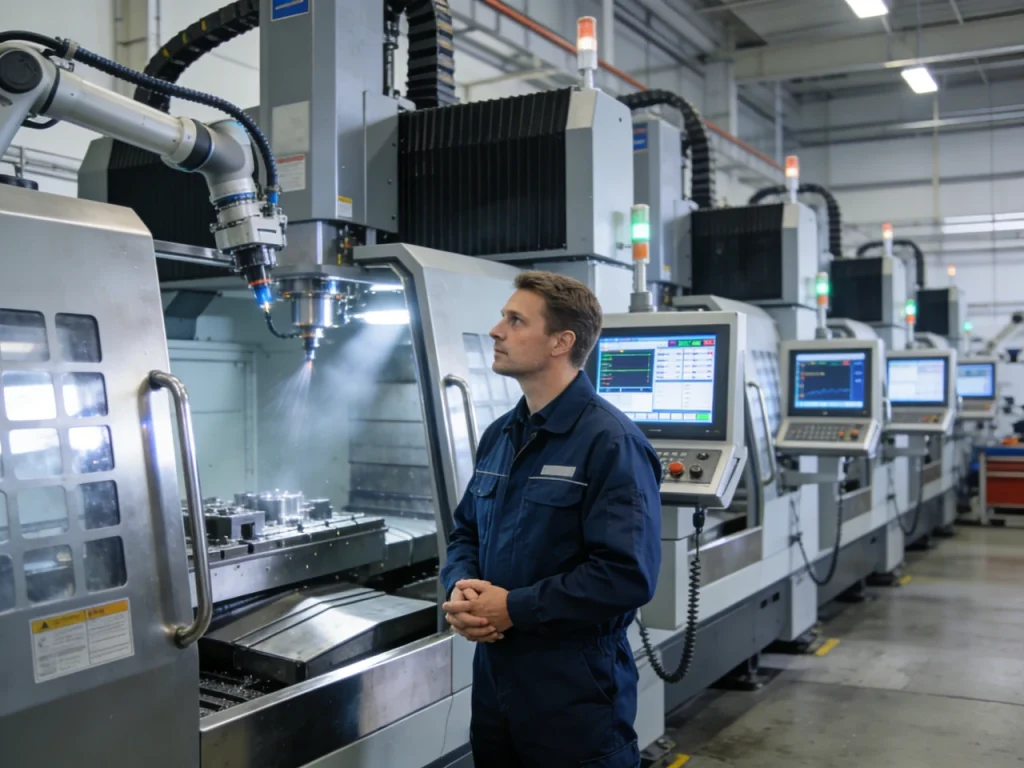
What drives “China speed”: 24/7 automation, robotic tending, capacity planning (Industry reports)
“China speed” is real in many programs, but it is not magic. It tends to come from higher utilization, flexible staffing, and—more recently—automation like robotic tending that keeps machines running beyond standard shifts.
In practice, responsiveness is often a system outcome:
- If quoting is tied to real capacity data, dates stay stable.
- If CAM and inspection planning are mature, engineering questions resolve early.
- If the shop can run longer hours safely, urgent work can fit in without pushing everything else out.
Speed is useful only when paired with proof. Fast parts that cannot be verified can slow your program more than a slower but correct supplier.
How fast can I get CNC prototypes from China without sacrificing quality?
Prototype speed depends on your drawing clarity, material availability, finishing steps, and inspection scope. What you can control as the buyer is the readiness of the package: a clean model and drawing, clear critical features, defined finish requirements, and a stated inspection expectation for prototypes (often lighter than production, but still structured).
When quality cannot slip, keep two rules. First, do not skip a first article check just because the quantity is small. Second, make sure any “quick ship” request does not remove the time needed for measurement and documentation.
Smart factory integration benchmark: 50% faster scheduling response via CNC–ERP/MES connectivity
Research reporting describes a benchmark where CNC connectivity to ERP/MES increased production scheduling response speed by 50%. For buyers, this shows up as shorter time to confirm dates and fewer surprises when a supplier’s load changes.
You do not need access to their systems. You just need observable behavior: fast, consistent updates; fewer date slips; and the ability to commit to realistic milestones like DFM feedback, machining start, inspection completion, and ship date.
Visual: timeline chart (RFQ → DFM → machining → inspection → shipping) + lead-time checklist
Program timeline (define milestones, not only a final date)
| Stade | What you provide | What you should receive back |
|---|---|---|
| RFQ | Model, drawing, quantity, finish, inspection ask | Quoted scope with assumptions and exclusions |
| DFM | Responses to questions | Clarified approach, setup plan, risk callouts |
| Usinage | Approved revision | Confirmation of start and key checkpoints |
| L'inspection | Defined inspection plan | FAI or measurement report as agreed |
| Shipping | Packaging and labeling rules | Tracking and shipment documentation |
Lead-time checklist (align expectations early)
| Checklist item | Pourquoi c'est important |
|---|---|
| Separate build lead time from shipping time | Shipping is not machining and needs its own risk buffer |
| Confirm finish and curing/processing time | Finishing often drives the critical path |
| Define inspection deliverable format | Avoids delays waiting on rework of reports |
| Lock revision control before cutting | Prevents scrap from mixed revisions |
Smart machining & AI: what to ask so your supplier is future-proof
As CNC machining China continues to evolve, buyers are no longer evaluating suppliers solely on cost, speed, or traditional precision. The next frontier is “smart machining”: integrating AI, in-process sensing, and connected digital workflows. Understanding how a supplier leverages these tools is becoming just as critical as verifying tolerances or lead times. Before diving into AI-driven programming or predictive maintenance, it helps to frame your sourcing questions around how the shop maintains repeatable quality, traceability, and responsiveness in a digitally connected environment.
AI five-axis programming: 50% programming efficiency + 40% process reuse (Tuopu case)
Technical reporting describes a case where AI methods applied to five-axis programming increased programming efficiency by 50% and improved process reuse by 40%. From a buyer perspective, those gains matter less as a headline and more as a signal: the supplier may rely less on a few expert programmers, and may be able to respond faster to revisions without quality falling apart.
You do not need the supplier to use a specific AI tool. You need evidence that programming is repeatable, reviewed, and not dependent on a single person’s tribal knowledge.
Predictive maintenance benchmark: 40% ops cost reduction via AI fault diagnosis
Research reporting also describes predictive maintenance and fault diagnosis reducing operating costs by 40%, with fault diagnosis performance comparable to several years of engineer experience. For sourcing, the practical point is uptime and stability. A supplier that can detect drift, vibration issues, or spindle problems early may be less likely to miss dates or ship borderline parts.
Ask how they prevent machine condition issues from becoming your quality issue. The answer should include containment behavior and how they decide when to stop a run.
Digital twins + cloud-edge collaboration: what “connected CNC” changes for buyers
Digital twins and cloud-edge collaboration are discussed in technical research as a way to connect CNC assets with planning and quality data. Buyers should care when it improves traceability and decision speed. For example, a connected environment can make it easier for a supplier to link an inspection result back to a specific batch, tool life window, or machine condition.
Still, connectivity can raise data governance issues. If you share models and process details, you should set boundaries on access, retention, and who can export data.
Visual: questions-to-ask checklist (AI/QC/IoT/traceability) + maturity scoring rubric
Questions to ask (keep them tied to your risks)
| Sujet | Question | Evidence you can request |
|---|---|---|
| Programming control | “How do you review CAM changes and revisions?” | Revision log, approval steps, example change note |
| In-process sensing | “Do you probe datums and criticals during machining?” | Example in-process check record |
| Traçabilité | “Can you trace parts to lots and inspection records?” | Sample lot traveler or trace record |
| Machine condition control | “What triggers a stop for vibration/thermal drift?” | Example nonconformance and containment record |
| Data access | “Who can access models and drawings?” | Access control policy summary |
Maturity scoring rubric (simple, buyer-side)
| Score | Description | Typical risk level |
|---|---|---|
| 1 | Mostly manual, limited records | Higher risk for repeatability and change handling |
| 2 | Basic QC records, some standard work | Medium risk; needs more buyer-side verification |
| 3 | Consistent inspection proof and revision control | Lower risk for many part families |
| 4 | Connected planning + in-process control evidence | Lower risk for schedule and repeatability, if governance is clear |
Sustainability & compliance: green CNC without greenwashing
Before evaluating specific claims, it helps to frame sustainability as part of process discipline rather than a marketing label. Thinking of “green” practices in terms of measurable controls—how cutting fluids are managed, how recycled materials are tracked, and how energy use is monitored—allows engineering teams to link supplier commitments to tangible outcomes, while maintaining both compliance and product quality.
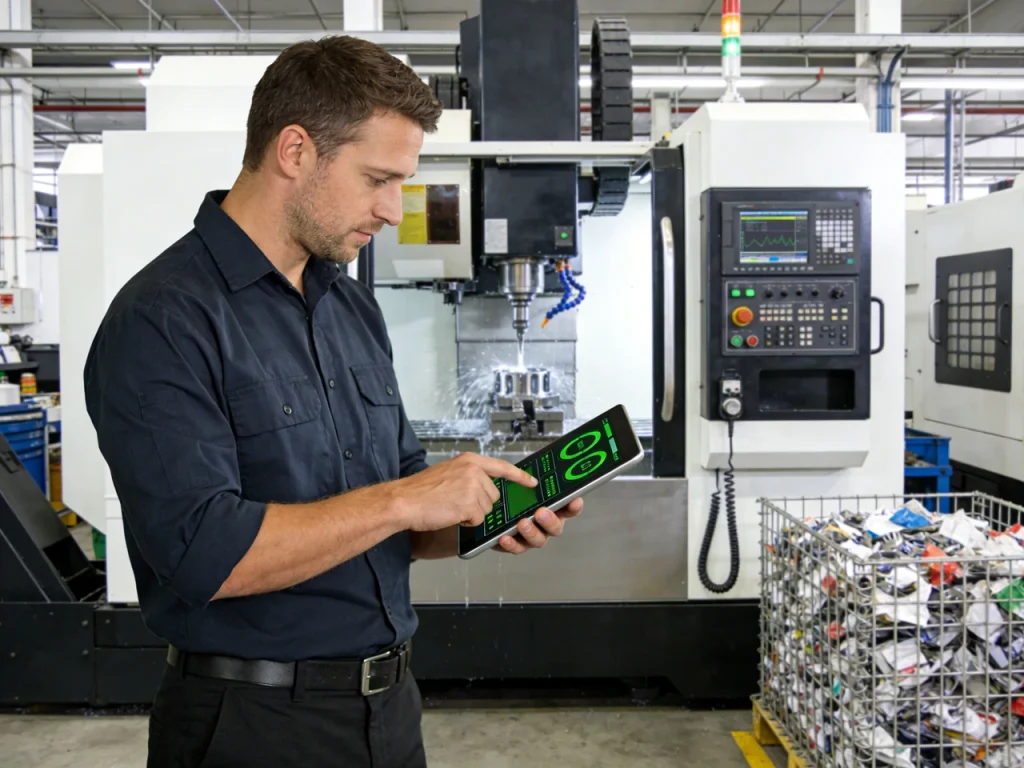
Green machining practices to verify: low-loss cutting fluids, recycled material processing (Industry/technical reports)
Sustainability claims are common in supplier presentations, but engineering teams need to treat them like any other requirement: define what you mean, then verify evidence.
Industry and technical reporting points to practices like low-loss cutting fluid systems and recycled material processing. In machining terms, that can involve fluid management methods that reduce waste, and material sourcing and segregation methods that support recycled inputs without losing traceability.
Even if you do not have formal carbon targets, these practices can connect to practical outcomes like better housekeeping, better process discipline, and more stable finishing results. Still, do not assume a “green” label implies quality.
Benchmark to reference carefully: 15% carbon emission reduction claim and what to validate
A reported benchmark describes a 15% carbon emission reduction associated with green CNC techniques like low-loss fluids and recycled materials. Treat this number as a starting point for questions, not a guarantee you can apply to your supplier. The claim may depend on the factory baseline, the accounting boundary, and the mix of processes included.
If carbon reporting matters for your program, define the boundary: machining only, finishing included, purchased material included, and shipping included. Without that boundary, two suppliers may report numbers that are not comparable.
How can I verify a CNC supplier’s sustainability claims?
Ask for documentation that links claims to controlled processes. A credible supplier should be able to show what they measure, how often, and who reviews it. If they cannot provide any metrics or records, treat sustainability claims as unverified.
Also check whether sustainability requirements conflict with your quality requirements. For example, recycled materials may be acceptable only if the supplier can maintain material identity and provide the documentation your program requires.
Visual: sustainability evidence checklist (metrics requested, process controls, documentation) (Industry/academic sources)
| Evidence area | What to request | A quoi ressemble le “bon” ? |
|---|---|---|
| Metrics | Energy, fluid use, scrap tracking | Clear definitions and consistent time periods |
| Contrôles de processus | Cutting fluid management method | Records of monitoring and maintenance |
| Material handling | Recycled material handling rules | Segregation and traceability evidence |
| Documentation | Any formal environmental documentation you require | Version-controlled documents and responsible owner |
Risk management: IP, supply chain resilience, and geopolitics
Effective risk management starts with understanding that IP protection, supply chain resilience, and geopolitical factors are interconnected. Before diving into contracts and legal controls, it helps to frame these risks in practical, operational terms: how information flows, how materials and tooling move, and how external forces can influence your supplier base. This mindset ensures that legal safeguards are implemented in a way that aligns with day-to-day machining and sourcing realities.
Contract & IP basics: NDAs, drawing control, access controls, data-sharing boundaries (Legal/standards references)
IP risk in CNC machining often comes from routine behavior, not dramatic theft scenarios. The usual failure modes are uncontrolled drawing sharing, unclear ownership of CAM files and fixtures, and weak access control to customer data.
A practical baseline includes:
- NDA coverage that matches your risk.
- Controlled drawing distribution and revision rules.
- Clear boundaries on who can access and export your files.
- Clear statements on what can be subcontracted and what cannot.
- Agreement on data retention and deletion expectations, if relevant.
Also treat “drawing control” as part of quality. Mixed revisions can create functional failures that look like machining variation but are really document failures.
Supply chain resilience plan: dual sourcing, buffer stock triggers, critical tooling ownership
Resilience is not only about geopolitics. It is also about normal disruptions: machine downtime, material shortages, and capacity constraints.
A sourcing plan for cnc machining services is more resilient when you define:
- Dual sourcing triggers (what causes you to qualify a second shop).
- Buffer stock rules tied to your demand volatility and shipping mode.
- Ownership and control of critical tooling and fixtures, especially if the part cannot be easily transferred.
- A process for transferring inspection methods and datum strategy between suppliers.
If you cannot dual source, at least define how you will contain the risk: higher inspection, more safety stock, or design changes that reduce sensitivity.
Policy context: “Made in China 2025” localization push and what it means for CNC tech autonomy
Selon le USCC, “Made in China 2025” continues to prioritize domestic capability in high-tech manufacturing sectors, including automation, robotics, and advanced machine tools, signaling sustained investment that could reshape supplier capabilities over time. For CNC buyers, the important point is not slogans. It is the direction of travel: more domestic capability in controls, ecosystems, and manufacturing tech, and continued investment that can change supplier capability over time.
The same official source also notes China-based firms accounted for nearly 25% of global export growth in sectors tied to that policy over a past period, though this figure is not CNC-specific and should not be used as a direct proxy for machining capacity. Still, it signals sustained momentum that can affect availability, technology depth, and competitive dynamics among suppliers.
Visual: risk matrix (impact vs likelihood) + mitigation workflow diagram
Risk matrix (customize to your program)
| Risque | Likelihood | Impact | Typical mitigation |
|---|---|---|---|
| Mixed drawing revisions | Moyen | Haut | Revision control rules + FAI tied to revision |
| Measurement mismatch | Moyen | Haut | Define datums + method + report format early |
| Rework loop due to ambiguity | Moyen | Moyen | Pre-cut DFM questions + clarified notes |
| IP leakage via uncontrolled sharing | Faible-Moyen | Haut | Access control + subcontracting rules |
| Shipping disruption | Moyen | Moyenne-élevée | Buffer stock triggers + shipping mode planning |
Mitigation workflow (buyer-side)
RFQ scope alignment → DFM clarification → Supplier audit evidence check → FAI requirement set → In-process control agreement → Shipment documentation check → Post-receipt feedback loop
Real-world examples & decision toolkit (put it all together)
These case studies demonstrate how suppliers translate technology, process control, and ecosystem strategies into tangible outcomes. Rather than offering a one-size-fits-all solution, they highlight approaches that reduce risk, improve efficiency, and support consistent quality. By examining the underlying practices, engineering teams can identify actionable questions and evaluation points for their own RFQs and supplier selection.
Case study: Tuopu CNC AI five-axis gains (50% programming, 40% reuse)
A reported case from technical research described AI deep learning embedded into five-axis machining workflows, translating part models toward control instructions with less manual process planning. The reported outcome was 50% higher programming efficiency and 40% higher process reuse.
For sourcing, the lesson is not that “AI solves machining.” The lesson is that some suppliers are building systems that reduce dependence on a small number of expert programmers. When you have frequent revisions or a large family of related parts, that can reduce risk of delays and inconsistent interpretation.
What to take into your RFQ: ask how programming changes are controlled, reviewed, and reused across similar parts, and how those changes are validated against inspection results.
Case study: automated 5-axis + in-line inspection for consistency and lower cost per part (PTSMake)
Industry reporting describes facilities using 24/7 automation with robotic tending and in-line inspection tools to support consistent output and lower cost per part through efficiency rather than labor alone. The sourcing takeaway is that automation can support both speed and repeatability when paired with measurement discipline.
What to take into your supplier evaluation: ask what inspection happens in-line or in-process, what triggers containment, and how the supplier proves consistency across shifts. If the supplier’s story is only “we run 24/7,” you still need to see how they prevent drift at hour 20 from becoming your problem.
Case study: Huazhong open-ecosystem localization (domestic OS-compatible CNC)
Technical reporting also describes localization efforts using open interfaces and domestic OS compatibility to build an ecosystem for CNC development, supported by policy and education integration. For buyers, this matters when it changes the supplier landscape: controls and software stacks may become more standardized domestically, and suppliers may adopt tools that differ from what you see in Europe or North America.
This does not automatically increase or decrease risk. It changes what you should ask: how the supplier manages compatibility, data exchange, and control stability, and how they validate changes in their stack without affecting your parts.
Toolkit visuals: supplier scorecard table + RFQ checklist + quote comparison sheet (Downloadable templates)
Supplier scorecard (use consistent scoring across candidates)
| Catégorie | Weight (you choose) | Supplier evidence | Score (1–4) | Notes |
|---|---|---|---|---|
| Part capability fit (axes, size, materials) | ||||
| Inspection proof and measurement fit | ||||
| Revision control and communication clarity | ||||
| Lead-time realism and update discipline | ||||
| Risk controls (IP, subcontracting, traceability) | ||||
| Sustainability evidence (if required) |
RFQ checklist (engineering-ready, not marketing)
| Objet | Ce qu'il faut inclure | Pourquoi c'est important |
|---|---|---|
| Drawing + model | Controlled revision, units, datums | Prevents interpretation drift |
| Caractéristiques essentielles | Mark functional surfaces and GD&T drivers | Focuses process control where it matters |
| Matériau | Grade, acceptable substitutes, cert needs | Avoids silent substitutions |
| Finition | Functional vs cosmetic, masking rules | Avoids rework and appearance disputes |
| Inspection ask | FAI scope, sampling plan, report format | Aligns proof expectations |
| Emballage | Part protection, labels, separation | Prevents shipping damage and mixing |
| Logistics | Delivery terms and shipping mode | Keeps schedule assumptions visible |
Quote comparison sheet (scope alignment first)
| Quote line | Supplier A assumption | Supplier B assumption | Risk if wrong |
|---|---|---|---|
| Comptage de la mise en place | Misalignment drives cost and tolerance risk | ||
| Portée de l'inspection | Missing proof causes downstream failures | ||
| Finish definition | Cosmetic disputes and rework loops | ||
| Shipping plan | Late delivery despite “fast machining” |
Ending: how to decide if CNC Machining China fits your program
CNC machining in China can be a strong option when you treat it as an engineering-controlled supply chain, not a price hunt. It tends to fit best when you can define critical features clearly, require inspection proof, and align on revision control and packaging so parts arrive usable.
It is often a poor fit when the drawing is ambiguous, the program needs very fast iteration but has slow decision-making on requirements, or when you cannot resource basic supplier verification. In short, success depends less on where the shop is and more on whether you can match part risk to supplier capability, then verify it with evidence.
FAQ
Outsourcing CNC machining to China can still make sense in 2026, especially when you’re balancing cost, schedule, and flexibility. It’s not just about lower prices—total landed cost, including shipping, duties, and handling, often drives the real savings. The key is to work with suppliers who can deliver reliably and provide proof of their process control. When inspection, revision management, and nonconformance handling are validated upfront, you can treat China as a capable extension of your engineering team. The country itself doesn’t guarantee results—what matters is how well you manage and verify the supplier.
The most reliable way to verify a supplier is to tie evidence directly to the risks that matter for your parts. Ask for sample FAI reports, calibration records, inspection plans, and how they handle revisions and traceability. Seeing a short audit checklist in action often reveals gaps that a quote won’t show, like inconsistent documentation or untested processes. Also, check how they control drift-prone features during production, and whether they have in-process verification methods. Essentially, you want proof that their controls match your expectations, not just a written promise.
Shipping from China is more than just distance—it depends on your chosen mode, customs, and how clearly delivery responsibilities are defined. Air freight is faster but expensive, while sea freight is slower and subject to port congestion. Don’t lump shipping time together with machining lead time; treat it as a separate schedule line with clear assumptions. Make sure your supplier communicates expected transit times and contingency plans for delays. Planning ahead and separating machining and shipping timelines gives you a realistic picture of when parts will arrive, reducing surprises in your program schedule.
Yes, they can be, but quality varies widely between suppliers and part families. The best results come from buyers who define critical features upfront, insist on structured inspection evidence, and verify in-process control for dimensions prone to drift. Don’t rely on marketing claims or machine labels alone—ask for concrete proof, such as inspection reports on similar parts or documented calibration routines. Consistency comes from disciplined process management, not geography. With careful supplier selection and verification, Chinese CNC parts can meet high standards, but you need to actively manage risk rather than assuming quality is guaranteed.
Références
https://www.uscc.gov/sites/default/files/2025-11/Made_in_China_2025–Evaluating_Chinas_Performance.pdfhttps://jstmt.com/cnc-machining-trends-in-2025/


 French
  English
  German
  Italian
  Spanish
  Polish
  Czech
Czech  Japanese