
Precipitation hardening, also called age hardening, is a heat treatment method that can make certain metal alloys much stronger without changing the part’s shape. If you’ve ever needed a lighter bracket, a stiffer shaft, or a harder mold insert—but you couldn’t make it thicker—precipitation hardening is often the answer. It works because tiny particles called precipitates form inside the metal matrix and block the movement of dislocations (small shifts in the crystal that allow metal to bend). This guide covers what it is, why it works, the exact three steps (solution treatment → quench → aging), and what to watch for in real shop conditions like distortion, corrosion risk, and missed hardness.
What Is Age Hardening?
When people ask what is precipitation hardening, they usually want a plain definition first, then the “how” and “when.”
Precipitation hardening is a heat treatment process used on selected metal alloys—especially aluminum alloys, precipitation hardening stainless steel, and nickel-based high-temperature alloys—to increase the yield strength and raise hardness. You may also hear it called precipitation heat treatment, particle hardening, dispersion hardening, solutionizing (for the first step), artificial aging, or natural aging (for the last step).
It is used when you want a strong part after forming and machining. For example, many teams do CNC-Drehen und fräsen with precipitation hardening in mind: they machine in a softer condition for tool life and stability, then age the part to lock in final mechanical properties.
Definition, alternate terms, and where it’s used (Al, PH stainless, Ni)
This treatment is common in:
- Precipitation hardened aluminum (many structural aluminium alloys in the 2xxx, 6xxx, and 7xxx families)
- Precipitation-hardened stainless steel (often called PH stainless; popular grades include 17-4 PH, 15-5 PH, and 13-8 type alloys)
- Nickel alloys used at higher temperature (a well-known example is Alloy 718)
You’ll also see age hardening in some copper alloys (including copper alloys that keep good conductivity) and in certain titanium alloys.
Why strength increases: dislocations blocked by fine precipitates
Inside a metal, strength depends a lot on how easily dislocations can move. If dislocations move easily, the metal yields (permanent bending starts) at a lower stress. Precipitation hardening adds a “traffic jam” inside the crystal lattice.
After the right heat and cooling steps, the alloy forms many fine precipitate particles spread through the matrix. These particles block dislocations in two main ways:
- If particles are very small and “match” the lattice well, dislocations may try to cut through them.
- If particles are larger or less matched, dislocations tend to bow around them (often called bypassing or looping).
A useful rule of thumb in many age-hardened systems is that maximum strengthening often happens when precipitates are very small—on the order of about 5–30 nm in radius—because spacing and coherency are just right to resist dislocation motion.
What users should expect: typical gains and typical limits
People love precipitation hardening because the strength jump can be dramatic. The key point is that it’s not “magic strength.” You gain strength, but you may give up ductility, toughness, or corrosion performance depending on the alloy and the aging condition.
Here are realistic, commonly reported ranges that help set expectations:
- In many aluminum systems, yield strength can move from roughly 50–100 MPa in a soft/as-quenched state to 300–500+ MPa after peak aging (alloy and temper matter a lot).
- In common PH stainless grades, yield strength can rise from roughly 720–800 MPa after solution treatment to 1100–1200+ MPa after a high-strength aging condition.
- In Alloy 718, properly aged material commonly reaches >1000 MPa yield strength at room temperature and keeps strong performance up to roughly 650°C in many applications.
So yes, precipitation hardening can harden an alloy a lot. The limit is that these precipitates can coarsen or dissolve if the part sits too hot for too long, and some peak-strength conditions can raise stress-corrosion cracking risk.
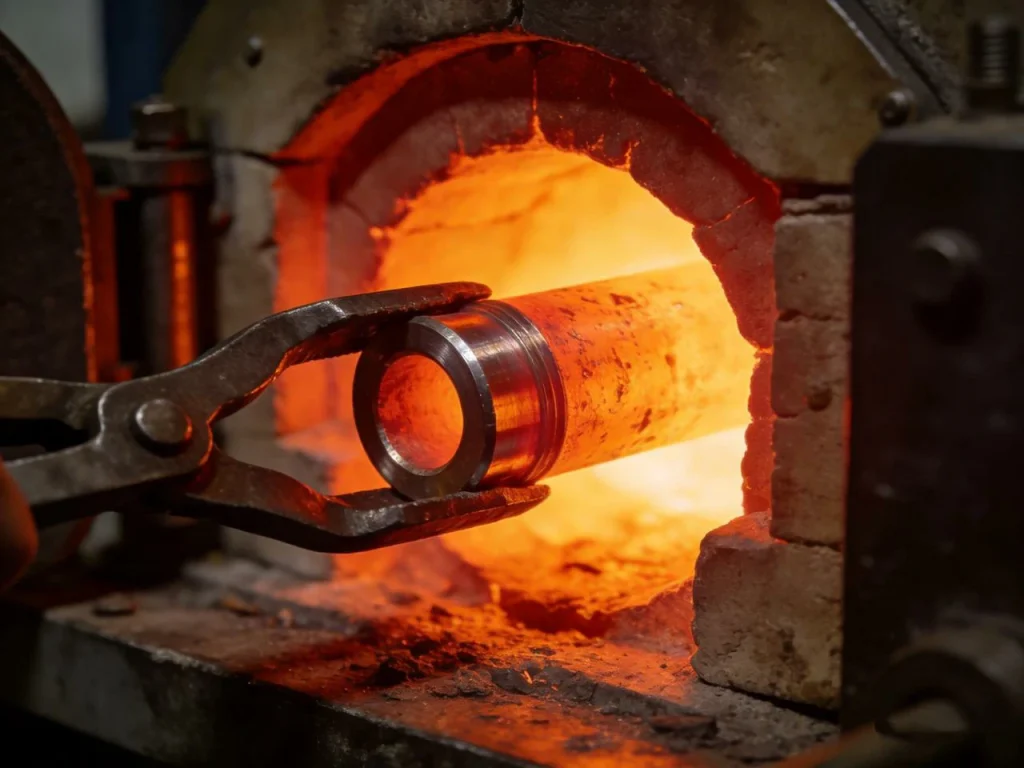
Precipitation Hardening Process (3-Step Heat Treatment)
If you remember only one thing, remember this: the precipitation-hardening process involves three core steps.
- Solution treatment (solutionizing)
- Abschrecken (schnelles Abkühlen)
- Aging (natural or artificial)
That sequence answers two common questions directly: What are the three steps in precipitation hardening? and What are the three steps in an age hardening treatment? They are the same three steps.
Step 1 — Solution treatment (solutionizing): purpose + typical ranges
Solution treatment means heating the alloy high enough that the alloying elements dissolve into a single-phase solid solution. In simple terms, you heat it so the “ingredients” spread out evenly.
The exact temperature depends on the alloy family. The point is to be hot enough to dissolve strengthening phases, but not so hot that you melt or damage the structure.
Typical solution treatment ranges (family-level) are below.
| Alloy family | Typical solution treatment temperature | Practical notes (why it matters) |
|---|---|---|
| Age-hardenable aluminum alloys | ~500–540°C | Close control helps prevent overheating and grain boundary melting. Hold time depends on thickness. |
| PH stainless steel | ~1040–1065°C | Often followed by rapid cooling to keep a soft-ish, workable condition before aging. |
| Nickel alloy Alloy 718 | ~980–995°C | Usually paired with a defined multi-step aging cycle to form the right precipitates. |
During solutionizing, you also reduce chemical “patchiness” from prior processing. That helps you get a more even precipitate distribution later, which is a big deal for consistent hardness after CNC machining.
Step 2 — Quench: media choices, quench severity, distortion risk
After solutionizing, the part is rapidly cooled—often described as a quenching process. The goal is to “freeze in” a supersaturated solid solution, meaning more alloying elements stay dissolved than would normally be stable at room temperature.
This step is why people ask: What is the difference between precipitation hardening and quenching? Quenching is only the middle step. Quenching alone does not give the final strength of precipitation hardening. Quenching creates the starting point (supersaturation). The aging step is what actually forms the precipitates that do the strengthening.
Quench media choices usually include water, polymer solutions, oil, or forced air. The trade-off is simple:
- Faster quench reduces unwanted early precipitation and helps reach higher peak strength.
- Faster quench also raises distortion, residual stress, and cracking risk—especially in thin or complex shapes.
If you’ve ever pulled a thin ring from a severe quench and watched it “potato chip,” you already know why quench planning matters. Fixtures, part orientation, agitation control, and choosing a quench medium with the right severity can save an entire batch.
Step 3 — Aging: natural vs artificial; single vs multi-step cycles
Aging is where the precipitation happens on purpose. You hold the alloy at an ageing temperature where atoms can move enough to form many small precipitates, but not so much that they rapidly grow coarse.
There are two main styles:
- Natural aging: the part ages at room temperature over time.
- Artificial aging: you heat the part to a controlled temperature to speed up and stabilize the reaction.
Below are common artificial aging windows used as practical starting points (final values must follow the material specification for your exact alloy and temper).
| Alloy family | Common artificial aging window | What people use it for |
|---|---|---|
| Aluminium-Legierungen | 120–200°C for ~4–24 h | High strength at low weight; typical structural parts. |
| PH stainless steel | 480–620°C for ~1–4 h | Choice of condition controls strength vs toughness/corrosion resistance. |
| Nickel alloy Alloy 718 | ~720°C/8 h → controlled cool → ~620°C/8 h | High yield + creep resistance at elevated temperature. |
This step also answers two practical questions: How to perform precipitation hardening? and How long does age hardening take? The honest answer is: it depends on the alloy and the target condition. Aging can take hours in an oven for artificial aging, or days at room temperature for natural aging in some aluminum systems.
What’s the difference between natural aging and artificial aging?
Engineers ask this because it affects production control and scheduling.
- Natural aging happens at room temperature after quench. It can improve strength over hours to days, but it may be less predictable if time and storage temperature vary.
- Artificial aging uses a controlled oven cycle to reach a defined temper. It is faster and more consistent, which helps when you need repeatable hardness after machining and before shipment.
If you need stable results across many lots, artificial aging is usually easier to control.
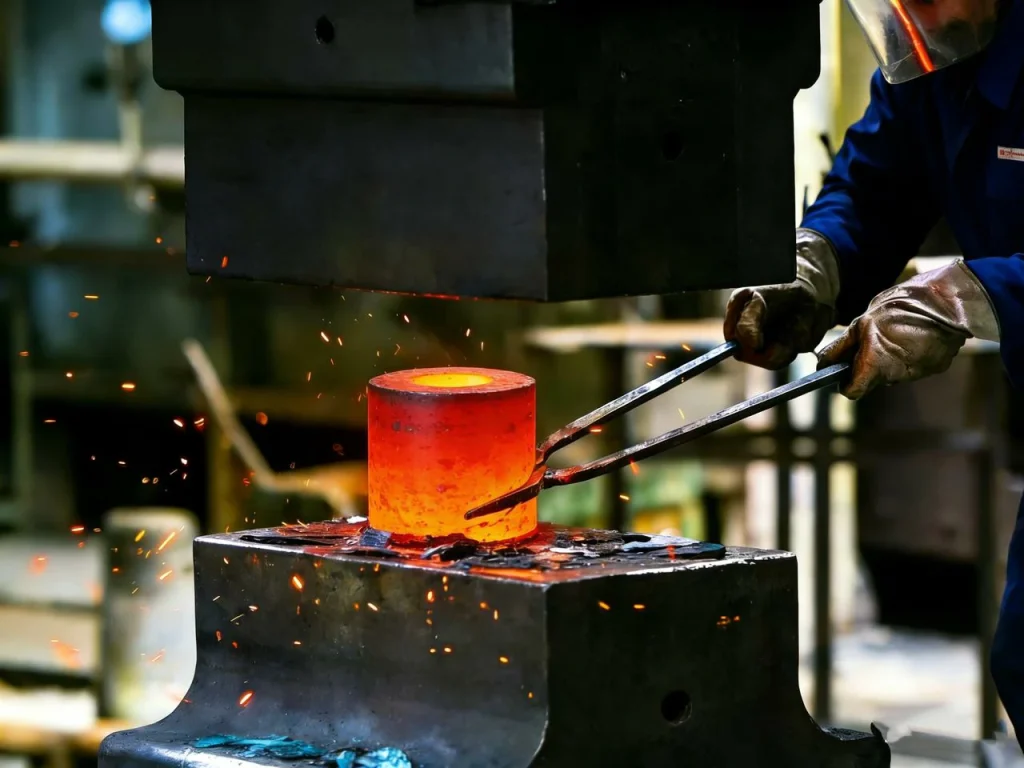
How It Works: Microstructure, Precipitates, and Strengthening Modes
The strengthening is not just “because it’s heated.” It is because the microstructure changes in a planned way.
Precipitate evolution: under-aged → peak-aged → over-aged (coarsening)
During aging, precipitates form and change size over time. The strength trend usually follows a simple shape:
- At first, strength rises as many fine particles form.
- Strength reaches a maximum at peak-aged condition.
- Strength drops during over-aging as particles grow and spacing increases.
This is why one batch can come out perfect and the next comes out soft even though “we did the same thing”—a small temperature error, a longer hold, or a slow cool can push the structure toward over-aging.
Coherency and particle size: coherent vs semi-coherent vs incoherent
Early precipitates often fit the matrix well, meaning they are coherent. Coherency creates strain fields that resist dislocations. As precipitates grow, the fit gets worse and they become semi-coherent or incoherent. That shift changes the strengthening mechanism and often reduces peak strength.
A helpful mental image is this: at first, the precipitates are like tiny bumps under a carpet—hard to slide over. Later, they turn into fewer, larger obstacles with more spacing between them. Dislocations find pathways.
Cutting vs Orowan looping (bypassing): what changes at peak strength
At smaller sizes, dislocations may cut through precipitates, but doing so costs energy because the precipitate is different from the matrix. At larger sizes, dislocations bow between particles and leave loops behind them. The resistance depends heavily on particle spacing.
This is why the “sweet spot” often shows up around 5–30 nm particle size in many systems. At that size, particles are numerous and closely spaced, so dislocations have a hard time moving.
Typical precipitate phases (by alloy system)
Different families form different precipitates. You do not need to memorize phase names to run parts correctly, but it helps to know that the “strength phase” is different by alloy, so the cycle is different too.
| Alloy system | Common strengthening precipitates (high-level) | What that implies |
|---|---|---|
| Aluminum (example Al-Cu, Al-Mg-Si, Al-Zn-Mg) | Early zones (often called GP zones) then stronger precipitates such as θ′-type in Al-Cu systems | Strength is sensitive to time/temperature history and even storage after quench. |
| Nickel alloys (example Alloy 718) | γ′ / γ″ type precipitates | Strong elevated-temperature performance; multi-step aging is common. |
| PH stainless steel | Often Cu-rich precipitates (grade-dependent) plus other fine phases | Aging condition changes strength, toughness, and sometimes corrosion response. |
Alloy-by-Alloy Guide: Parameters, Properties, and Use Cases
This is where most people want quick clarity: “I have this alloy; what does precipitation hardening look like for it?”
Aluminum alloys (2xxx / 6xxx / 7xxx): tempers and property jumps
Many aluminium alloys used in structures are designed for precipitation strengthening. You will often see “T” tempers that describe the condition after solution heat treatment and aging (the exact meaning of each temper code is defined in standards).
In real work, one of the biggest surprises is how quickly some aluminum changes right after quench. If you delay artificial aging, natural aging may start and shift final properties. That matters when you do tight-tolerance turning or mill operations after solutionizing. I’ve seen parts that machined beautifully in the morning but cut “gummy” in the afternoon because the material started to age and the cutting feel changed.
Here is a family-level view with common examples and typical windows. Always follow the material specification for the exact alloy/temper you are buying.
| Aluminum alloy example | Typical solution temperature | Typical artificial aging | Typical yield strength range (ballpark, temper-dependent) |
|---|---|---|---|
| 2024-type (Al-Cu family) | ~495–505°C | ~190°C for ~8–12 h (varies by temper/process) | ~300–450+ MPa |
| 6061-type (Al-Mg-Si family) | ~530–540°C | ~160–180°C for ~6–18 h | ~240–320 MPa |
| 7075-type (Al-Zn-Mg-Cu family) | ~470–490°C | ~120–130°C for ~18–30 h (or multi-step for over-aged conditions) | ~450–550+ MPa |
So, what is precipitation hardening aluminum? It is this solutionize–quench–age cycle applied to age-hardenable aluminum alloys to form fine precipitates that raise yield and hardness. When done well, it gives high strength-to-weight. When done poorly, you get soft parts or stress-corrosion problems.
Precipitation-hardening stainless steels (17-4 PH, 15-5 PH, 13-8 type)
PH stainless steels are popular because they can reach high strength while still keeping useful corrosion resistance. They are not the same as martensitic stainless steels that rely mainly on quench-and-temper strength. PH stainless uses precipitation to do the final strengthening after solution treatment.
A big day-to-day decision is which aging condition to choose. For example, one common grade offers conditions often referred to by aging temperature (a higher-strength, lower-temperature age versus a tougher, higher-temperature age). People sometimes chase maximum hardness, then learn the hard way that the toughest choice for service is not always the hardest choice.
Here is a simplified comparison style that matches how engineers actually choose. Exact numbers vary by product form and spec, but the trend is reliable.
| PH stainless condition style | Aging temperature range | Trend zur Stärke | Toughness/corrosion trend |
|---|---|---|---|
| Higher-strength condition (lower aging temperature) | ~480–510°C | Higher yield and hardness (often can reach ~HRC 40+) | Toughness may drop; SCC sensitivity can rise in some environments |
| More-tough condition (higher aging temperature) | ~590–620°C | Lower yield than peak | Toughness often improves; SCC risk may reduce |
This ties directly to purpose of precipitation hardening in stainless: you can tune properties with aging temperature and time, not just “make it hard.”
Nickel-based superalloys (Alloy 718 benchmark)
Nickel alloys used in hot sections often need strength that lasts at temperature. In these alloys, precipitates like γ′ and γ″ help resist creep (slow deformation under load) far better than many other alloy families.
A commonly used cycle for Alloy 718 uses a two-step aging treatment, such as holding around 720°C, then cooling in a controlled way and holding again around 620°C. That controlled path builds the right precipitate size and distribution. It’s not just heating twice. It’s controlling nucleation and growth so the alloy stays strong when hot.
If you’ve ever wondered why a shop insists on recording ramp rates and cool rates for these alloys, this is why: small changes can shift precipitate size, and that changes strength and life.
Copper and titanium (where age hardening applies)
Age hardening is not only for aluminum and stainless.
Some copper alloys are age hardened to get a useful mix of strength, fatigue resistance, and electrical or thermal conductivity. These are common where you need spring force and good conduction at the same time.
Some titanium alloys also use solution treatment and aging to raise strength. The details vary by alloy type, but the idea is similar: form fine precipitates in the matrix to block dislocations. Titanium processing is often sensitive to contamination and atmosphere control, so shops follow tight procedures.

Property Trade-Offs: Strength vs Toughness, Corrosion, and Temperature
If precipitation hardening were “free strength,” every alloy would use it the same way. The reality is more balanced.
Over-aging on purpose: when lower strength is safer (ductility/toughness)
Over-aging sounds like a mistake, but it is sometimes a design choice. Why would you accept less strength?
Because a slightly coarser precipitate structure can increase ductility and fracture toughness. In some PH stainless steels, a higher-temperature age reduces peak strength but can improve toughness and stress-corrosion performance. In some high-strength aluminum alloys, over-aged tempers are chosen to reduce stress-corrosion cracking (SCC) risk.
So if your part is a critical fitting, pressure component, or anything that sees a harsh environment, the safest choice may not be the strongest one.
Stress-corrosion cracking (SCC) and corrosion resistance implications
SCC risk depends on alloy family, temper, environment, stress level, and surface condition. A common pattern is that peak-aged, high-strength conditions can be more vulnerable in aggressive environments.
This does not mean “avoid precipitation hardening.” It means match the temper to the environment. If the part lives near salt water, sees cleaning chemicals, or holds constant tensile stress, you should treat SCC as a design input, not an afterthought.
Fatigue performance: precipitates, residual stress, surface condition
Fatigue life depends on microstructure, but also on the surface. A beautifully aged microstructure can still fail early if the surface has machining tears, sharp notches, or tensile residual stress from a severe quench.
This is where sequencing matters. Many teams do rough machining, then heat treat, then finish machining or surface treatment. Others do full machining first and accept some movement during heat treat. There is no single rule—geometry and tolerance decide.
Temperature stability: service temperature ceilings and coarsening risk
Precipitation-hardened alloys can lose strength if exposed to temperatures where precipitates coarsen or dissolve.
- Many precipitation-hardened aluminum alloys can lose strength when exposed for long times around ~200–250°C (exact temperature depends on alloy and temper).
- Nickel precipitation-strengthened alloys can keep strength to higher temperatures because their precipitates are more stable in hot service.
If your part will run hot, ask early: will it sit near an aging temperature during service? If yes, your carefully chosen temper might drift.
Process Control, QA, and Shop-Floor Best Practices
A precipitation hardening treatment looks simple on paper. In a real furnace with real loads, it is easy to miss peak properties.
Furnace/oven control: uniformity, ramp rates, and tight tolerances
Many aging cycles are sensitive enough that practical control often needs to be around ±5–10°C to reliably hit the target condition. Temperature uniformity matters because one corner of a load that runs 15°C hotter may over-age while the rest is perfect.
Load size, part spacing, and airflow can cause thermal lag. A thick part may not reach soak temperature as quickly as a thin one, even if the furnace display says “at temperature.”
Standards and traceability: what to link and what to document
In controlled industries, you usually need proof that the heat treatment met the required cycle. Even in general industry, documentation helps when a hardness audit fails.
Typical records include furnace charts, load maps, quench medium checks, and part traceability to heat/lot. If you ever had to sort mixed-lot parts after the fact, you know why this paperwork matters.
Testing and verification: hardness, tensile, microstructure confirmation
Hardness testing is quick and often good for process control, but hardness alone is not always enough. Some specifications require tensile coupons or periodic tensile tests because yield and elongation matter as much as hardness.
If there is a failure investigation, microstructure checks may confirm whether parts were under-aged, peak-aged, or over-aged by looking at precipitate distributions (often indirectly, because many precipitates are too fine for basic microscopes).
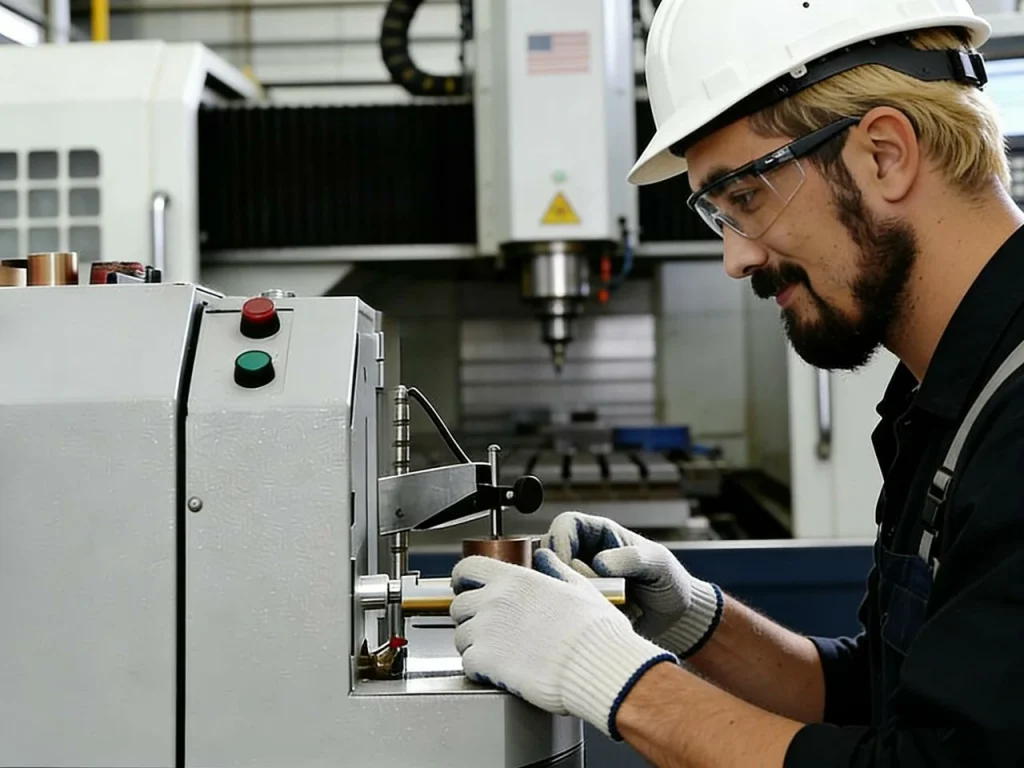
How do you verify a part is properly precipitation hardened?
You verify it by matching tests and records to the requirement, typically using:
- Hardness checks (often multiple locations for larger parts)
- Tensile tests on coupons when required
- Furnace time-temperature records for the lot
- Material and lot traceability so you know the alloy condition was correct before processing
Common Problems & Troubleshooting (Distortion, Soft Parts, Rework)
Even experienced shops deal with these issues. The good news is that most problems have a traceable cause.
Distortion and quench cracking: causes + prevention
Distortion usually comes from uneven cooling and residual stress. Quench cracking is the extreme case where stress exceeds the material’s ability to deform.
Common risk factors include sharp internal corners, big thickness changes, thin webs, and asymmetric shapes. If you can smooth transitions or add machining stock to remove distortion later, you often should.
Quench severity selection is also part of the answer. Water quenching may be required for properties in some alloys, but polymer or air cooling may reduce distortion for others—if the spec allows it.
Soft parts (under-aged) vs over-aged parts: symptoms and root causes
Soft parts can happen in more than one way:
- Under-aged: aging time too short, aging temperature too low, parts not fully soaked, or parts cooled too quickly before time was complete.
- Over-aged: aging time too long, temperature too high, hot spots in the furnace, or the part saw unintended heat exposure later (like a high-temp paint bake).
A practical shop clue is consistency. If only the center of a dense load is soft, you may have thermal lag. If the edges are soft, you may have temperature overshoot or airflow patterns.
Can you re-heat treat? limits of re-solutionizing and re-aging
Often, you can re-heat treat by re-solutionizing and re-aging, but it depends on alloy, spec, and how many cycles the material has already seen. Rework can change grain size, surface condition, and corrosion response. Some parts also pick up distortion each time.
So the best strategy is still prevention: correct alloy condition in, correct cycle control, correct quench plan, and careful handling after heat treat.
What causes over-aging, and how do you prevent it?
Over-aging is usually caused by excessive time at aging temperature, higher-than-planned temperature, or unintended exposure to heat after aging. You prevent it with tight oven calibration, controlled soak timing, good load spacing for even heating, and avoiding extra thermal steps that sit near the aging range.
Selection Guide and Applications
Strengthening mechanisms can look interchangeable on the surface, but they rely on different physics and suit different alloys and part conditions. This section maps precipitation hardening, work hardening, and quench-and-temper to real use cases, ideal alloy families, and the trade-offs that matter in manufacturing. The goal is to give a clean selection guide with actionable takeaways, not just metallurgy theory.
When to choose precipitation hardening vs work hardening vs quench-and-temper
People mix these up, so here’s the clean separation.
Precipitation hardening uses fine precipitates formed during aging to block dislocations, according to NIST, these finely dispersed precipitates impede dislocation motion and increase strength. It is common in aluminum, PH stainless, nickel alloys, and some copper and titanium systems.
Work hardening increases strength by deforming the metal (rolling, cold drawing, forming). It raises dislocation density instead of adding precipitates. Based on materials science literature, the accumulation and entanglement of dislocations makes further deformation more difficult. It is useful when the alloy is not age-hardenable or when heat treat would distort a finished part.
Quench and temper (common in many grades of steel, including carbon steel) forms a hard phase by rapid cooling from austenite (martensite), then tempers it to regain toughness. This is different from precipitation strengthening and is common in many steels that are not designed for age hardening.
Here is a direct comparison where a table helps.
| Methode | Main strengthening mechanism | Typical materials | Key advantage | Key limit |
|---|---|---|---|---|
| Precipitation hardening | Fine precipitates block dislocations | Al alloys, PH stainless, Ni alloys, some Cu/Ti | Big strength gain with small shape change | Sensitive to time/temperature; can affect toughness/SCC |
| Arbeitsverhärtung | Plastic deformation raises dislocation density | Many ductile metals | No furnace needed; local strengthening possible | Can reduce ductility; hard to apply uniformly to thick parts |
| Quench & temper | Martensite + tempered structure | Many steels | Strong and tough when done right | Less suited to many aluminum alloys; distortion/cracking risks |
This also answers: What is the difference between tempering and precipitation hardening? Tempering is a step used mainly after quenching steel to adjust martensite hardness and toughness. Precipitation hardening is a different hardening process that creates precipitates during aging in specific alloys.
Application map (aerospace, medical, automotive, tooling, energy)
Precipitation hardening shows up where strength-to-weight, corrosion resistance, or hot strength matters.
In aerospace structures, precipitation hardened aluminum helps cut weight while keeping stiffness. In corrosion-prone fittings, PH stainless can provide strength with corrosion resistance. In energy and turbomachinery, nickel precipitation-strengthened alloys handle high stress at high temperature where many steels would soften.
In tooling and molds, precipitation hardening is often used because it can give a stable final condition after machining. If you have ever chased a tight tolerance on a mold insert, you know why “machine soft, then age to final hardness” is a popular flow.

Which alloys can be precipitation hardened?
In simple terms, alloys can be precipitation hardened when their chemistry and phase diagram allow a useful sequence: dissolve at high temperature, trap a supersaturated state by quench, then form fine precipitates during aging.
Common precipitation hardening materials include many aluminum alloys, PH stainless steels, certain nickel alloys, many beryllium-containing copper alloys, and some titanium alloys. Some magnesium alloys can also be age hardened.
Summary: key numbers + quick “process card”
If you want a fast mental checklist for the process of precipitation hardening, use this:
- Solution treat to form a single-phase solid solution
- Quench (rapid cooling) to keep a supersaturated solid solution
- Age at a controlled ageing temperature to form a fine precipitate population and increase strength and hardness
And remember the most common reasons it fails: wrong time/temperature, uneven heating, quench distortion, and uncontrolled time at room temperature (especially for some aluminum).
FAQs
Precipitation hardening (also called age hardening) generally happens in three key stages: solution treatment, quenching, and aging. First the alloy is heated to a high temperature so the alloying elements dissolve and form a single-phase solid solution. Then it’s rapidly quenched to lock those elements in place so they don’t precipitate out too early. Finally, during the aging stage, fine precipitates form and block dislocation movement, which is what gives the metal its big boost in strength and hardness. In practice, manufacturers adjust temperature and aging time to hit the best strength–ductility balance for the part.
Tempering and precipitation hardening both involve heating, but they’re not trying to accomplish the same thing. Tempering is mainly used on quenched steels to reduce brittleness and improve ductility and toughness. Precipitation hardening, on the other hand, is used on precipitation-hardenable alloys (like aluminum, nickel, and stainless steels) to actually increase hardness and tensile strength by forming fine precipitates. You could say tempering “softens to stabilize,” while precipitation hardening “hardens to strengthen.”
Quenching is actually just a part of precipitation hardening, not a competing process. Quenching means cooling very rapidly—usually by water, oil, or air—to trap the alloying elements in a supersaturated solid solution. Precipitation hardening takes it further by adding the aging step where controlled precipitation boosts strength. Without the aging step, quenching alone would give higher strength than annealing but not as high as fully precipitation-hardened material.
To perform precipitation hardening, you typically:
Heat the alloy to its solution-treat temperature,
Quench quickly, and
Age at a lower, controlled temperature.
The exact temperatures and times depend on the particular alloy series. For example, many aluminum alloys are solution treated around ~480–550 °C, then quenched, then artificially aged around ~120–190 °C. The goal is to form fine nano-scale precipitates that pin dislocations and improve strength. Industrial setups may batch process parts or use continuous furnaces for large-scale aerospace and automotive components.
The main purpose is to make the alloy stronger and harder without sacrificing too much ductility. By forming tiny, dispersed precipitates, the metal can resist deformation better under load and wear. This is why precipitation-hardened aluminum, nickel superalloys, and stainless steels show up in aerospace, turbines, high-performance automotive parts, pressure vessels, and fasteners.
Precipitation heat treating is another way of saying precipitation hardening. It refers to the entire thermal cycle (solution treat → quench → age) that engineers use to change the microstructure. The “precipitation” comes from alloying elements coming out of solid solution to form finely distributed precipitates that block slip and increase strength.
Precipitation-hardened aluminum refers to aluminum alloys—especially the 2xxx, 6xxx, and 7xxx series—that get their strength from age hardening. Alloys like 6061, 2024, and 7075 can reach surprisingly high strength-to-weight ratios once properly aged. That’s why aircraft structures, performance bike components, automotive parts, and precision machining components often specify T6 or T651 tempers—they indicate a precipitation-hardened state.
Age hardening is just another name for precipitation hardening. The “aging” step is where the magic happens: precipitates slowly form and block dislocations. Aging can be natural (at room temperature, like 6061-T4) or artificial (in a furnace at elevated temperature, like 6061-T6). Artificial aging is faster and gives more predictable results for manufacturing and aerospace.
It depends on the material and whether aging is natural or artificial. Natural aging can take days to weeks, depending on composition and temperature. Artificial aging can finish in hours, typically anywhere from 4–24 hours for many commercial aluminum alloys. Over-aging is a thing too—leave it too long or too hot and precipitates coarsen, reducing hardness again.
The three steps are the same as precipitation hardening: solution treating, quenching, and aging. Each step plays a distinct role—solution treatment dissolves phases, quenching creates a supersaturated solution, and aging forms strengthening precipitates. Without all three, you can’t get full age-hardened properties.
While it’s a powerful strengthening method, it’s not perfect. Some disadvantages include:
It requires precise temperature control, which adds cost.
Not all alloys are precipitation-hardenable.
Over-aging can weaken the alloy if heat exposure is too high in service.
Corrosion behavior can change depending on the precipitates formed.
Distortion can occur after quenching, especially in machined shapes.
In highly demanding industries like aerospace, these trade-offs are carefully managed through alloy selection and controlled heat treatment schedules.

 German
  English
  French
  Italian
  Spanish
  Polish
  Czech
Czech  Japanese