
The die casting process makes metal parts by forcing molten, non‑ferrous metal into a hardened steel tool under high pressure. Many production lines run in the range of 7–140 MPa (1,000–20,000 psi), which helps fill thin walls fast before the metal freezes. This guide explains how die casting works, which type to pick, what defects to watch for, and how cost is set.
What Is Die Casting?
If you have ever held a crisp metal housing with clean edges and a smooth surface, it was likely formed using a hardened metal die during the die casting process. In plain terms, die casting is a manufacturing method that pushes molten metal into the die (a hardened steel tool) so the metal takes the exact shape of the cavity. After it cools, the part is pushed out, and the cycle repeats.
So, what is die cast metal? It is simply a metal part made through this method. And yes, die cast metal can be very good when it is matched to the right job. The key is knowing what the process is great at, and where it can bite you.
Die casting is a highly efficient metal casting process, ideal for producing complex shapes, thin walls, and consistent dimensions at scale. It is also popular because the surface finish can be good right out of the tool, which can cut down the need for heavy sanding or polishing.
At the same time, it is not magic. The dies cost real money, the setup takes time, and the high-speed fill can trap gas. If your part must be fully dense for heavy welding or certain heat treatments, you may consider vacuum die casting, which reduces trapped air and improves metal density.
Where die casting wins (best use cases)
Die casting is ideal when your part needs fine details, ribs, bosses, and thin sections that would be slow or costly to machine. It also works well when you want to combine multiple parts into one casting and reduce assembly steps. In many factories, the casting process is used with automation, so the same part can be made again and again with low variation.
Where it struggles (fast reality check)
The most common limitations of die casting come down to tooling cost, lead time, and porosity risk. If you only need a small batch, paying for a die may not make sense. Also, because molten metal fills the die at high speed, air can get trapped, which can limit welding or high‑temperature heat treatment on standard high‑pressure parts.
Die Casting Process (Step-by-Step Cycle)
A lot of people ask, “What is a die casting process?” The clearest answer is to walk through the cycle. The die casting process involves repeated shots where metal is injected, cooled, and removed. The process varies slightly depending on whether you use hot‑chamber, cold‑chamber, or vacuum assist, but the core loop stays the same.
Step-by-step cycle
- Die prep & clamping The die halves are cleaned and sprayed with lubricant or release. Then the machine closes the die and clamps it with enough force to resist opening when metal is injected under high pressure. If clamp force is too low, you can get flash at the parting line.
- Metal melting & dosing Alloy is melted in a controlled furnace. In a hot‑chamber setup, the furnace within the casting machine feeds the shot system. In a cold chamber die casting setup, metal is moved from a separate furnace and measured into the shot sleeve before being injected into the die.
- High-speed injection + intensification pressure The plunger pushes metal through the runner and gate into the cavity. This is the core of pressure die casting, ensuring thin walls fill before the metal solidifies. The goal is to fill the cavity before the metal “skins over.”
- Cooling/solidification The metal solidifies while the die holds shape. Cooling lines inside the die help manage heat so the cycle stays stable. Small changes here can change warpage, porosity, and cycle time.
- Die open & ejection The die opens in the direction of the die design, and ejector pins push the casting out. In many tools, runners and sprues stay attached, so you remove them later. This is also where you may see ejector pin marks, which designers often try to hide on non‑cosmetic faces.
- Trimming & finishing This includes removal of the casting from runners, trimming flash, deburring, and optional machining. When features must be very precise—like bearing bores or sealing faces—shops often use CNC-Fräsen oder CNC-Drehen after casting. Some people just say “send it to the mill” or “do a quick turning pass,” but the point is the same: cast close to shape, then machine only what matters.
- Recycling loop Runners, sprues, and trim scrap are often remelted and added to a die casting melt stream (following alloy rules). This is one reason die casting can be efficient with material, even though there is always some process scrap.

Types of Die Casting (and When to Use Each)
There are several types of casting methods, including high-pressure, low-pressure, hot-chamber, and cold-chamber die casting, each suited to different metals and part complexities. Still, there are several types of die casting processes, and choosing well can make the difference between a clean part and a problem part.
High-Pressure Die Casting (HPDC)
HPDC is the workhorse. It is fast, repeatable, and well-suited for complex parts. If someone asks how die casting work in most modern factories, HPDC is usually the answer.
The tradeoff is that the fast fill can trap air, so porosity control depends on die design, venting, and stable process settings. If your part is cosmetic or lightly loaded, standard HPDC may be perfect. If your part is structural or must be leak-tight, you may need vacuum assist or a different method.
Hot-Chamber Die Casting
In hot and cold chamber die discussions, hot‑chamber is the “fast cycling” option. The injection system sits in molten metal, which makes dosing and injection quick. This hot chamber die casting process is often used for zinc because zinc melts at a lower temperature and is less aggressive to the submerged shot system.
If you need small, detailed parts with thin walls and great surface finish, hot‑chamber zinc can be a strong match.
Cold-Chamber Die Casting
A cold chamber process uses a separate melting furnace. Metal is ladled into the shot sleeve, then injected. This is common for aluminum because aluminum’s higher melt temperature would damage a hot‑chamber system.
If you are looking into an aluminium die casting process (also written as aluminum die casting process), you are usually looking at a chamber die casting and cold setup, meaning a chamber die casting machine running the cold‑chamber method.
Vacuum-Assisted Die Casting
Vacuum assist pulls air out of the cavity before and during fill. This reduces trapped gas and can improve density, which matters when parts must hold pressure, carry higher loads, or be welded with fewer issues. It does add complexity to the tool and process, but for many “must-not-leak” parts, it is worth it.
Squeeze Casting & Semi-Solid (Rheocasting/Thixocasting)
These methods aim to reduce porosity and improve mechanical properties by changing how the cavity is filled and pressurized. They are often slower and more complex than standard HPDC, but they can help when standard die casting cannot meet strength or ductility needs.
Process selection table (decision support)
| Variant | Typical alloys | Speed / cycle time | Porosity risk | Komplexität | Tooling & process cost | Best-fit-Anwendungen |
|---|---|---|---|---|---|---|
| HPDC | Al, Zn, Mg | Sehr schnell | Medium unless well-controlled | Hoch | Mittel-Hoch | Housings, brackets, consumer and auto parts |
| Hot-chamber | Zn (some Mg) | Schnellste | Mittel | Mittel-Hoch | Mittel | Small precision parts, thin walls, plated parts |
| Cold-chamber | Al (some Cu alloys) | Schnell | Mittel | Hoch | Mittel-Hoch | Aluminum housings, covers, frames |
| Vacuum-assisted | Al, Mg | Schnell | Unter | Hoch | Hoch | Structural parts, leak-tight parts |
| Squeeze / semi-solid | Al, Mg | Mittel | Niedrig | Hoch | Hoch | High-integrity, higher strength needs |
Die Casting Materials: Aluminum vs Zinc vs Magnesium
Most buyers start with a simple question: “Which metal should I pick?” The answer depends on weight, strength, corrosion needs, finish, and budget. These are the most common materials used in die casting, and they cover a wide range of real products.
Aluminum die casting
Aluminum is widely used because it balances strength, weight, corrosion resistance, and heat flow. This is why aluminum shows up in motor housings, gear housings, and frames that must stay stiff without being heavy.
People also ask about aluminum die casting materials because aluminum is not “one metal.” There are families of die casting alloys (often aluminum‑silicon based) chosen for flow, strength, and corrosion needs. Your supplier usually picks a short list based on your loads, wall thickness, and finishing plan.
A practical example: I once helped with a small enclosure design that started as a machined block. It looked simple, but the machining time was high, and too much material became chips. When we redesigned it for aluminum die casting, we added ribs, kept the walls more uniform, and left only two sealing faces for machining. The part got lighter, cycle time dropped, and the finish improved.
Zinc die casting
Zinc is a favorite for small parts with fine details. It flows very well, can make thin walls, and often gives a smooth surface that takes plating nicely. Zinc tools can also have long die life because zinc melts at a lower temperature than aluminum, which is easier on the die.
If you have small hardware parts, latches, locks, or decorative components, zinc may be the simplest path.
Magnesium die casting
Magnesium is very light, so it is picked when weight matters and you still need metal stiffness. It is common in electronics frames and some automotive parts. Corrosion control and coatings matter more with magnesium, so the finishing plan should be set early.
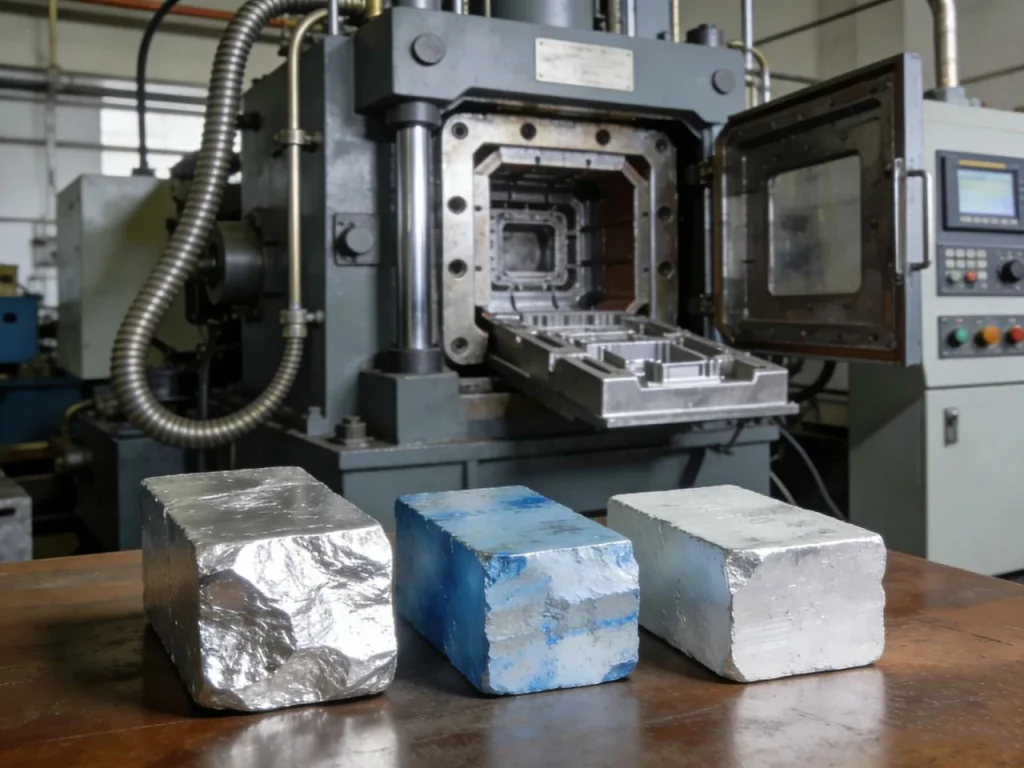
Quick comparison table (engineer’s view)
| Alloy family | Density (relative) | Thin-wall capability | Oberflächengüte | Corrosion considerations | Typische Anwendungen | Tool life notes |
|---|---|---|---|---|---|---|
| Aluminium | Mittel | Gut | Gut | Generally good | Housings, frames, thermal parts | Moderate tool wear due to temperature |
| Zink | Hoch | Ausgezeichnet | Ausgezeichnet | Good with plating/finish | Small precision parts, hardware | Often longer tool life |
| Magnesium | Niedrig | Gut | Gut | Needs careful protection | Lightweight frames, electronics | Temperature moderate; coating plan matters |
Design for Die Casting (DFDC): Rules That Cut Cost and Defects
Die casting can feel “easy” once it runs well, but the design is where most wins happen. If you want fewer defects, lower scrap, and a faster launch, design for die casting is the lever.
Geometry fundamentals (the “90% rule”)
If you do only a few things right, do these: keep walls fairly uniform, use ribs instead of bulky mass, add fillets, and avoid sharp jumps in thickness. Thick hot spots cool slowly and are where shrinkage porosity likes to live.
Draft is also a must. Without draft, the part drags in the die and needs more ejector force, which can cause marks or even sticking. When you plan draft early, you also make it easier to pick the parting line and reduce side actions.
Undercuts are another cost trigger. You can make them with slides, but every slide adds tooling cost, maintenance, and cycle time. A good question to ask is: “Do I need that undercut, or can I change the shape and keep the function?”
Wall thickness, tolerances, and surface finish (typical expectations)
Die casting can make thin walls, but there are practical ranges. Small zinc parts can go down to about 0.5–1.5 mm in many cases, while many aluminum parts land around 2–3 mm. Trying to force ultra-thin walls on a large aluminum part is a common reason projects stall in tool tryouts.
For tolerances, a common expectation is ±0.1–0.2 mm on many features, with tighter control possible on certain dimensions when the die, machine, and process are stable. Surface roughness can often be around Ra ~1–3.2 µm as‑cast, but this depends on alloy, tool condition, and how the die is maintained.
Feature best practices (what usually works)
Bosses, ribs, and holes are normal features used in die casting. The trick is sizing them so the metal fills well and cools evenly. A boss that is too thick compared to the wall can create a hot spot. Ribs help stiffness without adding mass, but ribs that are too thin may not fill, while ribs that are too thick may shrink and pull the wall.
Threads also raise questions. Many parts use cast-in holes and then tap threads later, because threads are sensitive and may need clean metal. In other cases, inserts are added after casting. If the assembly will see lots of torque cycles, it is often safer to use inserts or machine critical threads.
Logos and text are easy to add, but they can show flow lines or trap gas if placed in a poor area. If cosmetics matter, ask early where the best “show surface” should be, and where ejector marks can be hidden.
Gating, venting, overflow, and ejection (high-impact cost drivers)
Gate location controls flow direction, weld lines, and where gas ends up. Poor gate placement can cause cold shuts, misruns, or porosity right where you need strength. Vents and overflows give air a place to go. If air has nowhere to escape, it becomes bubbles inside the metal.
Ejector pins are not just a tooling detail. They leave marks, and they also tell you where the tool needs push points to release the part safely. A clean design makes room for pins on non‑cosmetic faces and avoids fragile thin sections that bend during ejection.
Quality, Defects, and Inspection in Die Casting
A buyer usually sees a finished part and asks, “Why did this one fail?” A process engineer often asks a different question: “Where did the air go, and where did the heat go?” Most die casting defects come back to gas, heat, metal flow, or tool fit.
Common defects (cause → fix)
| Defekt | Wie es aussieht | Common cause | Common fix |
|---|---|---|---|
| Gas porosity | Small voids, leaks, weak spots | Trapped air, poor venting, fast turbulent flow | Better venting, vacuum-assisted fill, gating changes |
| Shrinkage porosity | Larger voids near thick sections | Hot spots cooling last | More uniform walls, thermal balance, intensification control |
| Cold shuts / misruns | Lines where metal fronts don’t fuse | Metal too cool, fill too slow, thin sections | Higher temp, faster fill, gate redesign |
| Flash | Thin metal at parting line | Low clamp force, die wear, dirt on die faces | Correct clamp tonnage, die maintenance, better die fit |
| Soldering / sticking | Metal adheres to die | Alloy/tool reaction, poor coating, hot die spots | Coatings, thermal control, alloy/process tuning |
| Warpage | Part bends after ejection | Uneven cooling, poor ejection support | Cooling balance, rib changes, ejection layout changes |
Inspection & process control
Dimensional checks often use gauges, fixtures, or coordinate measurement machines. For internal defects, X-ray/radiography is common when parts are safety‑critical or must be leak-tight. If you are buying critical parts, it helps to ask how sampling is done and how rejects are tracked.
Process control also matters. A stable line tracks key settings like metal temperature, shot speed, and die temperature. Many plants also track scrap rate and defect types. Even if you do not need deep statistics, you can still ask for clear evidence that the process is under control and repeatable.

Die Casting vs Other Manufacturing Processes (Choose the Right Method)
Many projects start with one question: “Should we cast this, or machine it?” The answer depends on volume, tolerance needs, alloy, and the shape you want.
Die casting vs sand casting
Processes such as sand casting are flexible and cheap to start because tooling can be simpler. Sand is often better for low volumes, very large parts, or when you need alloys not suited to die casting. On the other hand, die casting usually wins on surface finish, repeatability, and fast cycles once the die is built.
Die casting vs investment casting
When people compare casting and investment casting, they often focus on detail and material options. Investment casting can handle more alloys and can make complex shapes with good detail, but it is usually slower per part. Die casting is often faster and can be more cost-effective at high volumes, but it is mainly for non‑ferrous alloys and can have more gas‑related porosity unless controlled.
Die casting vs machining from billet (CNC)
Here is where the “Is die casting cheaper than CNC?” question comes up. At low volume, CNC often wins because you avoid die cost and can start fast. A machinist can take a block and produce a part with CNC milling and CNC turning (sometimes both), and your only “tooling” may be standard fixtures and cutters.
At higher volume, die casting can become cheaper per part because the shape is made near‑net, with less machining time. The big cost is paid upfront in the die, so the savings show up only when you spread that cost across many parts.
So what is the difference between CNC and die cast? CNC is subtractive, removing material, whereas die casting is a process that shapes the part by injecting molten metal into a die, making it faster for large-volume production. CNC is flexible and precise for short runs and design changes. Die casting is fast and repeatable once locked in.
Die casting vs injection molding (plastics)
Plastic molding and die casting have a similar “inject into a mold” idea, but the materials and performance are different. Die casting gives you metal strength, stiffness, and heat spreading. Plastics can be lighter and cheaper per part in some cases, but they may not handle heat, wear, or stiffness needs the same way.
Summary comparison matrix (high-intent)
| Prozess | Werkzeugkosten | Unit cost at volume | Tolerance & repeatability | Oberflächengüte | Komplexität | Lead time to start |
|---|---|---|---|---|---|---|
| Druckguss | Hoch | Niedrig bis mittel | Hoch | Hoch | Hoch | Mittel |
| CNC-Bearbeitung | Niedrig | Mittel-Hoch | Sehr hoch | Sehr hoch | Mittel | Schnell |
| Sandguss | Niedrig bis mittel | Mittel | Mittel | Niedrig bis mittel | Mittel | Mittel |
| Feinguss | Mittel | Mittel-Hoch | Hoch | Hoch | Sehr hoch | Medium–Slow |
Die Casting Cost, Tooling, and ROI (What Drives Your Quote)
Cost can feel confusing because two parts that look similar can quote very differently. The core reason is that cost is not just about metal weight. It is also about tool complexity, cycle time, scrap rate, and how much machining is still required.
The real cost drivers (direct quote factors)
- Die complexity: slides, cores, and how many moving actions are needed
- Number of cavities: one part per shot vs multi‑cavity
- Alloy choice: melt temperature, flow, and finishing needs
- Part weight and shot size: more metal per shot usually means higher cost
- Cycle time: cooling time is often the hidden driver
- Scrap and rework rate: porosity, flash, warpage, and cosmetic rejects
- Secondary operations: trimming, drilling, tapping, coatings, plus cnc turning or milling for critical features
Tooling economics (when it becomes “worth it”)
Tooling is the big entry fee. If you are making a few hundred parts, that entry fee can dominate the cost. If you are making tens of thousands, the die cost per part can drop to a small number. This is why people say die casting is ideal for repeat production.
Die life also matters. A tool that lasts longer lowers your long-term cost. Zinc tools often run longer than aluminum tools because zinc runs cooler, which reduces thermal stress on the die.
A simple break-even framework (plain language)
Ask yourself these questions before you commit:
- How many parts will you buy per year, and for how many years?
- How many minutes of cnc milling and turning does the machined version take today?
- Which surfaces truly need machining, and which can stay as-cast?
- Is the part sensitive to porosity (leak-tight, weld, pressure)?
- Are you likely to change the design soon?
If volume is low or the design is still changing, CNC is often the safer start. If volume is stable and the geometry is well suited, die casting often wins on long-run cost.
Selecting a Die Casting Supplier (Engineer + Buyer Checklist)
Choosing a supplier is not only about price. It is also about whether they provide comprehensive die casting services, including vacuum assist, trimming, and CNC machining.
Capability fit
Start with the basics: machine tonnage range, alloys supported, and whether they can do vacuum assist if your part needs higher density. Also ask about trimming, machining, and finishing. Many projects fail not because the casting cannot be made, but because nobody planned the full chain from casting to final inspection.
Quality and compliance
If you work in regulated industries, certifications and traceability matter. Even outside regulated work, it is fair to ask how they inspect parts, how they handle nonconforming product, and how they keep process settings stable across shifts. According to ISO 9001 standards, a robust quality management system ensures consistent production and traceability.
RFQ questions that prevent surprises
You do not need a giant spreadsheet to get clarity. A few direct questions help a lot: Who owns the tooling? What is the expected lead time for tooling and first samples? What inspection plan is used? What secondary operations are included in the quote? How will engineering changes be handled?
Supplier comparison table template
| Supplier | Standort | Prozesse | Alloys | Machine tonnage | Vacuum capable | Machining (CNC) | Zertifizierungen | Typical lead time | Anmerkungen |
|---|---|---|---|---|---|---|---|---|---|
| A | |||||||||
| B |
Applications and Industry Examples (Automotive, Electronics, Industrial)
If you are still asking, “What is die cast used for?” it helps to look at where it shows up in daily life. Applications of die casting are often parts that must be strong, repeatable, and made in high volume.
Die casting is used in automotive and EV applications to make housings, structural nodes, and brackets, where both weight reduction and stiffness are critical. Many of these parts are aluminum, and higher‑integrity versions may use vacuum assist to reduce porosity.
In consumer electronics, magnesium and aluminum frames are chosen for stiffness and heat spreading. The smooth finish also supports painting and coatings.
In industrial products, you often see pump housings, gearbox covers, and power tool housings. These are good examples of “casting a part” where internal ribs and mounting bosses are built in, then only key holes and faces are machined.

Schlussfolgerung
Die casting is one of the highest‑productivity ways to make repeatable metal parts, especially in aluminum, zinc, and magnesium. When the design follows DFDC basics and the process controls air and heat, die casting can deliver excellent finish, tight sizing, and low unit cost at scale. If you are unsure, start by matching your volume, porosity sensitivity, and machining needs to the right die casting variant, then choose a supplier who can prove control through inspection and stable production.
FAQs
The aluminium die casting process is a manufacturing method where molten metal, usually aluminum, is injected under high pressure into a precise mould die casting. This process is excellent for producing complex shapes with smooth surfaces and high repeatability. Compared to other methods like CNC machining, it’s much faster for large production runs. Think of it as pushing molten aluminum into a highly detailed mold, and once it cools, you get a ready-to-use part without much extra finishing.
Die cast parts are everywhere around us! They are used in car engines, gear housings, plumbing fixtures, electronic casings, and even toys. Anything that needs a strong, lightweight metal part that can be produced quickly and repeatedly can benefit from die casting. It’s especially popular when you need the part to have intricate details or smooth surfaces right out of the mold, saving time on finishing.
The main drawback of die casting is cost. Creating the mould die casting is expensive, which makes it less suitable for small production runs. Additionally, only certain metals like aluminum, zinc, or magnesium are practical. Poorly controlled die casting can also lead to defects like porosity. So while it’s fast and highly precise, the upfront investment and material limitations are the trade-offs.
Die casting offers multiple advantages. It produces parts that are dimensionally accurate and consistent, often reducing the need for extra machining. It can create complex shapes with thin walls, and the surface finish is smooth, sometimes ready to use straight out of the aluminium die casting process. For large-scale production, die casting is faster and more cost-efficient than methods like CNC milling or CNC turning, especially when using aluminum die casting materials for lightweight yet strong parts.
It depends on quantity. For mass production, die casting is usually cheaper per part because of its speed and automation. However, the initial cost of the mould die casting can be high. On the other hand, CNC milling or CNC turning doesn’t require molds, so it’s better for small batches or custom parts. In short, for hundreds of thousands of parts, die casting wins. For custom, low-volume, or highly precise components, CNC machining is more economical.
The main difference lies in the manufacturing method. CNC milling and CNC turning are subtractive processes: you start with a solid block of metal and remove material to create the part. Die casting, on the other hand, uses molten metal injected into a mould die casting, shaping the part all at once. CNC is flexible and great for precision and customization, while die casting excels at producing large volumes of complex parts quickly using aluminum die casting materials. Both have their strengths depending on the application.
Yes, die cast metal can be very good, especially for parts that need strength, consistency, and complex shapes. Aluminum die cast is strong, lightweight, and resistant to corrosion, while zinc die cast is durable and very precise. That said, the quality depends on the process control—poor die casting can lead to porosity or defects. But when done right, die cast metals are widely used in industries from automotive to electronics because they combine durability with fast, efficient production.

 German
  English
  French
  Italian
  Spanish
  Polish
  Czech
Czech  Japanese