
Metal stamping services sit in a useful middle ground between “prototype-friendly” processes (like laser cutting) and “shape-complete” processes (like casting). If you are buying stamped parts, your main job is not to learn how a press works. It is to confirm feasibility: can the supplier form your geometry in the chosen material at the needed rate, while holding the functional features and quality controls that your product and industry require?
Industry reports project steady growth in metal stamping through the late 2020s, but the more practical takeaway for buyers is why it is growing: lightweighting (especially in automotive structures using AHSS and aluminum), higher throughput requirements, and rising use of automation, sensors, and data-driven quality control to control scrap and downtime. Those drivers affect what capabilities you should ask for and what trade-offs you will face.
Metal Stamping Services: Quick Buyer Checklist
Before diving into the checklist, it’s helpful to understand that a successful metal stamping project depends on matching your part’s design requirements with the right capabilities. Whether you need stainless steel, brass, or other metal materials, and whether you’re producing intricate or high-volume parts, knowing how metal forming works and how suppliers offer služby lisování kovů will help you plan a smooth production run that meets exact specifications and unique needs.
Define requirements: part geometry, volume, tolerances, and secondary ops (Checklist)
Before you compare suppliers, lock down a “manufacturing requirement,” not just a drawing. Stamping is sensitive to missing details because the tooling is purpose-built. Late changes can mean rework of a die, new tryouts, and new approvals.
Use this checklist to make sure your team is aligned:
- Part geometry and forming content
- Flat blank size and final envelope
- Bends, flanges, hems, emboss features, coined features, lances/tabs, and any deep draw features
- Critical-to-function datums and interfaces (mounting holes, connector windows, latch features)
- Burr direction preference and edge condition requirements (if you have them)
- Volume and demand pattern
- Annual demand and expected ramp
- Order pattern (steady, seasonal, or program builds)
- Service life expectations (how long the die must run before refurbishment)
- Tolerance intent (not just numbers on a print)
- Which features are přísné tolerance because they locate assemblies, and which are cosmetic
- Where you can accept variation due to springback (common in formed sheet metal)
- How you want to treat stack-ups across multiple bends or formed features
- Material and condition
- Alloy/grade and specification callout (for example, an ASTM-defined grade if applicable)
- Thickness and allowable thickness variation (if specified in your standard)
- Temper, coating, or surface condition that may affect forming and friction
- Sekundární operace
- Deburr, tumble, wash/cleanliness requirements
- Plating or coating needs and any masking constraints
- Heat treat needs (if any) and how it could affect distortion
- Assembly steps: clinch nuts/inserts, spot welds, or sub-assemblies
- Quality and approval requirements
- PPAP and/or FAI expectations (common in automotive and aerospace supply chains)
- Traceability level (lot, coil, heat, or piece-level marking if required)
- Packaging constraints to protect formed features from distortion
The key point is that stamping feasibility is often decided by a few “silent constraints”: where the material must flow, where it must not thin, and where dimensional control depends on controlling springback and variation.
Match capabilities: press tonnage range, die type, automation/robotics, and in-die sensing
When buyers say “metal stamping services,” they might mean anything from simple blanking to progressive die stamping with in-die sensing and automated handling. You do not need to specify a press model, but you do need to match your part risk to the supplier’s capability set.
Decision matrix (use as a screening tool)
| Requirement / Risk driver | What to ask a supplier | Why it matters for feasibility | Typical best-fit approach |
|---|---|---|---|
| High volume stamping with many features | Progressive die capability; tool and die support; run-at-rate evidence | Progressive tooling can integrate multiple operations, but it is sensitive to part stability across stations | Progressive die stamping |
| Larger formed parts with multiple operations | Transfer capability; part handling strategy; how they control part orientation | Handling and re-grip steps can drive marks, distortion, and misfeeds | Transfer stamping |
| Deep draw cups/shells | Deep draw stamping experience; draw reduction strategy; lubrication and surface control approach | Drawn geometries fail from tearing, wrinkling, or thinning if process windows are narrow | Deep-drawn stamping |
| Tight feature-to-feature relationships | In-die sensing; in-process checks; how they control strip progression | Sensors reduce escapes when a feed error causes progressive damage | Progressive with sensing |
| Cosmetic surfaces | Tooling surface finish control; handling to prevent scratches; cleaning | Marks often come from handling, not forming | Depends on geometry |
| Frequent engineering changes | Modular die approaches; change-control workflow | Hard tooling changes can be slow and costly | Modular tooling where possible |
| Labor availability and uptime risk | Automation/robotics integration and material handling systems | Automation reduces manual handling variation and supports throughput | Automated lines |
| Traceability and regulated approvals | Traceability system, PPAP/FAI workflow, documented corrective action | Approval packages can gate production shipments | Any, but requires quality system maturity |
Industry trend reports point to increased use of automation/robotics and IoT sensors in stamping to improve monitoring and reduce downtime. As a buyer, treat those as “risk controls.” Ask where sensors exist (feed, tonnage signature, misfeed detection) and how alarms are handled.
Verify quality systems: inspection methods, traceability, and corrective-action workflow
Stamped parts can fail in two ways: you get the wrong dimensions, or you get the wrong process history (wrong material lot, missing inspection, uncontrolled change). A quality system should cover both.
From a buyer’s perspective, the supplier quality system should follow a closed-loop control logic that begins with incoming material verification and ends with full traceability and records retention.
All incoming materials are first verified against applicable specifications. Material certificates are reviewed, specification compliance is confirmed, and each lot or coil is uniquely identified and recorded to ensure traceability from the outset.
Before volume production, a first article or approval build is completed, such as FAI or PPAP where required. This stage includes a defined measurement plan and, for critical characteristics, supporting capability evidence to demonstrate process stability and conformity.
During production, multiple layers of control are applied to maintain consistency. In-process inspections are performed using appropriate methods such as gaging, optical measurement, or CMM. Statistical process control is implemented where applicable to monitor critical features and detect process drift, and in-die sensing or press monitoring is used when available to provide real-time feedback.
When nonconformances occur, a structured response process is triggered. Affected product is contained through holding, sorting, or isolation, followed by root cause analysis and implementation of corrective actions. The effectiveness of these actions is then verified to prevent recurrence.
Finally, the system maintains full traceability and record retention. Each shipment is linked back to its originating lot or coil, and all quality records are controlled by revision to support audits, recalls, and long-term quality assurance.
For technical buyers, the practical question is: can the supplier prove what happened to your parts? That includes revision control (drawing level), change control, and whether they can trace parts back to the coil/lot when problems show up in assembly.
RFQ-ready inputs to speed quoting: prints/CAD, material spec, annual demand, and PPAP/FAI needs
Quoting delays often come from missing assumptions. A good RFQ removes guesswork about material, volume, inspection burden, and secondary ops. Provide a stable package and call out what is “must meet” versus “nice to have.”
RFQ template (copy/paste structure)
| RFQ field | Co poskytnout | Notes that prevent re-quoting |
|---|---|---|
| Part number + revision | Identifier and rev level | Tie to ECN/ECR if mid-change |
| Drawing (2D) | PDF with GD&T and notes | Identify critical-to-function features |
| CAD (3D model) | STEP/IGES/native if possible | Useful for DFM and tool concept |
| Specifikace materiálu | Grade/spec + thickness + condition | State coating or surface requirements |
| Annual demand + peak rate | Forecast and ramp | Include service life expectations if known |
| Intended process | If you know (progressive/transfer/deep draw) | If unknown, ask supplier to recommend |
| Sekundární operace | Plating/coating, deburr, cleaning, inserts | State cosmetic surfaces and handling risks |
| Quality requirements | PPAP/FAI, traceability level, inspection plan needs | Approval gates often drive schedule |
| Balení | Bulk/returnable, layer separation needs | Prevent post-process deformation |
| Delivery terms | Incoterms/site, ship schedule | Helps capacity planning assumptions |
| Special requirements | Cleanliness, corrosion resistance targets | Avoid vague phrases; tie to test/spec |
If you need custom sheet metal stamping for a new program, the fastest path is a stable drawing, clear critical features, and a defined approval package.
What Are Metal Stamping Services?
Metal stamping is a versatile method used to shape the metal into precise forms, offering high-quality results for a wide range of industries and applications. From intricate parts to complex assemblies, stamping can be customized to meet exact design requirements. Whether using fourslide, progressive, or other techniques, suppliers that offer custom metal stamping services help buyers produce successive parts efficiently, often at a lower price than other methods. Understanding how stamping fits into your project helps ensure you select the right process for your materials, volumes, and unique needs.
Definition and where stamping fits vs. machining, casting, and laser cutting
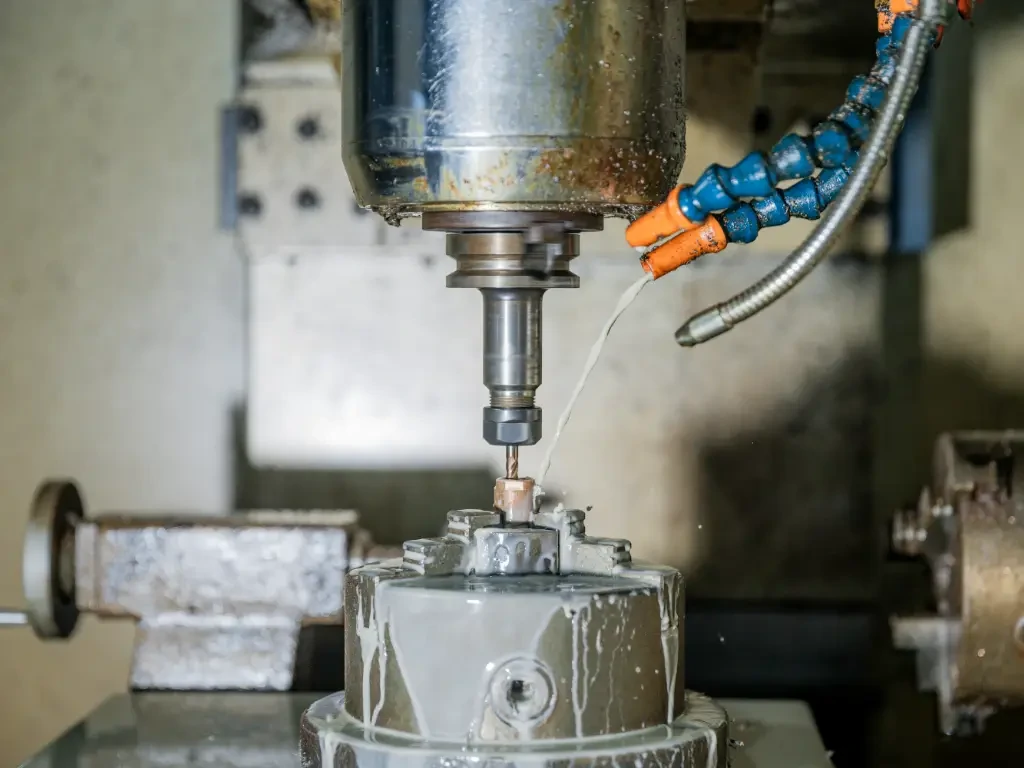
Metal stamping is a manufacturing process that uses a press and a die to cut and/or form sheet metal into specific shapes. In practice, stamping services often include blanking (cutting the outline), piercing (holes), bending, forming, embossing, and sometimes coining (local compression for sharper definition). The workpiece is deformed by tooling, not removed as chips.
For parts requiring prismatic shapes, complex pockets, or very tight dimensional control, machining—often performed using CNC frézování—can complement or substitute stamping, especially at low to medium volumes. Where it fits depends on part thickness, geometry, and volume. This table frames the decision the way buyers usually need it framed.
| Proces | Nejvhodnější | Limits / watch-outs | Typical buyer reason |
|---|---|---|---|
| Metal stamping | High-volume production of sheet metal parts with repeatable features | Upfront tooling; change resistance; forming limits (springback, wrinkling, tearing) | Lowest unit cost at volume; consistent forming |
| Obrábění | Low to medium volume; prismatic parts; tight control on many dimensions | Material waste; slower cycle time for large volumes | Flexibility and tight control without hard tooling |
| Casting | Complex 3D shapes; thicker sections | Tooling and qualification; porosity risk; finishing | Shape complexity not feasible in sheet |
| Laser cutting | Fast iteration for flat blanks; prototypes and low volume | Limited forming; edge condition and heat effects may matter | Quick turnaround before committing to a die |
A common buyer question is: Is stamping cheaper than machining? At low volume, machining may be cheaper because it avoids custom tooling. At high volume, stamping can become cost-effective because cycle time is short and the die repeats features quickly. The breakpoint is not universal; it depends on part size, operations integrated into the die, scrap rate, secondary ops, and inspection burden.
Common outputs: brackets, enclosures, clips, connectors, frames, and structural components
Stamping projects usually fall into a few recurring part families:
- Brackets and mounts used in automotive and industrial equipment, where bends and hole patterns define fit.
- Enclosures and housings in appliances and electronics, where flatness, edge quality, and assembly features (tabs, flanges) matter.
- Clips, springs, and retention features, where material condition and grain direction can affect performance.
- Connectors and terminals in electronics, where precision metal stamping services may focus on small features and defect prevention.
- Frames and structural components in transportation, where lightweighting drives interest in AHSS and aluminum.
Industry reports link demand to automotive and aerospace programs that need lightweight components, as well as renewables expansion that uses aluminum frames, brackets, and tracker components.
Where stamping excels: repeatability, high throughput, and consistent forming for lightweight parts
Reports from multiple market research groups project growth in metal stamping through the late 2020s, but they do not agree on one headline number. One widely cited projection is a global market growing from about USD 213.8 billion (2023) to USD 257.1 billion by 2028 at 3.7% CAGR (MarketsandMarkets). Another projects an increase of USD 38.4 billion from 2024–2029 at 4.5% CAGR (Technavio). A third cites a USD 231.8 billion market in 2024 with 2.51% CAGR from 2025 onward (Spherical Insights). These differences often come from scope (services vs. equipment vs. regional mix) and baseline year.
For buyers, the more actionable link is between growth drivers and process choice:
- Lightweighting pushes more formed thin-gauge structures, which favors stamping methods that can make repeatable bends and forms in AHSS and aluminum.
- Throughput pressure favors processes that can produce hundreds of parts with stable cycle time once a die is proven.
- Consistency needs favor controlled forming techniques and in-die sensing so defects are caught before large lots are produced.
If your part is a lightweight structural or semi-structural component and your program volume is stable, stamping can be a strong fit because the die can integrate multiple steps and repeat them with low variation.
What’s the difference between metal stamping and sheet metal fabrication?
Metal stamping uses a stamping press and a die to cut and form sheet metal through repeated cycles. Sheet metal fabrication is a broader label that can include laser cutting, bending on press brakes, welding, and other steps that may be more flexible at low volume. In short, stamping is often selected for repeatability and rate, while fabrication is often selected for change flexibility and lower upfront tooling.
Metal Stamping Processes and Press Technologies
Once you understand the basics of metal stamping and how it fits into manufacturing, the next step is to explore the specific processes and press technologies used to shape metal into precise parts. From high-volume progressive dies to flexible transfer stamping and deep-drawn geometries, each approach offers unique advantages for producing intricate or complex parts. Choosing the right technology depends on part size, feature complexity, handling needs, and the quality requirements your project demands.
Progressive die stamping: high-volume workflows and complex feature integration
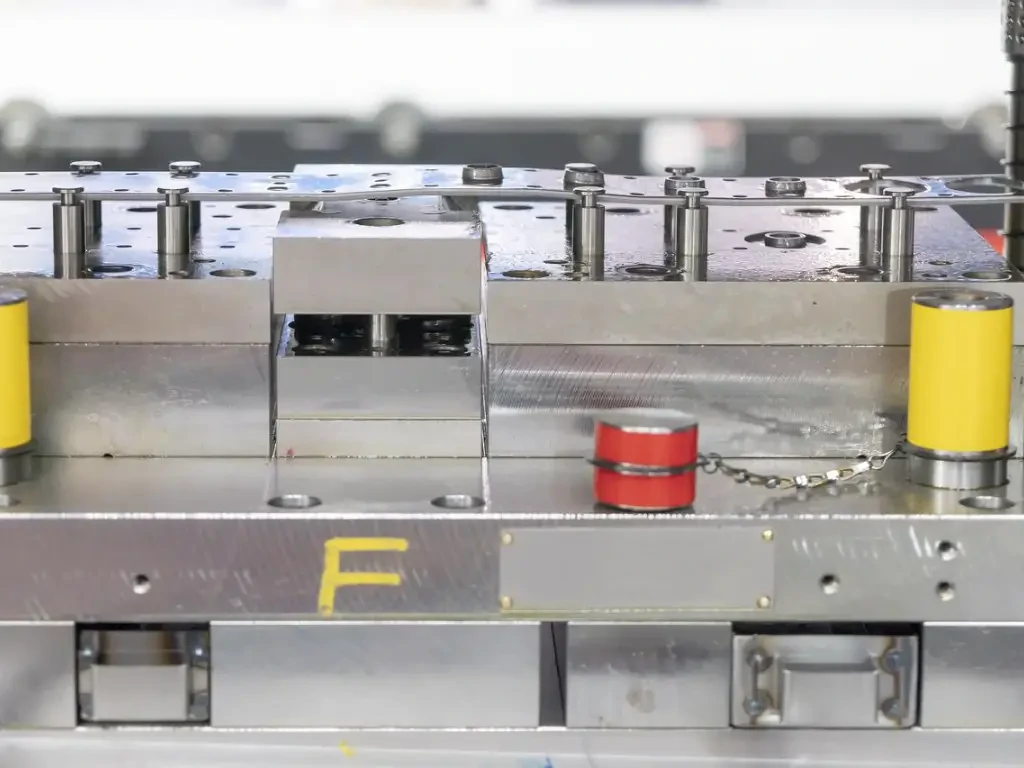
Progressive die stamping feeds sheet metal from a coil through a die in a series of stations. Each press stroke moves the strip forward by a fixed pitch. Each station adds or modifies features until the final station cuts the part free.
This method is common when you need multiple operations: pierce, form, emboss, coin, and cut, all controlled by one tool. The trade-off is that the strip must remain stable as it advances. A single upstream error can cascade downstream.
The part progresses through the press line in a station-by-station sequence, beginning with coil feed and straightening, followed by entry into the die.
At the first station, the part is piloted and located, and the initial piercing operation is performed. The second station completes additional piercing or creates slots as required. The third station forms the first bend, while the fourth station performs a second bend and adds any embossing features. At the fifth station, coining or restriking operations may be applied if needed. Finally, at the sixth station, the part is cut off from the coil as a blank and exits the press.
If your part has intricate features, progressive dies often reduce handling because the part is controlled by the strip until cutoff. That can improve consistency, but it can also constrain geometry because features must be possible while the part is still attached to the carrier strip.
Transfer stamping: larger parts, multiple operations, and handling strategy trade-offs
Transfer stamping separates the part from the strip early, then transfers it between stations using mechanical transfer fingers or robotic handling. This is often used for larger parts or parts that cannot stay connected to a strip without distortion.
The buyer’s main trade-off is between integrated control (progressive) and handling flexibility (transfer).
| Téma | Progressive die | Transfer stamping |
|---|---|---|
| Part retention | Attached to strip until cutoff | Part handled between stations |
| Nejlepší pro | Many features on smaller parts; coil-fed | Larger formed parts; more freedom of orientation |
| Handling marks risk | Lower during forming (strip control) | Higher if handling is not controlled |
| Tooling complexity | High; strip layout is critical | High; transfer and grippers add variables |
| Change flexibility | Lower (hard tooling dependencies) | Can be better for some geometry changes, but still tooling-heavy |
| Common failure modes | Misfeed damage, strip instability, station timing | Mis-grip, part drop, orientation errors |
If you have a large enclosure, frame, or structural component with multiple forms, transfer stamping can reduce strip-related constraints. On the other hand, if your part is small and benefits from strip control, progressive die stamping may reduce variability.
Deep-drawn stamping: cups, shells, and drawn geometries with formability constraints
Deep draw stamping forms a flat blank into a cup or shell by pulling material into a die cavity with a punch. The main feasibility issues are material flow and stability: the metal must stretch and flow without tearing, while the flange must not wrinkle.
Buyers often run into trouble when they treat deep draw as “just a shape.” In reality, the draw has a narrow process window controlled by material properties, lubrication, and tooling radii.
In the deep drawing process, the part begins as a flat blank positioned on the die. The blank holder applies downward force to control material flow, while the punch presses into the blank, forcing it into the die cavity.
As the punch descends, the material is drawn into the cavity, forming the walls of the cup. During this process, certain areas are particularly susceptible to defects. The flange may wrinkle if material flow is not properly controlled, the cup walls can experience thinning or tearing, and the bottom radius may develop splits if excessive stress is concentrated.
When evaluating suppliers for deep draw stamping, ask how they manage risk areas: blank holder force control, lubrication strategy, and whether they use multi-step draws (draw/redraw) when needed. Also confirm how they inspect wall thinning or dimensional drift across lots.
Progressive die vs. transfer stamping—how do you choose?
Choose progressive dies when the part can stay attached to a strip and you want high throughput with many integrated features. Choose transfer stamping when the part is larger, needs re-orientation, or would distort if carried by a strip. In both cases, the “right” choice depends on geometry stability, handling risk, and how many operations must be controlled tightly.
Materials for Stamping: AHSS, Aluminum, and More
Choosing the right stamping process is only part of the equation—material selection plays an equally critical role in achieving high-quality, consistent parts. Different metals behave differently under forming: from AHSS for automotive lightweighting, to aluminum for corrosion-resistant structures, and titanium for aerospace applications. Understanding how each material responds to stamping, and how it interacts with your tooling and finishing requirements, helps ensure your parts meet exact specifications across industries and applications.
Advanced high-strength steels (AHSS): lightweighting driver for automotive structures
Advanced high-strength steels (AHSS) are often used to reduce mass while keeping strength, which is why they show up in lightweighting discussions for automotive structures. Market sources commonly cite automotive as the dominant demand segment for stamping, with over 38% share reported by at least one industry source (single-source share, not cross-verified in the provided material).
From a feasibility view, AHSS can be more sensitive to springback and tool wear than mild steel. That matters because the part may “relax” after forming, changing angles and hole locations relative to formed surfaces. It also matters for progressive tools that rely on predictable strip behavior.
If you are specifying AHSS, align early on:
- Which dimensions must be controlled after springback
- Whether a restrike or additional forming step is needed
- How the supplier monitors drift over long runs
Aluminum alloys: weight reduction and corrosion considerations for transport and renewables
Aluminum alloys are pulled by the same lightweighting driver, plus corrosion considerations in outdoor and transport environments. Trend reports link aluminum stamping demand to transportation and renewables components such as solar frames, brackets, and tracker structures.
For buyers, aluminum can be attractive because of weight and corrosion behavior, but it also brings forming and surface risks:
- Surface damage shows easily, so handling and tool condition matter.
- Some geometries can be prone to tearing if radii are tight or friction is high.
- If plating or coating is required, confirm compatibility with your alloy and surface condition.
When you evaluate metal stamping services for aluminum parts, do not stop at “can you form it.” Ask how they prevent cosmetic damage and how they control lubrication and cleanliness before finishing.
Titanium alloys: aerospace-focused use cases and forming considerations
Titanium alloys show up in aerospace-focused discussions where high strength-to-weight and corrosion resistance are valued. Reports connect aerospace demand to lightweighting and high-reliability components, which pushes interest in precision stamping and tighter process control.
Feasibility concerns tend to be about formability and process control:
- Titanium forming can be sensitive to tool design and friction conditions.
- If your part has tight radii or deep formed features, validate the forming route early.
- Inspection expectations may be higher in aerospace supply chains, so plan for the approval and traceability burden.
The practical buying point is that titanium stamping is not just “a harder material.” It may need different tooling assumptions, more conservative forming, and a more demanding qualification package.
Table: Material selection factors (formability, strength needs, corrosion exposure, finish/coating compatibility)
The table below is meant to structure early material conversations. It avoids property numbers because those must come from your specific grade/spec and thickness.
| Faktor | Why it matters in stamping | What to define on the RFQ |
|---|---|---|
| Formability | Drives risk of tearing, wrinkling, splitting, and springback | Minimum bend radii intent, drawn depth intent, and any “no wrinkles” surfaces |
| Strength needs | Higher strength can increase springback and tool loads | Functional load paths, critical stiffness features, and post-form fit needs |
| Corrosion exposure | Outdoor or galvanic environments can drive alloy/coating choice | Environment description, salt exposure, mating materials |
| Finish/coating compatibility | Coatings can crack on bends or affect friction in forming | Coating type/thickness if known, cosmetic surfaces, masking needs |
| Supply chain availability | Material lead times and coil availability affect schedule | Approved equivalents, substitution rules, and change-control expectations |
Use recognized material specifications (for example, ASTM-defined grades where applicable) so the supplier can match coil certs and traceability to your requirement.
Precision, Quality Control, and Certifications
Once the right materials and forming processes are chosen, the next step is ensuring precision and consistency across production. High-quality stamping isn’t just about shaping metal—it requires robust measurement, in-process control, and adherence to recognized standards. Whether your part has intricate features, tight tolerances, or successive operations, understanding how suppliers monitor, inspect, and certify their work helps align output with your exact specifications and industry requirements.
Precision metal stamping and tightening tolerances: micro/nano capability and progressive dies
Precision metal stamping services are often discussed in the context of smaller features, tighter dimensional control, and more stable monitoring. Market reporting on precision stamping highlights trends like progressive dies, digital twins, and even micro/nano capability claims in the broader market narrative.
As a buyer, treat “precision” as a set of controls, not a label. Ask what makes the process stable for your part:
- How the die locates the strip or part (pilots, datums)
- Whether critical features are created early or late in the process (late-stage piercing can reduce distortion effects)
- Whether a restrike step is used to “lock in” formed geometry
Also confirm whether the supplier’s measurement plan matches the tolerance intent. Precision is often limited by how the part is fixtured and measured, not only by how it is formed.
Inspection and process control: in-process checks, CMM/optical methods, SPC, and defect prevention
Inspection for stamped parts often mixes fast checks (go/no-go gages, attribute checks) with deeper measurement (CMM, optical methods, or Drátové elektroerozivní obrábění for intricate cut verification). The right mix depends on risk: safety-related parts, tight interfaces, and high-cost assemblies justify more structured control.
The typical quality control workflow begins with a defined control plan that outlines inspection requirements and acceptance criteria. Incoming materials are first checked against this plan, including verification of certificates and lot identification.
Before full production, setup approval or first-off verification is conducted to ensure the process produces conforming parts from the start. During production, in-process inspections are carried out at defined intervals. These checks may include quick gaging of key dimensions, visual inspections for burrs, cracks, or surface damage, and statistical process control for features sensitive to process drift.
At the end of production, a final inspection is performed according to the risk profile of the parts. This can range from sampling to 100% inspection and may include CMM or optical measurements to verify critical geometric features.
If any nonconformances are detected at any stage, a structured process is followed: affected parts are contained, root causes are identified, corrective actions are implemented, and effectiveness is verified to prevent recurrence.
Even if you do not require formal certifications, ask how corrective actions are tracked and closed. Stamping failures can be intermittent (tool wear, coil variation, lubrication drift), so your goal is a system that detects drift early.
Industry 4.0 quality: IoT sensors, real-time monitoring, and predictive maintenance to reduce scrap/downtime
Industry 4.0 themes show up across stamping trend reports: IoT sensors, real-time monitoring, and predictive maintenance. The operational benefit described in those sources is reduced downtime and scrap, and more consistent throughput.
From a buyer standpoint, the question is how monitoring affects your risk:
- Press monitoring can flag tonnage signature changes that may signal tool wear or misfeeds.
- In-die sensors can detect misfeeds or part presence issues before a bad stroke damages tooling or produces defects.
- Predictive maintenance can reduce surprise outages, which matters if you are planning capacity around a high-volume stamping line.
If your program is sensitive to delivery interruptions, suppliers with better monitoring and maintenance discipline may be lower risk, even if their base piece price is not the lowest.
What tolerances can precision metal stamping achieve?
Precision metal stamping can hold very tight tolerances on some features, but the achievable tolerance depends on material behavior, thickness, feature type, and where the feature is created in the die sequence. Progressive dies can help repeatability because each stroke repeats the same tool geometry, but formed features can still move due to springback. Some reporting on precision stamping points to micro-scale capability and sub-millimeter expectations in certain contexts, but you should only accept tolerances that a supplier can validate for your exact geometry and control plan.
Pricing Drivers, Tooling Strategy, and DFM
After ensuring your stamping process meets precision and quality requirements, the next step is understanding how design choices and tooling strategies influence overall cost. Whether you’re planning high-volume runs with progressive dies or customizing complex parts, tooling, material use, and design-for-manufacturability all play a key role in achieving both performance and cost targets.

What drives total cost: tooling, material utilization/scrap, cycle time, finishing, and inspection burden (Table: cost driver checklist)
A stamped part’s cost is rarely explained by one line item. It is the mix of tooling and variable costs, plus the quality workload your program requires.
Cost driver checklist (buyer view)
| Hnací síla nákladů | What changes it | What to clarify early |
|---|---|---|
| Tooling (die) | Part complexity, number of stations, expected tool life, change frequency | Expected revisions, program life, and approval requirements |
| Material utilization / scrap | Strip layout, nesting efficiency, carrier design, skeleton scrap | Grain direction constraints and any “no rotate” rules |
| Cycle time / throughput | Press speed, handling, sensor checks, part transfer time | Required volumes and whether surge capacity is needed |
| Sekundární operace | Plating, coating, deburring, cleaning, inserts, assembly | Cosmetic requirements and corrosion resistance needs |
| Zatížení inspekcí | Measurement method, sampling rate, traceability, PPAP/FAI | Critical features list and required documentation |
This is also where the “Is stamping cheaper than machining?” question becomes concrete. Stamping can be cost-effective at high volume because cycle time per part is low and operations are integrated, but the die and qualification effort must be justified by stable demand.
Tooling choices: progressive dies vs. modular approaches and how complexity affects flexibility
Progressive dies are often the default answer for high volume stamping because they can combine many operations. The drawback is that the tool becomes a tightly coupled system: a change to a hole location can affect upstream pilots, downstream forming, and strip stability.
Modular approaches try to isolate change. Examples include modular inserts for certain punches or features, or designing families of parts around a shared die set with swap components. The feasibility question is not “is modular good,” but “where do you expect change?”
A useful way to think about it:
- If your design is stable and volume is high, a fully integrated progressive die may be the best path.
- If your design is likely to change or you have part variants, modular tooling may reduce rework scope, but it can add constraints and complexity.
Tooling strategy should match your program risk. A buyer who expects several design iterations should not select tooling assumptions that only make sense after the design is frozen.
Design for manufacturability (DFM): bend radii, holes near edges, grain direction, and feature stack-ups (DFM checklist)
Most stamping issues that show up in production were “designed in” early: tight radii, holes too close to a bend, or stacked tolerances across multiple formed features. DFM is not about making the part easy; it is about making it stable.
DFM checklist for stamped parts
- Bend radii and formed transitions
- Very tight bend radii raise cracking risk and increase springback sensitivity.
- If a bend must be sharp, confirm if coining or restrike steps are planned, and what that does to tool loads.
- Holes and slots near edges or bends
- Holes near an edge can distort during forming.
- Holes near a bend line can ovalize or shift; consider moving the feature, adding relief, or sequencing pierce after forming when possible.
- Grain direction
- Grain direction can affect bend behavior and springback.
- If the part is a clip or spring-like feature, confirm whether grain direction is controlled in the blank layout.
- Feature stack-ups
- Multiple bends compound variation. A tight hole-to-flange relationship can be hard if both features move during forming.
- Define datums that match how the part is functionally located in assembly, not just how it is easy to measure on a flat.
- Burr direction and edge condition
- Burrs are not just cosmetic; they affect electrical contact, sealing, and handling safety.
- If burr direction matters, call it out so tooling and process routing support it.
A short DFM review with a supplier can surface whether your part needs progressive features, a different forming sequence, or a geometry change to avoid unstable forming.
How much do metal stamping services cost?
Metal stamping services cost depends on tooling scope, material utilization, press time, secondary operations, and the inspection and documentation you require. Supplier quoting guides often separate non-recurring tooling from per-part cost drivers because the mix changes with volume and revision frequency. If you need a meaningful estimate, provide annual demand, material spec, and whether PPAP/FAI and traceability are required, since those can change inspection time and approval effort.
Lead Times, Capacity Planning, and Supply Chain Resilience
Once tooling strategy, DFM, and cost drivers are understood, the next critical focus is lead time and capacity. Even with optimized dies and high-quality processes, production schedules for custom metal stamping depend on tool build, tryouts, approvals, and the supplier’s ability to scale throughput to match demand. Planning ahead ensures both timely delivery and supply chain resilience.
What affects lead time: tool build/tryout, material sourcing, approvals (FAI/PPAP), and change-control process (Timeline diagram)
Lead time in stamping is usually not one block of time. It is a chain with gates. The gates that surprise buyers are tooling tryout iterations and approval packages.
A typical stamping project follows a logical progression, though actual durations may vary depending on part complexity and production requirements. The process begins once the RFQ package is finalized. Design-for-manufacturability (DFM) reviews are conducted, and the tool concept and quoting assumptions are aligned with the customer.
Next, the stamping tool is designed and built. Once the tool is ready, tryout iterations are performed, with adjustments made based on the results of formed parts to ensure quality and dimensional compliance.
After successful tryouts, a first article inspection or approval package—such as PPAP or FAI—is completed if required. Following approval, production is released, and the process ramps up to the intended production rate while ongoing monitoring ensures consistent quality.
Two points control real schedules:
- Iteration count during tryout (more complex forming can require more tuning).
- Approval gates (PPAP/FAI review cycles, especially when multiple parties must sign off).
If you expect engineering changes, define a change-control process up front. Uncontrolled “small changes” are a common cause of missed launches.
Capacity and throughput levers: automation/robotics integration and material handling systems
Trend sources describe automation and robotics as a key lever in stamping operations. For buyers, automation matters in three practical ways:
- Throughput stability: automated feeding and part transfer reduce variability tied to manual handling.
- Quality stability: sensors and controlled handling can reduce damage and reduce the chance of mixed parts.
- Labor sensitivity: programs that rely on consistent output may be less exposed to labor availability swings.
When you evaluate a supplier, ask how they plan capacity around your demand pattern. If you have surge builds, confirm whether they can add shifts, reallocate presses, or adjust material handling to keep output stable.
Case example: lead time reduction via laser cutting + inventory optimization (Outcome: 25% lead-time reduction)
One case described in a Technavio market report ties lead time reduction to process routing and inventory strategy: an automotive context used laser cutting plus inventory optimization to reduce lead time by 25%. This is not a claim that laser cutting replaces stamping. It shows a common launch tactic: use flexible cutting to bridge early demand or to reduce bottlenecks, while stamping tooling and capacity stabilize.
For buyers, the lesson is to plan a launch path:
- Early builds may rely more on flexible methods (like laser cutting for blanks) while tooling is finalized.
- Once the die is stable, high-volume stamping can take over to support rate and cost targets.
If you are risk-averse on schedule, ask suppliers how they support bridging strategies without losing configuration control.
How long does stamping tooling take?
Stamping tooling time depends on die complexity, number of stations or operations, and how many tryout loops are needed to hit the required geometry. Tool build is only part of the schedule; tryout, measurement, and approval packages (FAI/PPAP where required) can be gating items. The safest way to plan is to treat tooling lead time as a range tied to complexity and to define what “tool complete” means in your program (first-off parts, approved parts, or production-ready at rate).
Industry Applications and Where Demand Is Concentrated
To understand where stamping demand is concentrated, it helps to look at the key industries driving volume and specialized requirements. Each segment brings unique priorities—some focus on high throughput, others on precision or material performance—which shape sourcing decisions and supplier expectations.

Automotive metal stamping: dominant demand segment (over 38% cited) and lightweighting with AHSS/aluminum
Automotive is repeatedly described as the largest stamping demand segment. One source cites over 38% of usage tied to automotive (single-source in the provided inputs). IBISWorld reports the US automobile metal stamping segment reached $47.3 billion in 2025, growing at 4.5% CAGR over five years, which reflects both demand and supply chain focus.
From a technical buying view, automotive stamping tends to stress:
- High volume stamping with stable cycle times
- Lightweighting materials like AHSS and aluminum
- Structured approvals and change control because parts are safety- and fit-critical
If your part is automotive-adjacent, expect that suppliers will ask about PPAP needs, traceability, and long-run consistency, not just geometry.
Aerospace components: lightweight, high-reliability stamped parts and precision requirements
Aerospace demand is often linked to lightweighting and reliability expectations. Stamped aerospace components can include brackets, clips, frames, and formed housings where sheet metal offers weight advantages. The buyer-side risks tend to be less about raw throughput and more about process control, inspection, and documentation.
If you are sourcing stamped parts for aerospace, align early on:
- FAI expectations and revision control
- Inspection depth and traceability
- Material pedigree and any special handling requirements tied to the alloy
The feasibility question is whether the supplier’s quality system can support the approval cadence and record retention your program requires.
Electronics and connectors: customization needs and defect reduction via AI-driven quality control
Electronics and connector components push stamping toward smaller geometries and defect sensitivity. Trend reports connect electronics demand with customization and the use of AI-driven quality control to reduce defects and cycle time. Even without adopting any single technology, the buyer’s concern is consistent: defects that are tiny can still be functional failures.
In connector-like applications, focus on:
- Burr control and edge quality (electrical contact and assembly risk)
- Feature integrity across long runs (tool wear effects)
- Inspection methods appropriate for small features (optical methods may be more practical than contact measurement in some cases)
If your design has very small or intricate features, ask how the supplier validates tool wear and how they prevent drift before it becomes scrap.
Renewables (solar/wind): aluminum frames, brackets, trackers; growth signals from renewable expansion
Renewables expansion is tied in market sources to demand for stamped aluminum frames, brackets, and tracker components used in solar and wind systems. A Technavio report case summary references 12% annual renewable sector growth in the context of increased component demand, and Spherical Insights notes growth signals tied to sustainability initiatives in multiple countries.
The buying angle is that renewables parts often combine:
- Outdoor corrosion exposure (material and finish choices matter)
- High part counts (repeatability matters)
- Logistics and installation constraints (packaging and deformation control matter)
If your stamped parts will be installed outdoors, define corrosion exposure and finishing compatibility early so the supplier can align material and coating choices with forming.
Market Outlook, 2025–2028 Trends, and Next Steps
With the current demand landscape established, the next step is to examine how the market is expected to evolve over the next few years. Understanding projected growth, emerging technologies, and sustainability initiatives provides context for sourcing decisions and supplier selection.
Market size and growth: comparing published projections and why they differ
Multiple sources project growth but with different baselines and scopes:
- MarketsandMarkets: USD 213.8B (2023) → USD 257.1B (2028) at 3.7% CAGR
- Technavio: USD 38.4B increase from 2024–2029 at 4.5% CAGR
- Spherical Insights: USD 231.8B (2024) and 2.51% CAGR from 2025 onward
These can all be “true” in their own definitions (what is counted as stamping, which regions, and whether services/equipment are included). For sourcing decisions, it is safer to use the projections as a directional sign: stamping capacity and capability investment is expected to continue, especially in automation, sensors, and lightweight materials.
The market size trajectory can be viewed through multiple growth scenarios, based on published projections. Under a higher-growth scenario reported by Technavio, the market is expected to increase by approximately $38.4 billion between 2024 and 2029. A mid-growth projection from M&M shows growth from 213.8 to 257.1 over the period from 2023 to 2028. Meanwhile, a lower-growth scenario from Spherical anticipates a compound annual growth rate of about 2.51% starting in 2024.
It is important to note that these projections are based on different baselines and scopes. They should be treated as directional indicators rather than directly comparable or interchangeable forecasts.
Technology roadmap: servo presses, digital twins, automation, and AI-driven inspection
Trend reporting highlights several technology directions that can affect supplier selection:
- Servo presses are discussed as enabling more precise forming control. For buyers, the practical meaning is better control of motion profiles, which can help when forming windows are narrow.
- Digital twins are referenced in precision stamping reporting as part of the push toward better predictability and process tuning.
- Automation and robotics integration continues to show up as a way to stabilize throughput and reduce handling variation.
- AI-driven inspection is noted in trend reporting for electronics and other defect-sensitive segments, where rapid detection can reduce escapes.
Do not treat these as “must have” buzzwords. Use them as prompts: if your part is sensitive to variation, ask what the supplier monitors, how they detect drift, and how they prevent defect escape at speed.
Sustainability in stamping: waste reduction and energy recovery initiatives shaping supplier selection
Sustainability themes in stamping reporting often point to waste reduction and energy recovery initiatives. For buyers, sustainability claims only matter if they link to measurable risk or compliance needs:
- Material utilization: better strip layout and scrap reduction can lower cost and reduce waste.
- Energy recovery and efficiency: may matter if you have supplier reporting requirements.
- Process stability: reduced scrap is also a quality signal, since scrap is often a symptom of drift or unstable forming.
If your organization has sustainability reporting requirements, ask suppliers what data they can provide (scrap rates by program, recycling handling, or energy reporting), but keep it tied to your procurement and compliance needs.
Final checklist: how to shortlist providers and submit an RFQ that improves quote accuracy
You can improve quote quality by scoring suppliers against the risks that matter for your part. This avoids the common failure mode where a supplier “can stamp” but cannot prove stability, traceability, or approval readiness.
RFQ worksheet (fields to attach)
(Use the RFQ template earlier, plus a one-page “critical features and risks” note: critical dimensions, cosmetic surfaces, burr direction needs, and any regulated approval gates.)
Scored evaluation table (example structure)
| Kategorie | Weight (set by buyer) | Supplier A score | Supplier B score | Notes to record |
|---|---|---|---|---|
| Process fit (progressive/transfer/deep draw) | Evidence of similar stamped parts | |||
| Material experience (AHSS/aluminum/titanium) | Forming risks and mitigation | |||
| Quality system (inspection, traceability, corrective action) | PPAP/FAI readiness | |||
| Automation and monitoring (sensing, press monitoring) | Drift detection and downtime control | |||
| Secondary ops integration (plating, inserts, cleaning) | Control of cosmetic damage | |||
| Change control and revision discipline | How changes are costed and scheduled | |||
| Capacity planning and delivery risk | Surge capability, bottleneck handling |
Scoring does not replace engineering review, but it forces the right conversations early: where forming risk sits, how it is controlled, and what documentation you will get with parts.
Decision summary (how to decide if stamping is suitable)
Metal stamping services are a good fit when your part is a sheet metal geometry that benefits from repeatable forming, and your demand is stable enough to justify custom tooling and approval effort. Stamping is a weaker fit when you expect frequent geometry changes, when your geometry pushes forming limits without room for iteration, or when the business case depends on low volume. Feasibility comes down to matching geometry and material behavior to the right stamping method (progressive, transfer, or deep draw), then confirming the supplier can control quality through inspection, traceability, and disciplined change control.
Nejčastější dotazy
Metal stamping is essentially shaping flat sheet metal into parts by pressing it against a die. The press repeatedly applies force, cutting, bending, embossing, or forming the metal into the desired shape. Some parts go through multiple stations, each performing a step like piercing or coining. The key is controlling the metal’s deformation so it doesn’t tear, wrinkle, or drift out of tolerance. Stamping works best when the material, die design, and press speed are all coordinated. For complex geometries, engineers carefully plan the sequence to ensure each stroke produces consistent, high-quality parts.
Stamping is generally more cost-effective than machining for high-volume parts because each stroke produces a finished feature quickly, while machining removes material slowly. Tooling upfront can be expensive, but once the die is ready, each part costs far less than a milled or turned component. For lower volumes or highly complex geometries, machining may still make sense. Stamping also offers faster cycle times and better repeatability, especially for thin sheet metal. The real savings show up when producing hundreds or thousands of identical parts, making it ideal for automotive, electronics, or appliance components.
There are several stamping methods, each suited to different part shapes and volumes. Progressive die stamping feeds a metal strip through multiple stations, performing sequential cuts, bends, and holes. Transfer stamping moves individual blanks between stations, allowing larger or heavier parts to be formed. Deep draw stamping pulls sheet metal into cup or shell shapes, creating high-aspect-ratio parts like cans or housings. Choosing the right method depends on the part’s size, complexity, feature requirements, and how it can be handled without distortion. Suppliers also weigh cycle times, tooling cost, and defect risk when recommending an approach.
Stamping works with a range of metals, most commonly steels—including high-strength variants—aluminum alloys, and sometimes titanium for aerospace applications. Each material behaves differently: steel offers strength but can spring back after forming, aluminum is lighter but may wrinkle, and titanium requires careful handling. Material choice affects corrosion resistance, finishing options, and how the sheet can be formed. Suppliers rely on certified coils or sheets, ensuring traceability and consistent properties. Picking the right alloy early helps prevent forming problems and ensures your parts meet both mechanical and cosmetic requirements without expensive trial-and-error adjustments.
The price of a stamping die depends on part complexity, number of stations, and durability requirements. Simple blanking dies are relatively inexpensive, but progressive dies with multiple operations, tight tolerances, and integrated sensing or handling features can be costly. Material thickness, coil type, and feature precision all influence the tooling budget. The most accurate way to estimate is to provide suppliers with finalized CAD files, volumes, and material specifications, along with any approval or traceability requirements. Planning for tryouts, adjustments, and maintenance ensures the die produces consistent parts over its life without unexpected costs.


 Czech
Czech  English
  German
  French
  Italian
  Spanish
  Polish
  Japanese