
A case hardened part solves a problem most engineers and machinists face: you want a surface that can take sliding, rolling, and grit without wearing out, but you still need the inside to bend a little instead of snapping. Case hardening makes that possible by creating a very hard outer case (often a martensitic hardened surface) while keeping a softer core that stays tough and ductile. In this guide, you’ll get quick, usable benchmarks first—typical surface hardness and effective case depth—then clear process comparisons with real temperatures and depth ranges. After that, we’ll cover design rules, inspection, common failures, and an RFQ checklist you can send to a heat treater.
What “Case Hardened” Means
Case hardening exists for a practical reason: many steel components need a tough, shock-resistant core for strength, but also need a highly wear-resistant surface for long service life. This combination is difficult to achieve with uniform heat treatment alone, so industry uses surface hardening processes to selectively enhance the outermost layer without compromising the interior. According to ASM International, surface hardening “improves the wear resistance of ferrous parts without affecting the more soft, tough interior of the part,” and this combination of a hard surface and a ductile core “is of inestimable value in modern engineering practice.” The result is a part that handles contact, scuffing, and fatigue better during real-world operation.
Definition: hard case + tough core (surface hardening)
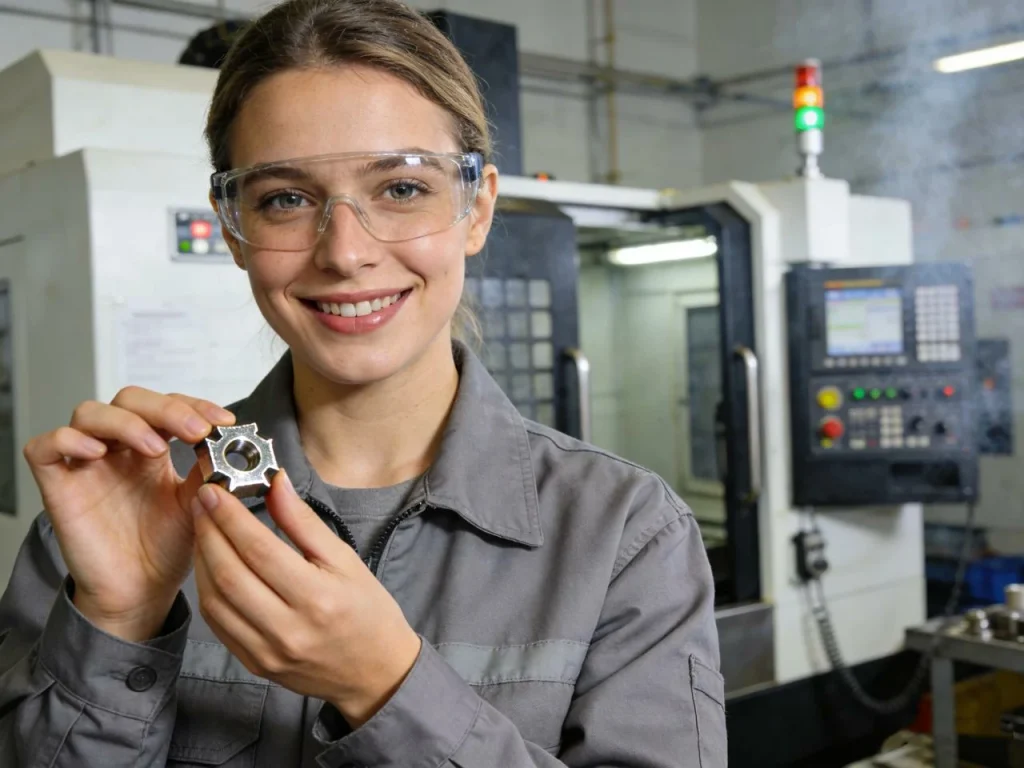
So, what does case hardened mean in plain terms? It means the outer surface of a steel part is made much harder than the inside. That outer layer resists abrasion, scuffing, and contact fatigue, while the interior stays tougher to handle shock and bending.
There are two main ways this happens:
In thermo‑chemical methods, carbon and/or nitrogen are added to the outer surface of the metal at elevated temperatures. Carbon and nitrogen atoms diffuse inward, so the surface layer ends up with more hardening elements than the core. After that, many processes use heating and quenching as a form of subsequent hardening so the enriched layer transforms into a very hard martensitic structure.
In thermal-only methods, the surface is heated quickly and then quenched, but the chemistry does not change. This only works well when the steel already has enough carbon to harden.
In both cases, the goal is the same: a wear-resistant exterior and a soft interior that helps prevent brittle fracture.
If you’re looking for a formal definition used in industry, ASM’s heat-treating references describe case hardening as a form of surface hardening that changes properties near the surface while preserving a tougher core.
Case hardened vs through hardened vs nitrided (quick comparison)
People often say “hardened” and mean different things. If you’re writing a print or reviewing a vendor quote, this quick comparison saves time.
| Process family | What gets hard | Typická tvrdost povrchu | Core toughness | Riziko zkreslení | Typická použití |
|---|---|---|---|---|---|
| Case hardened (carburize/carbonitride + quench) | Hard case + tough core | ~58–62 HRC (common target range) | High (core stays lower carbon) | Medium to high (high heat + quench) | Gears, shafts, pins, fasteners |
| Through hardening (quench + temper) | Whole section | Varies with alloy (often 40–62 HRC) | Can drop as hardness rises | Medium (quench) | Tools, some shafts, wear blocks |
| Nitrided steel (nitriding / nitrocarburizing) | Hard diffusion layer (no quench) | Often very hard surface layer (commonly reported higher than carburized cases in microhardness terms) | Very high (core largely unchanged) | Nízká | Tight-tolerance parts, dies, crankshafts |
A key phrase you’ll see in specs is effective case depth. That matters more than the “total” depth, because it ties depth to a minimum hardness level that actually carries load.
Typical numbers engineers look for (benchmarks)
If you only remember a few numbers, remember these. They won’t replace a drawing spec, but they help you sanity-check quotes and inspection reports.
For many industrial components, effective case depth is commonly around 0.25–0.75 mm. Many gears and heavily loaded parts go deeper. With deep carburizing on suitable alloys, the case can reach 4–5 mm, but that’s not “standard”; it’s a choice that affects cost, distortion, and grind stock.
For carburized and quenched parts, surface hardness is often specified around 58–62 HRC. The core is usually much lower (often below the mid‑30s HRC), because a tough core is the point.
Is case hardened the same as carburized?
No, but it’s easy to see why people mix them up.
Carburizing is one common case hardening process, where carbon is diffused into the surface. But “case hardened” is a broader term. A drawing note that says “case hardened” could also mean carbonitriding, nitriding, or even induction hardening depending on the shop and the part. If you need a specific result—depth, hardness, distortion limit—you should call out the exact method or the exact property targets (especially effective case depth and hardness profile).
How Case Hardening Works (Metallurgy You Actually Use)
Case hardening isn’t just a surface treatment—it’s a metallurgical process that changes how steel behaves under load. The underlying mechanisms involve diffusion, phase transformations, and residual stresses that work together to produce a hard wear-resistant shell around a tougher, more ductile core. Understanding these fundamentals helps explain why depth, microstructure, and stress state matter so much in real parts.
Diffusion basics: why depth grows with time (√t behavior)
Many case processes are diffusion-controlled. That’s a fancy way of saying atoms spread out slowly, and the longer you hold at temperature, the deeper they go.
A practical rule engineers use is that case depth tends to grow roughly with the square root of time. If you want twice the depth, you usually need much more than twice the time. That’s why deep cases cost real money and take real furnace time.
Depth is mainly controlled by four knobs:
Temperature matters because diffusion speeds up fast at higher heat. Time matters because diffusion needs time. The atmosphere matters because it sets carbon potential (for carburizing) or nitrogen activity (for nitriding). And steel chemistry matters because alloying elements change hardenability and nitride formation.
If you’ve ever wondered why a shop asks, “What case depth do you really need?” this is why. Depth is not a switch you flip; it’s time at temperature.
Microstructures: martensite at the surface, tougher core inside
In carburizing and carbonitriding, the surface becomes higher in carbon (and sometimes nitrogen). When the part is heated into the austenite range and then quenched, the enriched surface transforms into hard martensite. Inside, because the carbon content is lower, the core does not harden as much and stays tougher after tempering.
That “hard outside, tough inside” structure is exactly what you want when a tooth flank needs high wear resistance, but the gear body still needs to absorb shock loads.
Two details matter in real shops:
Retained austenite can remain in the case, especially with high carbon at the surface. Too much can reduce dimensional stability and change contact behavior over time. Residual stresses also matter. A well-made case often has compressive stress at the surface, which helps fight fatigue cracks.
Why fatigue improves: compressive residual stress at the surface
If a crack is going to start, it usually starts at the surface, at a notch, or at a stressed contact patch. A case hardened surface often has compressive residual stress that makes it harder for cracks to open. That is one reason case hardened gears often show large improvements in bending fatigue and contact fatigue life compared to untreated steel, and in many designs it can beat a uniformly hard part that is more brittle.
You’ll sometimes see gear references reporting bending fatigue gains on the order of ~30–50% with the right case and finishing steps. The exact number depends on geometry, grinding, shot peening, lubrication, and load, so treat it as a direction, not a guarantee.
Effective case depth vs total case depth (and why specs differ)
If you’ve ever received a report that lists two depths, you’re not alone. Shops often talk about both total case depth and effective case depth, and they are not the same thing.
| Term | Co to znamená v praxi | Proč je to důležité | Typical measurement |
|---|---|---|---|
| Effective case depth | Depth to a specified minimum hardness (a “useful hardness”) | Ties directly to load capacity and wear life | Microhardness traverse (Vickers) |
| Total case depth | Depth where microstructure or chemistry changes back to core | Can be larger than “useful” depth | Metallographic section + etch |
If you only specify “case depth” without saying which one, you can end up with a part that technically passes a vague note but fails early in service.
Case Hardening Processes (Carburizing, Nitriding, More)
Case hardening isn’t a single process but a family of methods that harden the surface in different ways—some add carbon or nitrogen, others rely on rapid heating and quenching. The choice affects depth, hardness profile, distortion, surface condition, and ultimately which applications the part can survive. Understanding the major processes helps with specifying parts, comparing supplier quotes, and avoiding expensive rework in production.
Carburizing (gas, pack, liquid, vacuum/low‑pressure)
Carburizing is the classic case-hardening method. The steel part is heated in a carbon-rich environment so carbon diffuses into the outer layer, then the part is quenched to form a hard case.
Many industrial carburizing cycles run around 850–950 °C (and can be wider depending on equipment and recipe). A common planning number is that you may get roughly 0.5–1 mm in a few hours, with deeper cases requiring longer cycles. Deep cases into the multiple-millimeter range are possible on the right steels, but they’re not “free.”
Pack carburizing, often called pack hardening, is an older method still used in some repair and low-volume work. Parts are packed in a carbon-bearing material and heated for hours. It can work, but depth control and repeatability are harder than with controlled atmospheres. If the part is safety-critical, most teams prefer a modern controlled furnace cycle.
Vacuum or low-pressure carburizing is chosen when you want cleaner surfaces, better control, and less oxidation. It can also help when you care a lot about surface integrity and consistent results from lot to lot.
| Carburizing method | Control of case depth | Stav povrchu | Distortion tendency | Nejvhodnější |
|---|---|---|---|---|
| Gas carburizing | High (with proper atmosphere control) | Some oxidation risk | Střední až vysoká | High volume gears, shafts |
| Pack hardening | Lower (depends on packing, heat uniformity) | Proměnná | Střední až vysoká | Small batches, legacy work |
| Vacuum/low‑pressure | Velmi vysoká | Clean surface, low oxidation | Medium (still high temp + quench) | High-performance parts, better consistency |
Carbonitriding (shallow, fast, production-friendly)
Carbonitriding adds both carbon and nitrogen to the surface. It usually runs at lower temperatures than carburizing, often in the ~700–900 °C range, and it’s widely used for smaller parts that need a hard skin but not a deep case.
A typical carbonitrided surface layer is often in the ~0.1–0.75 mm depth range. This makes it a strong choice for high-volume fasteners, pins, small gears, and wear-prone stamped or machined items where cycle time matters.
If you’ve ever seen repeated thread engagement chew up a mild steel screw, you’ve seen the problem carbonitriding solves. A hard case resists thread wear and galling, while the core stays tough enough to take tightening loads.
Nitriding & ferritic nitrocarburizing (low distortion, no quench)
Nitriding diffuses nitrogen into steel at lower temperatures than carburizing, often around 482–621 °C in an ammonia environment (sometimes using dissociated ammonia). Because nitriding does not usually require a quench, parts tend to move less. That low distortion is a big reason engineers choose it.
The trade-off is speed. Nitriding often needs long cycle times—commonly tens of hours—to reach typical depths like 0.25–0.75 mm.
Ferritic nitrocarburizing is related, but it adds a small amount of carbon as well and is often used to improve scuff resistance and surface behavior.
If you have a tight bore size that must stay tight, nitriding can be the difference between “minor polish” and “scrap the batch.”
Induction/flame hardening (localized, chemistry unchanged)
Induction and flame hardening heat only the surface zone, then quench it. There is no added carbon or nitrogen, so the steel must already have enough carbon to form martensite. A common working range is roughly ~0.3–0.6% C.
Induction hardening is a go-to method when you need selective hardening. Think about a shaft: you may want a hard bearing journal but a tough center section, or you may want hard gear teeth without running the whole part through a long diffusion cycle.
Flame hardening uses an oxy-gas flame to heat the surface. Induction uses induction heating (an electromagnetic field). Induction is often easier to control and repeat in production, while flame can be effective for larger parts and certain repair jobs.
When to Specify Case Hardened
Specifying case hardening is ultimately a design decision that depends on what the surface is asked to survive and how the rest of the part carries load. Many failures are driven by surface wear or fatigue initiation at the boundary, while the core still needs ductility for shock or bending. A simple decision framework helps reduce ambiguity on prints and ensures the chosen process fits both performance requirements and manufacturing reality.
Use-case triggers: wear + impact loading + fatigue life
When should you reach for “case hardened” on the drawing? A good trigger is when the surface sees wear, but the part also sees shock or bending.
Gear teeth are the classic example. The tooth surface sees repeated rolling and sliding contact that can cause pitting, while the tooth root sees bending stress that can crack a brittle material. A hard case helps resist pitting and scuffing. A tough core helps resist tooth breakage.
Cams and followers, pins and bushings, and threaded engagement points are also common. If you can scratch the part and wear is the dominant problem, case hardening is often a strong move. If the whole section must be hard all the way through, through hardening may be better.
Process selection matrix (fast selection)
This table is not a full design standard, but it is a practical starting point when you’re choosing a method.
| Your main requirement | Best starting process | Proč |
|---|---|---|
| Deep case for heavy contact load | Carburizing | Deep effective case depth is achievable |
| Shallow case, high-volume production | Carbonitriding | Faster cycles, good for small parts |
| Tight tolerances, low distortion | Nitriding / nitrocarburizing | Lower temperature, no quench |
| Selective hardening on a larger part | Induction/flame | Harden only where needed |
Many teams use a “process selector” approach: start with required depth, then check distortion tolerance, then check steel chemistry, then check part volume and cost.
Case hardened vs nitrided steel: what changes in performance & workflow
A simple question helps: do you want to quench?
Carburized and carbonitrided parts are usually quenched. That creates the martensitic case but can also create distortion. So the workflow often becomes: rough machine, leave grind stock, heat treat, then finish grind.
Nitrided parts are usually not quenched. That means you can often finish-machine first, then nitriding is the last step. For case hardened parts CNC machining workflows, that difference can decide the whole route sheet.
There’s also a surface behavior difference. Nitriding forms hard nitrides and can offer excellent wear resistance and fatigue performance with low movement. Carburizing offers deeper load-carrying capacity when you need more depth under the contact patch.
When should I choose nitriding instead of carburizing?
Choose nitriding when distortion control is the top priority, when you can accept slower cycles, and when the required depth is moderate rather than very deep. Nitriding is also attractive when you want to preserve a prior heat treatment in the core, because nitriding runs at lower temperatures.
Choose carburizing when you need deeper case depth and high contact load capacity, and you can plan for post-heat-treat grinding and size correction.
Materials & “Case Hardening Steel” Selection
Choosing the right steel is just as important as choosing the right case hardening process. Core carbon content, alloying elements, and hardenability all decide how deep the case can go, how strong the core becomes, and how much distortion you’ll need to manage later. A quick materials framework helps match chemistry to performance and shop workflow.
Steel chemistry basics: low-carbon cores, alloying for hardenability
What is case hardened steel in terms of chemistry? Often it starts as a low-carbon steel, commonly around ~0.1–0.25% C, so the core stays tough after heat treatment. Then carbon is added at the surface during carburizing or carbonitriding.
Alloying elements matter because they change how the case and core respond. Chromium and molybdenum can help hardenability and temper resistance. Nickel is often used for toughness. Manganese also supports hardenability. These elements help the core reach the needed strength while the surface becomes extremely hard.
If you’re asking what is case hardened steel on a material list, it usually means the steel grade is intended for a case-hardening route, not that it is already hardened in stock form.
Common case hardening steel families & typical applications
In practice, many case-hardening steels fall into families that are tuned for gears and shafts. You’ll see chromium-manganese and chromium-molybdenum types used across drivetrains, and nickel-bearing alloys when toughness is critical.
Instead of memorizing grades, focus on the match between the steel and the case hardening process. A steel that carburizes well is not always the best nitriding steel, because nitriding performance depends strongly on nitride-forming elements.
Specifying properties: surface hardness, core hardness, and gradients
Good specs name the properties, not just the process. For many parts, you care about three things at once: surface hardness, case depth, and core hardness.
| Component type | Surface hardness target | Effective case depth (typical) | Why it’s typical |
|---|---|---|---|
| Small pins / bushings | High (often upper‑50s to low‑60s HRC for carburized) | ~0.3–0.8 mm | Wear resistance with limited section size |
| Common gears | ~58–62 HRC (carburized) | ~1–2+ mm | Contact fatigue + bending fatigue balance |
| Heavy duty gears/shafts | High with controlled gradient | ~2–4+ mm (application dependent) | High Hertzian stress, longer life |
| Small fasteners | Hard case with ductile core | ~0.1–0.4 mm (often) | Thread wear resistance without brittle failure |
These are planning ranges, not universal rules. Geometry, load, lubrication, and material all shift the “right” numbers.
Can you machine case hardened steel after heat treatment?
This is one of the most common shop-floor questions, and the honest answer is: sometimes, but you usually don’t want to.
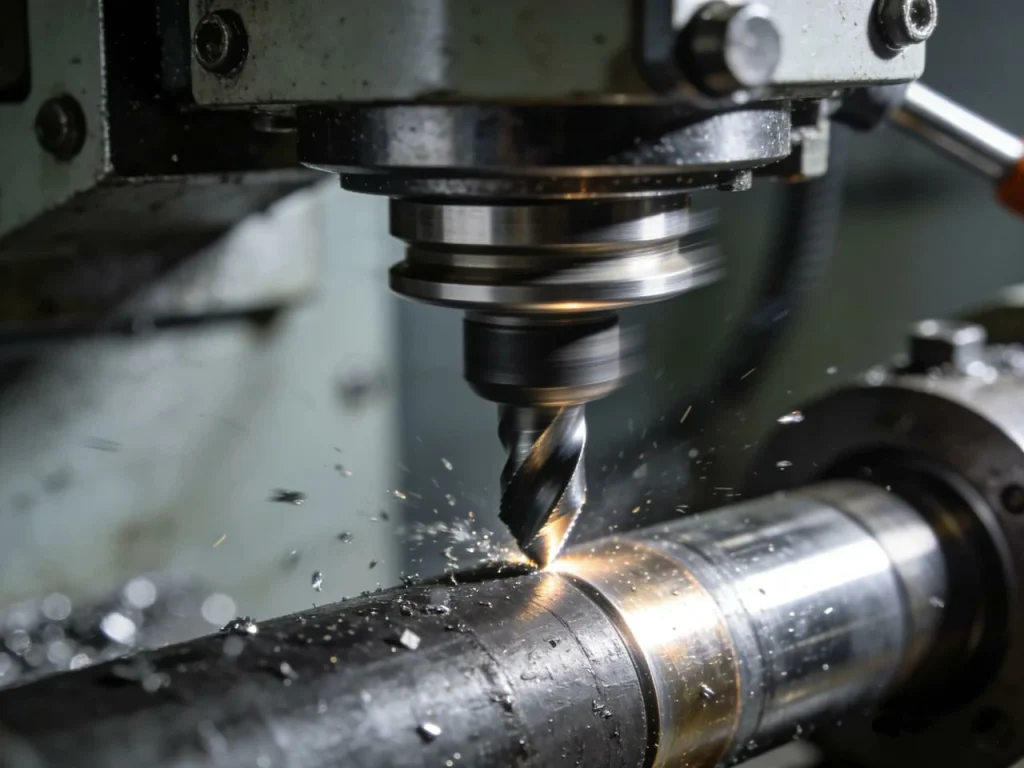
A case hardened layer can be in the high‑50s to low‑60s HRC range. Conventional machining tools struggle there, and even if you can cut it, you may damage surface integrity (microcracks, heat checks, smeared material). That can remove the very benefits you paid for.
So most production routes do this: rough machine first, then heat treat, then finish by grinding, honing, or polishing. If you must cut after hardening—maybe for a repair, a prototype, or a feature that moved—you can use hard turning or grinding strategies, but plan carefully.
This also affects CNC soustružení a frézování with case hardening. The cleanest approach is to treat case hardening as a near-final operation, then use finishing processes that are meant for hard surfaces.

What is the best insert for turning hardened steel?
If you need to turn hardened surfaces, insert choice depends mostly on hardness and whether the cut is smooth or interrupted.
For hardened steel around or above ~50 HRC, CBN inserts are often the top choice for hard turning because they handle high hardness with good wear resistance. For very hard materials and stable setups, ceramic inserts can also work, especially at higher surface speeds, but they can be less forgiving in interrupted cuts. For lower hardness ranges (or when you’re cutting near the transition from case to core), high-quality coated carbide may work, but tool life can be short on the hard case.
One practical warning: a case-hardened part has a hard skin over a softer substrate. If your depth of cut crosses that boundary, cutting forces can change quickly, and chatter can spike. A rigid setup, controlled depth of cut, and a plan to avoid the transition zone often matter as much as the insert grade.
Design Rules for Case Hardened Parts (Avoid Rework)
Designing for case hardening isn’t just about picking a process — it’s about making sure the geometry, tolerances, and depth targets actually survive heat treatment and assembly. Small details like wall transitions, fillets, or machining stock often decide whether a batch runs smoothly or comes back for rework. A few practical design rules help keep the print realistic and the parts functional.
Choosing case depth by load and failure mode (practical targets)
Here’s a simple way to pick a starting depth: ask what failure you are trying to stop.
If you mainly need light wear resistance on a sliding surface, depths around ~0.3–0.6 mm are common starting points. For many gears, ~1–2+ mm is typical because the contact stresses and bending stresses are high. For extreme duty, deeper cases up to ~4–5 mm can be used on suitable steels, but you should expect longer cycles and more distortion management.
If you’re unsure, don’t guess. Ask the heat treater what depth they can hold consistently on your geometry, then tie that back to your load model or field history.
Distortion control: geometry, fixturing, and machining allowance
Distortion is not an accident. It is a normal outcome of high heat, phase changes, and quenching. The question is whether you planned for it.
Uniform wall sections help. Generous fillets help. Sharp corners, thin webs next to thick hubs, and sudden section changes make distortion more likely. Keyways, thread roots, and tooth roots also concentrate stress and can be crack starters if the case is too brittle or too thin in that region.
On the machining side, leave enough stock for finishing. Many shops plan grind stock on journals and gear teeth because the part may grow, ovalize, or warp slightly.
I’ve seen a batch of shafts come back “hard and beautiful” but out of size because the drawing had no grind allowance and no distortion limit. The fix was not a better furnace; it was better planning.
Surface finish & edge conditions (where failures start)
Case hardening does not erase bad geometry. In fact, it can make sharp features more risky because a hard case can crack more easily at a stress riser.
Pay attention to tooth roots, thread roots, keyways, and edges that see sliding contact. If you need the case to support load at an edge, specify adequate case depth there and avoid over-sharp transitions.
A good rule is to treat high-risk features as first-class design items, not as “small details.”
How deep should case hardening be for gears?
Many gears land in the ~1–2+ mm effective case depth range, but the “right” number depends on gear size, module, load, and duty cycle.
For high-volume automotive-style duty, you often see controlled cases that balance pitting resistance with bending fatigue and quiet running. For heavy equipment, deeper cases may be used because the contact patch and stress field reach deeper into the tooth.
If you’re choosing between two depths, the safer question is: are you failing by surface pitting/scuffing, or by tooth breakage? The answer points you toward adjusting the case depth, the core strength, or both.
Inspection, Quality Control, and Standards
Once a part has been case hardened, the real question becomes whether the heat treater actually delivered the depth, hardness, and surface condition you specified. Inspection methods and standards define how to verify that, and they often influence how drawings and purchase orders should be written. Clear quality controls prevent arguments between design, production, and suppliers later in the workflow.
Measuring hardness & case depth (what shops actually do)
A shop can check surface hardness with Rockwell testing, but you cannot confirm effective case depth from a single surface reading. The standard approach is a microhardness traverse: cut a section, polish it, and take hardness indents at set depths (often using Vickers). That produces a profile you can compare to your spec.
If you need a step-by-step view of the common lab method, it looks like this:
- Section the part through the area of interest (for gears, often through the tooth).
- Mount and polish the cross-section.
- Take microhardness readings from the surface inward at fixed spacing.
- Plot hardness vs depth and record the depth where hardness falls to the specified threshold (your effective case depth).
This is slower than a quick check, but it answers the question that matters: did you get the case you paid for?
Surface integrity checks: decarburization, oxidation, IGO
Even if the hardness numbers look fine, surface integrity can still sink you.
Decarburization is a loss of carbon at the surface. It can create a thin soft skin that wears fast and can start pitting early. Oxidation and intergranular oxidation (IGO) can also damage the near-surface zone, especially in high-temperature processes if atmosphere control is poor.
That’s why controlled atmospheres and clean processing matter. The case is only valuable if the surface you put into service is truly hard, intact, and supported by a proper gradient beneath it.
Standards & documentation to reference in specs
For specs, clarity beats jargon. Instead of only writing “case harden,” call out measurable requirements: process type (if fixed), effective case depth, surface hardness range, core hardness range, allowed distortion, and inspection method.
For documentation, ask for furnace records, atmosphere control records (when applicable), quench and temper records, and the hardness traverse report when case depth is critical.
How do you test if something is case hardened?
In the field, you can sometimes get hints. A file may skate on the surface but bite once you break through. A spark test can hint at carbon level, but it’s not proof of a case. These checks are useful for a quick triage, not for acceptance.
In the lab, verification is straightforward: a hardness traverse and a metallographic section will show the case and measure it.
Defects, Failures, and Troubleshooting (Field-Proven)
Once case hardened parts enter service, the question shifts from “how to make them” to “what actually fails and why.” Most issues trace back to depth, hardness, surface integrity, or distortion — and they tend to repeat across gears, shafts, and fasteners. A practical troubleshooting lens helps connect field symptoms to root causes and corrective actions.
Common process defects and root causes
Most case hardening failures fall into a few patterns. The part is either not hard enough where it needs to be, too brittle where it needs to bend, or damaged at the surface by processing.
| Symptom in service or inspection | Pravděpodobná příčina | Common corrective action |
|---|---|---|
| Early wear, galling, thread strip | Case too shallow or soft | Increase effective case depth or adjust process |
| Pitting/spalling on gear flanks | Case depth insufficient for contact stress | Increase depth, improve finishing/lube, check surface integrity |
| Cracks near edges or roots | Case too hard/brittle, sharp geometry, severe quench | Add fillets, adjust quench/temper, refine hardness target |
| Soft spots / uneven hardness | Poor atmosphere control, shielding, load layout issues | Improve furnace control, racking/fixturing, verify carbon potential |
| Quench cracks | Excessive quench severity, sharp corners, high stress | Adjust quench method, redesign features, temper discipline |
| Unstable size over time | Retained austenite too high | Adjust cycle, sub-zero step if needed, temper strategy |
Service failures by component type (gears, shafts, fasteners)
Gears often fail by pitting first, then spalling, and finally tooth breakage if the crack grows. Shafts may show wear at journals or fretting at fits. Case hardened fasteners can fail when the case is too brittle at the threads, or when the case is too thin and the threads wear out fast.
If you’re troubleshooting, ask a simple question: did the surface fail first, or did a crack start at a root/notch? That points you toward case depth and surface integrity versus core strength and stress concentration.

Practical prevention: controls that matter most
On the heat-treat side, atmosphere control and repeatable quenching matter. On the design side, smooth geometry, planned grind stock, and clear property specs matter.
Masking is another practical control. If you have a bore that must stay soft for assembly or for later machining, masking can help keep the case off areas where it causes trouble.
Mini case studies (real-world patterns)
A gear set that pitted early can look like a lubrication issue at first. But when the tooth is sectioned, the case may be thinner than expected at the flank, or the effective depth may be shallow at the highest load zone. The fix is often a deeper effective case depth, plus a check on surface integrity and finishing.
A batch of thin-ring parts can come back distorted after carburizing and quench. The parts may meet hardness, but roundness is lost. In many shops, nitriding or a lower-temperature method is chosen next time, or the design is changed to support fixturing and reduce section changes.
A tight-tolerance shaft may be perfect after machining, then slightly out after heat treat. Switching to nitriding at the end of the route can preserve size, because the process runs at lower temperature and avoids quench movement.
Costs, Lead Time, Vendors, and Practical Buying
Even if the technical requirements are clear, the buying side can make or break a project. Case hardening has real cost and lead-time consequences tied to cycle time, alloy choice, inspection rigor, and post-processing. Understanding those drivers makes vendor quotes easier to compare and reduces unpleasant surprises after the PO is issued.
Cost drivers and cycle-time reality (what changes the quote)
Case hardening cost is mainly driven by time at temperature, part size, alloy, and how strict your inspection needs are.
Deeper cases usually mean longer cycles. Larger parts take longer to heat and may need special fixturing. Some alloys need tighter control to hit targets. If you require a microhardness traverse on every lot, cost rises, but so does confidence.
Post-process finishing is a hidden driver. If the part needs grinding after heat treat, the total cost may be dominated by machining time, not furnace time.
Vendor qualification checklist (beyond “near me”)
A capable vendor can explain how they control atmosphere or nitrogen potential, how they rack parts to reduce distortion, and how they verify effective case depth. They should be able to show traceability and provide hardness maps when needed.
If your part is critical, ask how they handle calibration, sample prep for traverses, and how they respond to nonconformance. Those answers tell you more than a low quote.
RFQ template: what to include to avoid delays and rework
If you want fewer back-and-forth emails, include the details that heat treaters need to lock the process down. At minimum, provide: material grade, drawing, required method (or acceptable options), target surface hardness range, target core hardness range, target effective case depth, location where depth is measured, distortion limits, and required inspection method and frequency.
When you leave these out, the vendor has to guess. And guessing is how you end up with parts that “passed” but don’t last.
Actionable takeaways (synthesis back to core message)
When you specify case hardened parts, choose the process based on required depth and distortion tolerance, not habit. Put effective case depth and hardness on the drawing because that is what you can measure and control. Match the steel chemistry to the method, and plan the machining route so you’re not forced into cutting a hard case when a grind or hone would be safer.
Nejčastější dotazy
Case hardening, sometimes also called pack hardening, is a process where the surface of a steel part becomes super hard while the inside stays softer and more flexible. This gives the steel a hard, wear-resistant exterior but a tough, shock-absorbing core. It’s especially useful for things like gears, cams, and shafts—basically any part that experiences heavy friction or contact. When people talk about case hardened steel, they’re referring to steel that has undergone this process, so the outer layer can handle wear without compromising the inner strength.
The way to case harden steel is by adding carbon or nitrogen to the surface while keeping the core softer. In pack hardening, for example, the steel is buried in a carbon-rich material and heated, allowing carbon to diffuse into the surface. After heating, the steel is quenched to lock in the hard exterior. Other methods include gas or salt bath hardening, but the principle is the same: create a hard surface and a ductile interior. Engineers often consider this when planning CNC turning and milling with case hardening, because the hardened layer behaves differently under cutting tools compared to the softer core.
Even though case hardening offers a great balance of wear resistance and toughness, there are some trade-offs. Only the outer layer is hardened, so if a part wears too much, it loses its protective benefit. The process can also introduce distortion or residual stress, which is important to consider for precise case hardened parts CNC machining. Post-hardening machining can be tricky, and additional costs and steps are involved, making it slightly more complex than using regular steel. So while it’s excellent for specific applications, it’s not always the easiest or cheapest solution.
Yes, case hardened steel is machinable, but it’s not as simple as machining untreated steel. The hardened outer layer is tough and wear-resistant, so regular tools wear out quickly. Specialized tools, like carbide or CBN inserts, are often used. Most machinists prefer to do rough CNC turning and milling with case hardening before the hardening step, and leave only minor finishing cuts afterward. Otherwise, cutting through a fully case hardened part can be challenging and may damage tools.
When dealing with case hardened parts CNC machining, the best inserts are usually coated carbide or CBN inserts. CBN inserts are particularly effective for steel hardened above 60 HRC, while coated carbide works well for slightly softer surfaces. Using these inserts with proper feeds, speeds, and cooling ensures longer tool life and cleaner cuts. Picking the right insert is crucial—otherwise, the outer hardened layer can quickly chip tools, slowing down production and increasing costs.
Odkazy
https://www.asminternational.org/wp-content/uploads/files/06952G/06952G-toc.pdf

 Czech
Czech  English
  German
  French
  Italian
  Spanish
  Polish
  Japanese