
Custom CNC machining is usually searched with one goal: decide if a part can be made (and inspected) with acceptable risk, time, and cost. In 2026, the “can it be machined?” question still starts with geometry, material, tolerance, and finish. What changed is how much of the feasibility work is now supported by AI-assisted programming, connected machines, and a stronger digital thread from CAD to inspection.
This guide stays focused on decision points engineers and technical buyers face: when CNC is the right choice, what process and machine type fits, what hybrid manufacturing really changes, and what information a CNC machining shop needs to quote and control risk.
Custom CNC Machining: What It Is & When to Use It
Custom CNC machining is computer numerical control (CNC) subtractive manufacturing. A CNC machine removes material from solid stock (metal or plastic blocks, or bar/rod stock) using cutting tools, driven by a program generated from CAD/CAM data. “Custom” mainly means the part is made to your design, not from a standard catalog. According to 国際標準化機構, standardized exchange formats for CAD/CAM data ensure consistent interpretation of geometry and features across different software and machines.
The feasibility question is rarely “Can a CNC cut it?” The more useful question is “Can a CNC cut it with the needed tolerance, surface, and inspection method, without creating unstable setups, high scrap risk, or excessive cycle time?”
Where custom CNC fits: prototypes, high-mix/low-volume, precision parts
Custom CNC machining tends to fit best in three common scenarios:
- Prototypes and engineering iteration
When you need prototypes and production parts in engineering-grade materials (not just visual models), CNC is often selected because it can produce functional geometry in metals and thermoplastics with predictable mechanical properties. Industry sources describing 2026 trends highlight rapid prototyping demand as a key driver, with functional prototypes produced in days to support faster iteration loops. (See sources listed in the inputs.)
- High-mix / low-volume production
For many OEM CNC parts, the biggest advantage is avoiding dedicated tooling. If you have frequent design revisions, product variants, or uncertain demand, CNC can be economically workable because your “tooling” is mainly programming, fixturing, and setup time. Multiple 2026 trend reports emphasize custom CNC’s role in high-mix, low-volume production without tooling costs.
- Precision parts where inspection and traceability matter
Aerospace, medical, electronics, and other regulated or high-consequence sectors tend to care as much about inspection evidence as the part itself. CNC fits well when you can define measurable requirements (datums, tolerances, surface finish) and verify them with a planned inspection approach. 2026 sources also point to more in-process inspection and closed-loop quality controls (AI vision, scanning), which shifts some risk from end-of-line detection to earlier detection.
CNC vs additive vs injection molding: speed, geometry, cost (comparison table)
Most feasibility reviews compare CNC to two other methods: additive manufacturing (3D printing) and injection molding. Each has “gotchas” that show up only after you map part geometry, volume, and acceptance requirements.
| ファクター | Custom CNC machining (subtractive) | Additive manufacturing (3D printing) | 射出成形 |
|---|---|---|---|
| ベストフィット | Precision metal and plastic parts; prototypes and production parts; tight datums; predictable mechanical properties | Complex internal geometry; near-net shapes; lightweighting features; early prototypes | High-volume repeat production once tooling is stable |
| Speed to first part | Often fast for prototypes because no mold tooling is needed; depends on programming, setup, and inspection plan | Can be fast for complex shapes because little machining is needed; post-processing may dominate | Slower start because mold design/build must be completed before parts |
| Geometry strengths | Prismatic features, bores, flatness/parallelism control, sealing surfaces, controlled surface finish | Internal channels, lattices, shapes not reachable by cutters | Thin walls, repeatable features once mold is tuned |
| Cost drivers | Setup + programming, cycle time, material, inspection | Build time, support removal, post-processing, inspection | Tooling cost + tuning + per-part cycle |
| Change management | CAD revisions are usually manageable; programming/inspection updates needed | CAD revisions are manageable; process qualification may be needed | Revisions can be expensive and slow if they require tool changes |
A common misunderstanding is treating “3D printing vs CNC” as a single trade-off. In practice, the comparison depends on where the tolerance, surface finish, and inspection burden sits. For example, if you have sealing surfaces or bearing fits, you may still end up machining critical features even if the bulk shape is printed.
Is custom CNC machining good for low-volume production?
Often yes, when you want production-grade materials and you want to avoid mold tooling. Low-volume feasibility depends on whether setup and programming can be spread across enough parts, and whether the inspection plan is proportional to risk. If the part needs complex multi-face machining with many setups, the “low volume” advantage can shrink because setup time dominates.
2026 Innovations: AI, IoT & Digital Thread in CNC
The 2026 story is not that CNC suddenly became “smart.” The practical change is that more shops can connect CAD/CAM, machine monitoring, and inspection data into a usable loop. The goal is fewer surprises: fewer broken tools, fewer unplanned stops, and fewer defects discovered after the part leaves the machine.
The inputs provided cite multiple industry/technical reports describing AI-powered automation, IoT-connected machining, in-process quality inspection, and digital thread/digital twin approaches. They do not fully agree on one “top trends” list, so treat the trend labels as overlapping categories rather than separate boxes.
AI-powered toolpath generation + autonomous machining from CAD (reference: industry/technical reports)
AI-assisted toolpath generation is usually discussed as “from CAD to machining with less manual effort.” In practice, the value is not magic. It is reduction of routine decision load:
- selecting toolpaths that avoid air-cutting and reduce cycle time
- choosing cutting tool strategies that reduce chatter risk
- suggesting feeds/speeds choices based on prior runs
- flagging hard-to-machine features early (deep pockets, thin walls, long-reach tools)
Some 2026 sources describe AI-embedded CNC systems moving toward autonomous machining from CAD models. Even when full autonomy is not realistic for your part, partial automation can matter. If programming time drops, or if the CAM output is more consistent, then quoting, scheduling, and revision handling can become less fragile.
Engineering caution: “autonomous” does not remove the need for manufacturability review. It shifts the work from manual CAM clicks to validating assumptions. Thin ribs, weak datum schemes, and unstable fixturing can still fail, even with an AI-generated toolpath.
IoT-connected machining: real-time tool wear detection, auto-adjustments, remote monitoring (reference: industrial IoT research)
IoT-connected machining links machines, sensors, and analysis software so the system can observe cutting conditions and react. The 2026 inputs describe real-time tool wear detection, auto-adjustments, and remote monitoring as key enablers of higher overall equipment efficiency (OEE).
From a feasibility view, IoT matters when your part is sensitive to process drift. Examples:
- long cycle times where tool wear accumulates and dimensional drift becomes likely
- hard materials where edge wear changes surface finish and size control
- tight tolerance stacks that cannot tolerate gradual offset drift
Remote monitoring also matters for quick-turn parts, because it can reduce the time between “something changed” and “someone acted.” That does not guarantee a shorter lead time, but it can reduce the risk of a late surprise.
Digital thread + digital twin/cloud-edge: closed-loop scheduling responsiveness (+50%) (chart)
A digital thread is the connected data path from CAD to CAM to the machine to inspection and back to engineering records. A digital twin is a digital representation used for planning or simulation. The supplied 2026 sources claim that digital twin and cloud-edge collaboration can increase production scheduling response speed by 50%.
That number should be read carefully: it is about responsiveness (how fast schedules react), not a blanket promise of faster delivery. Still, responsiveness is a real constraint in high-mix work, where priorities change and revision cycles are common.
Chart: Scheduling response speed (relative index)
| アプローチ | Relative scheduling response speed |
|---|---|
| Traditional disconnected systems | 1 |
| Digital twin + cloud-edge collaboration (reported) | 1.5 |
Where this shows up in real projects is revision handling and queue changes. If a prototype fails a test and needs a revision, the bottleneck is often not cutting time. It is reprogramming, re-approval, re-scheduling, and re-inspection planning. A closed-loop digital thread reduces “lost time” between those steps.
How is AI used in CNC machining?
In 2026 discussions, AI is used mainly to automate or support decisions that used to depend heavily on expert judgment: toolpath generation, tool wear prediction, predictive maintenance, and in-process defect detection. In many cases, AI does not replace engineering review; it reduces manual programming work and helps detect drift earlier. The useful test is whether AI outputs are traceable enough to support your quality requirements.
CNC Processes & Machine Choices (3-Axis to 5-Axis)
Selecting “CNC machining” is not selecting one process. Milling, turning, mill-turn, and 3-axis vs 5-axis choices change cost, risk, and achievable geometry. A correct match can remove setups, reduce tolerance stack-up risk, and simplify inspection. A wrong match can create fragile fixturing and hard-to-control deflection.
Milling vs turning vs mill-turn: choosing by geometry and tolerances (decision tree diagram)
CNCフライス加工 is a subtractive manufacturing process that uses rotating cutting tools to remove material while the workpiece is held. CNC turning removes material using a stationary tool while the part rotates (typically from metal rod stock). Mill-turn combines both lathe and mill capabilities, often as CNC旋盤加工 with live tooling.
When deciding on a machining process, start by considering the dominant geometry of the part.
If the part consists mostly of cylindrical features machined from rod stock, then turning is generally the preferred process. If these cylindrical parts also require additional features such as flats, cross-holes, keyways, or pockets, mill-turning (turning with live tooling) is appropriate. For parts that require tight coaxiality or concentricity, turning should remain the primary process.
If the part consists mostly of prismatic or multi-face features, milling is usually the best choice. For features located on up to three sides with simple access, 3-axis milling is often sufficient. However, for parts with features on many faces or at complex angles, 4-axis or 5-axis milling should be considered.
For parts that combine prismatic and cylindrical features, especially where critical geometric relationships must be maintained, mill-turn or 5-axis milling is typically the preferred option.
Two practical rules that reduce surprises:
- If a part needs many setups, the risk is not only time. It is datum transfer error and tolerance stack-up between setups.
- If critical features must align across faces, fewer setups usually means lower risk, even if the machine time is higher.
5-axis CNC machining: fewer setups, complex surfaces; high-precision interpolation (note uncertainty on near-nanometer claim; reference: academic sources/Google Scholar)
5-axis machining adds two rotational axes to the standard X/Y/Z motion. That matters for two reasons:
- Fewer setups A complex part that would need multiple fixtures on a 3-axis machine can sometimes be done in fewer operations on a 5-axis. Fewer setups often reduces accumulated error and reduces the number of times a part must be re-indicated and re-referenced.
- Better access to complex surfaces If you need sculpted surfaces, angled features, or tool access without long tool stick-out, 5-axis tool orientation can reduce deflection risk and improve surface consistency.
The inputs include a claim that 5-axis CNC machines with high-precision interpolation can achieve surface machining approaching the nanometer level. This is single-source and not fully verified in the provided material, so treat it as a trend statement rather than a guaranteed capability. For high-precision surface work (turbine blades, precision molds, medical implants), the safer engineering approach is to ask what surface finish and form can be verified with the supplier’s inspection method, not what the machine brochure suggests.
In practice, “high precision” depends on the whole system: thermal stability, fixturing stiffness, tool wear control, probing/inspection plan, and how the CNC加工プロセス is compensated over time.
What is 5-axis CNC machining used for?
It is used when part geometry needs access from many angles, when complex surfaces must be cut with stable tool engagement, or when reducing setups lowers tolerance risk. Typical applications discussed in 2026 trend sources include turbine blades, precision molds, and medical implants. It is also used when you want to combine operations so the part stays in one reference frame longer.
Hybrid CNC + additive (3D printing + finish machining): when it’s the right fit (process workflow diagram)
Hybrid manufacturing combines 3D printing for near-net shaping with CNC for precision finishing. The reason this keeps appearing in 2026 sources is simple: additive can create shapes that cutters cannot reach, but CNC still does better on tight features, sealing surfaces, and predictable finishes.
The workflow begins with creating a CAD model of the part. Next, the part is produced using an additive manufacturing process to achieve a near-net shape. After the build, stress relief and support removal are performed as required. CNC datum features are then created to establish machine reference points, followed by CNC finish machining to achieve critical dimensions, sealing faces, and bores. For certain hard-to-reach features or tight internal geometries, CNC放電加工機 can be employed to cut slots, cavities, or intricate shapes that traditional milling cannot easily reach, making the hybrid workflow more versatile. Finally, the part undergoes inspection, including both in-process checks and final verification, to ensure it meets all specifications.
Hybrid is not “better CNC.” It is a different risk profile. You trade some CNC cycle time and material waste for added process steps and more inspection complexity. Hybrid can be the right fit when internal geometry is a hard requirement, not a preference.
Hybrid Manufacturing: Additive + Subtractive for Complex Parts
Hybrid matters most when the part is constrained by geometry rather than just tolerance. In 2026 sources, hybrid is tied to aerospace and automotive needs: lightweighting, complex internal features, and reducing buy-to-fly waste.
Why hybrid matters: complex internal geometries + near-net shaping (aerospace/automotive fit)
When you need internal channels, lattice structures, or weight-reduction cavities, pure CNC may be blocked by tool access. You cannot machine what you cannot reach. Additive processes can form these shapes, then CNC is used to bring interfaces, datums, and critical surfaces into spec.
This pattern is common in:
- aerospace parts where mass and performance drive geometry choices
- automotive lightweight components where design freedom supports new structures
The key point is that hybrid is not chosen to avoid CNC; it is chosen to avoid impossible or very wasteful subtractive-only approaches.
Material waste reduction: hybrid CNC–3D printing can cut waste by 30% (bar chart)
Two sources in the provided inputs report that hybrid CNC–3D printing can reduce material waste by 30%. This is meaningful when the part would otherwise be machined from a large billet with extensive removal.
Bar chart (text): material waste (relative)
| アプローチ | Relative material waste |
|---|---|
| CNC from billet (baseline) | 1 |
| Hybrid near-net + CNC finish (reported) | 0.7 |
Engineering caution: the 30% figure is not presented as an industry-wide benchmark across many independent datasets in the inputs. Treat it as a reported outcome that may apply when near-net shaping significantly reduces removed volume.
Trade-offs: accuracy, surface finish, inspection needs, and when pure CNC is better (pros/cons matrix)
Hybrid changes what you have to control.
| ファクター | Hybrid (additive + CNC finishing) | Pure CNC machining |
|---|---|---|
| 幾何学 | Enables complex internal geometry and near-net shaping | Limited by tool access; internal features may be impossible |
| 精度 | Critical features can be finished by CNC, but printed geometry may vary | More uniform control across all machined features |
| 表面仕上げ | Often needs CNC on functional surfaces; printed surfaces may be rougher | Finish control is straightforward on accessible surfaces |
| 検査 | More complex because you must verify both printed and machined regions | Often simpler because process is more uniform |
| ベストユース | When internal geometry or waste reduction is a hard requirement | When full geometry is accessible and precision is dominant |
Pure CNC is often better when you need uniform surface finish, tight control across many features, or simpler inspection. If the additive step introduces variability that is hard to inspect (especially internal), the program risk can rise even if the part is “manufacturable.”
Case Study: Aerospace complex components—hybrid near-net + CNC finish (30% waste reduction) (callout box)
Case study callout (from provided sources):
Aerospace programs needed lightweight, high-strength components with intricate internal features. A hybrid approach was used: 3D printing for near-net shaping followed by CNC precision finishing on critical features. The reported outcome was 30% material waste reduction, while enabling geometries that were not practical with traditional machining alone. The main engineering takeaway is that near-net shaping can reduce removed volume, but it also requires a planned datum strategy for the CNC finishing step and a credible inspection plan for internal features.
Rapid Prototyping With Custom CNC Parts
“Rapid prototyping CNC” is not just about speed. It is about iteration with the same materials and manufacturing process family you expect in production parts. That reduces the risk that a design passes prototype tests but fails when moved to a different process later.
The 2026 sources provided link rapid prototyping demand to agile product development and personalization trends, with functional prototypes delivered in days in many situations.
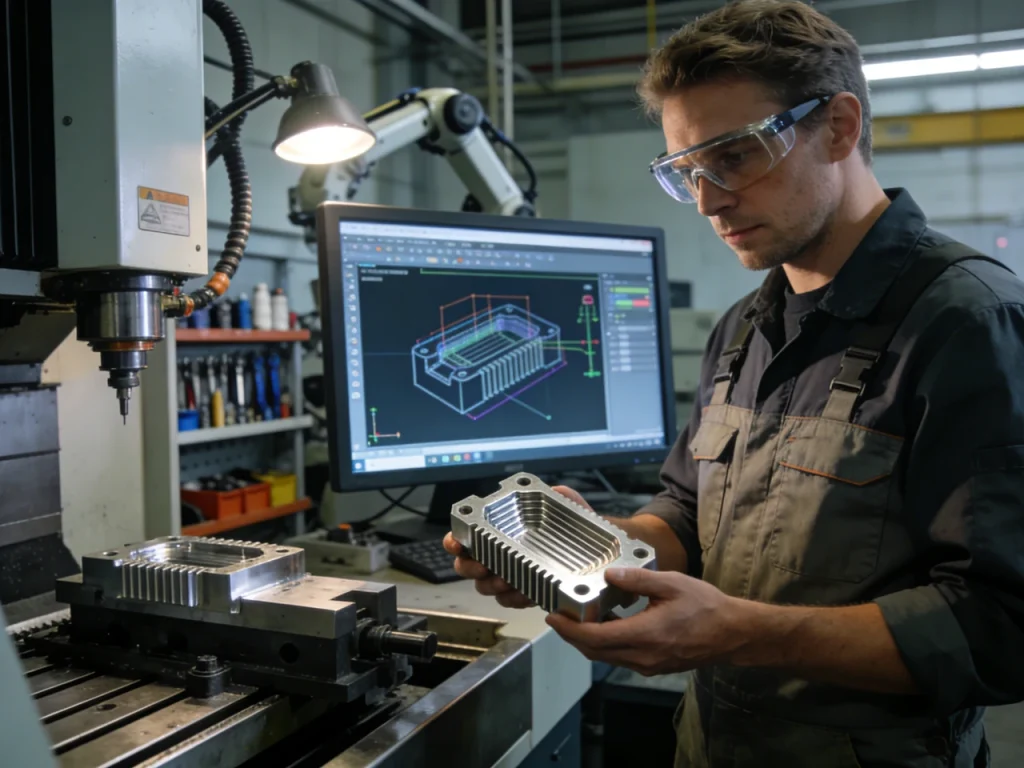
Prototypes in days: iteration loops for engineering-grade materials (timeline diagram)
A realistic prototype loop has several steps that are easy to forget when planning schedules: manufacturability review, programming, setup, machining, and inspection. The exact time depends on part complexity and the shop’s queue, so avoid assuming any fixed lead time. Still, the “days” framing from 2026 sources aligns with the idea that CNC prototypes can move fast when the design is machinable and inspection is scoped correctly.
The process begins with the CAD release, followed by a DFM (Design for Manufacturing) review to identify risk features and establish the datum plan. Next, CAM programming is performed to define toolpaths and the setup plan. Machining then proceeds, typically starting with roughing and followed by finishing operations. Inspection is carried out with critical features checked first, followed by test or fit verification. If necessary, revisions are made, repeating the cycle until the part meets all specifications.
If you want prototypes quickly, the common limiter is not spindle time. It is design clarity (datums, tolerances), revision churn, and whether inspection criteria are defined early.
Prototype-to-production handoff: keeping CAD/CAM/inspection data consistent (digital thread checklist)
A digital thread is valuable when your prototype becomes the seed for production parts. The handoff fails when “prototype logic” (informal tolerances, missing datum scheme, limited inspection) is not upgraded before scaling.
Digital thread checklist (focused on feasibility, not paperwork):
| Item to keep consistent | なぜそれが重要なのか |
|---|---|
| CAD model revision control | Prevents machining the wrong revision during fast iteration |
| Datum scheme defined in the model/drawing | Enables consistent setups and repeatable inspection |
| CAM assumptions captured (stock, clamps, zero points) | Reduces re-learning when scaling or moving shops |
| Inspection plan tied to critical features | Avoids late discovery that a requirement cannot be measured |
| Material and finish callouts stable | Prevents re-qualification of surface/function late |
This is also where many buyers struggle when trying to find a custom CNC shop: every supplier can “make a part,” but not every shop will preserve traceability across revisions. The practical test is whether they can return clear inspection evidence tied to your datums and requirements, and whether they can explain how revisions are handled.
How fast can you get CNC prototypes?
Some 2026 sources describe prototypes produced in days, especially when the geometry is straightforward and the material is readily available. Actual speed depends on part complexity, required inspection depth, and whether the design is ready for CNC (clear tolerances and datums). The safest planning approach is to treat “days” as possible, not automatic, and to confirm what will slow the quote-to-ship cycle for your specific part.
DFM for prototyping: features that add time/cost (design checklist)
Design for manufacturability (DFM) is not a lecture; it is a list of geometry choices that change cycle time and scrap risk. If you want quick-turn parts, these are common features that add time or force process changes:
Design checklist (things that often slow prototypes):
| Feature / requirement | Why it adds time or risk |
|---|---|
| Deep narrow pockets | Long-reach tools deflect, chatter, and wear faster |
| Thin walls / thin ribs | Deflection during cutting makes size control hard |
| シャープな内部コーナー | End mills leave radii; sharp corners need extra steps or EDM |
| Many tight tolerances across many features | Increases setup control and inspection burden |
| Unclear datum scheme | Forces the shop to guess how features relate |
| Cosmetic surface requirements everywhere | Drives extra finishing and careful fixturing |
If you can mark “tight where needed” and leave non-functional areas looser, you usually improve both feasibility and iteration speed.
Materials & Finish Requirements for Precision CNC Parts
Material selection and finish requirements are where many CNC projects become expensive or risky without looking complex in CAD. A “simple” part can be hard if it combines a difficult material with a sealing surface and a tight tolerance stack.
This section stays at the framework level because the inputs do not provide verified property numbers. Still, you can make good early decisions with relative comparisons: strength needs, corrosion resistance, chemical resistance, impact strength, and machinability.
Material selection framework: metals vs plastics by strength, machinability, and use case (comparison table)
Custom CNC machining commonly covers both metal and plastic parts. The choice usually comes down to mechanical properties and environment.
| 素材ファミリー | 選ばれる理由 | Common feasibility considerations |
|---|---|---|
| アルミニウム合金 | Good strength-to-weight; common for prototypes and production parts | Heat and burr control; surface finish needs; corrosion considerations by environment |
| Steels (various) | Higher strength and wear resistance for loaded parts | Harder machining, tool wear, and cycle time; may require more inspection attention |
| Engineering thermoplastics (for example polycarbonate, PTFE, other thermoplastic options) | Chemical resistance, low moisture absorption, impact strength (material-dependent) | Workholding deformation, thermal expansion, burr/fuzz control, surface cosmetic limits |
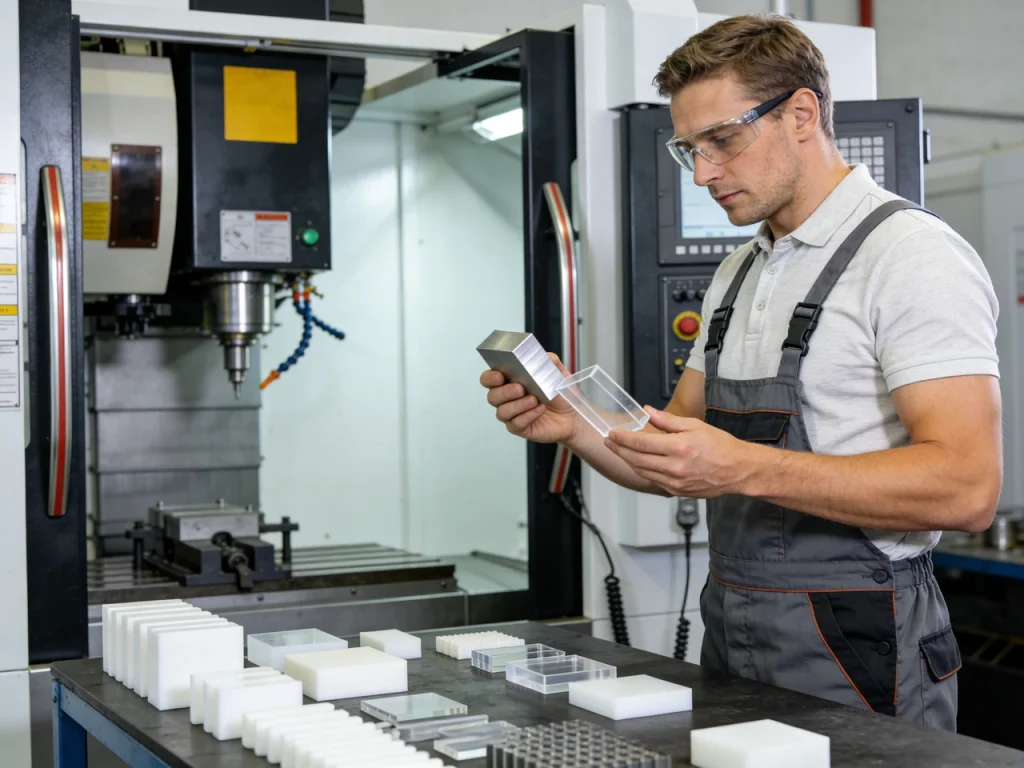
A practical buyer question is “What materials can be CNC machined?” In short, a wide range of metals and thermoplastics can be machined, but feasibility changes with stiffness, heat sensitivity, and how the material behaves under cutting loads. When material behavior is uncertain, prototyping is often used to confirm stability before scaling.
Surface finish and functional requirements: sealing surfaces, friction, cosmetic needs (finish selection matrix)
Surface finish is not just appearance. It can control sealing, friction, and wear.
Finish selection matrix (conceptual):
| Functional need | What matters | CNC implication |
|---|---|---|
| Sealing surface | Smoothness and controlled flatness | More finishing passes; stable fixturing; inspection focus on sealing face |
| Sliding/friction surface | Consistency and directionality | Toolpath strategy matters; may require controlled finishing method |
| Cosmetic external face | 均一な外観 | Extra handling risk; may require protective fixturing and careful deburr |
| Bonding/coating interface | Surface condition and cleanliness | May require specific surface preparation steps and verification |
If you do not specify where finish matters, many shops will assume the tightest interpretation to reduce risk, which can increase cycle time and inspection.
Tolerance strategy: “tight where needed” to avoid cost creep (tolerance decision checklist; reference: academic/metrology sources)
Tolerances are where CNC machining costs can escalate without an obvious geometry change. “Tight where needed” is a strategy, not a slogan. It means identifying which dimensions control function (fit, alignment, sealing, timing) and leaving the rest to a looser tolerance band.
Tolerance decision checklist:
| 質問 | If “yes,” expect higher cost/risk because… |
|---|---|
| Does the tolerance control a functional interface (bearing, seal, alignment)? | It must be inspected and controlled with priority |
| Is the tolerance applied across multiple setups? | Setup-to-setup datum transfer becomes a risk driver |
| Are you tolerancing many features tightly instead of a few critical ones? | Inspection time rises and scrap risk increases |
| Is the datum scheme unclear or inconsistent? | The shop may choose conservative setups and rework paths |
| Is measurement method defined for the tightest features? | If you cannot measure it reliably, you cannot control it |
The metrology point is often missed: a tolerance is only practical if it can be verified with available measurement methods. For high-consequence parts, you should align tolerance requirements with an inspection plan early, not after the first parts arrive.
What materials can be CNC machined?
A wide range of metal and plastic parts can be CNC machined, including common aluminum alloys, many steels, and engineering thermoplastics such as polycarbonate and PTFE-class materials. Machinability and part stability vary by material, so the same geometry may be low risk in one alloy and high risk in another. If chemical resistance, corrosion resistance, or high strength drives your selection, confirm early how that material affects tool wear, surface finish, and inspection needs.
Quality, Inspection & Real-Time Defect Prevention
For technical buyers, “precision” claims are not useful without proof. The most practical question is how defects are prevented, detected, and documented. The 2026 inputs emphasize in-process quality control using 3D laser scanning and AI vision, along with predictive maintenance to reduce downtime and support OEE.
In-process QC: 3D laser scanning + AI vision to catch defects in real time (inspection loop diagram; reference: research/technical reports)
In-process QC means checking part features during machining, not only at the end. This can reduce rework because a defect can be caught before the part is fully machined.
The 2026 sources provided describe in-process quality control using 3D laser scanning and AI vision to catch defects in real time and minimize rework in complex part production.
During machining, in-process measurements are performed using scanning, vision systems, or probing. These measurements are used to detect any drift or emerging defect trends. Based on the control plan, offsets are adjusted or the process is stopped if necessary. Machining then continues, followed by a final inspection to verify critical features and datum references, ensuring the part meets all specifications.
Engineering caution: “real-time inspection” does not remove the need for a clear acceptance definition. AI vision is only as good as the defect definition, lighting/visibility, and calibration. For regulated parts, you still need documented inspection outputs tied to requirements.
Predictive maintenance: reducing downtime through AI monitoring (OEE-focused KPI chart; reference: industry reports)
Predictive maintenance uses sensor data and analysis to estimate when a tool or machine component is likely to cause defects or downtime. The 2026 inputs link AI and IoT integration to improved OEE by detecting tool wear and enabling auto-adjustments or planned intervention.
Because the provided inputs do not give verified OEE percentage improvements, the most honest way to treat this is directional: predictive maintenance aims to reduce unplanned downtime and reduce quality losses caused by worn tools or unstable machines.
KPI chart (conceptual, no new numbers):
| OEE loss category | What predictive monitoring targets |
|---|---|
| Availability losses | Unplanned stops due to tool failure or machine faults |
| Performance losses | Slowdowns from conservative feeds after issues |
| Quality losses | Scrap/rework from drift, wear, or instability |
For feasibility, the relevance is highest on long-running jobs, hard-to-machine materials, or parts where tool wear directly changes size or surface function.
Documentation & traceability: building a closed-loop from design to inspection (digital thread map)
Traceability is not only for compliance. It is how you avoid repeating mistakes after a revision, material change, or supplier change.
The digital thread begins with the CAD definition of the part. This is followed by CAM programming, including setup assumptions. During machining, machine execution data such as process signals are collected where available. In-process checks are performed using probing, scanning, or vision systems. After machining, a final inspection report is generated, linking measurements to specific datums and features. Finally, this information is fed back into design and process planning to support continuous improvement and traceability.
If you are evaluating an online CNC machining service or a local cnc machining shop, this is a useful question set: Can they tie inspection results to your revision and datums? Can they explain how a change request flows into updated programming and updated inspection criteria?
Certifications & compliance needs by industry (ISO/AS/medical) (requirements checklist; reference: official standards bodies)
Certification needs depend on where the part goes and what risk it carries. The inputs mention ISO/AS/medical as common categories. Since the provided material does not list specific clauses or requirements, treat this as a scoping tool, not a compliance guide.
Requirements checklist (high level):
| Industry context | What you usually need to confirm |
|---|---|
| Aerospace supply chain | Quality system expectations, documented inspection, traceability |
| Medical devices / implants | Traceability, validation discipline, inspection documentation aligned to risk |
| 自動車 | Process consistency, revision control, documentation expectations |
| Electronics / precision assemblies | Cleanliness, cosmetic controls, tight interface control and inspection evidence |
A key buyer move is to ask what documentation is available by default (inspection reports, first article inspection packages where used, material certs where applicable) and what is optional. This helps you compare “precision” claims using evidence rather than promises.
Cost, Lead Time & Scalability: What Drives CNC Pricing
CNC machining costs are usually dominated by a small set of drivers: setup and programming, material, cycle time, and inspection. The best early cost control is not negotiation. It is design choices that reduce setups, reduce cycle time, and avoid unnecessary tolerance and finish burden.
This section avoids adding unsupported price numbers. Instead, it gives a structure for reading quotes and predicting what will change if you revise the design.
Main cost drivers: setup, programming, material, cycle time, inspection (cost breakdown table)
| コストドライバー | What increases it | What often reduces it |
|---|---|---|
| Setup & fixturing | Many setups, hard workholding, unstable datums | Fewer setups, clear datum features, 5-axis where it removes refixturing |
| Programming (CAM) | Complex surfaces, many tool changes, frequent revisions | Stable revisions, good CAD definition, repeatable feature patterns |
| 素材 | Large stock size, expensive alloys, high scrap risk | Near-net stock, stable process that reduces scrap, hybrid where appropriate |
| サイクルタイム | Deep pockets, small tools, hard materials, tight finish requirements | Geometry with better tool access, fewer small features, realistic finish targets |
| 検査 | Many tight tolerances, unclear datums, hard-to-measure features | “Tight where needed,” defined measurement plan, accessible critical features |
This table also answers a common quoting question: “How do I get a CNC machining quote?” You get better quotes when you provide the information that stabilizes these drivers: clear revision-controlled CAD, defined material, defined datums, and a realistic inspection scope.
High-mix/low-volume economics: avoiding tooling costs and scaling pathways (quantity vs cost-per-part graph)
The provided sources emphasize custom CNC for high-mix/low-volume because it avoids dedicated tooling costs. The scaling question is what happens when volume grows: do you keep machining, switch to molding, or introduce hybrid steps?
The cost per part varies with production quantity. For CNC machining, the cost per part is relatively high at very low quantities because setup and programming time dominate. As the number of parts increases, these fixed setup costs are spread across more units, causing the cost per part to drop. In contrast, injection molding has very high costs at low quantities due to the expense of tooling, but the per-part cost becomes very low at higher quantities once the tooling cost is amortized over many parts.
Without introducing numbers, the decision logic is:
- CNC stays attractive when design changes are frequent, part variants are many, or volumes are uncertain.
- Injection molding becomes attractive when the design is stable and quantity is high enough to justify tooling.
- Additive/hybrid fits when geometry is driving constraints, or when waste reduction or internal geometry is essential.
Lead time expectations: what speeds up vs slows down a quote-to-ship cycle (workflow diagram)
A buyer often asks: “What is the lead time for custom parts?” The honest answer is: it depends on information quality and complexity. The 2026 sources suggest prototypes can be delivered in days in many cases, but that is conditional.
The workflow begins when the RFQ (Request for Quotation) is sent. A DFM (Design for Manufacturing) and feasibility review is conducted, followed by returning a quote with documented assumptions. Once the order is placed, revisions are locked or managed through a controlled revision process. Programming and setup planning are then performed, leading into machining operations. After machining, inspection is carried out and all documentation is completed. Finally, the finished part is shipped to the customer.
What commonly speeds this up:
- clean CAD file with clear revision ID (yes, you can CNC machine from a 3D file; CAD is the normal starting point)
- defined material and finish requirements
- tolerances limited to functional needs
- a clear datum scheme or a drawing that identifies what matters
What commonly slows it down:
- unclear tolerances and datums (shop must ask questions or assume conservatively)
- complex multi-setup parts without an agreed inspection plan
- frequent revision churn without controlled change handling
カスタムCNC加工の費用は?
Cost depends mainly on setup/programming effort, material, cycle time, and inspection requirements. High-mix, low-volume work often pays more per part because setup and inspection are spread across fewer pieces, even though there is no tooling cost like molding. If you want a meaningful estimate, provide a revision-controlled CAD file, material choice, and “tight where needed” tolerances so the shop does not have to guess.
Choosing a Custom CNC Machining Partner (Avoiding Common Pitfalls)
Many buyers say the hardest part is not selecting CNC as a process. It is selecting a supplier who can actually meet the technical need with predictable execution. One of the user pain points in the provided inputs is that “finding the right partner feels overwhelming” because many suppliers claim precision but few show advanced capabilities.
A good evaluation process is evidence-based: match capability to your part’s risks, then request proof tied to those risks.
Capability checklist: AI-enabled inspection, 5-axis capacity, hybrid options, remote monitoring (vendor scorecard)
Vendor scorecard (use as a comparison tool):
| 能力エリア | 何を聞くべきか | なぜそれが重要なのか |
|---|---|---|
| 3-axis / 5-axis capacity | What axis capability will be used for your geometry | Directly affects setup count and tolerance risk |
| Mill-turn (lathe + mill) | Can they handle cylindrical features with live tooling | Reduces transfers and preserves concentric relationships |
| Hybrid options | Can they combine additive near-net with CNC finishing | Enables internal geometry; can reduce waste (reported 30% in sources) |
| AI-enabled inspection | Do they use AI vision / scanning in-process where relevant | Can reduce late defect discovery (per 2025 sources) |
| IoT / remote monitoring | Do they monitor tool wear and process drift | Helps control wear-driven defects; supports OEE focus |
| Digital thread discipline | How do they manage CAD revisions and inspection linkage | Reduces revision confusion and improves traceability |
This also helps answer “How to find a custom CNC shop?” Start by filtering for the process you actually need (milling vs turning vs mill-turn vs 5-axis), then filter for the controls that reduce your specific risk (inspection capability, revision control, documentation).
“Precision” claims vs proof: what to request (FAI/inspection reports, example tolerances, process controls) (request checklist; reference: industry quality frameworks)
Do not accept “we hold tight tolerances” as meaningful without proof. Ask for evidence that matches your part’s critical risks.
Request checklist (evidence-based):
| Proof item | What it tells you |
|---|---|
| Example inspection reports tied to datums | Whether results are traceable and measurable |
| First article inspection (FAI) style package where used | Whether the shop can document feature-by-feature conformance |
| Process control description (high level) | Whether offsets, wear, and revision changes are managed consistently |
| Measurement method for hardest features | Whether the tightest requirements can be verified |
The goal is not to burden the supplier. It is to confirm that measurement capability matches the tolerance strategy. If a feature cannot be measured reliably, it cannot be controlled reliably.
Communication & risk control: DFM feedback loops, revision handling, and scheduling responsiveness (decision framework)
A capable shop can still fail a project if communication is weak. For custom machined parts, the failure mode is often silent assumption:
- The shop assumes a datum that the designer did not intend.
- The buyer assumes a finish applies only to one face, but it was interpreted as all faces.
- A revision is sent, but the old CAM program is still in the queue.
Decision framework (simple test questions):
- Do they provide DFM feedback that references your actual geometry and datums, not generic advice?
- Do they have a clear revision handling method (what triggers re-quote, what triggers program update, what triggers inspection plan update)?
- Can they explain how scheduling reacts to changes? (This ties to the 2026 digital thread trend claiming up to 50% faster scheduling response in some implementations.)
These questions matter even for an online CNC machining service where quoting is fast. Speed without revision control is a common cause of wrong parts.
Case Studies: Customized medical implants (AI-embedded CNC) + automotive lightweight components (hybrid 5-axis) (results snapshot boxes)
Results snapshot box: Customized medical implants (from provided sources)
- Context: Need for patient-specific fit and complex structures in medical devices.
- Approach described: AI-embedded CNC systems aimed at end-to-end autonomous machining from CAD.
- Reported outcome: Precise, patient-specific implants with high repeatability and reduced dependence on expert intervention.
- Why it matters for feasibility: For personalized parts, the bottleneck is often programming and repeatability across one-off designs. AI-assisted programming and a controlled digital thread can reduce variation, but the inspection plan still needs to be tied to the patient-specific CAD revision.
Results snapshot box: Automotive lightweight components (from provided sources)
- Context: Lightweighting pressure in automotive applications.
- Approach described: Hybrid additive + subtractive processes on 5-axis machines to reduce setups and errors.
- Reported outcome: Shorter lead times (reported qualitatively), fewer setups, and fewer setup-driven errors.
- Why it matters for feasibility: Lightweight designs often introduce thin walls and complex features. Reducing setups can reduce distortion and datum transfer error, but inspection focus must shift to the features that drive assembly function.
Ending: Decision logic you can reuse
Custom CNC machining is a good fit when you need production-grade materials, controlled geometry, and measurable requirements without investing in dedicated tooling. The approach becomes higher risk when the design forces many setups, uses thin features that deflect, or applies tight tolerances broadly without a clear datum strategy and inspection plan.
In 2026, AI, IoT monitoring, and digital thread tools can reduce routine work and help catch drift earlier. They do not remove the need to define what matters: functional tolerances, datum relationships, surface requirements, and how those will be measured. If you can state those clearly, CNC feasibility and quoting become much more predictable.
よくあるご質問
Finding the right custom CNC shop isn’t just about picking someone who says they can cut metal or plastic. You want a partner who understands your design, tolerances, and materials, and can turn solid plastic and metal blocks into final parts with precision machining. Look for shops with a variety of CNC capabilities, from 3-axis milling to 5-axis indexed milling processes, including live tooling that combines both lathe and mill functions for cylindrical features from metal rod stock. Checking if they can handle your specific CNC machining applications, surface requirements, and high-impact parts ensures your part comes out right the first time.
Lead time for custom CNC parts really depends on complexity, material, and the processes involved. Simple prismatic parts might be done quickly, while parts that require features from metal rod stock or tight tolerances on a CNC machining surface could take longer. Shops with online quote tools or instant quote options can help you plan faster. Factors like queue time, programming, and inspection scope affect delivery, especially if your design demands high tensile strength or uses a range of CNC machining materials. Clear CAD files and defined datums speed up production, while frequent revisions or unclear tolerances usually cause delays.
To get a quote, start with a clean CAD file showing your design, material choices, and any special requirements for surface finish or mechanical properties. Many shops offer online quote tools or instant quote options, letting you request a quote quickly. Be clear about functional features, tolerances, and high-impact areas that require precise machining. If you need documentation for inspection or regulatory compliance, mention it early. Providing information on whether your part requires 3-axis milling or more advanced 5-axis indexed milling helps the shop assess time and capabilities, ensuring accurate pricing and avoiding surprises during production.
Yes, CNC machining commonly starts from a CAD model, which is basically a 3D file driving the entire CNC technology workflow. This digital design helps the shop plan toolpaths, choose the right mill capabilities to machine parts, and select proper CNC machining materials. Solid plastic and metal blocks can be cut into precise parts with cylindrical features or complex surfaces. While 3D files are sufficient for basic shapes, adding details on tolerances, datum references, and surface finish ensures precision machining. With the right information, CNC shops can transform your design into real-world parts for a wide range of applications that require high impact strength or tight geometries.
Custom CNC machining is widely used across aerospace, automotive, medical, electronics, and industrial equipment sectors. These industries need parts with high tensile strength, tight tolerances, and precise CNC machining surfaces. From prototypes to production, shops can cut solid plastic and metal blocks into final parts for applications that require both 3-axis milling and 5-axis indexed milling, or turning with live tooling combines features from metal rod stock. The versatility of CNC machining means it’s suitable for low-volume, high-mix runs, or parts with high impact strength. Essentially, custom CNC machining services cover a wide range of materials and applications where precision and reliability are critical.

 Japanese
  English
  German
  French
  Italian
  Spanish
  Polish
  Czech
Czech