
Choosing between waterjet cutting and CNC milling is critical for metal fabrication, alongside laser and plasma precision cutting options. This guide breaks down their working principles, edge quality: waterjet vs cnc, heat affected zone (haz) comparison, material choice and heat effects, covering the stream of water, laser beam, material versatility and avoiding heat to help you pick ideal accurate cuts for different materials and thicknesses, following standard guidelines from The Fabricators & Manufacturers Association, International (FMA) for metal fabrication process evaluation.
Waterjet Cutting vs CNC: edge quality: waterjet vs cnc, heat affected zone (haz) comparison & Precision Cutting Options
Waterjet cutting vs CNC frézování is not a simple question of which process is “better.” The better choice depends on the part geometry, material, thickness, tolerance, edge condition, and the work that comes after cutting.
Waterjet cutting is mainly a profiling process. It uses a high-pressure water stream, often mixed with abrasive, to cut through material along a programmed path. It is strong for flat parts, thick plate, brittle materials, composites, and heat-sensitive alloys because it does not create a heat-affected zone.
CNC milling is a machining process. It uses rotating cutting tools to remove chips from a workpiece. It can create pockets, steps, holes, slots, 3D surfaces, controlled depths, and precision features. It is often the better choice when the final part needs true machined geometry rather than a cut outline.
The choice matters because each process creates different risks. Waterjet may leave taper in thick sections. Milling may create heat, burrs, tool wear, vibration, and fixturing limits. Laser and plasma may be faster for some sheet or plate work, but heat and edge quality can become concerns.
Laser vs Waterjet vs CNC: Precision Cutting Options & Material Choice Guide
The first decision is geometry.
If the part is mostly a flat profile cut from sheet or plate, waterjet cutting is often feasible. Examples include outer contours, internal cutouts, slots, tabs, brackets, shims, and rough blanks. The waterjet follows a 2D path and cuts through the full thickness.
If the part needs depth-controlled features, CNC milling is usually required. This includes blind pockets, counterbores, tapped holes, stepped surfaces, accurate bearing seats, 3D contours, and features that do not go through the full material thickness.
Many parts use both. A common workflow is to waterjet rough-cut a blank, then CNC mill the final datums, holes, pockets, or precision faces. This can save milling time because the mill does not need to remove all excess stock from a large billet.
Where Waterjet Cutting Fits: Material Versatility and Avoiding Heat Damage
For hybrid workflows, waterjet is commonly used to rough-cut the blank while leaving machining stock on critical edges and holes for later CNC finishing. Datums, hole locations, and functional surfaces should be defined so the rough-cut profile supports repeatable fixturing and finish machining.
This is common when material is expensive, difficult to machine, thick, heat-sensitive, or brittle. Waterjet can cut titanium, Inconel, hardened steel, composites, glass, stone, and mixed or non-metallic materials without melting the edge. That makes it useful when thermal damage affects part quality.
For aerospace-type billet roughing, waterjet can remove large amounts of unwanted material before CNC finishing. The key value is not that waterjet replaces precision machining. It reduces the time a CNC machine spends roughing material that does not need a machined surface.
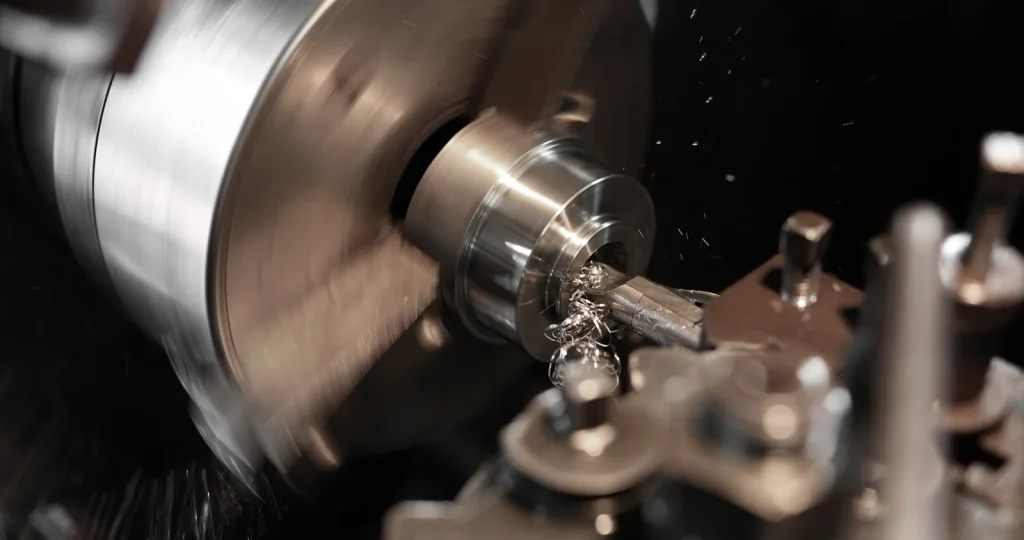
High-Accuracy CNC Milling Components for Intricate Designs & Detailed Work
CNC milling fits when the part needs controlled geometry beyond a through-cut profile. Milling can create flatness, perpendicular faces, pockets, drilled or interpolated holes, slots, chamfers, and 3D shapes. Multi-axis milling can also reach complex surfaces that waterjet cannot produce.
CNC milling is also used as a finishing process after rough cutting. If a waterjet-cut blank has edge taper, a rough surface, or tolerance that is not tight enough for the final design, milling can bring critical surfaces to print.
For high-volume or repeat parts, CNC milling can also be efficient when the setup is stable, tooling is known, and material removal is predictable. Tool wear and fixturing still matter, but the process can be repeatable for machined features that waterjet cannot make.
Table: Primary differences by geometry, material, heat, edge finish, and tolerance
| Faktor | Waterjet cutting | CNC frézování | Decision impact |
|---|---|---|---|
| Geometrie | Best for 2D through-cut profiles | Best for 3D, pockets, holes, controlled depths | Use waterjet for profiles; use milling for machined features |
| Materiály | Strong for heat-sensitive, brittle, hard, composite, and non-metallic materials | Strong for machinable metals, plastics, wood, and precision features | Material behavior often drives the first choice |
| Heat | No heat-affected zone | Generates heat through tool contact and friction | Waterjet is safer where heat changes material properties |
| Edge finish | Often clean, with no dross, slag, or burr | May leave burrs and tool marks | Secondary finishing may be lower with waterjet |
| Tolerance | Waterjet tolerance depends on material, thickness, cut quality, and feature type. Treat profile tolerance, hole size, taper, and perpendicularity as separate requirements, and confirm which features are acceptable as-cut versus finish-machined. | Can match or exceed waterjet for controlled machined features | Tolerance depends on feature type, setup, and finishing |
| Tloušťka | Strong for thick and mixed materials | Limited by tool length, rigidity, chip removal, and access | Thick plate profiles often favor waterjet |
| Rychlost | Slower in many cases, but can be faster for some 2D tough-metal profiles | Fast for many thin or repeated machined features | Geometry and material decide speed |
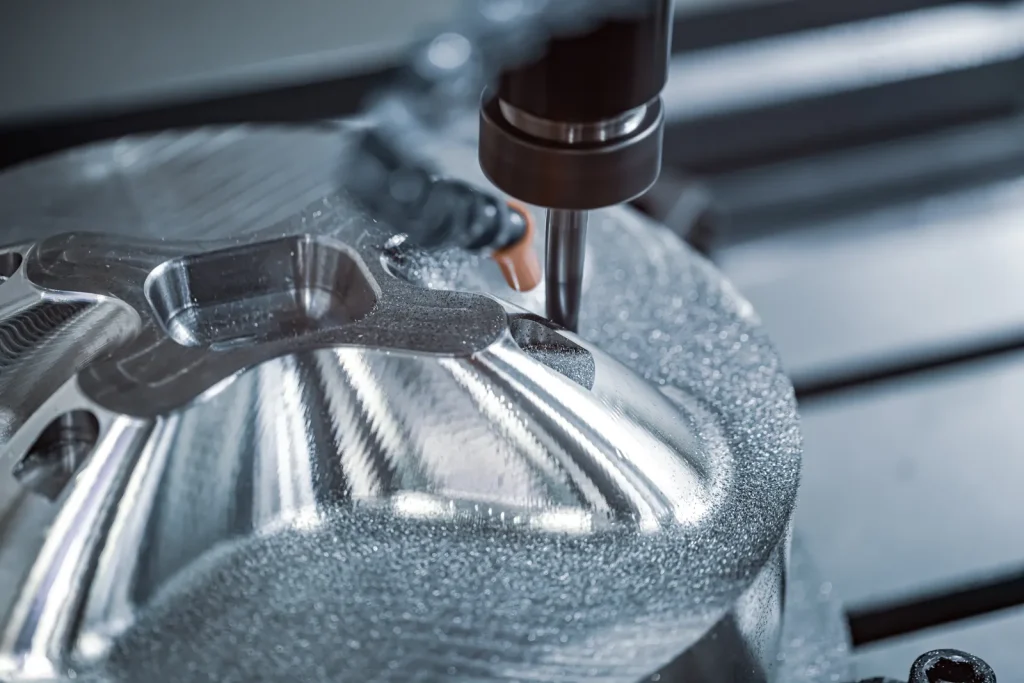
Feasibility: Precision CNC Plasma Cut Parts & Versatile Precision Cutting Options
Feasibility starts with the print. A part that looks simple in top view may still require milling if it has controlled depths, tight perpendicularity, or functional surfaces. A part that looks hard to machine may be easy to waterjet if it is only a through-cut profile.
For buyers, the key is to separate “cut shape” from “finished part.” Waterjet may create the shape. CNC milling may be needed to make the part functional.
Waterjet vs CNC: Edge Quality & cutting thick metal plates Comparison for Different Materials and Thicknesses
For thick plates, the decision is not thickness alone but whether the part is mainly a through-cut profile or a machined feature set. As thickness increases, taper, hole quality, narrow webs, and workholding after cut-through become more critical, so small holes and functional edges often still need finish machining even when the outer profile is waterjet cut.
Waterjet does not care about chip formation. It cuts by erosion from the abrasive stream. This makes it practical for thick plate profiles, internal cutouts, and rough blanks. Waterjet can cut thick stainless steel when the geometry is a through-cut and the tolerance and taper are acceptable for the application.
CNC milling is still needed when thick plate parts require milled shoulders, accurate holes, counterbores, gasket faces, bearing surfaces, or other features that are not simple through-cuts.
Material Properties: Waterjet vs CNC Router & CNC Cutting Technology
How material properties influence waterjet cutting versus CNC milling is one of the main reasons there is no single winner.
Waterjet performs well on materials that are hard, heat-sensitive, brittle, abrasive, laminated, or difficult to machine. Titanium, Inconel, hardened steels, composites, glass, and stone are common examples. Since waterjet does not create a heat-affected zone, it avoids many risks tied to melting, burning, or heat-related material change.
CNC milling depends on cutting tool engagement. The material must form chips in a controlled way. Hard or tough alloys can raise tool wear and cycle time. Brittle or layered materials can chip, delaminate, or require special tooling. Plastics and softer metals may machine well, but heat control and burr control still matter.
CNC Mill Limitations for Thick Plate Laser & Waterjet Cutting Profiles
The limitations of CNC milling for complex cut profiles in thick plate are mostly mechanical. A rotating tool has a diameter, a length, and a stiffness limit. Long tools deflect more easily. Small tools cut fine detail but remove material slowly and may break. Internal corners are limited by tool radius unless extra operations are added.
Chip removal is another concern. A deep slot in thick plate can trap chips and heat. This increases the risk of poor surface finish, chatter, tool wear, or tool failure. Fixturing can also become harder because the part must stay rigid while the cutter applies side loads.
Waterjet avoids cutting forces from tool contact, so it can follow complex 2D profiles in thick plate with less fixturing force. But it may introduce edge taper, and it cannot make depth-controlled features.
Checklist: Features Needing CNC Mill Over Waterjet Cutting Services
Use CNC milling, either alone or after waterjet roughing, when the part includes:
- Blind pockets or cavities that do not cut through the part
- Counterbores, countersinks, or precision hole features
- Threaded holes or tapped features
- Controlled-depth slots
- 3D contours or sculpted surfaces
- Tight flatness or perpendicularity requirements on functional faces
- Precision fits for shafts, pins, bearings, or bushings
- Chamfers or radii that must be machined to a specific size
- Edge conditions where waterjet taper is not acceptable
- Features that require toolpath control in the Z-axis
If the part is only a flat profile with through-cut geometry, waterjet may be enough. If it has functional mechanical features, milling is likely part of the process.
How Laser vs Waterjet vs CNC Cutter Processes Actually Work
Waterjet and milling remove material in very different ways. Those physical differences explain most of the tradeoffs in tolerance, speed, edge finish, and risk.
Waterjet uses a narrow stream. Milling uses a rotating tool. Waterjet has no cutting tool in contact with the material. Milling depends on tool contact. Waterjet avoids heat-affected zones. Milling creates friction and heat that must be managed.
Abrasive Waterjet Cutting Principles vs Laser Cutting Technology
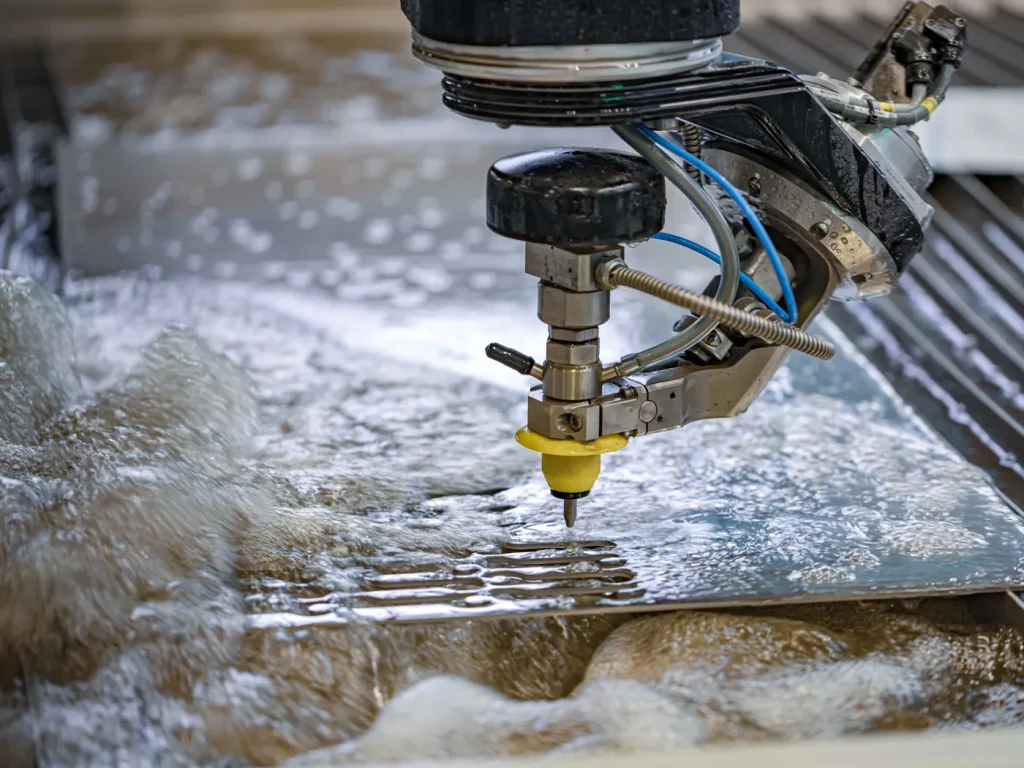
Abrasive waterjet cutting uses high-pressure water mixed with abrasive particles. The abrasive stream erodes the material along the programmed path. The process is cold cutting, so it does not produce a heat-affected zone.
Piercing is a separate feasibility issue from steady-state cutting. Brittle materials, laminates, cosmetic surfaces, and small hole locations may be limited by pierce damage, witness marks, delamination risk, or blowout at breakthrough.
This matters for metals and composites where heat can change material properties, cause distortion, or damage surrounding material. It also matters for brittle materials such as glass and stone, where thermal shock or mechanical force can cause cracking.
Waterjet cutting is still a mechanical erosion process. It has a kerf, which is the width of material removed by the stream. It can also leave taper, especially in thick sections, because the jet loses energy as it passes through the material.
CNC Machine & CNC Cutting Technology Milling Working Principles
CNC milling uses rotating cutters to remove material like chips. The machine controls tool movement through programmed toolpaths. The part must be clamped or fixtured so it does not move while the cutter applies force.
Milling can control depth, stepovers, feeds, speeds, and tool engagement. That is why it can create precise 3D and depth-controlled features. But the same tool contact creates heat, burrs, tool wear, and cutting forces.
The process depends on the relationship between tool size, material, toolpath, workholding, and machine rigidity. If one of these is weak, the part may chatter, deflect, or miss tolerance.
Kerf Width Factors in Waterjet Cutting vs Laser Cutting
Minimum feature feasibility should be checked against kerf, thickness, and required tolerance together, not by kerf alone. Small holes, narrow slots, and thin bridges become less reliable as thickness increases, especially when pierce location, taper, and remnant stability affect edge quality.
Kerf matters for internal features. Small slots, narrow bridges, and tight internal corners must be checked against the waterjet kerf. If the kerf is too wide for the feature, milling, laser, EDM, or a design change may be needed.
Waterjet kerf is often slightly wider than laser kerf, but it avoids heat damage. Compared with milling, waterjet can create fine internal profiles without tool side load, but it does not create a milled surface.
Process diagram: waterjet stream vs milling cutter engagement
| Krok | Abrasive waterjet cutting | CNC frézování |
|---|---|---|
| 1 | High-pressure water mixed with abrasive | Rotating cutter engages the workpiece |
| 2 | Focused into a narrow jet | Side and end engagement by cutting edges |
| 3 | Material removed through full thickness | Chips ejected as cutting edges shear material |
| 4 | No tool contact with the workpiece | Heat, force, and tool wear must be controlled |
| 5 | No heat-affected zone | - |
The diagram shows the core difference. Waterjet cuts by stream erosion. Milling cuts by tool engagement. That difference controls most practical manufacturing decisions.
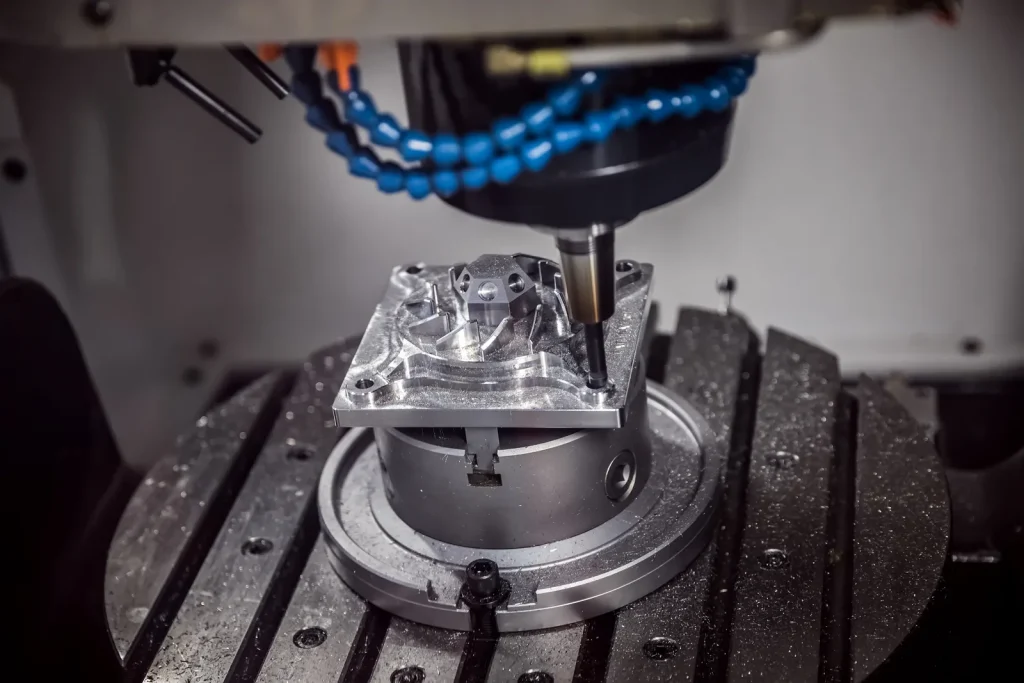
Waterjet vs Laser vs CNC: Fabrication Advantages & Limitations
The right process depends on what the material allows and what the geometry demands. Waterjet is often better for difficult materials and flat profiles. CNC milling is better for controlled machined features.
Laser and plasma also compete in many cutting jobs. They can be fast, but they introduce heat. That can affect accuracy, edge condition, and post-processing needs.
Waterjet Cutting vs Laser Cutting for Heat-Sensitive Fabrication
Waterjet cutting is better than laser cutting for heat-sensitive materials when the part cannot accept melting, burning, thermal distortion, or a heat-affected zone. This includes many composites, titanium parts, hardened metals, glass, stone, and some laminated materials.
The same logic applies when reviewing challenges of cutting brass with laser compared to waterjet, or why laser cutting struggles with reflective metals compared to waterjet. If the material behavior makes laser cutting unstable, reflective, heat-sensitive, or distortion-prone, waterjet becomes a stronger option.
This does not mean a waterjet is always faster. The tradeoffs between cutting speed and precision in waterjet vs laser depend on thickness, material, feature size, and edge requirements. Laser can be efficient for some thin materials, while waterjet is often preferred when thermal damage is the main risk.
CNC Mill vs Waterjet Cutting Accuracy for Internal Edge Corners
The accuracy limitations of CNC milling compared with waterjet for internal corners are tied to cutter geometry. A milling cutter is round, so an inside corner cannot be perfectly sharp. The smallest possible internal corner radius depends on cutter diameter, tool length, rigidity, and cutting conditions.
Waterjet also has a kerf, so it cannot make a zero-radius corner either. But for flat through-cut profiles, the waterjet stream can sometimes produce intricate internal profiles without the same tool deflection and chip evacuation issues that affect deep milling.
For parts with tight internal corners in thick plate, the buyer should check the minimum inside radius, kerf width, taper allowance, and whether the edge is functional. If the corner is used for clearance,a waterjet may work. If the corner is a precision mechanical interface, milling or another finishing step may be needed.
Edge Quality Comparison: Waterjet Cutting vs CNC Mill Fabrication
Edge quality differences between waterjet cutting and CNC milling depend on material, thickness, cut speed, tool condition, and finishing requirements.
Waterjet often produces a clean edge with no dross, slag, or heat-affected zone. It is also less likely to create burrs than milling or plasma. For many profiles, this reduces secondary finishing.
CNC milling can produce accurate and functional surfaces, but burrs may form at exits, thin edges, slots, and cross holes. Tool marks may also be visible. Deburring or finishing may be needed before assembly.
The practical question is whether the edge is cosmetic, clearance-only, or functional. A waterjet edge may be acceptable for a bracket outline. A machined edge may be needed for a sealing surface, precision fit, or sliding contact.
Decision matrix: titanium, Inconel, hardened steel, composites, glass, stone, aluminum, plastics
| Materiál | Waterjet cutting | CNC frézování | Typical decision logic |
|---|---|---|---|
| Titan | Strong for rough blanks and heat-sensitive profiles | Needed for final precision features | Waterjet roughing can reduce milling time |
| Inconel | Strong for profiling difficult material | Tool wear and time can be high | Use waterjet for 2D cuts; mill critical features |
| Kalená ocel | Good for through-cut profiles without heat | Milling may be difficult depending on hardness | Waterjet can avoid thermal and tool-wear issues |
| Kompozity | Good because it avoids melting and thermal damage | Can delaminate or require special tooling | Waterjet often preferred for profiles |
| Glass | Good for brittle through-cut work | Milling may be difficult or risky | Waterjet is often more feasible |
| Stone | Good for thick brittle profiles | Milling may struggle with tool wear and cracking | Waterjet is usually stronger |
| Hliník | Good for profiles and rough blanks | Good for machining features | Choose based on geometry and finish |
| Plasty | Good when heat must be avoided | Good if material machines cleanly | Check melting, burrs, and edge finish |
Laser Plasma CNC Cutting: Fabrication Failure & Quality Risks
Most process failures come from applying a good process to the wrong feature. Waterjet is not a replacement for milling when depth control is required. Milling is not efficient for every thick 2D profile. Laser and plasma are not ideal when heat or tight tolerance is the main concern.
Impact of abrasive waterjet cutting on edge taper in thick sections
The impact of abrasive waterjet cutting on edge taper in thick sections should be reviewed early. As the waterjet stream passes through the material, it loses energy. This can make the cut wider at one side than the other, especially in thick material or at higher cutting speeds.
Edge taper may be acceptable for clearance holes, outer profiles, or rough blanks. It may not be acceptable for precision mating edges, press fits, or parts that must sit square against another component.
If taper is a concern, the drawing should define which surfaces are critical. A common approach is to waterjet rough and then mill the critical edges.
Risks of thermal distortion in laser cutting thick metal
The risks of thermal distortion in laser cutting thick metal come from concentrated heat. The cut zone can expand, contract, harden, oxidize, or warp depending on the metal and geometry. Thin webs, narrow slots, and asymmetric profiles can be more sensitive.
Waterjet avoids this risk because it does not create a heat-affected zone. This is why waterjet is often considered when heat-sensitive materials, thick sections, or precision flatness are part of the decision.
How material thickness changes the choice between laser, plasma, and waterjet is tied to this balance. Speed may favor thermal processes in some cases, but edge condition and distortion risk may favor waterjet.
How heat affected zone impacts plasma cut part accuracy
How heat affected zone impacts plasma cut part accuracy is important when plasma is considered as a lower-cost or faster cutting method. Plasma cutting uses heat to melt material, so the edge can have thermal effects, dross, and distortion.
For parts with loose tolerances, plasma may be acceptable. But when tight tolerances, clean edges, or stable material properties are required, plasma becomes less suitable.
This is why CNC plasma cutting is not suitable for tight tolerances in many precision part workflows. It may still be useful for rough fabrication, but it often needs more finishing than waterjet.
What causes poor edge quality in thick plate plasma cutting?
Poor edge quality in thick plate plasma cutting is usually tied to heat, cut speed, material thickness, and molten metal behavior. Thick plate can produce more dross, rougher edges, and less accurate profiles than waterjet for precision work.
Waterjet avoids dross and slag because it does not melt the metal. The comparison is not only about the first cut. It is also about grinding, cleanup, and whether the edge can go straight into the next process.
For thick plate parts with tight profiles, buyers should compare total work, not only cutting time.
CNC & Waterjet Cutting Services: Cost, Tolerance & Speed Comparison
Cost depends on part geometry, material form, utilization, and secondary operations, not just machine rate. Waterjet is often favorable for nested plate parts and difficult materials when profile edges are acceptable as-cut, while milling becomes more economical when datums, flatness, hole quality, or 3D features require controlled machining.
Waterjet tolerance ranges: reported ±0.009 in. and high-precision claims near ±0.001 in.
Reported waterjet tolerance is around ±0.009 in., with some high-precision claims near ±0.001 in. These figures should be treated as process capability claims, not universal guarantees.
Actual tolerance depends on material, thickness, cut speed, kerf control, taper, machine condition, and feature geometry. Thick sections, small internal details, and high-speed cuts are more likely to show variation.
Waterjet can approach CNC-level tolerance for some profile features, but CNC milling is still stronger when the tolerance applies to depth, flatness, hole size, perpendicularity, or multi-step features.
CNC milling tolerance considerations for multi-step machining and depth-controlled features
CNC milling tolerance depends on machine condition, tool wear, fixturing, material stability, tool length, heat, and number of setups. Multi-step machining can stack errors if the part is moved or re-fixtured between operations.
Milling is the better process when the part requires controlled depths, machined datums, precise holes, or mating surfaces. It can match or exceed waterjet for these features because the toolpath controls 3D geometry.
The buyer should separate profile tolerance from feature tolerance. A waterjet may hold the outside shape well enough, while a mill may still be needed for holes or pockets.
Is waterjet cutting faster than CNC milling?
Waterjet cutting is often slower than CNC milling for thin materials, simple machining operations, or high-volume repeat work. But this is not always true for 2D profiles in tough or thick metals.
Waterjet cutting is often slower than CNC milling for thin materials, simple machining operations, or high-volume repeat work. But this is not always true for 2D profiles in tough or thick metals.
So the speed comparison depends on geometry. For 3D machining, CNC milling is required. For flat, intricate profiles in thick or difficult metals,a waterjet can reduce total cutting time.
So the speed comparison depends on geometry. For 3D machining, CNC milling is required. For flat, intricate profiles in thick or difficult metals, waterjet can reduce total cutting time.
Table: Operating cost drivers—abrasive use, tool wear, setup, fixturing, finishing, and machine time
| Hnací síla nákladů | Waterjet cutting | CNC frézování | Co zkontrolovat |
|---|---|---|---|
| Abrasive use | Major operating cost | Not applicable | Long cuts and thick material increase abrasive use |
| Opotřebení nástrojů | No cutting tool wear on the part | Major cost in hard materials | Hard alloys and long cycles raise tooling cost |
| Nastavení | Often simpler for flat plate | Can be complex for multi-face parts | Check number of setups and datums |
| Upevnění | Lower cutting forces | Higher cutting forces | Thin or flexible parts may need special support |
| Dokončovací práce | Often low due to no burr/dross | Deburring may be needed | Edge function decides finishing need |
| Čas stroje | Can be slow on long cuts | Can be slow on thick slots or hard material | Compare cycle time by actual geometry |
| Použití materiálu | Good for nesting flat profiles | Billet machining may waste more stock | Check blank size and roughing strategy |
Waterjet machines can also have high ownership and maintenance costs, with reported initial cost around $195,000 in the supplied research. That number is useful only as context for why abrasive use, maintenance, and utilization affect pricing.
Edge Finish: Waterjet, Laser & Plasma CNC Cutting Comparison
Edge finish is often where the lowest quoted cutting process becomes more expensive. Grinding, deburring, sanding, straightening, and machining can add time. For precision buyers, the right question is not only how the part is cut, but what condition the edge is in after cutting.
Why burr formation is more common in plasma cutting than waterjet
Why burr formation is more common in plasma cutting than waterjet comes down to heat and molten metal. Plasma melts the material. As molten metal exits the cut, it can solidify on the edge as dross or rough buildup.
Waterjet does not melt the material. It erodes the cut path with water and abrasive, so it avoids slag and dross. This is one reason waterjet is often selected when secondary cleanup must be reduced.
CNC milling can also leave burrs because the cutting tool pushes and shears material. Burrs are common at edges, slot exits, and hole intersections.
Additional finishing required after plasma cutting compared with waterjet
Additional finishing required after plasma cutting compared with waterjet may include dross removal, grinding, edge cleanup, and correction of heat-affected edges. The exact work depends on material thickness, edge quality, and tolerance.
Waterjet parts often need less cleanup because there is no heat-affected zone, no slag, and less burr formation. But waterjet is not always finish-ready. Thick sections may need taper correction, and functional edges may still need milling.
For buying decisions, finishing should be included in total cost. A faster cut is not always cheaper if cleanup time is high.
Comparison of surface finish after waterjet cutting vs plasma cutting
A comparison of surface finish after waterjet cutting vs plasma cutting usually favors waterjet when clean, cool-cut edges are required. Plasma can leave rougher, heat-affected edges because it relies on melting.
Waterjet can leave a striated edge pattern, especially in thicker material or at faster cutting speeds. This may be acceptable for structural profiles but not for sealing or sliding surfaces.
The correct specification should state edge requirements clearly. If surface finish is critical, do not assume a profile cutting method will meet a machined-finish requirement.
Cutting Speed & Precision: Waterjet vs Laser vs CNC Machine
The tradeoffs between cutting speed and precision in waterjet vs laser depend on material and thickness. Laser cutting can be fast and precise for suitable materials, but it introduces heat. Waterjet is slower in many cases but avoids thermal damage.
Waterjet tolerance claims near ±0.001 in. and laser precision around ±0.002 in. appear in the supplied research, but real results depend on material, thickness, and setup. Waterjet kerf can be slightly wider than laser kerf, so very small features need review.
For heat-sensitive materials, the absence of a heat-affected zone may be more important than raw cutting speed.
Laser vs Waterjet vs CNC Cutting Services Best Fabrication Uses
Waterjet and CNC milling often work best as complementary processes. Waterjet removes shape quickly from difficult stock. Milling adds precision geometry. The right workflow depends on which features the control part function.
Aerospace billet rough-cutting before CNC finishing
Aerospace billet rough-cutting before CNC finishing is a common use case for waterjet. Large billets of aluminum, steel, or titanium can be rough-cut close to the required outline, then moved to CNC machining for final surfaces and precision features.
This reduces the time the mill spends removing large amounts of non-functional material. It also avoids a heat-affected zone, which is important for regulated or heat-sensitive parts.
The decision point is stock removal. If the billet contains large areas that will be removed anyway, waterjet roughing may make the full process more efficient.
Composite and exotic material cutting without melting or thermal damage
Composite and exotic material cutting without melting or thermal damage is one of waterjet’s strongest areas. Composites, laminates, granite, and difficult alloys such as Hastalloy-type materials can be damaged by heat or hard to machine with conventional tools.
Waterjet can cut these materials without melting the edge. This can reduce the risk of delamination, burning, slag, or thermal change.
CNC milling may still be needed for drilled holes, countersinks, or tight mechanical interfaces. But for flat profiles, waterjet often offers a cleaner starting point.
2D steel profiling: outer contours, slots, and internal profiles
For 2D steel profiling, waterjet can be practical for outer contours, slots, and internal profiles. This is especially true when the part is cut from thick steel or stainless steel and does not need machined pockets.
User reports from machining forums describe waterjet cutting some 2D steel parts far faster than older milling approaches, even when the waterjet hourly rate was higher. These are not universal benchmarks, but they show why simple hourly-rate comparisons can be misleading.
For simple 2D shapes,a waterjet can be cheaper when it avoids hours of milling, tool wear, and deburring. The actual result depends on cut length, thickness, tolerance, and finishing.
Thick, brittle, mixed, or non-metallic materials where milling may struggle
Waterjet is often used for thick, brittle, mixed, or non-metallic materials where milling may struggle. Examples include glass, stone, rubber, composites, and layered materials.
Milling these materials can create cracking, tearing, melting, tool wear, or poor edge quality. Waterjet avoids tool contact and heat, which can make it more feasible.
The main checks are kerf width, edge taper, part support, and whether the cut edge is strong enough for the final use.
Decision Guide: Pick Waterjet, CNC Mill, Laser or Plasma Cutter
The best decision starts with the print, not the machine. Check whether the part is a profile, a machined component, or a profile that needs later machining. Then check material behavior, thickness, tolerance, edge finish, heat sensitivity, volume, and finishing requirements.
When should you choose waterjet cutting over CNC milling?
Choose waterjet cutting over CNC milling when the part is mainly a 2D through-cut profile and the material is thick, hard, brittle, heat-sensitive, or difficult to machine. It is also a strong choice when you need to avoid heat-affected zones, slag, dross, or burr-heavy edges.
Waterjet is often suitable for titanium, Inconel, hardened steel, composites, glass, stone, stainless steel, and mixed materials. It can also be a good roughing step before CNC finishes.
Avoid relying on waterjet alone when the part needs controlled-depth features, tight perpendicularity, precision holes, or machined surfaces.
When is CNC milling the better manufacturing choice?
CNC milling is the better manufacturing choice when the part needs 3D geometry, controlled depths, accurate holes, pockets, steps, threads, or functional surfaces. It is also better when the print requires machined datums or tolerance control across multiple faces.
Milling may also be more economical for repeated parts when the material machines work well and the process is stable. For thin parts, simple features, or high-volume machining, milling can be faster than waterjet.
Avoid using milling as a default for complex thick plate profiles without checking cycle time, tool wear, and fixturing. Waterjets may be more practical for rough cutting those shapes.
Decision factors for choosing a cutting method for intricate metal parts
Decision factors for choosing a cutting method for intricate metal parts include internal corner size, minimum slot width, material thickness, edge function, tolerance, heat sensitivity, and post-processing.
For intricate through profiles in thick metal, waterjet can reduce tool access problems. For intricate 3D geometry, milling is required. For very fine thermal-cut sheet work, laser may be considered if heat is acceptable. Plasma may fit rough work but is less suited for tight tolerances and clean edges.
The key point is to match the process to the controlling feature. If the controlling feature is the outer profile, waterjet may work. If the controlling feature is a machined pocket or precision hole, CNC milling is needed.
Buyer checklist: material, thickness, tolerance, edge finish, heat sensitivity, geometry, volume, and finishing requirements
Before selecting waterjet cutting vs CNC milling, review these items:
- Material: Is it hard, brittle, composite, heat-sensitive, or difficult to machine?
- Thickness: Is it thick plate where milling would require deep slots or long tools?
- Geometry: Is it only a 2D through-cut, or does it need 3D machining?
- Tolerance: Is the tolerance on the profile, hole size, depth, flatness, or perpendicularity?
- Edge finish: Is edge cosmetic, structural, clearance-only, or functional?
- Heat sensitivity: Can the part accept a heat-affected zone from laser or plasma?
- Internal features: Are internal corners, slots, and cutouts feasible with kerf or cutter radius?
- Volume: Is this prototype, low volume, or repeated production?
- Finishing: Will the part need deburring, grinding, taper correction, or milling after cutting?
- Lead time: Does the chosen process reduce total work, or only the first operation?
The RFQ should state material grade, thickness, drawing revision, cut file format, critical datums, and which edges or holes are functional. It should also identify whether taper is acceptable, whether as-cut edges are allowed, and which features will be finish-machined or inspected after cutting.
In short, waterjet is often the stronger choice for flat profiles in difficult, thick, brittle, or heat-sensitive material. CNC milling is stronger for precision 3D machining and controlled mechanical features. Many engineered parts use both.
Nejčastější dotazy
Can Waterjet Cutting Achieve CNC Machine Tolerances?
Waterjet tolerance sits around ±0.009 in., with high-end precision reaching nearly ±0.001 in.It can hold decent accuracy for basic flat profile outlines on most metal and composite materials.But CNC milling performs far better on structured machined features like holes and deep pockets.Milling easily outperforms waterjet on depth control, flatness and precise datum positioning.You can’t compare the two broadly—only check tolerance requirements per individual part feature.Profile tolerance works for waterjet, while critical functional tolerances always lean to CNC milling.
Does Waterjet Leave a Better Edge Than CNC Mill Cutting?
Waterjet naturally delivers smooth, clean edges with no dross, slag or heat-affected zones at all.It rarely creates sharp burrs, which cuts down extra grinding and secondary finishing work a lot.CNC milling can leave visible tool marks and small burrs along edges and slot exit points easily.Milling though can craft perfectly flat, sealed functional surfaces that waterjet simply can’t make.Cosmetic or clearance edges are fine with just waterjet as-cut results for most fabrication jobs.Precision mating and sealing edges will always need follow-up CNC milling for perfect fitment.
Is Waterjet Cutting Faster Than CNC Cutting Mill Process?
Waterjet usually runs slower than CNC milling when working with thin sheets and simple small parts.It struggles more on basic repetitive machining tasks that milling can crank out quickly in bulk.Yet it pulls ahead significantly on complex 2D outlines for thick, tough alloy metal plates.Milling has to slowly remove material chip by chip along every inch of the full cutting path.Waterjet slices straight through thick stock with a narrow abrasive stream without extra material removal.Overall speed always comes down to part geometry, material type, plate thickness and cut length.
Can Waterjet Cutter Cut Thick Stainless Steel in Fabrication?
Waterjet works perfectly well for thick stainless steel parts that only need simple through-cut profiles.It handles large outer contours and internal cutouts smoothly without causing thermal damage to metal.You just need to make sure kerf width, edge taper and basic tolerance limits fit your project needs.Any small precision holes, threaded features or deep pockets can’t rely on waterjet alone to finish.These detailed mechanical features will always require follow-up CNC milling for accurate dimensions.Always mark critical functional features clearly on drawings to plan waterjet roughing and milling steps.
Is Waterjet Cutting Cheaper for Simple Fabrication 2D Shapes?
Waterjet is super cost-effective for plain or detailed 2D outlines across all kinds of metal plate stock.It saves plenty of cost by skipping long milling cycles, heavy tool wear and tedious deburring work.Costs start rising fast though with long cut paths, thick materials and strict tight tolerance demands.High abrasive consumption and extended machine runtime can narrow the price gap with CNC milling.To calculate real cost, you have to include setup, cutting, finishing and any later machining processes.It’s most economical when you only need clean profile cuts without extra precision machined features.

 Czech
Czech  English
  German
  French
  Italian
  Spanish
  Polish
  Japanese