
Precision turned parts play a critical role in industries where dimensional accuracy, repeatability, and assembly fit cannot be compromised. This guide provides engineers and buyers with a comprehensive overview of these components, from defining key characteristics to understanding applications, processes, materials, and quality considerations. By framing the discussion up front, readers can navigate the technical details with context on why precision matters and how it impacts design and sourcing decisions.
What Precision Turned Parts Are And Why They Matter
Precision turned parts are highly dimensionally controlled cylindrical components used in critical industries such as aerospace, medical devices, and automotive. Understanding their purpose and key characteristics helps engineers and buyers make informed design and sourcing decisions.
Definition And Key Characteristics
Precision turned parts are cylindrical or rotational metal components made on CNC lathes (and related turning machines) where the key requirement is dimensional accuracy and repeatability. “Precision” usually means the part has tight tolerances on diameter, concentricity, runout, threads, or sealing surfaces, and that those requirements hold across a production lot. In higher-end use cases, the functional requirement can push into micron-level behavior, even when the drawing tolerance is written in inches or millimeters.
A useful way to think about it is that they are “assembly-critical” turning parts. The part is not just round; it must assemble cleanly, seal, spin, locate, or align with another component without forcing, leakage, or unpredictable wear. That is why buyers tend to see precision turned parts clustered in aerospace, medical devices, automotive (including EV), and electronics—industries where a small dimensional shift can change performance, safety, or yield.
Key characteristics that tend to separate CNC precision turned parts from general machined parts:
- Tight tolerance control on diameters and coaxial features (because turning naturally makes cylindrical geometry).
- Stable surface quality on functional surfaces like bearing fits, sealing lands, or thread flanks.
- Repeatability at volume, where the process is tuned, so parts stay within spec across many cycles.
- Documented quality assurance, because many applications need traceability, inspection records, or a defined quality system.
A common misunderstanding is equating “tight tolerances” with “high difficulty” in every case. Some very tight tolerances are feasible on simple geometries, while looser tolerances on complex, thin-walled shapes can be harder because the workpiece deflects or changes with heat and tool pressure. Feasibility depends on the full stack: geometry, material, machine strategy, inspection method, and lot size.
What Are Precision Turned Parts Used For In Manufacturing?
Precision turned parts are used where a cylindrical component must fit, seal, locate, or rotate in an assembly with controlled clearance. Common examples include shafts, bushings, fittings, threaded turned parts, sleeves, pins, valve components, and small housings. They show up in both prototypes and high volumes because turning is efficient for round parts and can hold repeatable dimensions when the process is stable.
Precision Turned Parts Versus Standard Turned Components
The main difference is not the machine type alone. It is the expectation around tolerance, documentation, and how much process control is needed to meet the drawing.
| Atribut | Přesné soustružené díly | Standard turned components |
|---|---|---|
| Typical tolerance expectation | Tight tolerances; often quoted benchmark capability includes ±0.005 in for many suppliers (part-dependent) [industry reports] | Wider tolerances; may rely on general tolerancing |
| Geometry & complexity | Threads, grooves, sealing surfaces, coaxial bores, controlled runout; may combine turning + cross holes | Mostly basic diameters, facing, simple bores |
| Inspection intensity | More frequent in-process checks; CMM and documented measurement are common | Sampling and basic measurement can be enough |
| Typická odvětví | Aerospace, medical devices, automotive/EV, electronics [industry/technical reports] | General industrial, commodity hardware, non-critical subassemblies |
| Risk profile | Higher: small deviations can cause leakage, fatigue issues, assembly scrap, or field failures | Lower: more tolerance to variation |
Buyers should read that table as “risk and control,” not as “better vs worse.” Standard turning can be the right choice when the assembly is forgiving and cost pressure is high. Precision machining is the right choice when the cost of a defect is high or when performance depends on geometry.
Where Precision Turned Parts Are Most Common
They are common in:
- Aerospace: fittings, sleeves, spacers, sensor bodies, engine-adjacent cylindrical parts where concentricity and material performance matter.
- Medical devices: bone screws, catheter components, miniaturized connectors, small diameter turning for implantable or surgical assemblies.
- Automotive & EV: shafts, valve bodies, fuel-system-like fittings (application dependent), drivetrain-related cylindrical parts, thermal management components.
- Electronics: micro turned parts under 50 mm, connector shells, pins, small housings, threaded inserts.
Across these, the repeated theme is controlled geometry on cylindrical features plus rigorous quality control because parts must assemble the same way every time.
Market Snapshot & 2026–2031 Trends Shaping Demand
Market size and trend insights highlight growth drivers for precision turned parts, including industry demand, regional differences, and technology adoption. This context is essential for evaluating supply chain strategy and forecasting needs.
Market Sizing And Scope Clarity With 2024–2031 Projections
Industry reports place the global precision turned parts market at USD 3,071 million in 2024, projected to USD 4,609 million by 2031 [industry/technical reports]. That framing focuses on “parts” as a category. Separate reports also describe a much larger “precision turned product manufacturing” market in the USD 115+ billion range in 2025 [industry/technical reports]. Those figures can both be true because the scope differs: one may track a narrower set of precision turned parts, while the other bundles a wider set of products, services, and downstream manufacturing value.
For buyers, the practical takeaway is not the exact boundary between market definitions. The key point is that demand is growing across industries that need tight tolerances, miniaturization, and reliable supply chains.
Market value trajectory (reported):
| Rok | Market Size (USD Million) | Visual Indicator |
|---|---|---|
| 2024 | 3,071 | ■■■■■■■■■■■■■■■ |
| 2031 | 4,609 | ■■■■■■■■■■■■■■■■■■■■ |
Buyers should read that table as “risk and control,” not as “better vs worse.” Standard turning can be the right choice when the assembly is forgiving and cost pressure is high. Precision machining is the right choice when the cost of a defect is high or when performance depends on geometry.
Where Precision Turned Parts Are Most Common
They are common in:
- Aerospace: fittings, sleeves, spacers, sensor bodies, engine-adjacent cylindrical parts where concentricity and material performance matter.
- Medical devices: bone screws, catheter components, miniaturized connectors, small diameter turning for implantable or surgical assemblies.
- Automotive & EV: shafts, valve bodies, fuel-system-like fittings (application dependent), drivetrain-related cylindrical parts, thermal management components.
- Electronics: micro turned parts under 50 mm, connector shells, pins, small housings, threaded inserts.
Across these, the repeated theme is controlled geometry on cylindrical features plus rigorous quality control because parts must assemble the same way every time.
Market Snapshot & 2026–2031 Trends Shaping Demand
Market size and trend insights highlight growth drivers for precision turned parts, including industry demand, regional differences, and technology adoption. This context is essential for evaluating supply chain strategy and forecasting needs.
Market Sizing And Scope Clarity With 2024–2031 Projections
Industry reports place the global precision turned parts market at USD 3,071 million in 2024, projected to USD 4,609 million by 2031 [industry/technical reports]. That framing focuses on “parts” as a category. Separate reports also describe a much larger “precision turned product manufacturing” market in the USD 115+ billion range in 2025 [industry/technical reports]. Those figures can both be true because the scope differs: one may track a narrower set of precision turned parts, while the other bundles a wider set of products, services, and downstream manufacturing value.
For buyers, the practical takeaway is not the exact boundary between market definitions. The key point is that demand is growing across industries that need tight tolerances, miniaturization, and reliable supply chains.
Market value trajectory (reported):
A recurring constraint is labor: process planning, setup skill, and inspection competence still matter even when the machine is advanced. When labor is tight, suppliers may standardize their quoting and inspection approaches, so buyers should be explicit about what “precision” means on their drawing.
CNC Turning Workflow From CAD To Finished Part
The CNC turning process—from CAD to finished part—consists of multiple stages, each impacting accuracy and repeatability. Awareness of key steps can help engineering and procurement teams reduce iterations and prevent tolerance failures.
CNC Turning Workflow From CAD To Finished Part With Key Steps
At a high level, the CNC turning process is straightforward. The real risk is not the steps; it is the handoffs and assumptions inside each step. Tight tolerances fail most often because a datum is unclear, a feature is hard to inspect, or the part deflects during machining.
Podle ISO 1101:2017 from the International Organization for Standardization, geometric tolerances and datum structures must be clearly defined to ensure functional assembly and repeatable manufacturing outcomes.
Workflow diagram (typical):
| Krok | Process Stage | Popis |
|---|---|---|
| 1 | CAD + Drawing (GD&T) | Part design and technical drawings defining geometry, tolerances, and datum structure |
| 2 | Programování | CNC programming including toolpaths and workholding strategy |
| 3 | Nastavení | Machine setup with tooling, offsets, and first-article verification plan |
| 4 | Turning / Mill-Turn Operations | CNC turning and mill-turn machining to produce required features |
| 5 | Deburr + Finishing (if required) | Removal of burrs and application of surface finishing processes |
| 6 | Inspection + Documentation Package | Dimensional inspection, quality verification, and required documentation |
Dimensional inspection and GD&T interpretation should follow ASME Y14.5-2018 standards to ensure consistent measurement, tolerance verification, and assembly compliance.
Engineering and purchasing teams can reduce iteration by addressing these feasibility points up front:
- Define datums that match function. If the part is a shaft that runs in a bearing, the functional datum is often the bearing journal, not an arbitrary face.
- Avoid “hidden tolerances.” A diameter tolerance is not enough if runout or concentricity drives performance.
- Specify what must be inspected and how it will be accepted. If a tolerance is hard to measure, suppliers may default to a proxy measurement unless you require a method.
“How to design for CNC turning” fits here. Designs that tend to run well in production keep most critical features coaxial, avoid extremely thin walls on long parts, and use realistic thread and edge requirements. When features fight the turning process—like interrupted cuts on sticky alloys, or long slender workpieces with tight diameters—expect more process development and more inspection attention.
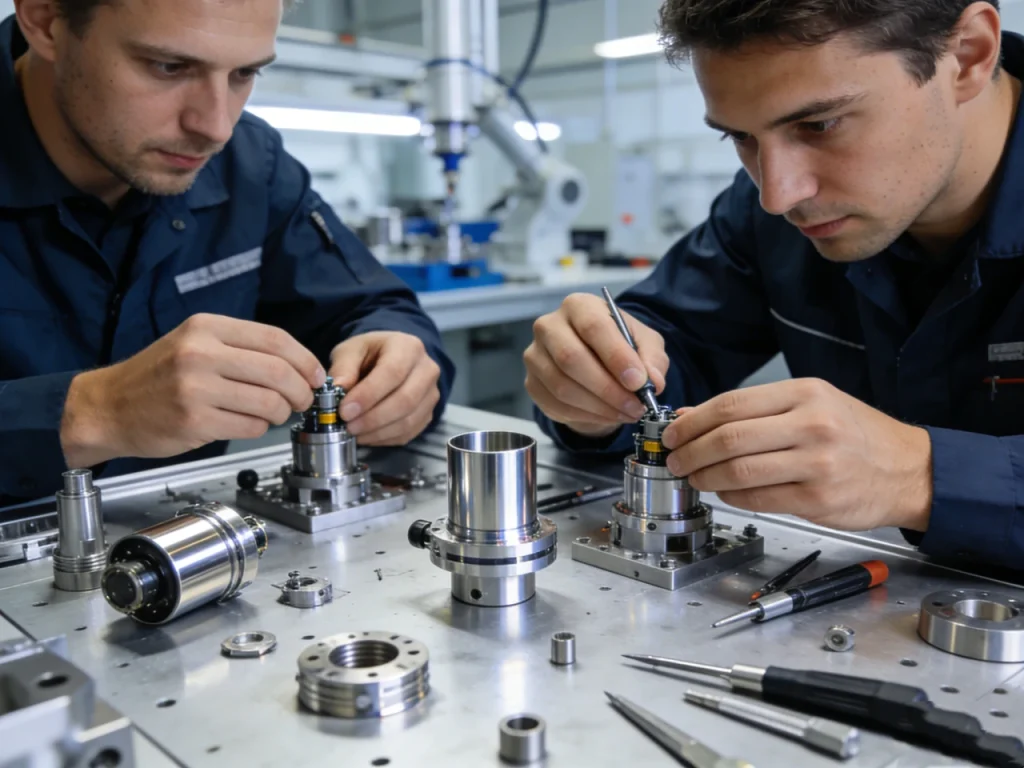
Swiss-Type Turning Guide Bushing Concept Explained
Swiss-type turning (often called Swiss machining) is common for micro turned parts and small diameter turning because it supports the workpiece close to the cut. The core concept is the guide bushing, which limits deflection and chatter when machining long, slender parts from bar stock.
Guide bushing concept (simplified):
| Prvek | Position in Process | Funkce |
|---|---|---|
| Bar stock | Material input | Feeds raw material into the machine |
| Guide bushing | Near the cutting zone | Supports the bar close to the tool to minimize deflection |
| Cutting zone | Tool–workpiece interface | Where turning, drilling, and milling operations are performed |
| Part features | Output side | Finished features produced on the turned component |
| Support principle | - | Guide bushing maintains rigidity by supporting the bar near the tool |
That support is a big deal for parts with high length-to-diameter ratios or delicate features. Without it, the workpiece can bend under tool pressure. The part may still “measure” on one diameter, yet fail assembly because the axis is not stable or because surface finish and geometry shift along the length.
Industry reports also forecast strong growth for Swiss-type turning, including a reported 9.90% CAGR [industry/technical reports]. That aligns with miniaturization in electronics and medical equipment, where parts are compact and the design often mixes threads, grooves, and cross features in limited space.
Multi-Axis One-Setup Machining To Reduce Error
Every time a part is unclamped and reclamped, you create a new chance for misalignment. Even when a shop is careful, multiple setups add:
- Datum transfer error (your new clamp position may not perfectly reference the functional axis).
- Stacked tolerances across operations.
- More inspection steps, because you have more places where variation can enter.
A common strategy in precision manufacturing is to reduce setups by using multi-axis turning and live tooling so more features are completed in one clamping.
| Setup approach | What it tends to do to risk | What it tends to do to throughput |
|---|---|---|
| Multiple setups across machines | Higher risk of datum shift and stacked error | Can be slower due to handling and queue time |
| Two setups in one cell | Moderate risk; manageable if datums are clear | Often efficient for medium complexity |
| One-setup / “done-in-one” machining | Lower risk of geometric mismatch between features | Can be fast once proven, but programming and tool planning can be more complex |
“Lower risk” does not mean “no risk.” One-setup machining can concentrate complexity into one cycle, so tool wear and thermal stability matter more. It also requires that the inspection plan can verify the features without guessing.
Practical Tolerances For CNC Turning
Swiss turning is a CNC turning method that supports bar stock with a guide bushing near the cutting area, which helps control deflection. It is often used for small, slender, high-precision parts where coaxial accuracy and surface quality are hard to maintain with conventional workholding. It tends to make sense when the part is compact (often under 50 mm), has complex features, or needs tight control that would be risky across multiple setups.
Processes Compared: CNC Turning vs Swiss-Type Turning vs Multi-Axis
Each turning process has strengths and limitations in terms of part size, complexity, tolerance capability, and industry fit. Comparing these methods helps select the most suitable approach for a given part.
Capability Comparison Of Precision Turned Parts By Key Attributes
From a buyer’s view, the “best” process is the one that hits functional requirements with a stable inspection method and acceptable risk. The table below frames the common trade space.
| Proces | Part size range (typical fit) | Complexity fit | Tolerance capability (practical) | Throughput fit | Best-fit industries (common) |
|---|---|---|---|---|---|
| CNC turning (standard) | Small to medium | Nízká až střední | Common benchmark quotes include ±0.005 in on many features [industry reports] | Flexible from prototype to volume | Automotive, general industrial, some aerospace |
| Swiss-type turning | Small parts and long/slender from bar | Moderate to high, dense features | Used for high-precision micro turned parts; supports micron-level behavior in demanding use cases [industry/technical reports] | Strong for high-volume small parts once proven | Medical devices, electronics, aerospace small components |
| Multi-axis / mill-turn (one-setup focus) | Small to medium (depends on machine) | High, mixed features | Helps protect geometric relationships by reducing setups | Good when part consolidation reduces handling | Aerospace, automotive/EV, medical instruments |
Tolerance capability is intentionally described as “practical” because what matters is the full drawing. A supplier may hold a diameter well but struggle with true position on a cross-hole relative to a thread start unless datums and inspection methods are aligned.
Small Parts Market Share And Demand Trends
Industry reporting places small components (<50 mm) at about 40–45% market share in 2024 [industry/technical reports]. This is consistent with what manufacturing engineers see in electronics and medical equipment: miniaturization pushes more function into compact assemblies, which increases demand for small diameter turning, micro threads, and compact housings.
Size segment share (reported 2024):
| Part Size Range | Market Share / Trend | Visual Indicator |
|---|---|---|
| < 50 mm | 40–45% of market | ■■■■■■■■■■■■■■■■■■ |
| 50–200 mm | Growing segment | ■■■■■■■■■■■ |
| > 200 mm | Smaller share | ■■■■■ |
The engineering implication is that small-part strategy matters. Small parts amplify issues like burr control, tool wear on tiny features, and inspection limits. If the acceptance method cannot reliably measure the feature, the “precision” requirement can become a dispute instead of a specification.
Medium Parts Growth And Demand Drivers
Reports describe medium-sized components (50–200 mm) as a faster-growing area [industry/technical reports]. This range often aligns with automotive and aerospace components where turning is still the right base process, but the part may need more secondary features, better geometric control, or tighter inspection expectations.
Common application drivers include:
- Automotive & EV systems that need repeatable turned components at meaningful volumes.
- Aerospace subsystems where medium-size fittings or cylindrical parts must meet stricter QA.
- Medical equipment components that are not implant-scale but still require reliable assemblies and traceable quality.
Medium parts also create different manufacturing constraints than micro turned parts. Workholding, thermal growth, and cycle time can become more important because the material removal volume and tool engagement are larger.
What Tolerances Can CNC Turning Typically Hold?
Industry sources often cite ±0.005 inches as a common capability benchmark for top manufacturers on many CNC-turned features, depending on geometry and material. Some features can be held tighter, but feasibility depends on part stiffness, feature access, tool wear, and how tolerance will be measured. Buyers should tie the tolerance to function and specify datums and inspection expectations so the supplier can plan a stable process.
Materials Selection Steel Titanium And Superalloys
Material choice directly affects part performance, machinability, and cost. Steel, titanium, and high-performance alloys each offer unique advantages that impact design and supplier decisions.
Steel Market Share And Dominance Factors
Industry reporting shows steel materials at about 45.10% share in 2025 [industry/technical reports]. Steel and stainless steel remain common because they cover a wide range of mechanical needs and are familiar to supply chains.
In practice, steel dominates precision turned parts for three reasons that buyers care about:
- Performance range: Many assemblies need strength, wear resistance, or fatigue behavior that steel families can support.
- Cost and availability behavior: While supply chains can be disrupted, steel alloys are widely produced and standardized.
- Machinability is manageable: Many steels machine predictably compared with some higher-performance alloys, which helps repeatability.
That said, “steel” is not one material. Buyers should specify the exact grade and any heat treatment or condition, because machinability and final properties can change.
Titanium And Superalloys Growth And Applications
Reports indicate titanium and superalloys as the fastest-growing material group, at about 7.72% CAGR through 2031 [industry/technical reports]. That tracks with aerospace and medical devices, where strength-to-weight ratio, corrosion resistance, and biocompatibility requirements can push designs away from steels.
From a turning perspective, titanium and many superalloys also bring machining constraints that impact feasibility:
- Heat concentrates at the tool edge, which can accelerate tool wear.
- Chip control can be difficult, which raises the risk of surface damage or cycle interruptions.
- Cutting forces and tool engagement need careful planning to protect small features and surface quality.
These constraints do not mean “avoid titanium.” They mean the drawing should be realistic about edge breaks, surface requirements, and inspection access, and the supplier should explain how they plan to manage tool wear and chip formation.
Material Selection Matrix: Stainless Steel, Steel, Titanium
| Rodina materiálů | Why buyers choose it | Typical applications for turned components | Machining considerations that affect feasibility |
|---|---|---|---|
| Uhlíková/legovaná ocel | Strength, wear resistance, broad availability | Shafts, pins, bushings, automotive turning parts | Tool life is often predictable; heat treatment requirements can distort parts if not planned |
| Nerezová ocel | Corrosion resistance; cleanliness in some environments | Medical equipment components, fittings, housings | Can work-harden; burr control and tool condition matter for threads and sealing surfaces |
| Titanium (and related high-performance alloys) | High strength-to-weight; corrosion resistance; medical and aerospace fit | Aerospace cylindrical parts, medical implants/components | Chip control and tool wear are key risks; conservative feature design helps repeatability |
“Best material” is always application-specific. A stainless grade can be the wrong choice for wear, and a high-strength steel can be the wrong choice for corrosion. The practical approach is to start from the functional requirements (load, environment, wear, compatibility), then check whether the chosen alloy creates machining or inspection problems that add risk.
What Material Is Best For CNC Turned Medical Or Aerospace Parts?

Medical and aerospace parts often use stainless steels and titanium alloys because corrosion resistance, strength, and application constraints can drive those choices [industry/technical reports]. The best option depends on the device or subsystem requirements, including environment, weight, and whether the part needs traceability and special handling. From a machining view, titanium can raise risk around chip control and tool wear, so drawings should avoid fragile features unless they are function-critical.
Inspection And QA Workflow For Precision Parts
Precision turned parts rely on rigorous inspection and quality systems. Understanding in-process checks, measurement strategies, and documentation requirements ensures part consistency and traceability.
Tolerance Guidelines for Buyers: Practical Ranges and Benchmarks
Tolerance language is where many RFQs fail. Buyers ask for “tight tolerances” but do not say which features drive function, which datums control the assembly, or how the tolerance will be verified.
In many industry discussions, ±0.005 inches appears as a quoted capability benchmark for CNC turning on common features [industry reports]. Treat that as a reference point, not a guarantee, because:
- A short, stiff diameter is different from a long, thin diameter.
- A tolerance on a single diameter is different from a tolerance on runout across multiple surfaces.
- A tolerance that is easy to measure is different from one that requires specialized gaging or CMM strategy.
Buyers also benefit from writing tolerances in a way that matches assembly intent. For example, if sealing is the requirement, a diameter tolerance alone may not control leakage. Surface condition, roundness, and runout can matter, even if they are not explicitly called out.
Inspection and QA Workflow: In-Process Checks and Documentation
Precision turned parts depend on two linked systems: machining control and measurement control. A capable supplier will normally use a mix of in-process checks (to catch drift early) and final verification (to confirm acceptance).
QA workflow diagram (typical):
| Fáze | QA Activity | Key Checks / Outputs |
|---|---|---|
| 1 | Probíhající kontroly | Monitoring critical diameters, tool offsets, and visual burr inspection |
| 2 | Final measurement | Hand metrology as appropriate; CMM or advanced measurement for GD&T-controlled features |
| 3 | Documentation package (as required) | Inspection results, material certifications (when specified), and revision or traceability records |
From an engineering standpoint, two failure modes appear often:
- “We can machine it, but we can’t measure it.” If a geometric tolerance is specified without a measurable datum scheme, the supplier may struggle to prove compliance.
- “We can measure it, but not at the sampling level you expect.” If you need more inspection coverage, specify it clearly so the supplier can plan time and equipment.
This is also where GD&T (geometric dimensioning and tolerancing) matters. GD&T can reduce ambiguity, but only if the datum structure matches how the part functions in the assembly.
Certifications And Compliance Checkpoints For Suppliers
Quality system requirements vary by industry and risk level. A baseline many buyers look for is ISO 9001:2015 certification. Some industries also require additional systems or customer-specific compliance.
Checklist for supplier verification:
| Kontrolní bod | Co potvrdit |
|---|---|
| ISO 9001:2015 | Certification is current and scope covers the relevant manufacturing activities |
| Industry-specific requirements | Any additional certifications or compliance requirements your program needs (verify in the RFQ) |
| Schopnost kontroly | Ability to measure your critical characteristics and provide the documentation you require |
| Sledovatelnost | Lot traceability expectations for material and process steps (if needed for your industry) |
| Change control | How revisions, deviations, and nonconformances are documented and approved |
Even with a certificate, buyers should confirm that the quality system connects to the specific part risks. A supplier can be certified and still be a poor fit if they cannot measure your tightest GD&T callouts or if they lack a stable approach for your alloy and geometry.
How Do I Verify A Precision Machining Supplier’s Quality System?
Ask for proof of current ISO 9001:2015 certification and confirm the scope matches the processes used for your part. Then verify that the supplier can measure the critical features on your drawing and can provide the inspection records your program requires. If your part is high-risk, also confirm how they handle revision control, nonconformance, and traceability.
Applications by Industry: Specs, Risks, and Part Examples
Different industries impose unique specifications, risk profiles, and functional requirements on precision turned parts. Examining industry-specific examples clarifies critical feasibility considerations.
Aerospace Component Requirements And Risk Checklist
Aerospace precision turned parts often include fittings, sleeves, spacers, and engine-adjacent cylindrical components. The risk profile is high because defects can propagate into leaks, fatigue cracks, vibration issues, or assembly mismatch. The part may be small, but the failure cost is not.
Aerospace-focused feasibility checks:
| Risk area | What to look for in the drawing and RFQ |
|---|---|
| Geometric relationships | Runout, concentricity, and datum structure that matches how the part mounts and loads |
| Threads and sealing | Thread class requirements, sealing land definitions, and surface requirements tied to leakage risk |
| Material and condition | Exact alloy callout and any required condition; confirm if heat treatment could distort key diameters |
| Dokumentace | Clear inspection and traceability expectations aligned with program risk |
In aerospace, “precision” often means controlling geometry across multiple features, not just holding a tight diameter. If the drawing leaves datum intent unclear, suppliers may quote more conservatively or require clarification.
Medical Device Miniature Part Feasibility And Traceability
Medical devices often rely on small, complex turned components: bone screws, catheter components, connectors, and miniaturized housings. Miniaturization makes machining and inspection harder because small features are easier to damage and harder to measure. Medical requirements can also add cleanliness and traceability expectations.
Medical-focused feasibility checks:
| Requirement area | What to define early |
|---|---|
| Mini features | Minimum wall thickness expectations, micro threads, and edge-break rules that do not damage function |
| Burr control | Where burrs are unacceptable (for example, fluid paths or mating surfaces) and how edges should be treated |
| Čistota | Any cleaning, handling, or packaging requirements needed for downstream processes |
| Sledovatelnost | Lot traceability and documentation package needs, based on device risk class and internal controls |
Even when the part is “just a turned component,” medical assemblies can be sensitive to small particles, burrs, or cosmetic defects if the part sits in a fluid path or near sealing features.
Automotive EV Parts Volume And Repeatability Needs
Automotive and EV manufacturing tends to stress two things at once: volume and repeatability. Precision turned parts in this space include shafts, sleeves, fittings, and other cylindrical machined parts used across powertrain, thermal management, and actuation systems (application dependent).
Reports also link growth to medium-sized components (50–200 mm) [industry/technical reports]. This fits automotive and EV architectures where parts are large enough to be mechanically significant but still well-suited to turning. As systems become more integrated, buyers may also try to consolidate features into fewer parts, which pushes demand toward multi-axis and one-setup machining to hold relationships.
A practical note for automotive buyers: if the program expects high volumes, design for process stability. Avoid tolerances that are tighter than function requires, because they can force higher inspection burden and increase the odds of line stops due to measurement disputes.
Electronics Miniaturization And High-Speed Production
Electronics often uses micro turned parts under 50 mm, such as pins, connector shells, and compact housings. Miniaturization makes these parts sensitive to burrs, tool wear, and handling damage.
With <50 mm components holding 40–45% share in 2024 [industry/technical reports], buyers should assume that a large portion of supplier capacity and process development is aimed at this size class.
Size trend implications (simplified):
| Trend / Driver | Manufacturing Impact | Engineering Implication |
|---|---|---|
| Increase in < 50 mm parts | More small-diameter soustružení | Higher sensitivity to tool wear and cutting stability |
| Miniaturized geometries | Greater burr formation risk | Burr control becomes critical for function and assembly |
| Tiny features | More difficult inspection | Requires specialized metrology and clear acceptance criteria |
A common feasibility risk in electronics is specifying a tight tolerance on a very small diameter without defining how it is measured or how the part is handled after machining. Small parts can pass dimensional inspection and still fail assembly if edges are damaged or if cosmetic defects interfere with automated feeding.
Real-World Case Studies: Key Improvements and Lessons
Case studies illustrate how one-setup machining, Swiss-type turning, and multi-axis approaches improve efficiency, accuracy, and yield, providing practical lessons for design and sourcing.
One-Setup Swiss Machining For Complex Parts
Industry case reporting describes Swiss-type machining configurations that complete complex medical and aerospace components in a single clamping. The key technical change is combining turning with cross drilling and multi-axis cutting so features that once required secondary setups are finished in one cycle.
Case-based workflow (reported pattern):
| Krok | Process Stage | Purpose / Benefit |
|---|---|---|
| 1 | Single clamp / guide-bushed support | Stabilizes the workpiece and minimizes deflection during machining |
| 2 | Turning + cross features + threads in one program | Completes multiple features in a single CNC cycle, reducing setup changes |
| 3 | Complete part with fewer datum transfers | Improves geometric accuracy by minimizing datum transfer and stacked tolerances |
The claimed improvement is higher efficiency and fewer errors because fewer setups reduce datum transfer risk [industry/technical reports]. From a buyer’s view, the important lesson is not the exact machine configuration. It is that one-setup strategy can be a strong fit when the drawing controls relationships between features (for example, cross holes relative to a thread axis) and when those relationships are hard to maintain across multiple fixtures.
Machining Titanium And Exotic Alloys Chip Control Approach
A second reported case describes a machining approach for sticky alloys like titanium where chip buildup and poor chip breakage cause downtime. The reported method uses a synchronized cutting motion to manage chip formation and reduce tool loading [industry/technical reports]. One source claims tool life extension “up to 30%,” but that claim is single-source and not cross-verified in the provided material.
For engineering teams, the transferable point is that titanium and exotic alloys often fail in production due to chip control, heat, and tool wear—not because the nominal geometry is impossible. If your part uses titanium, ask suppliers how they will manage chip formation and how they will detect tool wear before it drives drift in critical diameters.
Rapid Prototype And Low-Volume Production Lead Times
Industry sources also describe rapid production for prototypes and low-volume CNC turned components, including reports of delivery “as fast as 1 day” in some situations, with cited benchmark tolerance capability of ±0.005 inches [industry/technical reports]. Treat this as an existence proof that fast cycles are possible under the right conditions, not as a planning assumption.
Fast turnaround depends on part complexity, material availability, machine capacity, and inspection scope. A part with simple geometry and common stock can move quickly. A part with tight GD&T, special material certs, or extended inspection documentation will take longer because measurement and review time become part of the critical path.
Miniaturized Multi-Axis Turning For High-Speed Parts
A final reported theme is multi-axis turning applied to miniaturized parts under 50 mm, where high-speed production and compact feature sets drive demand [industry/technical reports]. This aligns with the reported 40–45% market share for <50 mm components in 2024 [industry/technical reports].
For feasibility, small parts are a double-edged case. They often use less material and can run fast, but they can also be harder to fix, easier to damage, and harder to inspect. If your drawing includes micro features, consider adding:
- Clear edge-break notes that protect function.
- Datum definitions that match how the part is held and measured.
- Inspection notes that state what must be verified (and at what stage), so acceptance is not subjective.
Supplier Selection, RFQ Inputs, and Cost Drivers
Supplier selection and RFQ preparation directly influence manufacturability, cost, and lead time. Understanding key inputs and cost drivers helps optimize procurement decisions.
RFQ Readiness Checklist CAD Drawings GD&T Material Spec
RFQs for precision turned parts succeed when they remove ambiguity. The buyer does not need to describe how to machine the part, but they do need to define the engineering requirements in a way that is measurable and revision-controlled.
RFQ readiness checklist:
| Zadání RFQ | Proč je to důležité pro proveditelnost |
|---|---|
| Model CAD | Helps identify feature access and machining approach; supports programming |
| 2D kresba | Legal definition of requirements; includes dimensions, notes, and revision |
| GD&T and datum scheme | Removes ambiguity on geometric requirements and assembly intent |
| Specifikace materiálu | Avoids “close enough” substitutions that can change performance and machinability |
| Požadavky na povrchovou úpravu | Surface requirements can drive tool choice and inspection needs |
| Požadavky na inspekci | Defines what must be measured, method expectations, and documentation package scope |
If you are still iterating the design, mark which dimensions are tentative. Suppliers can sometimes propose a machining strategy that is stable, but only if they know which callouts are truly critical.
Cost Drivers Material Setup Tolerance Volume Secondary Ops
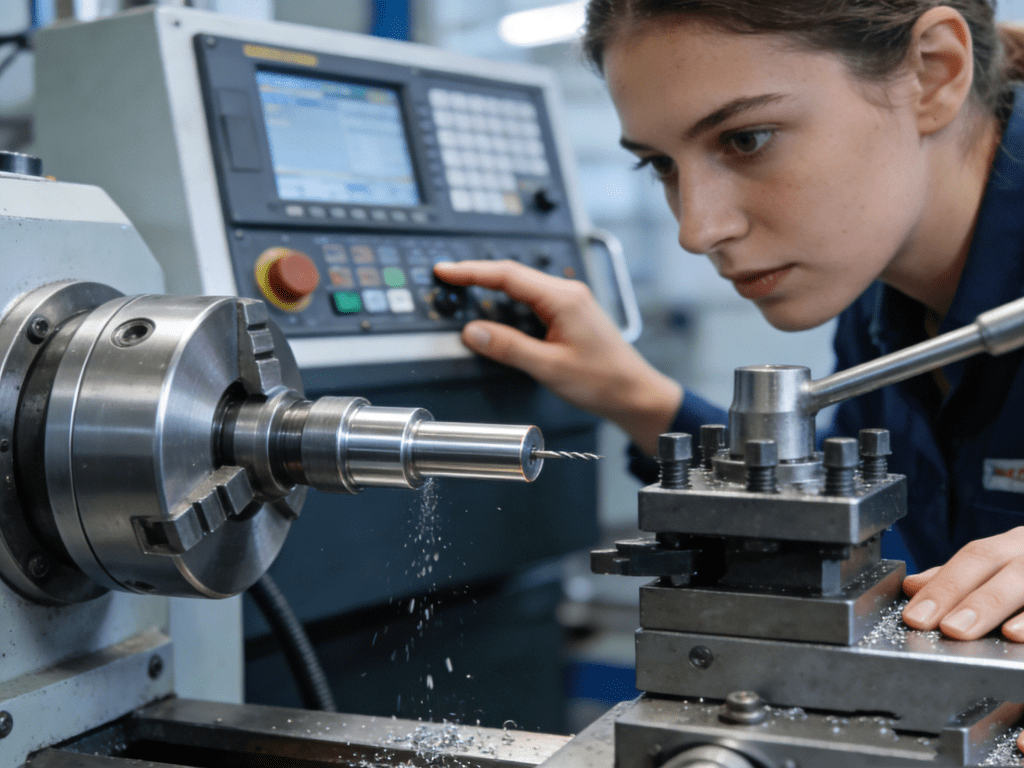
Cost in precision machining is usually driven by time, risk, and material behavior, not by the idea of “precision” alone. The table below frames what tends to push effort up.
| Hnací síla nákladů | What increases effort | Why it matters for precision turned parts |
|---|---|---|
| Material choice | Titanium and exotic alloys; special conditions | Machining can require more tool management and process development |
| Setup complexity | Multiple features requiring careful orientation | More setups increase datum transfer risk; one-setup strategies may need more programming |
| Tolerance & inspection level | Tight tolerances; GD&T; higher inspection coverage | Measurement time and method complexity increase |
| Svazek | Very low volume vs stable production lots | Low volume may carry higher setup and verification burden per part |
| Sekundární operace | Deburr, finishing, heat treatment, cleaning | Each added step can change dimensions or add handling risk |
Buyers can often reduce cost without reducing function by tightening only the features that matter. Over-specifying tolerances creates more inspection and rejection risk without improving assembly performance.
Lead Time And Production Strategy Prototype Small-Batch Volume
Different production stages have different success criteria. Prototype work values speed and learning. Volume work values stability and repeatability. Precision turned parts move through these stages best when the drawing and inspection plan evolve with the program.
Decision tree (simplified):
| Rozhodovací otázka | Answer | Recommended Strategy | Key Focus Areas |
|---|---|---|---|
| Is the design still changing often? | Ano | Prototype strategy | Prioritize clear critical dimensions; expect iteration on process and inspection |
| Is the design still changing often? | Ne | - | Move to volume assessment |
| Is annual demand low to moderate? | Ano | Small-batch strategy | Focus on setup repeatability; define inspection sampling and records |
| Is annual demand low to moderate? | Ne | Volume strategy | Lock datums and gaging plan; control tool wear and drift detection |
A common failure mode is treating early prototypes like full production (too much documentation too soon) or treating early production like prototypes (insufficient control plan). Both create waste, just in different ways.
How Do I Choose A Precision Turned Parts Supplier For Prototypes Vs Production?
For prototypes, choose a supplier that can interpret your GD&T, communicate feasibility limits, and measure the critical features reliably, even if the full control plan is not yet optimized. For production, prioritize repeatability: stable process capability for your material, proven inspection methods for your tight tolerances, and a documented quality system such as ISO 9001:2015. In both cases, the best signal is whether the supplier asks the right technical questions about datums, measurement, and function-critical callouts.
To close the decision loop, the approach is suitable when the part is mostly rotational, critical features can be measured with a clear datum scheme, and the chosen alloy can be machined with controlled tool wear and chip behavior. It is a weaker fit when the geometry is thin and flexible, the drawing demands tight relationships without measurable datums, or the inspection plan is undefined for the tightest callouts. When buyers align function, tolerances, and verification early, precision turned parts are usually a practical, scalable path from prototype to high-volume manufacturing.
Nejčastější dotazy
They are CNC-turned metal components built around cylindrical geometry where tight tolerances and repeatability are required. They are often used in assemblies where fit, sealing, or rotation depends on controlled diameters and geometric relationships. They commonly appear in aerospace, medical devices, automotive/EV, and electronics.
Industry sources often cite ±0.005 inches as a common capability benchmark for many turned features, depending on part geometry and material. Some requirements can be tighter, but feasibility depends on stiffness, tool wear, thermal effects, and how the tolerance is measured. Geometric tolerances (like runout) often drive more risk than a simple diameter tolerance.
Steel and stainless steel are common, with steel reported around 45.10% share in 2025 in industry reporting. Titanium and superalloys are growing fastest for aerospace and medical use cases, but they can increase machining risk due to chip control and tool wear. Material selection should start from functional needs, then check machinability and inspection feasibility.
Swiss turning supports the bar stock near the cutting zone using a guide bushing, which reduces deflection on small or slender parts. It is often a better choice for micro turned parts, small diameter turning, and compact components with dense features. It can also reduce setup-related errors when many features must stay aligned.
Keep function-critical features coaxial when possible, and define datums that match how the part locates and loads in the assembly. Avoid fragile thin walls and unclear edge requirements unless they are necessary for function. Add GD&T and inspection notes where geometric relationships matter, so suppliers can plan a stable machining and measurement approach.
Odkazy
https://www.iso.org/standard/62085.html
https://www.asme.org/codes-standards/find-codes-standards/y14-5-dimensioning-tolerancing


 Czech
Czech  English
  German
  French
  Italian
  Spanish
  Polish
  Japanese