
Precision CNC Machining combines advanced cnc precision machining equipment and machine tools, controlled precision machining methods, and skilled operators to achieve different precision high precision parts, repeatable workpiece machining, and reliable production of manufacturing parts, supporting complex precision CNC machines and precision manufacturing workflows. This section outlines the services offered, cost considerations, and best practices for optimizing precision outcomes.
Precision CNC Machining: What It Is and When You Need It
Precision CNC machining is precision CNC manufacturing using many different types of CNC machines, including common types of CNC, applied when part risk is driven by geometry, function, machining tolerances, or assembly stack-up, and whether you need controlled repeatability, tighter risk management, or verifiable compliance for critical features. This includes Fresatura CNC, Tornitura CNC services, cnc drilling, electrical discharge machining, and lathe operations, covering multiple types of CNC precision approaches and making it suitable for all types of precision CNC workpieces. In practice, “precision” is less about a single tolerance number and more about how the whole process is controlled: workholding, thermal effects, tool wear, machine compensation, programming, and verification, because precision machining requires coordinated control across the entire machining workflow.
A useful way to think about it is feasibility. If a part’s function depends on tight relationships between features (position, flatness, true profile), then precision machining is often less expensive than the rework and delays that come from a “standard” approach that is pushed too far.
Precision Vs Standard CNC Machining Tolerance Repeatability And Risk
Standard CNC precision machining can make accurate parts or identical parts, but it is usually optimized for throughput and broad capability, unlike high precision machining and high lavorazione CNC di precisione that targets tighter tolerances and repeatable cnc machined parts. Precision CNC machining is optimized for repeatable accuracy under constraints like thin walls, long reach tooling, tight datum schemes, or difficult materials. Repeatability matters because buyers often qualify a first article and then expect later lots to match without a new learning curve, even if manual machining steps are involved in the workflow.
The risk differences show up in a few common scenarios:
- Setup-driven error: If a part needs multiple orientations, each setup adds alignment error. Standard machining or traditional machining methods may accept this risk; precision machining tries to remove it through fewer setups, better fixturing, and more capable kinematics.
- Tolerance stack-up in assemblies: A single “tight” dimension may be easy. Several tight relationships across faces and bores are often not. Precision planning focuses on the full GD&T chain rather than a single callout. In many industrial contexts, these GD&T practices are interpreted using standards published by the American Society of Mechanical Engineers (ASME), which define how geometric tolerances, datum reference frames, and feature relationships should be specified and verified in precision engineering.
- Material behavior: Some workpieces move after material removal or during machining because of residual stress and heat, which means each machining operation must be planned with deformation control and verification in mind. Precision machining is about controlling that movement and planning around it.
- Measurement limits: If inspection is near the resolution of the available metrology, the process must be designed so you can prove compliance. Parts that cannot be measured reliably are hard to qualify, even if they “look right.”
This also answers a common buyer question: why is precision machining expensive? It is expensive when you pay for risk control—more capable machines, more stable workholding, more careful programming, more in-process checks, and more inspection time. The machining minutes may not change much, but the control plan does.
Tolerance Capabilities Of Precision CNC Machining
Precision CNC machining, including different types of CNC milling, is used when tolerances are tight enough that process variation becomes the main risk, using precision machining to ensure careful planning and process control, and CNC precision machining uses advanced techniques throughout the entire machining workflow to deliver the advantages of precision in critical applications. The exact tolerance that can be held depends on the feature type, material, tool access, part stiffness, and how it will be inspected. A practical way to evaluate capability is to ask for feature-by-feature assumptions (datums, setups, and verification method), not a single “best tolerance” claim. This approach is consistent with measurement science principles promoted by the Istituto Nazionale di Standardizzazione e Tecnologia (NIST), which emphasizes traceable measurement, uncertainty analysis, and process capability as foundations for reliable manufacturing validation.
Where Precision Matters Most Complex Geometry Fewer Setups Higher Accuracy

Cnc precision machining tends to matter most when geometry forces multiple operations or awkward tool access. If you can machine most critical features in one stable orientation, life gets easier. If you must rotate the workpiece several times, each re-clamp is a chance to lose datum alignment.
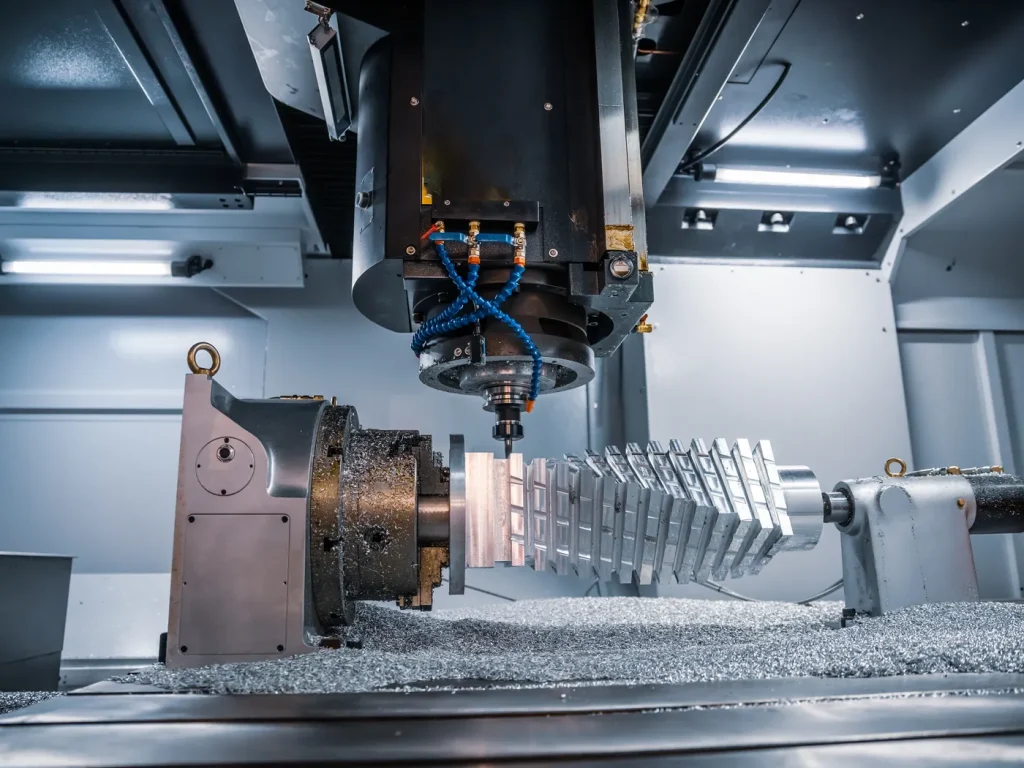
A simple mental model is 3-axis versus 5-axis access. This is not “good vs bad.” It is about whether the milling machine or lathe can reach the critical features while allowing the workpiece to rotate or reorient safely, maintaining datums and reducing error.
3-axis vs 5-axis access (concept diagram)
| Caratteristica | 3-AXIS (X/Y/Z) | 5-AXIS (X/Y/Z + rotation/tilt) |
|---|---|---|
| Tool Approach | Mostly vertical | Can tilt/rotate to reach faces/angles |
| Z Axis Orientation | Vertical | Vertical |
| Tool Position | [TOOL] above workpiece | [TOOL] can tilt/rotate on faces |
| Workpiece | Fixed orientation | Fixed orientation, reoriented by machine |
| Setups Required | Setup A → flip → Setup B → flip | Often fewer flips; features reached by reorientation |
Where this shows up in real parts:
- Angled holes and compound faces: On 3-axis, you may need fixtures or multiple setups. On multi-axis, the machine can reorient the tool or part.
- True position across faces: If a bore on one side must align with a feature on another side, fewer setups usually lowers alignment risk.
- Surface finish on complex surfaces: Tool angle control can reduce chatter and improve consistency on some shapes, though it also adds programming complexity.
Proof Points And Global CNC Market Context
Multiple industry reports forecast continued growth in CNC equipment and services demand. One cited projection places the global CNC machine market near $100B by 2026, driven by high-precision demand and efficiency needs, but reported totals vary with scope (machines vs services, regions, and category definitions). This matters for buyers because capacity constraints and technology turnover tend to follow investment cycles: when demand rises, shops invest in multi-axis, automation, and monitoring to protect margins and reduce quality escapes.
Core Technologies That Drive Accuracy Multi Axis Controls And Post Processors
Precision CNC Machining relies on precision CNC machines and CNC machining equipment, CNC laser systems, advanced controls, and post-processors to translate CAD/CAM designs into highly accurate parts.
Multi Axis CNC Machining For Complex Parts Fewer Setups Finer Tolerances
Multi-axis precision cnc machines (often 5-axis) can reduce the number of setups, which reduces cumulative alignment error, helping produce parts that require high precision, create parts faster, deliver accurate parts, and maintain reliable precision machining while ensuring level of precision. It can also improve tool access, which helps you avoid long slender tools that deflect under load. Both effects support tighter, more repeatable outcomes when the part geometry is complex.
That said, multi-axis introduces its own error sources: rotary axis calibration, kinematic compensation, and higher dependence on CAM strategy. A precision plan treats those as measurable risks, not as reasons to avoid the technology.
Setup reduction concept (diagram)
| Impostazione | Conventional Machining methods (many setups) | Multi-Axis Path (fewer setups) |
|---|---|---|
| 1 | Face A | Face A + angled features |
| 2 | Face B | Secondary operations if needed |
| 3 | Side features | - |
| 4 | Angled holes via fixture | - |
In aerospace and medical precision machining, fewer setups often matters because datums and feature relationships are more critical than individual dimensions. The benefit is less about “the machine is better” and more about “the process has fewer chances to drift.”
Post Processors And Advanced CNC Controls Workflow
Precision CNC machining is not just about mechanical machine tools. The translation chain from CAD to CAM to machine code is a frequent source of variation.
- CAD defines nominal geometry.
- CAM defines toolpaths, stepovers, lead-ins, and machining order.
- Post-processor converts CAM output to machine-specific instructions, accounting for controller format and machine kinematics.
- CNC control executes motion, applies compensation, and manages feeds/speeds behavior.
When this chain is weak, you can see issues like unexpected axis limits, rotary overtravel, poor surface transitions, or small but consistent feature location shifts. Those are hard problems because the part can be “machined as programmed,” yet still not match the design intent.
CAD/CAM to machine workflow (diagram)
| Palcoscenico | CAD Model | CAM Toolpaths | Post-Processor | Machine Code | CNC Control | Parte |
|---|---|---|---|---|---|---|
| Key Focus | Datums, GD&T | Strategy + order | Machine kinematics | - | Execution behavior | Final part |
| Note | Defines nominal geometry | Toolpaths, stepovers, machining order | Converts CAM to machine-specific code, kinematics compensation | Instructions for CNC | Applies motion, compensation, probing, offsets | Physical part produced |
The key point is traceability: for tight tolerance machining, you want to know which CAM version, which post, and which control settings were used when a part was made and inspected. That supports repeatability across lots and across machines.
Real Time Monitoring And Adaptive Adjustments
Real-time monitoring and IIoT sensors are used to observe spindle load, vibration, temperature trends, and sometimes tool condition signals. This can help detect drift before it becomes scrap. Some systems can also trigger adaptive responses.
It helps to separate what can be adjusted during machining from what usually cannot:
- Often adjustable mid-cut: feed rate limits, tool change decisions, alarms for load spikes, pausing for inspection, and compensation updates between passes.
- Hard to fix mid-cut: wrong setup datum, poor workholding rigidity, tool access that forces deflection, and unstable thin-wall behavior. Monitoring can detect these patterns, but it will not change the physics.
So monitoring is a control layer, not a substitute for sound part strategy.
Is 5-Axis CNC Always Better Than 3-Axis For Precision Parts?
No. 5-axis can reduce setups and improve tool access, which can support precision. But 3-axis can be the better choice for simple prismatic parts, or where fixturing allows critical features to be finished in one stable orientation. The decision should follow the part’s datum scheme, feature accessibility, and inspection plan, not the axis count.
Automation And Lights Out Manufacturing For Higher Throughput
Automation in cnc precision machining process reduces idle time, improves consistency, and enables lights-out operation, enhancing productivity while maintaining accuracy for high-quality parts and precision prototyping.
Robotics For Material Handling And Tool Changes
Automation in precision CNC machining is often aimed at two bottlenecks: waiting and variability. Waiting shows up as idle spindles during loading, unloading, and tool management. Variability shows up as inconsistent handling, inconsistent chip clearing, or inconsistent offsets.
Robotic arms and automated guided vehicles (AGVs) are commonly discussed because they can move workpieces and tend machines with less interruption. In lights-out manufacturing, the target is not just “no people,” but stable unattended cycles that do not create hidden scrap.
Automation process map (high level)
| Passo | Workholding Prep | Load Workpiece | Machine Cycle | Unload | In-Process Check (as defined) |
|---|---|---|---|---|---|
| Key Elements | Pallets | Robot / AGV | Monitoring | Robot / AGV | Gauges / CMM Sampling |
For feasibility, the main question is whether your part and tolerance scheme can tolerate unattended variation. Some parts do well in this model; others are too sensitive to tool wear or material movement without frequent checks.
Case Study Automation And Real Time Analytics Improving Productivity And Reducing Waste Lakeview
One precision machining firm reported that downtime was driven by material handling and tool change interruptions. The firm invested in automation for handling (including AGVs and robotic arms) and paired it with real-time analytics for decision support. The reported outcome was higher productivity while maintaining accuracy, with less waste tied to avoidable stops and inconsistent handling.
For a technical buyer, the takeaway is not the exact result number (none was provided in the source). The takeaway is where the leverage was: reducing non-cut time and using data signals to prevent repeat errors.
Where Automation Adds The Most Value High Mix Vs High Volume Trade Offs Decision Matrix Table
Automation value depends on your part mix. High-volume runs can justify more dedicated automation, while high-mix work needs flexible setups and fast changeover. Precision requirements complicate both because tool life management and inspection become more central.
Decision matrix: where automation tends to fit
| Production profile | Typical constraint | Automation fit | Precision risk to check first |
|---|---|---|---|
| High-volume, stable design | Non-cut time and labor availability | Alto | Tool wear drift across long runs; inspection sampling plan |
| High-mix, low-volume | Changeover time and programming overhead | Medio | Setup repeatability; fixture strategy; first-article turnaround |
| High-mix, medium repeat | Scheduling and queue time | Medio-Alto | Data traceability across lots; offset control between jobs |
| Prototype / one-off | Engineering time | Da basso a medio | Measurement plan; rework risk from unclear GD&T |
This table is not a rule. It is a way to ask better questions early in sourcing.
How Automation Reduces CNC Machining Downtime
Automation reduces downtime by keeping the machine spindle cutting more of the time. It can shorten loading and unloading time, reduce pauses caused by manual handling, and standardize routine steps like tool changes and part transfer. When paired with monitoring, it can also reduce stops tied to avoidable alarms and repeated setup mistakes.
AI Machine Learning And Predictive Maintenance In CNC Operations
AI and machine learning enhance cnc precision machining uses by optimizing cnc programming, refining machining precision, reducing variability, and supporting predictive maintenance to avoid unexpected downtime, improving outcomes for precision prototyping and precision machining projects.
AI Driven Tool Path Optimization
AI and machine learning are being used to tune toolpaths and reduce error-prone motion patterns. In plain terms, the software learns from prior runs and known failure modes, then proposes changes that reduce sharp load spikes, excessive retraction moves, or chatter-prone engagement.
This is usually framed as an efficiency topic, but it also links to precision because unstable cutting forces and vibration are a common source of dimensional drift and poor surface finish.
Toolpath concept (visual sketch)
| Path | Representation | Effect / Notes |
|---|---|---|
| Prima | ┌─┐ ┌─┐ ┌─┐ └─┘ └─┘ └─┘ | Many abrupt direction changes → load spikes, vibration risk |
| Dopo | ~~~~~~~~~~ | Smoother engagement → more stable load, better repeatability potential |
A buyer-focused caution: AI does not remove the need for CAM judgment. If the underlying setup, datum selection, or tool access is wrong, a “better” toolpath can still produce a nonconforming part, just faster.
Predictive Maintenance Signals
Predictive maintenance uses sensor signals to forecast failures before they become unplanned downtime. The sources cited describe spindle load and vibration as common signals used for this purpose. When those signals trend away from baseline, a shop can schedule maintenance or tool changes with less disruption.
Trend concept
| Signal Trend | Descrizione |
|---|---|
| Stable Baseline | Normal operating condition, no maintenance needed |
| Rising Trend (approaching alarm threshold) | Indicates tool wear, spindle issues, or potential failure |
| Alarm Threshold | Predefined limit; triggers maintenance action to prevent downtime |
From a feasibility view, predictive maintenance helps most when your part cost of failure is high: hard-to-machine materials, long cycle times, or tight tolerance features that are scrapped late in the process. Preventing one bad run can matter more than saving a few minutes.
Case Study AI ML Predictive Maintenance Reducing Downtime And Minimizing Errors
A reported example described AI/ML integration to analyze spindle load and vibration in real time, paired with toolpath optimization based on data from past runs. The described outcomes were reduced unexpected downtime and fewer errors, with better resource allocation because maintenance and tool changes could be planned instead of reactive.
The sourcing lesson is that data value depends on feedback loops. If a shop collects signals but does not connect them to decisions (tool change rules, offsets, maintenance triggers), then the system becomes logging, not control.
Can AI Actually Improve Machining Precision Or Just Efficiency
AI can support precision when it reduces process variation, such as vibration events, tool wear surprises, or unstable engagement. It does not change basic limits like part stiffness, heat input, or poor fixturing. In many cases it improves consistency first, and precision improves as a side effect when variability drops.
Materials Finishes And Hard To Machine Challenges Aerospace Medical Automotive
Precision CNC Machining addresses challenges posed by titanium, Inconel, composites, and honeycomb cores, controlling heat, tool wear, and deformation risks.
Industry Applications And Material Mapping
The sources highlight growing demand for high-precision CNC solutions in materials and structures that are difficult to cut or fixture, including titanium, Inconel, honeycomb cores, and composites [3][5]. These are not difficult for the same reason:
- Titanium and Inconel can be sensitive to heat and tool wear behavior.
- Honeycomb cores and composite stacks can be sensitive to delamination, crushing, or edge quality.
- Thin sections and lightweight structures move easily under clamping and cutting loads.
Material challenge mapping (application table)
| Material / structure | What often makes it “hard-to-machine” | Common precision risk |
|---|---|---|
| Titanio | Heat concentration and tool wear behavior | Dimensional drift from heat and wear; surface integrity concerns |
| Inconel | High cutting forces and tool wear | Feature size drift; poor finish if cutting is unstable |
| Honeycomb cores | Low crush strength; edge sensitivity | Deformation during clamping; edge damage |
| Compositi | Layered structure; fiber pullout risk | Delamination; inconsistent surface quality |
This is where “what machines offer the highest precision?” becomes a practical question. It is not only about the machine’s axis count. Precision in hard-to-machine work is tied to rigidity, control stability, and how well probing, offsets, and monitoring are used. A highly capable machine with poor workholding can still miss critical relationships.
Industry Applications Aerospace Parts Medical Components Automotive Components Mapping Table
The same material trends connect to common regulated or high-risk applications: aerospace components, medical components, and automotive components. The difference between these sectors is often the verification burden and what “failure” means. Industry Applications include landing gear parts, aerospace components, medical components, and automotive components, reflecting sectors where extreme precision is essential.
Application mapping (table)
| Settore | Typical driver for precision machining | What buyers tend to care about most |
|---|---|---|
| Aerospaziale | Complex geometry, weight reduction, high consequence of failure | Feature relationships, traceability, and repeatability |
| Medico | Small features, fit with mating parts, compliance needs | Inspection evidence, surface quality expectations, consistency |
| Automotive | Scale and repeatability with cost pressure | Process stability, cycle-to-cycle variation control, throughput |
This is also why engineers ask “what is considered precision machining?” In these sectors, it is machining where process control and verification are planned from the start because downstream risk is high.
Inspection And Surface Quality Expectations Linking Precision Requirements To Verification CMM Focused Diagram
Precision is only meaningful if you can measure it. For many high precision parts, coordinate measuring machines (CMMs) are used to verify feature location and GD&T relationships. In practice, these verification methods are commonly aligned with geometric product specification and verification frameworks defined by the International Organization for Standardization (ISO), which establish globally recognized rules for tolerancing, datums, and dimensional conformity in precision manufacturing. Surface quality is also part of acceptance, but it must be linked to functional requirements. A surface that looks “smooth” may still fail if it does not meet a defined specification.
A simple way to connect design to verification is to map critical features to the measurement method and datum scheme.
Design-to-inspection link (diagram)
| Palcoscenico | Drawing (GD&T) | Datum Scheme | Setup Plan | Measurement Plan | Reportable Evidence |
|---|---|---|---|---|---|
| Key Elements | Caratteristiche critiche | A/B/C datums | Orientamento | Measurement method | CMM program / Gauges |
This answers another common question: how do you measure precision parts? You measure them with methods that match the tolerance type. Size can be measured with micrometers or gauges, but positional tolerances and true profiles often require CMM measurement or equivalent methods. The important part is that the inspection method must be agreed early, because it can change how the part is machined and how datums are established.
Suggested Reference Types For Material Behavior And Standards Academic Research Google Scholar Industry Technical Reports
For buyers dealing with titanium, Inconel, and composite or honeycomb structures, feasibility is helped by material-specific cutting research and standards-backed guidance. Academic papers can clarify wear modes and surface integrity risks, while technical reports help with practical parameter ranges and inspection expectations. The goal is not to copy settings from a paper, but to understand which failure modes are common so the machining plan can avoid them.
Hybrid Manufacturing CNC Plus Three D Printing For Prototyping And Complex Parts
Combining additive manufacturing with Precision CNC Machining allows for near-net shapes and critical tolerance finishing, balancing design freedom and accuracy.
When To Combine Additive And Subtractive Design Freedom Vs Precision Finishing Workflow Diagram
Hybrid manufacturing combines additive manufacturing (3D printing) for near-net shaping with precision CNC machining methods for finishing intricate parts and manufacturing parts, leveraging precision tools and machine tools to remove material from the workpiece and achieve final tight tolerances. It is often used when pure CNC would waste large amounts of material or when the geometry is hard to reach with cutting tools alone.
The usual pattern is:
- Use additive to create internal channels, lattice-like structures, or weight-reduction shapes.
- Use CNC to finish datum features, sealing surfaces, bores, and any tolerance-critical geometry.
Hybrid workflow (diagram)
| Palcoscenico | Additive Build (Near-Net) | Stress Relief / Conditioning (if required) | CNC Finishing | Ispezione |
|---|---|---|---|---|
| Key Focus | Libertà di progettazione | Material conditioning / stress relief | Tolerance control / critical features | Verify dimensional accuracy and functional requirements |
A practical note: hybrid can shift risk rather than remove it. Additive introduces its own variation (build distortion, surface texture, material consistency). CNC finishing can correct some of that, but only where tools can reach and where enough stock exists for cleanup.
Case Study Aerospace Hybrid Shift Faster Prototyping And Reported 50 Percent Less Material Waste Single Source
A single cited source described an aerospace shift toward hybrid CNC + 3D printing, reporting faster prototyping and about 50% less material waste compared with traditional approaches for certain components [2]. The source presents this as a broad benefit, but it is also flagged as single-source and not independently confirmed for all applications.
For decision-makers, the safe interpretation is narrower: hybrid can reduce waste when the alternative is machining a large billet down to a small final shape, or when complex internal features would otherwise require assembly of multiple parts.

Practical Decision Criteria Part Geometry Tolerance Critical Features And Material Waste Considerations Checklist
Hybrid tends to make sense when the part has both “hard” and “soft” requirements: complex geometry that benefits from additive, plus precision features that must be machined.
Hybrid decision checklist
| Domanda | If “yes,” hybrid may help | If “no,” CNC-only may be simpler |
|---|---|---|
| Does the part geometry force large material removal from billet? | Waste reduction may justify hybrid | Billet machining may be efficient enough |
| Are there internal features that CNC tools cannot reach? | Additive can create them | CNC can reach features with standard tooling |
| Are there clear datum features that can be machined after printing? | CNC finishing can anchor accuracy | Datum creation may be uncertain |
| Are tolerance-critical features accessible for finishing? | Hybrid can meet precision where needed | Additive-only surfaces may not qualify |
| Is inspection defined for both as-built and finished states? | Reduced qualification risk | Unclear acceptance criteria increases risk |
When Should You Use Hybrid CNC Plus 3D Printing Instead Of CNC Alone
Use hybrid when additive creates value that CNC alone cannot, such as inaccessible internal geometry or major material waste reduction, and when CNC can still finish the critical datum and functional features. Avoid hybrid when the tolerance-critical surfaces cannot be reached for finishing or when acceptance criteria for the as-printed state are unclear. Hybrid is often a fit for prototypes and complex parts, but it still needs a clear inspection plan.
Digital Twins IIoT Sensors And Connectivity For Quality Control
Digital twins and sensor networks support cnc precision machining process by simulating machining tasks, monitoring conditions, and enabling traceable control for applications of precision cnc machining, including aerospace, medical, and automotive precision parts.
Digital Twins For Process Simulation And Optimization What Gets Mirrored And Measured Diagram
A digital twin, in this context, is a digital model of the machining process that is connected to real process data. The intent is to simulate and optimize decisions, then compare predictions to measured behavior.
In machining, what gets mirrored is usually a subset of the full reality:
- Machine state and job parameters
- Toolpath intent and cycle structure
- Selected sensor signals (load, vibration, temperature trends)
- Quality outcomes tied to measured features
Digital twin concept (diagram)
| Palcoscenico | Physical Machining | Sensors / Data | Digital Model | Predicted Behavior | Feedback / Adjustments |
|---|---|---|---|---|---|
| Key Focus | Actual part cutting | Collect process signals (load, vibration, temp) | Simulate process based on data | Predict outcomes, identify drift | Adjust future runs or operations based on feedback |
This matters for precision because many defects are repeatable once the setup and strategy are set. A twin-like approach helps you detect when a “known good” process starts to drift.
IIoT Sensor Data Plus Real Time Analytics Monitoring Traceability And Process Control Dashboard Mockup
IIoT monitoring is often discussed as dashboards, but the engineering value is traceability and early warning. If a critical part feature fails, the question is not only “what is out of spec,” but “what changed.” Data helps answer that.
Dashboard mockup (concept)
| Parametro | Status / Notes |
|---|---|
| Job | Part_Revision_X |
| Macchina | Cell_3 |
| Spindle Load Trend | Stable / Rising |
| Vibration Indicator | Baseline / Elevated |
| Tool Life Status | Normal / Near Limit |
| Offset Changes | Count + Timestamps |
| Inspection Flags | Pass / Recheck Required |
The control benefit is strongest when the process has defined triggers. Without triggers, monitoring becomes a record after the fact.
Connectivity Standards And Integration MTConnect For Machine Data Interoperability Industry Standards References
When multiple CNC machines and devices must share data, interoperability becomes a constraint. MTConnect is a cited connectivity standard aimed at consistent machine data access across equipment, developed and maintained by the MTConnect Institute to enable interoperable, vendor-neutral data exchange between CNC machines, sensors, and manufacturing software systems. For buyers, this is less about the standard name and more about integration reality: if you expect traceability and monitoring across a fleet, the shop needs a way to collect comparable data signals and connect them to job context.
Case Study IIoT Enabled CNC For Titanium Composites With Robotics To Reduce Human Error
One reported example described using IIoT sensors for real-time monitoring alongside hybrid CNC capability and robotics for material loading, targeting titanium and composite work in regulated sectors. The stated intent was to maximize productivity while minimizing human error and handling irregular geometries with better repeatability.
The practical sourcing point is that “quality control” here includes handling control. For delicate or irregular workpieces, consistent loading and clamping can matter as much as the cutting parameters.
Sustainability And Cost Efficiency Levers In Precision CNC
Precision CNC Machining incorporates eco-friendly materials, lower-impact processes, and optimized setups to balance sustainability, cost, and precision requirements.
Sustainability Trends Eco Friendly Materials Bioplastics Recycled Metals And Lower Impact Processes
Sustainability in CNC machining is often discussed in terms of materials and waste. The cited sources point to interest in eco-friendly materials such as bioplastics and recycled metals, along with lower-impact processes [3][6]. For precision machining, sustainability is constrained by qualification and performance. Some parts can accept recycled feedstock if material certification and properties meet requirements; other parts cannot.
From a buyer’s view, the feasibility question is: can sustainability changes be made without changing verification, traceability, or part performance? If the answer is unclear, treat it as an engineering change, not a purchasing preference.
Market Trend Signal Sustainability Innovations Projected 9 Point 7 Percent CAGR Through 2026 Report Cited
One report-cited figure projects sustainability-focused innovations contributing to about 9.7% CAGR through 2026 in the CNC market. As with the market size projection, scope and definitions matter. Still, it signals that buyers will see more sustainability claims tied to machining. The safe approach is to require those claims to be backed by material documentation and process evidence, especially for aerospace and medical precision machining.
Cost Drivers You Can Control Setups Scrap Rework Downtime And Material Utilization Cost Levers Table
Precision CNC machining cost is often driven by avoidable process choices. Some drivers are fixed by design requirements, but many can be managed by planning and communication.
Cost levers table (buyer-relevant)
| Driver di costo | Cosa aumenta il costo | What usually reduces cost without lowering quality |
|---|---|---|
| Impostazioni | Many re-clamps, complex datum transfers | Designing for fewer orientations; clearer datum scheme |
| Scarti/lavorazioni | Unclear GD&T, unstable thin features, late detection | Early inspection of critical features; stable workholding |
| Tempi di inattività | Manual handling pauses, unexpected tool failure | Automation for handling; predictive maintenance signals |
| Utilizzo del materiale | Large billet removal; high scrap rate | Near-net approaches (including hybrid where justified); smarter nesting/blank choice |
This connects back to the earlier question about expense. Precision is expensive when you pay to recover from uncertainty. It is usually less expensive when you pay to remove uncertainty early.
Suggested Reference Types For Sustainability Claims Industry Reports Government And Official Bodies Where Applicable
If sustainability is a decision input, treat it like any other requirement: define it, verify it, and document it. Claims about recycled content, lower-impact processes, or waste reduction are most credible when linked to government or standards guidance, or to auditable material and process records.
How To Choose A Precision CNC Machining Partner RFQ Ready
Selecting a service company for cnc precision machining process requires clarity on CAD/CAM readiness, tolerances, machining tolerances, GD&T, materials, finishes, inspection capability, and the ability to handle precision machining projects or precision prototyping.
RFQ Checklist CAD CAM Readiness Tolerances GD T Materials Finishes And Inspection Requirements Downloadable Checklist
A precision CNC machining RFQ fails when it leaves too much open to interpretation. The goal is not to overload the supplier with paperwork. It is to remove ambiguity that causes incorrect quotes, wrong process assumptions, and disputes during inspection.
RFQ-ready checklist (copy/paste format)
| Articolo | Cosa fornire | Perché è importante per la fattibilità |
|---|---|---|
| CAD model + drawing | Native or neutral CAD plus controlled drawing | CAD shows geometry; drawing defines acceptance |
| GD&T and datums | Schema di riferimento e relazioni critiche | Drives setups, probing, and inspection plan |
| Tolerances by feature | Call out what is truly critical | Prevents over-processing noncritical surfaces |
| Specifiche del materiale | Grade, condition, and any cert needs | Impacts tool strategy and verification |
| Requisiti di finitura | Functional surfaces vs cosmetic surfaces | Prevents unnecessary finishing passes |
| Requisiti di ispezione | Measurement method expectations and reporting | Avoids parts that cannot be “proven” |
| Lot size and repeat expectation | Prototype vs repeat production | Affects process investment and control plan |
| Special constraints | Heat treat state, distortion limits, handling limits | Impacts workholding and process order |
This is also where the “tightest CNC tolerance” question should be reframed. A capable partner will discuss tolerance by feature and by measurement method, not as a single extreme number.

Quality Assurance Benchmarks CMM Reports Real Time Monitoring Process Documentation QA Comparison Table
Quality assurance for high precision parts is about evidence and control, not labels. The benchmarks below are practical signals that a supplier can support tight tolerance machining without relying on manual heroics.
QA comparison table
| QA element | Come appare il "bene" | What raises risk |
|---|---|---|
| CMM reporting | Feature results tied to datums; repeatable program | Partial checks with unclear datum setup |
| Process documentation | Clear revision control of program and offsets | Informal notes; hard-to-reproduce setups |
| Real-time monitoring | Defined triggers for alarms and interventions | Data collected but not acted on |
| Tracciabilità | Lot-level linkage between process and inspection | No connection between machine data and part results |
This answers “how do you measure precision parts?” in a sourcing context: you measure them with a plan that produces defensible records and repeatable setups, often including CMM evidence for GD&T-critical features.
Lead Time And Capability Fit Matching Complexity Multi Axis Automation Level And Monitoring Maturity Scorecard
Selecting a supplier is a matching problem. The best fit is the shop whose equipment and controls match your part’s risk profile. A simple scorecard helps avoid choosing based only on machine list or general claims.
Capability fit scorecard (fill-in template)
| Dimension | Low fit | Medium fit | High fit |
|---|---|---|---|
| Complessità della parte | Many setups likely; poor tool access | Some multi-axis or fixture approach | Clear plan for fewer setups and access |
| Automation need | Manual handling acceptable | Partial automation helps | Unattended stability needed and supported |
| Monitoring maturity | Minimal signals | Some monitoring present | Monitoring tied to decisions and traceability |
| Capacità di ispezione | Basic measurement only | Mixed capability | Strong GD&T verification evidence (CMM-focused) |
Use this to guide technical conversations. If the supplier cannot explain how they will hold relationships between features, equipment lists do not help much.
Decision Framework Tool Weighted Matrix Quality Precision Delivery Cost Certifications Inspection Capability
A weighted matrix works best when the “weights” reflect your risk, not generic purchasing priorities. For aerospace tolerances or medical precision machining, inspection and evidence may matter more than nominal cost. For automotive components, stable throughput and repeatability may dominate.
Weighted decision matrix (relative weights, no fixed numbers)
| Criterio | Suggested weight when risk is high | Cosa chiedere |
|---|---|---|
| Quality / precision control | Molto alto | How are datums transferred? How is drift detected? |
| Capacità di ispezione | Molto alto | What evidence will be provided for GD&T features? |
| Delivery reliability | Alto | What are the main schedule risks for this part type? |
| Costo | Medio | Which requirements drive cost most: setups, inspection, scrap risk? |
| Certifications / compliance needs | As required | What documentation is available and repeatable? |
A matrix like this keeps the selection grounded in feasibility. It also avoids a common failure mode: choosing a supplier that can cut the part, but cannot verify it in the way your customer or regulator will accept.
Fine
Precision CNC machining is the right approach when part function depends on tight feature relationships, when setups and datum transfer drive risk, or when difficult materials and complex geometry make process variation hard to control, emphasizing the importance of CNC precision in achieving repeatable and reliable outcomes. The main feasibility checks are simple: can the critical features be machined in stable orientations, can the process control tool wear and thermal effects, and can the supplier prove results with a matching inspection method. If any of those are unclear, cost and schedule risk tend to rise because uncertainty shows up late as rework, scrap, or qualification delays.
Domande frequenti
Precision machining refers to processes where control and verification are built into the workflow to meet tight requirements, rather than being added afterward. The focus is on repeatability of critical features and the relationships between them. This approach is often used when inspection results and compliance evidence are as important as the actual machining itself.
It can be costly because it requires tighter control of machine setups, tool wear, and inspection, which increases time and equipment demands. Parts may require fewer operations, but each must be executed carefully, with thorough verification. Costs can also rise significantly if issues are detected late, necessitating rework.
Machines that deliver the highest level of precision are precision cnc machines capable of stable motion, maintaining calibration, and supporting probing and compensation in a controlled cnc precision manufacturing workflow, ideal for swiss machining, precision grinders, and precision machining tools. Multi-axis machines can enhance accuracy by reducing setups and improving feature access, but axis count alone does not ensure results. Precision CNC Machining techniques are often applied here to link machine capability directly to feature verification.
Precision parts are measured using methods aligned with the tolerance types and datum schemes specified on drawings. While simple size features might use gauges, complex GD&T relationships usually require CMM-style measurement and repeatable setups. Agreeing on the measurement method early is critical because it influences machining strategy and datum selection.
There isn’t a single “tightest” tolerance applicable to all parts. Capability depends on geometry, material, tool access, thermal behavior, and how the feature will be inspected. A reliable approach is to evaluate tolerances feature by feature with a dedicated inspection plan, rather than relying on a generic number.

 Italian
  English
  German
  French
  Spanish
  Polish
  Czech
Czech  Japanese