
If you’ve ever tried bending steel and watched it crack, or machined a part that warped after removal, you’ve hit a common problem: the steel is too hard or stressed for the task. Annealed steel solves this. But what is annealed steel, exactly? It’s carefully heated and slowly cooled to become softer, more ductile, and easier to work with.
In this guide, you’ll learn:
- What is annealed steel in plain English
- How annealing affects hardness, strength, and ductility
- Step-by-step annealing process
- Types of annealing and their applications
- How to specify and verify annealed steel for CNC machining, forming, and fabrication
What is annealed steel?
Annealed steel might sound technical, but the concept is simple: it’s steel that has been carefully heated and cooled to make it softer and easier to work with. Understanding what happens during annealing helps you see why machinability, ductility, and stress reduction improve, and why engineers often choose this treatment for forming, welding, or CNC operations.
Plain-English definition of annealed steel
What does it mean to anneal steel? It means the metal is heated to a planned temperature, held there long enough for its internal structure to change, and then cooled slowly (often in a furnace), according to ISO 60261 standards. This heat treatment process is done so the steel becomes easier to work with, improving the properties of the metal for machining and forming.
In simple terms, the annealing definition for steel answers the question: what is annealed steel? Heat the metal, hold it, and slow-cool it to soften it and reduce internal stress. People sometimes misspell it as annealation, but it refers to the same idea: a controlled heat cycle that changes the steel’s structure.
When steel undergoes annealing, these trends are typical:
- Ductility goes up (it bends and stretches more before it cracks).
- Machinability goes up (it cuts more easily, tools last longer).
- Residual stress goes down (parts are less likely to warp or “spring”).
- Hardness and strength go down (it resists cutting and denting less).
That’s the key point: annealing is a heat treatment used when you need steel to behave more gently during forming, welding, or machining.
Property changes to expect
A lot of people ask, “Is annealed steel stronger or weaker?” Annealed steel is usually weaker than the same steel in a cold-worked, normalized, or hardened condition. That’s not a failure—it’s often the reason you asked for annealed stock in the first place.
When hardness drops, the physical properties of the steel improve, so cutting tools tend to stop rubbing and start cutting cleanly. In CNC machining, that often means fewer broken drills, less chatter in Fresado CNC, and more predictable finishes in Torneado CNC. When ductility rises, press brakes and forming dies can push the material further without edge cracks.
Dimensional stability is another practical win. If you rough-machine a block that’s full of locked-in stress, it may bend slightly as soon as you remove material. Annealing (or a lighter stress relief cycle) can reduce that “surprise movement,” which matters when you’re chasing tight flatness or straightness.
Microstructure, simplified: what’s happening inside the steel
If you’re wondering what is annealed steel at the microstructure level, steel isn’t just “one thing.” Inside it, grains and phases shift depending on temperature and time. Annealing works because it lets the steel rearrange itself into a lower-stress, lower-hardness state.
A simple way to think about the process of annealing metal is that it usually moves through three stages:
- Recovery: the steel starts reducing internal stress without fully changing grain structure.
- Recrystallization: new, strain-free grains form and replace the deformed ones created by cold work.
- Grain growth: if you hold too long or too hot, grains can grow larger than you want.
That last part is why “slow cool” and temperature control matter. The steel’s properties of metals come from its microstructure, and microstructure comes from the temperature history.
In many carbon steel grades, a full anneal tends to leave a softer ferrite/pearlite structure with fewer dislocations (fewer “tangles” in the crystal). Fewer dislocations usually means lower hardness and easier cutting.
What does “annealed” mean on a steel spec or datasheet?
On specs and certifications, “annealed” can mean different target outcomes depending on the alloy family and the supplier’s standard practice. You may see language like “annealed,” “soft annealed,” “spheroidize annealed,” or “stress relieved.”
Here’s the practical takeaway: when a datasheet says annealed, it often implies one or more of these:
- a target hardness range (common for bar stock and tool steels),
- a target microstructure (common for spheroidized tool steels),
- a manufacturing intent like “best condition for forming” or “best condition for machining.”
If your part is sensitive—thin walls, tight tolerances, heavy machining—don’t rely on the word alone. Ask for the hardness range or the exact annealing method (full anneal vs stress relief vs spheroidize).

Steel annealing process: step-by-step
The steel annealing process might seem straightforward—heat it, hold it, and cool it—but each step plays a critical role in shaping the steel’s properties. From achieving the right softness and ductility to controlling grain structure and surface quality, understanding the core three-step cycle helps you predict how the steel will behave during machining, forming, or finishing.
The 3-step cycle: heat, soak, slow cool
Most steel annealing schedules are variations of the same three steps. This is the core annealing process you’ll see across shop practice and standards.
- Heat: The steel is brought to a controlled annealing temperature. Depending on the steel, this may be above a critical temperature (where phase changes occur) or below it (subcritical).
- Soak (hold): The steel is held at temperature so heat can equalize through the section and the structure can change through diffusion and recrystallization.
- Slow cool: The steel is cooled slowly—often furnace cooling—to avoid forming harder structures and to keep thermal stress low.
That slow cooling is what separates many anneals from processes like normalizing, where air cooling is used to get a stronger, finer structure.
Key process variables that control results
Annealing sounds simple, but results can vary a lot. The steel family, section thickness, and prior processing history all matter.
Temperature selection is the big lever. Low-carbon steels, medium and high carbon steel, alloy steels, and stainless families each have different critical ranges. If you heat too low, you get incomplete annealing—the part stays stubbornly hard, and machining still feels “sharp and grabby.” If you heat too high or hold too long, grain growth can reduce toughness and make performance less consistent.
Time at temperature is the second lever. A common shop rule-of-thumb is that thicker parts need longer soak times, sometimes described as about an hour per inch of thickness for some cycles. It’s a rough guide, not a guarantee. Part geometry, load size, and furnace type can change it.
Cooling rate is the third lever. Furnace cooling is slow and usually leads to softer results. Still-air cooling is faster and may land closer to normalized properties, depending on the steel and the exact schedule.
Furnace types, atmospheres, and surface outcomes
Annealing is not only about internal physical and sometimes chemical properties. It also changes the surface.
If you anneal in air, you can get oxide scale. Some steels can also lose carbon at the surface (decarburization), which may matter if you need a hard skin later or if the part is finish-machined with little stock allowance.
If surface matters, a controlled atmosphere or vacuum furnace can help reduce scale and decarb. That can save time later if you’re trying to avoid heavy blasting, pickling, or extra machining stock just to clean up the surface.
A question worth asking yourself is: will this be a “cosmetic” surface, a sealing surface, or a fatigue-sensitive surface? If yes, the furnace atmosphere and post-anneal cleanup plan should be part of the conversation, not an afterthought.
Soak-time estimator idea (rule-of-thumb, with a warning)
People often want a quick calculator: “My part is 2 inches thick—how long do I anneal?” A simple estimator can help you start the discussion, but it cannot replace a qualified heat treater and the correct standard for the grade.
A practical way to use a rule-of-thumb is to treat it as a starting question, not an instruction: “For this thickness and steel family, what soak window do you recommend to hit the target hardness without grain growth?” That one sentence can prevent a lot of rework.

Types of annealing for steel
Steel can be annealed in more than one way. Picking the right type of annealing depends on what problem you’re trying to solve: restore ductility after cold work, reduce machining stress, maximize softness, or improve tool-steel machinability.
Full annealing (complete anneal): maximum softness for many carbon steels
Full annealing (also called complete annealing) is the classic “make it as soft as practical” treatment for many carbon steels. The steel is heated into a range where phase transformation can occur, then slow-cooled.
You choose full annealing when you want the biggest drop in hardness, usually before heavy machining or before a later hardening step. It’s common for forgings and castings that need structure refinement and easier cutting.
In real shop terms, full annealing is what you ask for when you want a bar or forging that stops eating tools and starts behaving.
Process annealing / recrystallization annealing (subcritical)
Process annealing is often used on low-carbon steel after cold work. It’s a subcritical annealing approach, meaning the temperature stays below the full transformation range. The goal is to restore ductility so the steel can survive more forming without cracking.
If you’ve seen sheet metal that bends fine at first and then starts splitting after repeated forming steps, process annealing is one of the fixes. It’s widely used in rolling and drawing routes where the metal is worked hard, annealed to “reset,” and then worked again.
You may also hear recrystallization annealing used in this context, especially when the main intent is to replace deformed grains with new, softer grains.
Stress relief annealing (stress-relief annealing)
Stress relief annealing targets internal stresses in a metal with minimal changes to strength and hardness. This is the cycle that saves you when a welded frame twists during machining, or when a large plate “potato chips” after you face mill one side.
Stress relief is often chosen for weldments, machine bases, fixtures, and large rough-machined parts. It’s also common after aggressive machining, where you remove a lot of material and release stresses that were trapped from rolling, forging, or welding.
If you’re asking, “Should annealing be done before or after machining?” stress relief gives a useful answer: many shops rough-machine first, then stress-relieve, then finish-machine. That sequence often reduces movement right before the final tolerance-critical passes.
Spheroidizing (spheroidize annealing) for tool/high-carbon steels
For high-carbon steel and many tool steels, spheroidize annealing is the go-to choice when machinability is the priority.
Instead of leaving carbides in long, plate-like shapes, spheroidizing encourages carbides to form as small rounded particles. Rounded carbides tend to cut more easily and reduce tool wear. If you’ve ever tried drilling a tool steel that felt like it was fighting every millimeter, you can usually tell the difference after a proper spheroidize cycle.
Spheroidizing is common before machining and before later hardening, especially for tooling and bearing-related steels.
Quick comparison of annealing types (technical summary)
| Annealing type | Typical temperature band (relative) | Main goal | Commonly annealed steel/products |
|---|---|---|---|
| Full annealing | Above critical range, then slow cool | Maximum softness, better machinability | Many carbon steel forgings/castings, bar stock before heavy machining |
| Process / recrystallization annealing | Below critical range | Restore ductility after cold work | Low-carbon steel sheet, wire, tube during forming routes |
| Stress relief annealing | Below transformation range | Reduce residual stress with minimal property change | Weldments, large machined parts, fixtures, machine bases |
| Spheroidize annealing | Near/below critical for longer time | Best machinability in high-carbon/tool steels | Tool steels and high-carbon steel before machining/hardening |
| Isothermal / diffusion annealing | Controlled cool/holds | Uniform structure, homogenization | Some alloy steels after casting/forging |
Annealed steel vs other conditions
Heat treatment terms get mixed up because they all involve heating and cooling. But the intent is different, and the results can be very different.
Annealed vs normalized steel
Normalizing usually uses air cooling instead of slow furnace cooling. That faster cooling tends to produce a finer structure and higher strength than a full anneal, with less maximum softness.
So when does normalization win? If you need more uniform properties and better strength than annealed, but you don’t need the steel as soft as possible, normalized may be the better call. It’s often chosen when the next step is service use (not heavy forming) and you want a good balance of strength and toughness.
Annealed vs quenched and tempered (and quenched steel)
A common confusion is: “What is the difference between annealed and quenched steel?” Quenching is the opposite direction.
- Quenched steel is heated to a hardening temperature and then cooled fast (often oil, water, or gas) to form a harder structure. Hardness and strength go up, but brittleness risk also rises.
- Annealed steel is slow-cooled to become softer and more ductile.
Many workflows use both. A common path is: machine in annealed condition, then harden (quench), then temper, and finally finish grind or finish machine.
Annealed vs tempered steel (and annealing and tempering)
People also ask: “What is the difference between annealed and tempered steel?” Tempering is done after hardening, not as a replacement for it.
- Annealing aims to soften and reduce stress by allowing the structure to relax and reform.
- Tempering aims to reduce brittleness in already-hardened steel while keeping useful hardness.
If you temper a part, it usually stays much harder than an annealed part. If you anneal a hardened part (depending on cycle), you may largely erase the hardened condition and move back toward softness.
Direct comparison table (when you’re choosing a spec)
| Condición | Starting point | Cooling style | Typical outcome | When it’s picked |
|---|---|---|---|---|
| Recocido | As-rolled, cold-worked, cast/forged, or hardened | Slow (often furnace) | Softer; ductility up; residual stress down | Forming, heavy machining, “soft” supply condition |
| Stress relieved | Usually welded or rough-machined | Controlled, not fast | Stress down; minimal structure change | Prevent warp before finish machining |
| Normalizado | Often forged/cast/as-rolled | Air cool | Stronger than annealed; more uniform | General-purpose strength/toughness balance |
| Quenched | Austenitized/hardening heat | Fast quench | Very hard/strong, can be brittle | When hardness is needed and tempering will follow |
| Quenched & tempered | Quenched first | Quench then reheat | High strength with controlled toughness | Shafts, bolts, high-load parts |
| Tempered | Must be hardened first | After quench | Brittleness down; hardness still high | Make hardened steel usable in service |
Data: how annealing shifts properties
Exact numbers depend on grade and prior processing, but you can still use indicative ranges to set expectations and write better purchase specs.
Hardness change examples by steel category
Hardness is often the first shop-floor clue that a part is truly annealed.
| Steel category (example) | Condición | Indicative hardness (typical ranges, schedule-dependent) | What you’ll notice in the shop |
|---|---|---|---|
| Medium-carbon steel (example: 1045 family) | As-processed vs full annealing | about 200–250 HB down to 130–170 HB | Drilling and turning feel smoother; less tool squeal |
| Alloy steel often supplied “soft” (example: 4140 family) | Annealed/soft condition | often around 18–22 HRC (varies by spec) | Better roughing in cnc milling and turning |
| Tool/high-carbon steels | Spheroidize annealed vs hardened | can drop from 60+ HRC hardened to roughly 20–30 HRC equivalent spheroidized | Tapping becomes realistic; less edge chipping on tools |
These are not promises, but they are useful “sanity check” expectations when you review a certificate or run incoming inspection.
Strength vs ductility tradeoffs
Annealing usually lowers yield and tensile strength while raising elongation. That tradeoff helps in two big ways.
First, annealing enhances machinability, so the chip forms more cleanly during machining. Softer steel tends to shear rather than tear, which can improve surface finish and reduce built-up edge in some cases. Second, during forming, higher ductility gives you a larger safe window before cracks start at edges or bend radii.
So, does annealing improve machinability? In many common cases, yes—because it reduces hardness, reduces work hardening effects, and reduces stress-driven movement during cutting. It doesn’t make every steel “easy,” but it often makes difficult steels workable.
Residual stress reduction and distortion risk
Residual stress is a hidden problem until it ruins a tolerance stack. After annealing or stress relief, parts often show less movement after rough machining, less risk of cracking during bending, and fewer “mystery” inspection failures.
Some guidance sources report that stress relief treatments can remove a large fraction of residual stresses in weldments and castings, but the exact reduction depends on geometry, temperature, time, and restraint. In practice, the proof is in the result: if your part stopped warping between rough and finish operations, the treatment did its job.
Does annealing remove all stress in steel?
Not always. Stress relief and full anneal can reduce stress a lot, but they don’t guarantee zero stress in every shape. Thick-to-thin transitions, weld patterns, and uneven cooling can leave some stress behind.
That’s why many shops verify with a mix of checks: hardness tests, distortion checks after a trial roughing pass, and (for critical work) microstructure review.
Applications and real-world examples (machining, forming, stainless strip)
Annealed steel isn’t just a lab concept—it shows up in real-world workflows from CNC machining to sheet forming and fabrication, especially when working with complex metal parts. Understanding how annealed conditions affect ductility, stress, and machinability helps explain why shops rough-machine parts first, anneal metal for formability, and use stress-relief cycles to keep welded structures stable. These examples reveal why annealing is often the practical starting point in production and fabrication.
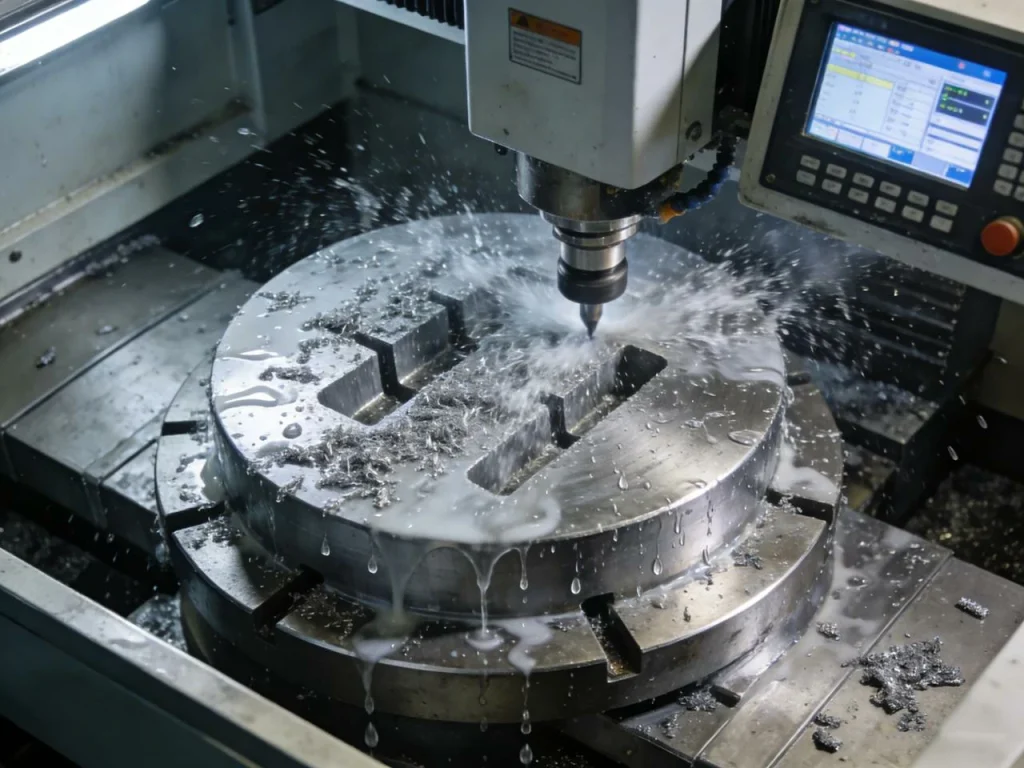
CNC machining workflow: rough machine in annealed → heat treat → finish
If you’ve worked around tight-tolerance parts, you’ve probably seen this pattern. You start with annealed steel, rough out pockets and profiles, send the part to heat treat for final strength (often quench and temper), and then come back for finishing cuts or grinding.
Why do it this way? Because machining a fully hardened part is slower, tool costs are higher, and the risk of chipping tools rises fast. By roughing in annealed condition, you protect your tools and you keep cycle times reasonable. Then you harden only after the bulk material is removed.
A scenario I’ve seen many times is a thin-wall pocket part that looks fine on the machine but moves during inspection. After switching to a rough-machine → stress relief → finish-machine sequence, the same geometry often holds size with fewer surprises.
Forming and sheet/strip production: why annealed states enable big reductions
Cold working increases strength but reduces ductility. Sheet and strip routes take advantage of this by alternating between cold work and anneals.
The steel is rolled thinner until it starts to lose formability. Then it is annealed to restore ductility, and rolling continues. This is one reason annealed (or “coil annealed”) material is so important in sheet supply chains.
This same idea applies in the fab shop. If you need tight bends, deep draws, or multiple forming hits, annealed metal is often the safer starting point than work-hardened stock.
Welding and fabrication: stress-relief annealing to control warp
Large welded frames can carry huge locked-in stress. You may not see it until you machine a reference surface, and then the part pulls like a banana.
Stress relief annealing is often used before final machining for weldments and heavy fabrications. It helps prevent movement during service too, especially in parts that see temperature swings or vibration.
Can annealed steel be hardened again later?
Often, yes. Many steels are annealed as a starting condition and later hardened by quenching and tempering. The limit is chemistry: some steels are not hardenable in the same way, and stainless families behave differently. For example, some stainless steels are hardened by heat treatment while others are not, and some gain strength mainly from cold work. The safe move is to confirm the grade family and the intended hardening route before you assume it will harden later.
Specs, purchasing, and drawing notes (how to request annealed steel)
When buying steel, a key question is: what is annealed steel and how should it be specified? Specifying annealed steel correctly is just as important as choosing the right grade. Whether for machining, forming, or welded assemblies, clear instructions on anneal type, hardness targets, and surface expectations ensure you get steel that performs as intended. Understanding what to include in RFQs and drawings helps prevent delays, scrap, and costly surprises in production.
How to specify annealed steel correctly (RFQ/drawing checklist)
Buying “steel” is not the same as buying annealed steel. If you care about machining, forming, or stability, you need to write the request clearly.
In an RFQ or drawing note, specify the steel grade and then add the supply condition details. The most useful items are the anneal type and a hardness target.
A clear request usually includes:
- Steel grade / standard designation
- Condition: annealed, soft annealed, spheroidize annealed, or stress relieved
- Target hardness or hardness range (when applicable)
- Certification requirements (test report, heat/lot traceability)
- Surface expectations (scale allowed or protective atmosphere required)
- Machining allowance if decarb or scale cleanup is expected
That last point is easy to miss. If you need clean surfaces and you’re annealing in air, you may need extra stock for cleanup.
Cost, lead time, and availability implications
Annealing adds furnace time, handling, and sometimes atmosphere control. That can increase lead time, especially in busy heat treat schedules or when protective atmospheres are required.
Still, the cost is not only the heat treat line item. If annealing reduces scrap, reduces tool consumption, and reduces rework from distortion, it can lower the total job cost. Many shops learn this after they fight one part number for weeks and then realize the issue was the starting condition.
How do you tell if steel is annealed?
Appearance is not a reliable indicator. Scale can happen on many treatments, and bright surfaces can come from controlled atmospheres.
The practical checks are:
- review the certification for the stated condition,
- run a hardness test (Rockwell or Brinell),
- and pay attention to machining behavior during a controlled trial cut.
If you’re receiving steel for production, incoming hardness checks can prevent an expensive “wrong condition” batch from reaching the machines.

Quality control, risks, and troubleshooting annealed steel
Even though annealing improves machinability and reduces stress, it’s not a “set-and-forget” process. Proper quality control—including hardness verification, microstructure checks, and trial machining—helps catch under- or over-annealing issues early. Understanding the common risks and troubleshooting methods ensures annealed steel performs reliably in production and prevents costly surprises.
Verification methods: hardness tests + microstructure checks
For most general work, hardness is the go-to verification because it’s fast and directly tied to machinability expectations.
| Check method | What it confirms | When to use it |
|---|---|---|
| Rockwell hardness | Quick pass/fail vs target range | Incoming inspection, shop-floor verification |
| Dureza Brinell | Good for softer steels and bulk checks | Medium-carbon steels, forgings, thicker sections |
| Microstructure examination | Confirms structure targets (like spheroidized carbides) | Tool steels, critical fatigue parts, failure investigations |
| Dimensional movement check (trial roughing) | Confirms stress condition in real geometry | Tight tolerance parts, thin walls, large plates |
Common problems and how they show up
Under-annealing shows up as steel that is still too hard. You’ll feel it in machining: tools wear fast, drilling is slow, tapping torque spikes, and formed edges crack early.
Over-annealing shows up differently. The steel may be soft, but grain growth can reduce toughness and make performance uneven. If a part that “should be fine” starts failing impact or shows inconsistent behavior across batches, this can be part of the root cause.
Surface problems are also common. Oxidation scale can ruin surface finish plans, and decarburization can cause soft surface layers that are unwanted if the surface must later be hardened or carry load.
Disadvantages of annealing (what can go wrong)
People often ask this straight: what are the disadvantages of annealing? The main ones are practical:
Annealing takes time and energy, so it adds process cost and lead time. It can also cause surface scale and decarb if done in air, which may force extra cleanup machining. If the cycle is not controlled, it can lead to grain coarsening (grain growth), which can hurt toughness. And because annealing lowers hardness and strength, it may be the wrong final condition for parts that must carry high loads without later heat treatment.
Annealing solves real problems, but it is not “free,” and it is not always the right end state.
Actionable takeaways (summary)
When you’re deciding whether to buy or use annealed stock, it helps to ask: what is annealed steel and will it solve your machining or forming issues? A simple mental checklist helps. Are you trying to stop cracking during forming, reduce tool wear during machining, or reduce warping from internal stress? If yes, annealing or stress relief is often on the short list.
When you specify annealed steel, don’t stop at the word “annealed.” Call out the anneal type and a target hardness range when possible. Then verify with hardness checks and, when needed, microstructure or movement checks.
Preguntas frecuentes
Annealing steel is basically a heat treatment process that makes steel softer and easier to work with. The annealing process involves heating the metal to a specific temperature and then cooling it slowly. This relieves internal stresses from previous manufacturing or hardening. The main purpose is to improve ductility, reduce brittleness, and make steel easier to bend, cut, or shape. So, if you’re doing CNC turning, CNC milling, or CNC machining, annealing your steel can save a lot of headaches because it improves workability without compromising too much strength.
Annealed steel and tempered steel are both heat-treated, but they serve very different purposes. Annealed steel is soft and ductile because of the slow cooling in the annealing process, while tempered steel is first hardened (often by quenching) and then reheated at a lower temperature to reduce brittleness. In short, annealed steel is for easier shaping and machining, while tempered steel is for applications needing hardness with some flexibility. Knowing what is annealing versus tempering helps you pick the right material for CNC machining or fabrication tasks.
Annealed steel is softened through the process of annealing metal, which involves slow cooling to relieve internal stresses. Quenched steel, on the other hand, is cooled rapidly, making it very hard but also brittle. So the key difference is hardness and flexibility: annealed steel is soft and workable, perfect for CNC turning or milling, while quenched steel is hard and better for wear resistance but more difficult to machine. Understanding annealing definition can help you choose the right treatment for your project.
While annealing improves workability, it also has downsides. Annealed steel is weaker than hardened or tempered steel and wears out faster under heavy stress. Also, the annealing process can be time-consuming and requires precise temperature control. If done incorrectly, the steel can become unevenly soft or even warped. So, while CNC machining and metal fabrication become easier after annealing, it’s not the best choice for tools or parts that need maximum hardness.
To anneal steel means to heat it to a specific temperature and then let it cool slowly. This process of annealing metal relieves internal stresses and softens the steel, improving ductility and machinability. Basically, annealing is like giving your steel a “relaxing treatment,” making it easier to bend, shape, or cut without cracking. Knowing what is annealing helps you understand why this step is critical before processes like CNC milling or turning.
When people say “steel,” it could be any type—soft, hard, tempered, or quenched. Annealed steel, however, has been softened through the annealing process to improve workability. The difference is in mechanical properties: annealed steel is softer, more ductile, and easier to handle in CNC machining or fabrication, while untreated steel may be harder, more brittle, and less predictable. Understanding annealing definition makes it easier to choose the right steel for your application.
You might want to anneal your metal because it improves machinability, reduces cracking risk, and makes it easier to shape, cut, or weld. The process of annealing metal makes steel more forgiving during fabrication, especially if you’re doing CNC turning, CNC milling, or machining. Think of it as prepping your metal for work: annealed steel is softer, more ductile, and much less likely to cause headaches in shaping or forming.
Yes! One of the biggest advantages of the annealing process is improved machinability. Annealed steel is softer, which reduces wear on tools during CNC turning, milling, or machining. Because internal stresses are relieved, the metal is less likely to warp or crack. So if you want smooth, efficient machining, annealing your steel before work is usually a smart move.
Typically, annealing is done before machining. The goal is to soften the steel, making CNC turning, milling, or machining easier and less stressful on tools. Sometimes, a secondary annealing may be done after rough machining to relieve stress caused by initial cuts, but in most cases, annealing comes first. Think of it as prepping your steel for work so it’s easier to shape and less likely to give you trouble.

 Spanish
  English
  German
  French
  Italian
  Polish
  Czech
Czech  Japanese