
Choosing between forging vs CNC machining is not just a sourcing decision. It affects part strength, fatigue behavior, geometry, tolerance strategy, material waste, finishing steps, and production cost. For many industrial components, the best answer is not “forging or machining.” It is often “forged blank plus CNC finishing.”
This guide focuses on manufacturability and engineering risk. It explains when a part can be forged, when it should be machined from bar or billet, and when a hybrid route is the safer choice.
What Forging and CNC Machining Are—and Why the Choice Matters
Forging and CNC machining both make metal parts, but they do it in very different ways. Forging changes the shape of metal by compressive force. CNC machining removes material from a starting stock such as billet, bar, plate, or a forged blank.
That difference matters because the process changes the internal structure of the part, the shapes that can be made, the tolerance plan, and the cost model.
Forging vs CNC machining: forming metal vs subtractive manufacturing
Forging is a forming process. Metal is pressed, hammered, or squeezed into shape using dies or tooling. It may be hot, warm, or cold. Hot forging gives high ductility and makes the material easier to form, but it can bring more dimensional variation and risk of warping. Cold forging can produce better dimensional control and may need less finishing, but it is less flexible for complex shapes.
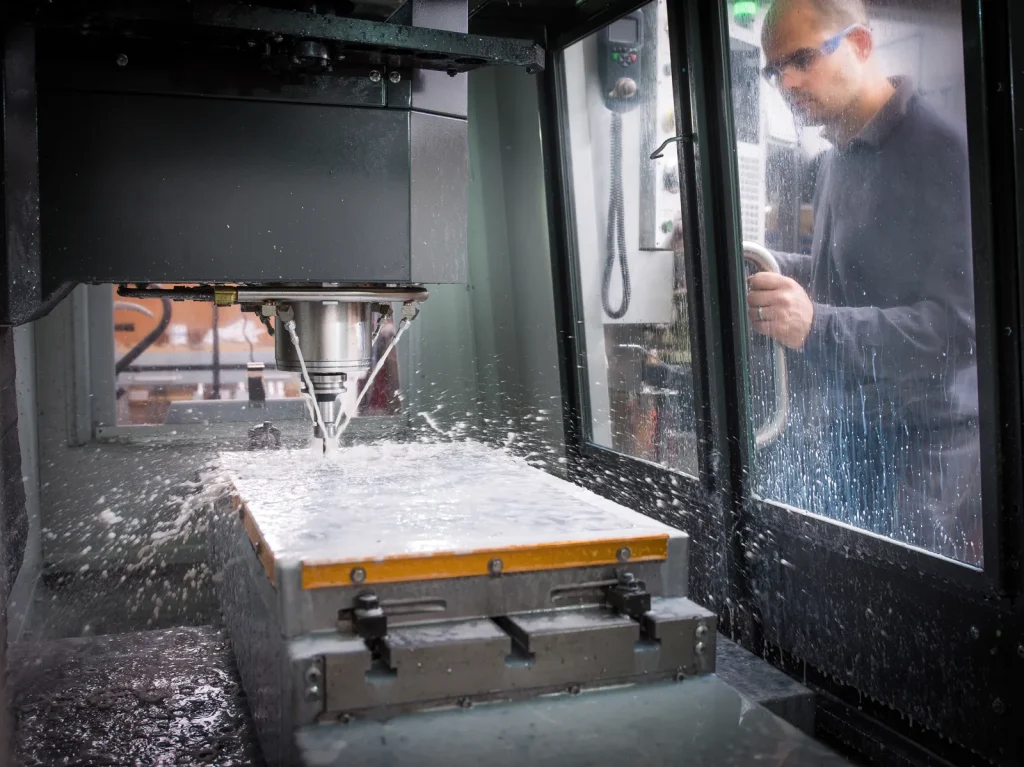
CNC machining is subtractive manufacturing. A programmed machine tool cuts away material to create the required geometry. Milling, turning, drilling, tapping, and related operations can produce precise features such as internal threads, flat datum faces, holes, pockets, sharp transitions, and complex 3D surfaces.
The engineering difference is simple: forging forms the material and can improve grain flow; CNC machining cuts the material to size and shape with high precision.
Why manufacturing methods affect strength, precision, cost, and finishing
A forged part often has better strength, toughness, and fatigue resistance than a part machined from stock of the same general material form. The reason is grain flow. During forging, the metal’s grain structure can be shaped to follow the part form. This is useful where loads pass through arms, webs, bosses, shoulders, or other high-stress regions.
Material family changes the decision. Carbon and alloy steels are commonly forged for load-bearing parts, stainless steels may need tighter control of scale and finishing, aluminum is often chosen for billet machining when geometry is complex, and titanium or nickel alloys require closer review of forgeability, oxidation risk, tool wear, and heat-treatment sequence. These material and forging principles are referenced by ASM International.
CNC machining does not create this grain flow. It removes material from billet, bar, or plate. The starting stock may still have useful material properties, but the machining operation can cut through the existing grain direction. For low-load parts, prototypes, fixtures, housings, brackets, and precise custom components, this may be acceptable. For high-impact or cyclic-load components, it may add design risk.
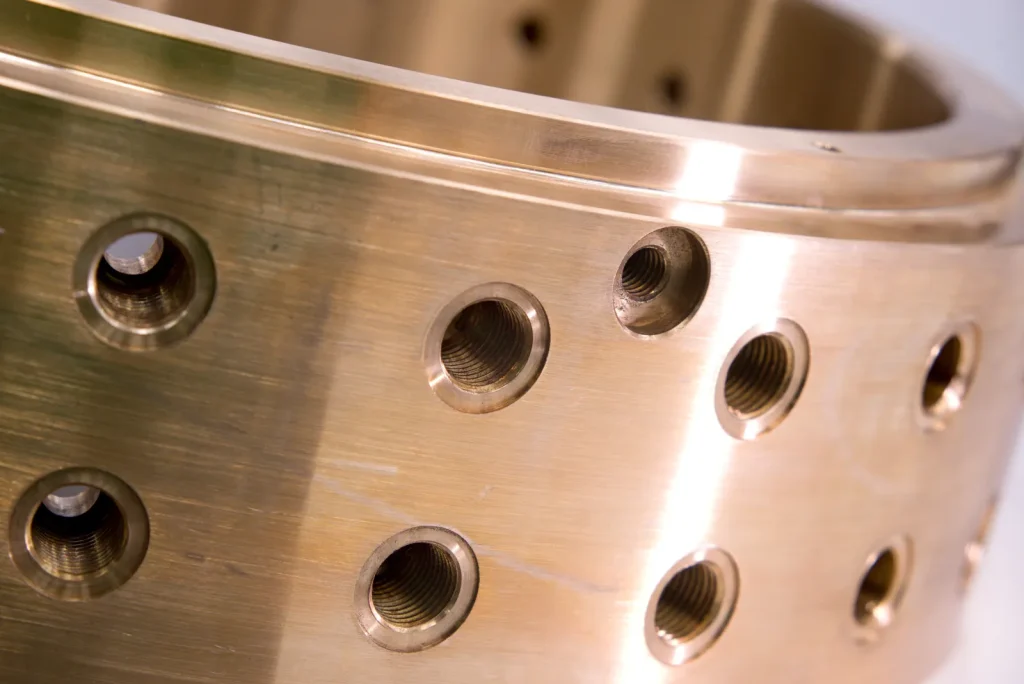
Precision works the other way. CNC machining is usually better for tight features and detailed geometry. Forging can produce the near-net shape, but it often needs secondary machining for bores, threads, sealing faces, bearing seats, and other functional surfaces.
Strength-critical parts: why process selection changes engineering risk
Forging vs CNC machining for strength-critical parts should be evaluated early in design. If the part will see high impact, repeated load cycles, shock, compressive loads, or bending stress, the manufacturing method can affect failure risk.
Forged parts are often chosen for aerospace, automotive, and heavy machinery components because grain flow can support load paths. This does not mean every forged part is automatically safe, and it does not mean every machined part is weak. The geometry, material, heat treatment, surface condition, and inspection plan still matter.
The key point is that CNC machining alone may not be the best route when the design depends on directional strength and fatigue resistance. In those cases, a forged preform followed by CNC finishing can reduce risk while still meeting precise dimensional needs.
Table: core differences between forged and machined parts
| Faktor | Kování | CNC obrábění |
|---|---|---|
| Basic method | Forms metal under compressive pressure | Removes material from stock |
| Internal structure | Can align and refine grain flow | Cuts from existing billet, bar, plate, or forged stock |
| Strength behavior | Often preferred for high-load and impact parts | It depends strongly on starting stock and geometry |
| Odolnost proti únavě | Often better due to grain flow continuity | May be limited if machining cuts across grain flow |
| Geometrie | Better for simpler, formable shapes | Better for complex geometry and detailed features |
| Tolerance | Often needs secondary machining for tight features | Strong choice for tight dimensional requirements |
| Povrchová úprava | Rougher as-forged surface | More consistent machined finish |
| Cost model | Higher initial tooling, lower unit cost at volume | Lower tooling burden, more machine time per part |
| Odpady | More material-efficient for near-net shapes | Can create high scrap when cut from solid block |
| Typical route | Forged blank, then finish operations | Machine directly from bar, billet, plate, or blank |
Can the Part Be Made by Forging, CNC Machining, or Both?
A feasible process choice starts with the part geometry and performance requirement. Some parts are clearly suited to forging. Some are clearly suited to CNC machining. Many fall between the two.
The practical question is whether the required shape can be formed without creating defects, whether the functional details can be added later, and whether the total process is economical for the expected volume.
When forged blanks are better than CNC machining
Forged blanks are better than CNC machining when the part needs high strength and the main shape is suitable for forming. This is common for connecting rods, crank-like parts, levers, shafts with enlarged sections, high-load hooks, impact tools, and structural arms.
Forging can reduce the amount of material removed because the blank is closer to the final shape. This is one reason how forging reduces material waste compared to CNC machining becomes important for larger parts or high-volume work. Machining a high-load part from a solid block may remove a large amount of material before the final form appears. A forged blank can place material closer to where it is needed.
Forged blanks also help when the load path matters. If the part has a shape where stress flows through curved arms, transitions, or bosses, grain flow can improve durability.
Forged parts are often selected for fatigue, impact, or multiaxial loading when the forged flow pattern, final geometry, and machining plan preserve material continuity in critical zones. Compression performance still depends on alloy, section size, heat treatment, and overall part design, so forging is not automatically superior in every compressive-load case.
When CNC machining is better for complex geometry and tight features
CNC machining is often better when the part has complex geometry, low production volume, or tight functional details that are difficult or impossible to forge. Examples include internal threads, precision bores, sharp angles, small pockets, thin walls, flat datum surfaces, and detailed 3D contours.
CNC machining also suits prototype and low-volume aerospace-style components where the design may change. In that case, the cost and time required to make forging dies may not be justified. Machining from billet or bar allows design changes without rebuilding forging tooling.
For this reason, forging vs subtractive manufacturing for aerospace components is rarely a simple either-or choice. Complex prototype shapes may be machined directly. Production strength-critical parts may be forged and then machined.
Design constraints when combining forging and precision milling
Combining forging and precision milling can be effective, but it adds design constraints. The forged blank must leave enough machining allowance for final surfaces. It must also be shaped so that cutting tools can reach the required features.
Forging feasibility still has practical limits: thin ribs, abrupt section changes, sharp radii, undercuts, deep recesses, and poor parting-line placement can create die-fill problems, flash control issues, or excessive cleanup stock. Symmetry, draft direction, and enough machining allowance on critical surfaces should be checked before treating a forged blank as near-net.
Design constraints when combining forging and precision milling include parting line location, draft, die access, machining datums, clamping surfaces, and stock allowance. If the forged blank has irregular surfaces, the CNC setup must still locate the part repeatably. Poor datum planning can lead to tolerance stack-up or uneven material removal.
The design should also avoid assuming that every forged surface will be final. Functional faces, holes, threads, sealing areas, and bearing features often need machining after forging.
Checklist: feasibility questions for material, geometry, volume, and tolerance
Use this checklist before choosing the route:
| Feasibility question | Proč je to důležité |
|---|---|
| Is the part strength-critical or impact-loaded? | Forging may reduce risk through grain flow and toughness. |
| Does geometry have smooth load paths? | Forging works better when the form can be shaped in dies. |
| Are there internal threads, tight bores, or sharp details? | These usually require CNC machining. |
| Is the volume high enough to justify forging tooling? | Forging often becomes more cost-effective at higher volumes, but no universal break-even applies. |
| Is material waste a major cost driver? | Forged blanks may reduce scrap compared with machining from solid block. |
| Are tight tolerances required for functional features? | CNC finishing may be needed even if the part is forged. |
| Can the forged blank be held and located for machining? | Fixturing and datums affect tolerance capability. |
| Will heat treatment be required? | Heat treatment may affect dimensions and finishing sequence. |
How Forging and CNC Machining Work
The process route affects both the internal structure and the final dimensions. This is why engineers should review manufacturing early, not after the drawing is complete.
How grain structure affects forged part strength
Metal has a grain structure. In simple terms, grains are small regions inside the metal with a shared crystal orientation. When metal is forged, compressive force can refine and direct this grain structure.
How grain structure affects forged part strength is central to the forging decision. In a forged component, grain flow can follow the outside shape of the part. This can help resist crack initiation and crack growth under load. It can also improve toughness compared with a machined shape cut from stock where the grain path may be interrupted.
This is most useful where stress is not uniform. Shoulders, transitions, bosses, and curved sections often see local stress concentration. A forged shape can place material flow around these features instead of cutting across them.
Impact of grain flow on durability of forged components
The impact of grain flow on durability of forged components becomes important under cyclic loading. Fatigue failures often begin at surface defects, notches, sharp transitions, or internal weak points. A forged grain pattern that follows the part geometry can improve resistance to fatigue-related damage.
Forged vs machined parts fatigue resistance is not controlled by grain flow alone. Surface finish, heat treatment, residual stress, design radius, and inspection quality also matter. A poorly designed forged part can still fail. A well-designed machined part can perform well in many applications. But for high-load parts with repeated stress, forged grain flow is often a strong reason to choose a forged blank.
How CNC machining removes material from billet, bar, or forged stock
CNC machining uses controlled cutting tools to remove material. The starting stock may be round bar, plate, billet, casting, extrusion, or forging. The tool path defines the shape.
When machining from solid block, the final part may occupy only part of the starting material. This creates chips and scrap. Factors affecting scrap rates in CNC machining from solid block include starting stock size, part envelope, pocket depth, wall thickness, material cost, and how closely the stock matches the final part shape.
Machining from forged stock can reduce this waste because the forged blank is closer to the final form. But it can also increase setup complexity. Irregular forged surfaces may need special fixturing, and the process must account for variation from blank to blank.
Process diagram: forged blank → heat treatment if required → CNC finishing
A common hybrid route is:
Material selection → Forging design and die planning → Forged blank production → Trimming, cleaning, or scale removal as needed → Heat treatment if required → Datum preparation → CNC turning, milling, drilling, or threading → Deburring, finishing, and inspection
This route uses forging for the near-net shape and mechanical performance, then CNC machining for precision surfaces and detailed features. Heat treatment may occur before or after some machining steps depending on the material and dimensional requirements.
Advantages and Limitations of Forging vs CNC Machining
Each process solves a different problem. Forging is not a universal replacement for machining. CNC machining is not a universal replacement for forging.
Strength and durability comparison of forged and machined parts
A strength and durability comparison of forged and machined parts starts with the load case. Forging is often preferred for high-impact metal components and parts that carry heavy cyclic loads. It can improve grain flow and toughness, which helps in service conditions where cracking, bending, or shock loads are concerns.
CNC machining is preferred when strength is not the main limiting factor or when precision geometry is more important than grain direction. It can also be the right choice for low-volume high-performance parts when forging tooling is not practical.
A machined part can still be strong if the material, stock form, heat treatment, and design are suitable. The risk is that machining from bar or billet may remove material in a way that does not support the main load path as well as a forged shape.
Forged vs machined parts fatigue resistance
Forged vs machined parts fatigue resistance depends on grain flow, surface finish, stress concentration, and post-processing. Forging may improve fatigue performance by keeping grain flow more continuously around the part shape. This is why many load-bearing automotive, aerospace, and heavy equipment components use forging as the first shaping step.
CNC machining can introduce sharp corners if the design allows them. Sharp internal features can increase local stress. Good machining practice uses suitable radii, smooth transitions, and controlled finishing where fatigue matters.
If a forged part is later machined, the finishing process should avoid cutting away too much of the beneficial grain flow in critical zones. This is a design and process planning issue, not just a machining issue.
Surface finish differences between forged and machined parts
Surface finish differences between forged and machined parts are usually clear. As-forged surfaces are rougher and may show scale, parting lines, flash trim marks, or die-related texture. These surfaces may be acceptable for non-functional areas, but they are often not suitable for sealing, bearing, sliding, or close-fit features.
Functional surfaces should be specified by whether they remain as-forged or are machined clean. Forged skin, scale, and decarburized surface layers may need full removal on sealing faces, fatigue-critical radii, corrosion-sensitive areas, or features that require stable datum definition for later machining.
CNC machined surfaces are more consistent and can produce precise functional faces. This is why forged components often receive CNC soustružení nebo frézování after forging. The machining step creates the final surface condition where function demands it.
Surface finish also affects fatigue. A rough surface can become a crack initiation site in loaded parts. For strength-critical applications, the surface condition should be reviewed along with material and geometry.
Table: strength, toughness, complexity, surface finish, material waste, and secondary operations
| Kategorie | Kování | CNC obrábění | Decision note |
|---|---|---|---|
| Síla | Strong choice for load-bearing forms | Depends on stock and design | Use forging when grain flow supports the load path. |
| Houževnatost | Often favorable due to worked grain structure | Material-dependent | Check heat treatment and service loads. |
| Složitost | Limited by die design and material flow | Strong for detailed geometry | Machine complex features when forging cannot form them. |
| Povrchová úprava | Rougher as-forged | Důslednější | Functional surfaces often need CNC finishing. |
| Materiálový odpad | Lower when near-net shape is practical | Higher when cutting from solid block | Waste depends on stock size and part shape. |
| Sekundární operace | Often required for precision | May need deburring or finishing | Hybrid routes are common for precision forged parts. |
Common Problems, Failure Risks, and Manufacturing Constraints
Manufacturing risks often appear when the chosen process is forced beyond its natural limits. A part designed for CNC machining may be difficult to forge. A part designed for forging may be expensive to machine from solid stock.
Forging also has process-specific quality risks, including laps, folds, underfill, scale, die mismatch, decarburization, and internal discontinuities from poor process control. Buyers should confirm what blank inspection is performed before machining, how machining stock is verified by feature zone, and whether first-article results show that critical areas clean up consistently after heat treatment and finish machining.
Limitations of CNC machining for high-stress components
Limitations of CNC machining for high-stress components are tied to material removal and grain direction. CNC machining does not improve grain flow around a part shape. If a part is machined from solid stock, the cut geometry may interrupt the original grain direction.
This can matter in arms, hooks, yokes, connecting members, and parts with highly loaded transitions. Machining can also create stress risers if internal corners are too sharp or if tool access forces small radii.
CNC machining is still useful for high-stress components when used for finishing forged blanks. The risk increases when machining is expected to replace forging for a part where impact strength, fatigue life, or directional load behavior are critical.
When CNC machining is not suitable for high-load parts
When CNC machining is not suitable for high-load parts, the reason is often not machine accuracy. CNC machines can make accurate parts. The issue is whether the material structure and geometry can carry the load safely.
Machining from bar or billet may be less suitable when the part needs continuous grain flow through a curved or branched shape. It may also be less suitable when the part would require removing large amounts of expensive material to create a near-net load-bearing form.
If the design has high stress and a simple formable shape, forging should be evaluated before committing to machining from solid stock.
Challenges of holding tight tolerances on forged parts
Challenges of holding tight tolerances on forged parts come from the nature of the forming process. Hot forging can involve dimensional variation, scale, die wear, cooling effects, and possible warping. Cold forging can achieve tighter control than hot forging in some cases, but it has more limits on shape and material flow.
Because of this, tight tolerances are often assigned only to machined features, not to every forged surface. The drawing should separate as-forged surfaces from machined surfaces. If every surface is given a tight tolerance, the forged route may become difficult or uneconomical.
Tolerance planning should include datums, machining allowance, heat treatment effects, and how the part will be held during CNC finishing.
Risks of machining complex shapes from forged stock
Risks of machining complex shapes from forged stock include uneven stock allowance, tool access problems, fixture instability, and cutting into regions where grain flow is important. A forged blank is not the same as a square billet. Its surfaces may vary, and the machining process must account for that variation.
If the blank is poorly designed, one part may clean up well while another does not have enough stock in a critical area. If the blank has too much stock, machining time and waste increase. If it has too little, features may not clean up or may fall outside tolerance.
This is why forged blank design and CNC process planning should be done together.
Cost, Tolerance, Waste, and Lead Time Factors
Cost tradeoffs between forging and CNC machining depend on volume, tooling, geometry, material, finishing, and inspection. There is no universal break-even point. A simple high-volume forged part may be economical after tooling is made. A complex low-volume part may be better machined directly.
A practical screening rule is to treat billet machining as easier for prototypes, low volume, or designs that may change, because it avoids die development and tooling revision cycles. Forging becomes more attractive as volume rises, geometry stabilizes, alloy cost increases, or hog-out waste and machining time become dominant, but the break-even point depends on tooling amortization, blank yield, secondary machining content, and inspection requirements.
Cost tradeoffs between forging and CNC machining
Forging usually has higher upfront cost because dies and process development are required. Once those are in place, the per-part shaping time can be efficient for repeated production. This is why forging is often used for high-volume automotive and heavy machinery parts.
CNC machining usually has lower initial tooling demand but more cutting time per part. Cost increases when the part needs long cycle time, many setups, complex fixtures, difficult tool access, or large material removal.
The cost of forging vs CNC from bar stock should include more than the quoted unit price. It should include material yield, scrap, finishing operations, inspection, heat treatment, and the cost of design changes.
How forging reduces material waste compared to CNC machining
How forging reduces material waste compared to CNC machining is tied to near-net shaping. A forged blank can place material near the final geometry before precision features are machined. This can reduce chip volume compared with milling the entire part from a block.
This matters when material is expensive, the part envelope is large, or the final shape has arms, bosses, and thick-to-thin transitions. In those cases, machining from solid stock may create high scrap because much of the starting material becomes chips.
Forging is not waste-free. Flash, trimming, scale, and rejected blanks can still occur. But for suitable shapes and volumes, it can reduce waste compared with fully subtractive machining.
Factors affecting scrap rates in CNC machining from solid block
Factors affecting scrap rates in CNC machining from solid block include the ratio between stock size and final part size, pocket depth, part complexity, number of setups, tool reach, and material behavior during cutting.
Parts with deep pockets, thin ribs, large cutouts, or sculpted forms often generate more chips. If the part must be machined from multiple sides, setup error can also create scrap risk. Material movement after roughing can affect final accuracy, especially when a large amount of material is removed.
A forged blank can reduce some of these issues, but only if the blank is repeatable and has enough machining allowance.
Tolerance challenges when machining forged blanks
Tolerance challenges when machining forged blanks come from locating and holding a shape that may not have flat, precise surfaces before machining. The CNC process needs stable datums. If the first operation cannot locate the part repeatedly, later features may shift.
Machining allowance is also important. Too little allowance risks uncleaned forged surfaces. Too much allowance removes the cost and wastes the benefit of forging. Heat treatment can add more dimensional change, so the process sequence must be planned around final tolerance requirements.
The practical approach is to define which surfaces are forged, which are machined, and which features control assembly function.
Applications: Where Each Process Performs Best
The best manufacturing method depends on load, shape, volume, and tolerance. Applications should not be selected by process preference alone.
Forging vs CNC machining for strength-critical parts
Forging vs CNC machining for strength-critical parts favors forging when the part has high loads, repeated stress, impact, or a need for directional grain flow. Examples include connecting rods, heavily loaded levers, shafts with formed features, and components used in heavy machinery.
CNC machining is often used after forging to finish critical features. This may include bores, faces, holes, threads, and mounting surfaces. The forged form carries the load; the machining step controls fit and function.
For low-volume strength-critical parts, direct CNC machining may still be used if the design, material, and inspection plan support the load case. But it should not be chosen only because it is easier to source.
Forging vs subtractive manufacturing for aerospace components
Forging vs subtractive manufacturing for aerospace components depends on production stage and part duty. Prototype parts with complex shapes, acute angles, or internal features may be machined because CNC allows precision without forging dies.
For production parts where strength and fatigue behavior are critical, forging followed by machining is often evaluated. Aerospace components often need both mechanical performance and precise interfaces. Forging supports the material structure, while CNC machining produces final geometry.
This hybrid logic is common when a part must be strong but also has precise assembly surfaces.
Best manufacturing method for high-impact metal components
The best manufacturing method for high-impact metal components is often forging if the shape can be formed. Impact-loaded parts benefit from toughness and grain flow continuity. Forging can help reduce the risk of brittle or fatigue-related failure in demanding service.
CNC machining may still be needed for final details. For example, a forged impact component may need machined holes, flats, slots, or bearing seats. If the component is simple and high volume, forging may control most of the shape. If it is complex or low volume, CNC machining may play a larger role.
Forging vs casting for impact-resistant metal parts
Forging vs casting for impact-resistant metal parts is a related decision. Casting can make complex shapes by pouring molten metal into a mold, but forged parts are often selected where impact resistance, toughness, and fatigue behavior are more important.
Casting may be useful when geometry is too complex for forging, but cast parts can have different internal structure and defect risks. For high-impact service, forging is often reviewed before casting or direct machining. The final choice should consider material, load case, geometry, inspection, and cost.
Decision Guide: How to Choose the Right Process
A practical decision starts with four questions: what loads will the part see, how complex is the geometry, how tight are the functional tolerances, and what production volume is expected?
Is forging stronger than CNC machining?
Forging is often stronger for load-bearing metal parts because it can refine and align grain flow with the part shape. This can improve toughness and fatigue resistance compared with machining the same shape from stock.
CNC machining does not make the material weak by default. Its limitation is that it removes material and may interrupt the stock’s original grain direction. For non-critical parts, precise parts, prototypes, and complex features, CNC machining may be the better route.
For strength-critical parts, forged blanks should be considered early.
Is CNC machining more accurate than forging?
CNC machining is generally more suitable for tight tolerances and precise features. It is the strongest choice for internal threads, accurate holes, flat datum surfaces, close-fit features, and detailed 3D geometry.
Forging can produce the main shape, but it is not usually the best process for final precision surfaces. Hot forging can have dimensional variation and warping risks. Cold forging can improve dimensional control, but it still has shape limits.
The practical answer is that forging controls the material form, while CNC machining controls precision.
Should forged parts still be CNC machined?
Forged parts often still need CNC machining. This is normal for parts that require tight tolerances, precise holes, threads, bearing surfaces, sealing faces, or controlled mounting features.
The hybrid route is useful because it combines the mechanical benefits of forging with the precision of CNC machining. It also allows the designer to place machining only where it is needed instead of machining the entire part from solid stock.
The drawing should make this clear by identifying machined surfaces, forged surfaces, datums, and critical dimensions.
Decision matrix: choose forging, CNC machining, or forged blank plus CNC finishing
| Situace | Better process route | Důvod |
|---|---|---|
| High-load part with simple formable geometry | Kování | Grain flow and toughness are valuable. |
| High-impact parts with tight bores or threads | Forged blank plus CNC finishing | Forging supports strength; machining controls features. |
| Low-volume prototype with complex geometry | CNC obrábění | Avoids forging tooling and supports design changes. |
| Part with many internal details or sharp features | CNC obrábění | Forging may not form these details. |
| High-volume simple metal component | Kování | Tooling can be spread over production volume. |
| Large part machined from solid with high material removal | Forged blank plus CNC finishing | May reduce waste and machining time. |
| Part requiring tight tolerance on most surfaces | CNC machining or hybrid | Forging alone is unlikely to meet all precision needs. |
| Part with high fatigue risk at transitions | Forging or hybrid | Grain flow and surface finishing should be planned together. |
In short, choose forging when strength, toughness, impact resistance, and volume matter more than detailed geometry. Choose CNC machining when precision, complexity, and low-volume flexibility matter more. Choose forged blank plus CNC finishing when the part needs both strength and accurate functional features.
Nejčastější dotazy
Is a forged part stronger than a machined part?
A forged part is often stronger for high-load service because forging vs CNC machining directly impacts internal structural performance by aligning grain flow with the part shape to boost toughness and fatigue resistance. A machined part can still deliver solid strength for general use scenarios and low-stress applications in standard industrial assembly. Machining cannot generate the same continuous directional grain flow that forging creates through compressive forming processes. Performance gaps tied to forged vs machined strength become most noticeable under cyclic loads, impact pressure, and long-term fatigue working conditions.
Why are aerospace parts often forged and then machined?
Aerospace parts must balance reliable mechanical performance and strict dimensional precision for safe assembly and long-term operational stability. Optimized grain structure in metal parts from controlled forging withstands extreme flight loads, vibration, and demanding long service cycle requirements. CNC machining then adds accurate holes, flat datum faces, threads and complex assembly features that standalone forging cannot form precisely. This hybrid method minimizes engineering risk while meeting both aerospace strength benchmarks and tight industrial tolerance specifications.
Can you achieve tight tolerances with forging?
Forging on its own rarely meets strict tight functional tolerances required for sealing, bearing and precision mating surfaces in mechanical systems. Cold forging offers better dimensional control than hot forging yet still faces inherent limits with complex detailed geometry and sharp transitional features. Hot forging commonly suffers from cooling warping, scale buildup and minor die wear that create unavoidable natural dimensional variation. Understanding when to use forged blanks for CNC ensures nearly all precision-critical forged components rely on secondary finishing to lock in final accurate tolerances.
What is the main cost difference between forging and CNC machining?
Forging requires expensive upfront die design, tooling fabrication and process validation investment at the initial project development stage. It delivers much lower per-unit production cost once scaled to high-volume consistent part runs across long manufacturing cycles. CNC machining avoids heavy initial tooling costs but accumulates higher expenses from long cutting cycle times and repeated machine setups. Professional high-stress component manufacturing strategies weigh both process costs alongside material waste and long-term service reliability.
Cost of forging vs CNC from bar stock?
Forging from custom blanks cuts material waste significantly by forming near-net shapes before any precision cutting or finishing work commences. CNC machining directly from solid bar stock removes large volumes of raw material, creating costly metal chips and extended processing hours per unit. Forging becomes far more cost-effective at high production volumes by spreading fixed tooling costs across thousands of identical finished units. Engineers also evaluate high-impact resistant CNC parts performance alongside custom forgings with precision milling to select the most economical and durable production route for low-volume prototypes and revised industrial designs.

 Czech
Czech  English
  German
  French
  Italian
  Spanish
  Polish
  Japanese