
Úvod
Choosing between progressive die and transfer die stamping is a manufacturability decision, not just a tooling preference. Choose progressive die stamping when the part can remain attached to a carrier strip, the geometry does not require regrip or rotation, and annual volume is high enough to justify more integrated tooling. Choose transfer die stamping when the part must be separated early, requires open access between stations, or needs deeper forming, larger part size, or independent station control. If both are technically feasible, compare scrap, press platform availability, secondary operations, and tooling amortization before release. If volume is low or the part changes often, a line or single-operation die may be the better path.
The core question is whether the part should move through the press as part of a continuous coil strip, or as an individual blank that is transferred between stations.
In simple terms, progressive die stamping is strip-based high-speed stamping. Transfer die stamping is blank-based transfer stamping. Both can make automotive parts at production scale, but they solve different problems.
The right choice depends on part size, geometry, annual volume, material utilization, tooling cost, tolerance risk, and program flexibility. A small bracket with holes and flanges may be ideal for progressive tooling. A deep-drawn shell, frame, or tall 3D part may need transfer tooling because it cannot stay attached to a carrier strip without interference.
The key point is to evaluate the part before the tool is designed. Once the die concept is fixed, changes become more expensive and harder to validate. Metal stamping processes such as progressive and transfer die stamping are widely used in automotive and industrial manufacturing. For a broader overview of stamping capabilities and production methods, see metal stamping services.
Progressive Die vs Transfer Die: What It Is and Why It Matters
Progressive Die vs Transfer Die Core Concept
Progressive die stamping and transfer die stamping are both high-volume metal forming processes used in automotive manufacturing. The key difference is how the part moves through the stamping stations.
In progressive die stamping, the part remains attached to a continuous strip and moves through multiple stations in a fixed sequence. In transfer die stamping, the blank is separated early and moved independently between stations using transfer automation.
Progressive systems are optimized for high-speed production and strip stability. Transfer systems are optimized for forming flexibility, part size, and open die access.
Progressive Die Key Characteristics
Progressive die stamping is best suited for small to medium automotive parts produced in high volumes. The strip controls part position throughout the process, which ensures stable indexing and fast cycle time.
Operations such as piercing, bending, embossing, and cutoff are completed across multiple stations in one continuous feed. The part is only separated from the strip at the final station.
Transfer Die Key Characteristics
Transfer die stamping is designed for parts that cannot remain attached to a strip during forming. After initial blanking, the part is moved independently between stations using mechanical transfer, robots, or grippers.
This allows open access for deep drawing, multi-side forming, rotation, and repositioning. It is commonly used for larger, thicker, or more complex 3D automotive components.
Table: Progressive vs Transfer Die Quick Comparison
| Faktor | Progresivní kostka | Transfer die |
|---|---|---|
| Part movement | Part stays attached to carrier strip until final cutoff | Blank is separated early and moved independently |
| Typical part size | Small to medium | Medium to large |
| Složitost geometrie | Moderate bends, pierces, coins, embosses | Deep draws, tall walls, shells, frames, 3D forms |
| Rychlost výroby | Very high; progressive presses may range from about 20 to 1,500+ strokes per minute depending on press, material, die, and part | Slower because transfer motion is required |
| Využití materiálu | Carrier strip and web skeleton can increase scrap | Pre-cut or separated blanks may allow better nesting |
| Tooling flexibility | Fixed integrated sequence | More modular station sequence |
| Cost-per-part profile | Lowest at high volume when tooling is amortized | Often practical for medium volume or large complex parts |
| Reference need | Compare using industry tooling input, scrap study, and press capability review | Compare using transfer simulation, blank handling review, and station timing review |
Feasibility: Can the Part Be Manufactured This Way?
Progressive die vs transfer die for complex part geometry
Progressive die stamping can handle moderate complexity well. Pierced holes, coined areas, embossed features, tabs, offsets, and bends can be built into a progressive strip sequence when the part remains stable in the carrier.
The challenge comes when part complexity affects strip travel. Tall forms, deep walls, or features that project into the feed path can interfere with the strip, neighboring stations, or die clearance. Progressive die vs transfer die for complex part geometry often comes down to whether the part can keep moving in a straight strip without crashing.
Transfer die stamping is better suited to deep draws, tall walls, shells, frames, and multi-side forming. Since the blank is free, the process can give the die more open access. It can also allow part rotation or repositioning when the next operation needs a different orientation.
Before selecting a process, check feed interference, strip clearance, forming direction, part rotation needs, and whether the carrier can support the part through all operations.
When progressive die stamping is not suitable
Progressive die stamping is not suitable when the part cannot remain attached to a carrier strip through the forming sequence. If the part must be fully free before later operations, transfer is usually the safer concept.
It is also risky when deep draw height interferes with strip feeding. A cup, shell, or tall wall may hit the die, strip, or adjacent station as the strip advances. This can lead to feed faults, damage, or unstable forming.
Large blanks can also make progressive tooling uneconomical because the web skeleton and carrier strip may create high scrap. If the material is costly, such as copper, stainless steel, or a specialty alloy, the scrap cost can drive the process choice.
Progressive tooling is less suitable when the part needs flipping, rotation, regrip, side access, or forming that breaks carrier-strip continuity. Strip-based indexing limits orientation freedom, die access, and support for tall or highly three-dimensional features, so interference and instability can appear before final cutoff. Progressive selection should also be checked against load balance, burr direction, and whether critical datums remain controlled through the full strip sequence.
Limitations of transfer die stamping for thin materials
Thin blanks can be difficult to grip and transfer without distortion because stiffness is low relative to span during pickup and motion. Gripper force, vacuum strategy, edge support, acceleration, lubrication, and surface-protection requirements all affect whether transfer handling is stable. Transfer may still be feasible, but the quote should state the handling concept and the evidence behind it, such as simulation, tryout history, or similar-part precedent.
Press tonnage requirements for complex stamped parts
Press tonnage requirements for complex stamped parts depend on material thickness, material strength, part area, draw depth, and forming severity. According to materials engineering guidance from ASM International, forming load is strongly influenced by both material mechanical properties and strain path during deformation.
In a progressive die, the press may see load from several stations at once. Piercing, forming, coining, and cutoff may all occur during the same stroke, so total tonnage is not based on one feature alone. Load balance across the die also matters because uneven loading can affect tool life and part consistency.
In a transfer die, tonnage is considered by station and by sequence. A deep draw station may control the press requirement, while trim or pierce stations may create different load profiles. The forming sequence should keep loads within press capacity and avoid unstable material flow.
Tonnage review should happen before tool design release, especially for thick, high-strength, large-area, or deep-drawn automotive parts.
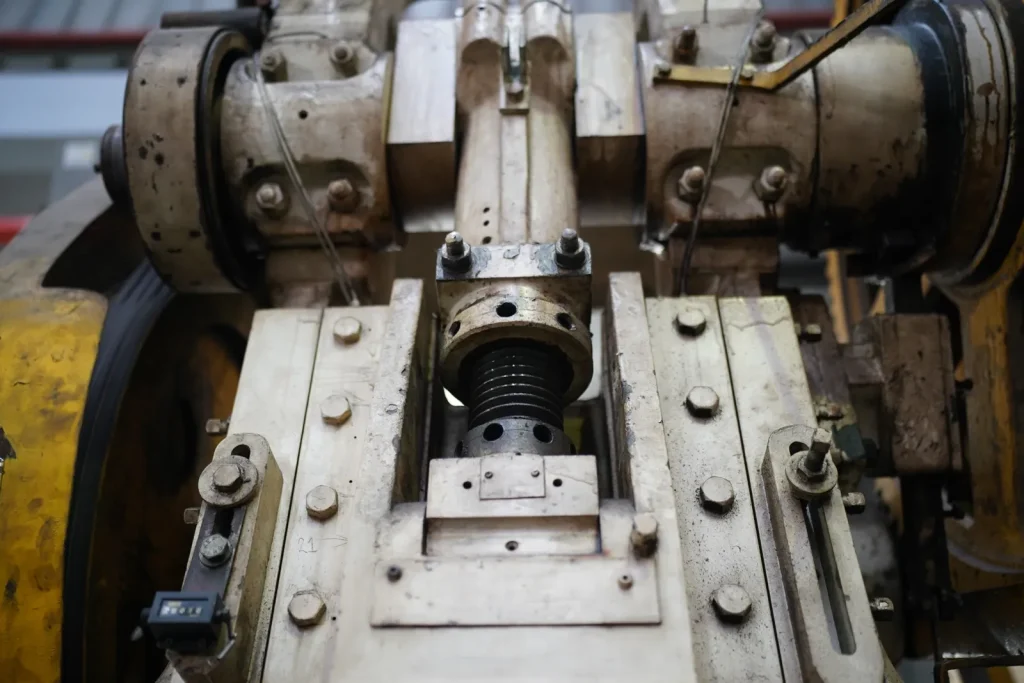
How Each Process Works: Strip Layout vs Blank Transfer
Progressive strip layout, carrier design, pitch, and cutoff
In progressive stamping, coil stock feeds into a multi-station die. The strip advances by a fixed pitch, which is the distance from one station to the next. At each stroke, every station performs its assigned operation on a different part position.
The carrier strip controls part location. It may be designed as one-side carrier, dual-side carrier, or another strip support form depending on part shape. The carrier must be strong enough to pull and locate the part without tearing or distorting.
The final station separates the finished part from the strip. Scrap remains in the skeleton.
A progressive strip layout diagram should show coil feed direction, pitch, pilots, carrier, part progression, formed features, and final cutoff. This visual is useful because many feasibility issues can be seen directly in the strip layout.
Transfer blank handling, station sequencing, and automation
Transfer stamping usually starts with a blank. The blank may be created in the first station or supplied as a pre-cut blank. It then moves through stations such as draw, form, trim, pierce, restrike, and flange.
The transfer system may use 2-axis or 3-axis motion. A 2-axis system can lift and move the part forward. A 3-axis system can add more placement control. Robots may also be used where more flexible motion is needed.
Part repositioning is one of the main advantages. The blank can be shifted or rotated so each station has better access. A transfer die process diagram should show the blank leaving the first station, moving between dies, and being placed for each operation.
Setup time differences between progressive and transfer dies
Setup time differences between progressive and transfer dies come from what must be aligned and timed.
Progressive die setup is tied to the full die timing, feed pitch, pilots, strip progression, stock straightness, and cutoff timing. If the strip does not feed correctly, every station can be affected.
Transfer die setup is tied to station alignment, automation timing, gripper position, lift height, and part handoff. Each station must receive the blank in the correct location and orientation.
For production planning, progressive dies can be efficient once debugged and stable, but the integrated tool may take careful setup. Transfer dies may need more time for automation timing and station-to-station handoff checks.
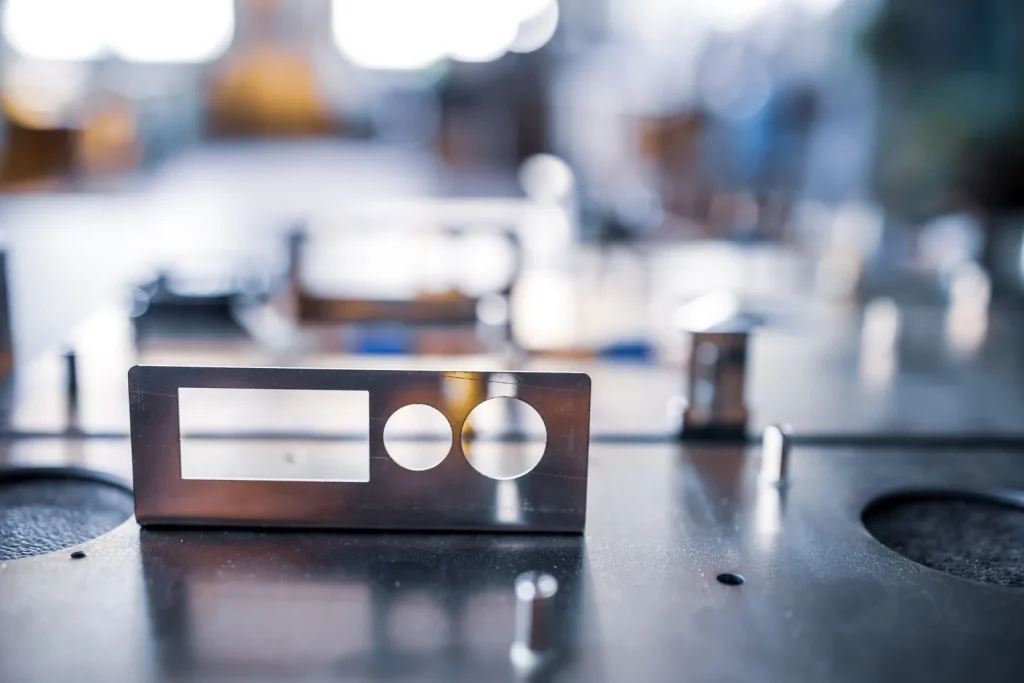
Can you deep draw in a progressive die?
Moderate deep drawing can be done in some progressive dies. The part must stay supported by the strip, and the draw must clear the die and feeding path.
The limits are strip feeding, station clearance, carrier support, and draw height. If the drawn shape becomes too tall or unstable, the strip may not move safely. The carrier may also distort as the material flows.
Transfer die stamping is generally favored for deep shells, cups, and tall 3D forms because the blank can move freely and the die has more open access.
Advantages vs Limitations: Speed, Scrap, Flexibility
How production volume influences die selection
Use volume only after geometry and handling feasibility are confirmed. In many programs, low annual volume favors line, single-operation, or simpler transfer approaches; medium volume can justify either process depending on scrap, station count, and change risk; high volume favors progressive when strip stability and station access are acceptable. Any volume rule of thumb also depends on material value, draw severity, required secondary operations, and available press capacity.
Risk of scrap in progressive die stamping
The risk of scrap in progressive die stamping comes from the carrier strip and web skeleton. Material is needed not only for the part but also for carrying, locating, and feeding the strip.
For small parts, this scrap may be acceptable because high speed and low handling cost can offset material waste. For large parts, the skeleton can become a major cost factor. The problem grows when the material is expensive.
Transfer blanks may allow better nesting for larger parts because the blank can be cut closer to the needed shape. The real scrap difference depends on blank shape, coil width, nesting layout, and strip stability requirements. It should be checked through a material utilization analysis, not assumed.
Cost tradeoffs between progressive die and transfer die stamping
Compare total cost as a stack of tooling, material utilization, cycle rate, setup, maintenance, automation, and any secondary operations not done in-die. A simple break-even check is: additional tooling cost divided by per-part savings equals break-even volume. Progressive tooling often carries higher integrated die cost, but a transfer system can also become capital-intensive when station count, handling development, and press automation are complex. Cost comparison should state the strip or blank layout basis, scrap assumption, and which features are made in-die versus later operations.
Flexibility: fixed progressive sequence vs adjustable transfer sequence
A progressive die locks the sequence into one integrated strip layout. Once the die is built, changes to pitch, carrier design, station order, or part geometry can be difficult.
Transfer tooling can be more adjustable because operations are split across stations. This does not mean changes are easy, but it may be easier to modify one station or adjust the sequence than to rebuild a long progressive die.
Engineering change risk can favor transfer in development programs where part geometry is still moving. Stable, mature, high-volume parts tend to favor progressive if the geometry fits.
Běžné problémy, způsoby selhání a rizika pro kvalitu
Causes of part misalignment in transfer die stamping
Causes of part misalignment in transfer die stamping include transfer finger position, gripper variation, blank movement, and station-to-station timing.
The blank is re-located at each station, so every pickup and placement adds variation. If the blank shifts during transfer, the next forming or piercing operation may be off location.
Misalignment can also come from blank distortion. A thin or flexible blank may not sit flat after handling. Station nests, guides, sensors, and gripper contact points must control this risk.
Common failure modes in transfer die operations
Common failure modes in transfer die operations include mis-picks, dropped blanks, transfer crashes, wrinkling, thinning, and station handoff errors.
Mis-picks happen when the gripper does not capture the blank correctly. Dropped blanks can damage the part or die. Transfer crashes may occur when timing, lift height, or part position is wrong.
Deep drawing adds forming risks. Material can wrinkle if it flows too freely, or thin and split if it is stretched too much. Maintenance records and production data are useful because they show which stations create repeat issues.
Maintenance concerns with progressive stamping dies
Maintenance concerns with progressive stamping dies include punch wear, sharpening schedules, pilot wear, feed timing, strip progression errors, and complex die timing across many stations.
Because many operations happen in one die, one worn punch or mis-timed station can affect the full process. Burr growth, hole location drift, or inconsistent forms may point to tool wear or feed issues.
Progressive dies need controlled maintenance because high stroke rates can accumulate wear quickly. The more stations and in-die operations are added, the more important preventive checks become.
How burr formation affects stamped part performance
Burr formation can affect assembly, electrical function, fatigue life, and safety during handling. A burr may interfere with mating parts or prevent a bracket from sitting flat. In electrical hardware, burrs can affect contact behavior.
Burrs can also act as stress risers where cracks may start under cyclic loading. For automotive parts, burr direction and burr height should be reviewed against assembly and function.
Control methods include die clearance control, punch sharpening, burr direction planning, and inspection. Burr direction should be defined before tool design when it matters for assembly or performance.
Faktory nákladů, tolerance a doby realizace
Factors affecting progressive die stamping die cost
Factors affecting progressive die stamping die cost include the number of stations, part complexity, tolerance requirements, in-die operations, strip layout complexity, material thickness, and material hardness.
More stations mean more tooling details, more timing interactions, and more debug work. Tight tolerances may require better pilots, more stable strip control, and more inspection during tryout.
In-die operations such as coining, embossing, tapping, or insertion can reduce secondary work, but they increase die complexity. Strip layout also affects cost because carrier design, pitch, and material utilization must be balanced.
Design features that increase stamping die cost
Design features that increase stamping die cost include deep forms, tight inside radii, multiple pierced features, close feature-to-edge distances, coining, embossing, and requirements to eliminate secondary operations.
Deep forms often need more stations and more tryout. Tight inside radii can raise cracking or springback risk. Close feature-to-edge distances can limit punch strength or affect part distortion.
Multiple pierced features may need careful punch support and sharpening plans. Coining and embossing increase forming load and tool wear risk.
Tolerance challenges in high volume metal stamping
Tolerance challenges in high volume metal stamping come from feed accuracy, tool wear, springback, and transfer positioning variation. From a quality system perspective, IATF 16949 requires manufacturers to implement preventive control methods to reduce process variation in high-volume production environments.
In progressive stamping, feed accuracy and pilot control affect station-to-station location. In transfer stamping, re-clamping and blank placement add another source of variation.
Springback depends on material behavior, thickness, form geometry, and tooling compensation. Tool wear can change hole size, burr height, and edge quality over time. These risks should be reviewed during die design, tryout, and production control planning.
Tooling lead time for progressive die stamping projects
Tooling lead time for progressive die stamping projects is affected by part complexity, station count, strip layout, die design, tryout loops, and validation needs.
Complex progressive tools can take longer to design and debug because many operations must work together in one die. A change in one station can affect later stations.
Transfer tooling may be more modular, but it still needs station alignment, automation timing, and part handling validation. Lead time should be based on forming risk, not just the number of tools.
Material, Thickness, and Stamping Quality Controls
Impact of material thickness variation on stamping quality
The impact of material thickness variation on stamping quality can be significant. Thickness affects forming load, springback, burr height, draw behavior, and part stiffness.
A thicker coil may require higher forming force and may spring back differently. A thinner coil may be more likely to wrinkle, distort, or thin during drawing.
Thickness variation also affects die clearance. If clearance is not suited to the actual material range, burr height and edge quality may change. Inspection planning should account for the full material thickness range, not only nominal thickness.
Quality control issues in automotive stamping parts
Quality control issues in automotive stamping parts include dimensional repeatability, hole location, flange angle control, surface defects, splits, wrinkles, and thinning.
Progressive parts often need checks for feed-related dimensions, burrs, and feature location. Transfer parts often need checks for draw quality, station alignment, surface condition, and trim accuracy.
Automotive quality planning should define critical dimensions, functional surfaces, burr direction, and inspection frequency. The process should also control known failure modes from tryout and production history.
Material utilization: coil strip vs pre-cut blanks
Progressive stamping uses coil strip stability but accepts the scrap tradeoff of carriers and skeletons. This can be efficient for small parts where the strip layout nests many parts well.
Transfer stamping uses separated blanks. For larger parts, pre-cut blanks may allow better material nesting and less skeleton waste.
Material utilization becomes more important when using copper, stainless steel, or specialty alloys. In those cases, a lower scrap process may offset slower cycle time or higher handling cost.
Checklist: What to review before tool design release
Before tool design release, review these items:
| Review item | Proč je to důležité |
|---|---|
| Material grade and thickness range | Affects forming load, springback, burrs, and draw risk |
| Směr zrna | Can affect forming behavior |
| Směr frézy | Affects assembly, contact, and fatigue risk |
| Kritické rozměry | Drives die design and inspection planning |
| Draw depth | Helps decide progressive vs transfer feasibility |
| Surface requirements | Affects handling, lubrication, and die finish |
| Annual volume forecast | Drives tooling amortization and process choice |
Applications and Use Cases by Part Type
Automotive stamping parts: brackets, clips, shells, and structures
Automotive stamping parts cover a wide range. Progressive dies are common for small brackets, clips, connectors, shields, and other compact parts with high annual volume.
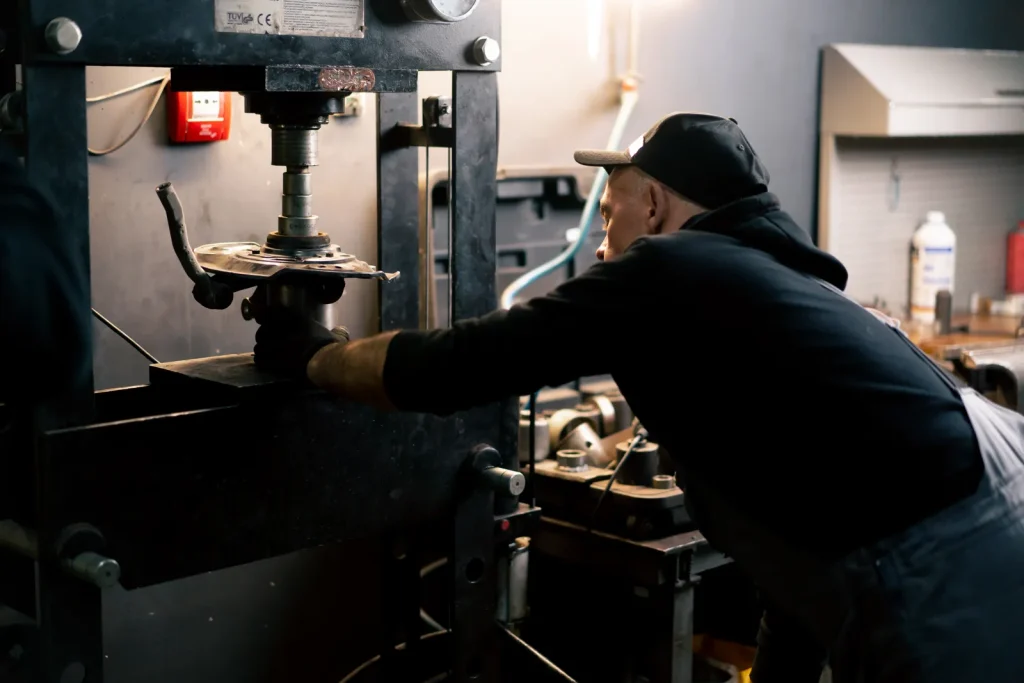
Transfer dies are common for shells, structural parts, frames, and deep-drawn components. These parts often need more open die access and may not clear a carrier strip.
The decision factor is usually size plus geometry plus annual volume. A high-volume part is not automatically progressive if the geometry cannot ride in a strip.
Electronics and electrical hardware
Electronics and electrical hardware often favor progressive stamping. Terminals, contacts, pins, and small precision components are usually small enough for strip feeding and high-speed production.
Progressive dies can integrate piercing, coining, forming, and cutoff in a controlled sequence. This supports repeatability when volumes are high.
Transfer stamping is used only when the geometry exceeds strip limits, such as when the part becomes too large, too tall, or requires repositioning.
Deep-drawn housings, cups, and 3D formed parts
Deep-drawn housings, cups, and 3D formed parts often favor transfer stamping. Tall walls and deep shells need open die access and controlled material flow.
If the part cannot clear a carrier strip, progressive tooling becomes risky. A transfer process can move the blank freely between draw, trim, pierce, and restrike stations.
| Geometrie části | Progressive fit | Transfer fit |
|---|---|---|
| Flat bracket with holes | Silný | Possible, but often not needed |
| Small clip with bends | Silný | Možné |
| Moderate emboss or coin | Strong if strip is stable | Možné |
| Tall cup or shell | Omezené | Silný |
| Large frame | Limited due to scrap and handling | Silný |
| Part needing rotation | Slabé | Silný |
When transfer die stamping is better than progressive die
Transfer die stamping is better than progressive die stamping when the part has a large envelope, deep draw requirement, tall 3D shape, or need for rotation and repositioning.
It may also be better when material nesting is critical. For large parts, transfer blanks can reduce the scrap penalty from carrier strips.
Transfer can also fit medium-volume programs where progressive tooling cost is hard to justify. This is especially true when design changes are likely or when the forming sequence may need adjustment.
Decision Guide: How to Choose the Right Die Type
Decision matrix: volume, size, geometry, material, tolerance, and budget
A practical decision matrix should weigh volume, size, geometry, material cost, tolerance risk, and tooling budget.
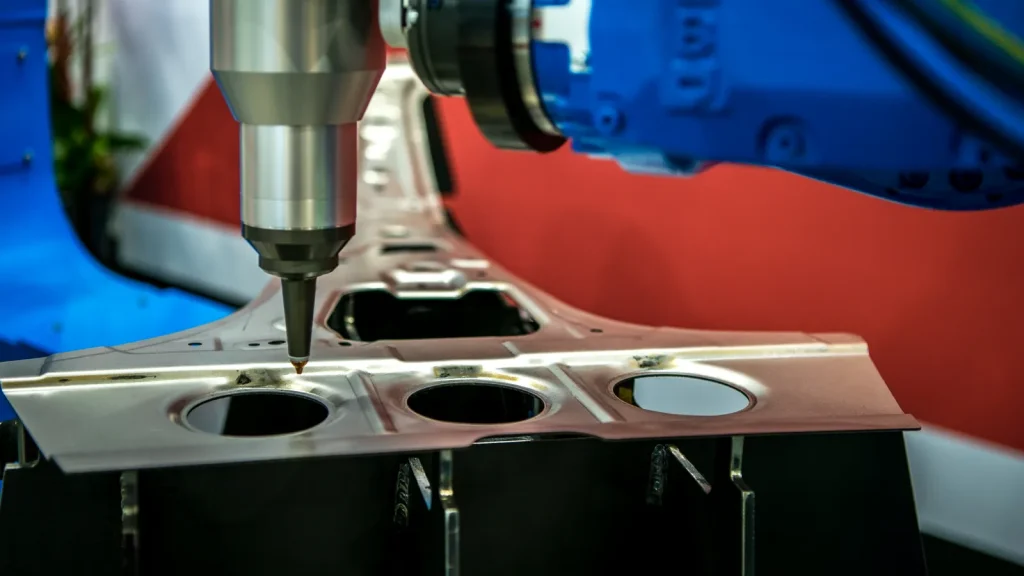
Use the following decision sequence before selecting a die concept. First confirm whether the part can remain attached to a strip through all forming stations. Then check whether the process requires rotation, regrip, side access, or draw depth that interferes with strip travel. Next confirm press bed size, press energy, shut height, feed system, and transfer automation capability at the supplier. Only after these feasibility checks should you evaluate annual volume, scrap level, maintenance burden, and tooling amortization.
The following matrix summarizes these decision factors in a structured comparison format.
| Faktor | Favors progressive | Favors transfer |
|---|---|---|
| Annual volume | Very high, stable demand | Medium volume or shorter program |
| Part size | Small to medium | Medium to large |
| Geometrie | Moderate bends, pierces, forms | Deep draw, shell, frame, tall 3D part |
| Využití materiálu | Scrap acceptable | Scrap is a major cost driver |
| Riziko tolerance | Strip location can control features | Repositioning needed for geometry |
| Budget | Higher tooling can be amortized | More modular tooling path preferred |
| Technické změny | Low change risk | Higher change risk |
Tie-breaker factors include program life, inspection requirements, press availability, material cost, and whether the part can stay attached to a strip.
How do you compare progressive and transfer die quotes?
Compare progressive and transfer die quotes by more than tool price. Do not evaluate quotations on cost or cycle time alone. Compare tooling cost together with scrap assumptions, cycle rate basis, setup requirements, maintenance strategy, tolerance capability, lead time, and validation approach. Each supplier should clearly explain how the strip layout or blank layout is defined, what process assumptions are used, and whether feasibility is supported by simulation, tryout history, or similar-part precedent.
Ask how the supplier estimated material utilization. For progressive tooling, review strip layout and carrier scrap. For transfer tooling, review blank nesting and transfer handling risk.
Also compare assumptions about tool maintenance. A low tooling price may not be lower cost if wear, burr growth, or setup issues increase production risk.
What should buyers check before choosing a stamping process?
Buyers should check whether the part can stay attached to a strip through all operations. If not, transfer is likely the better path.
They should also check whether the part requires deep drawing, rotation, or open access. Material scrap should be reviewed if the blank is large or the material is expensive.
Annual volume matters, but it should not override manufacturability. A very high-volume part still needs transfer tooling if the geometry cannot work in a progressive strip.
Checklist: Data to send for a process recommendation
Send these items for a process recommendation:
- 2D drawing and 3D CAD
- Material specification and thickness
- Annual volume and program life
- Kritické tolerance
- Surface and burr requirements
- Expected design change risk
- Target inspection requirements
The better the input data, the easier it is to compare progressive die vs transfer die on feasibility, cost, scrap, tolerance risk, and lead time.
ČASTO KLADENÉ DOTAZY
What are the three types of die?
In sheet metal stamping, common production categories are single-operation or line dies, progressive dies, and transfer dies. The right category depends mainly on annual volume, part geometry, and whether the part can remain attached to a strip during forming.
What is the difference between a progressive die and a compound die?
A compound die performs multiple cutting actions in one station and one stroke, usually for flatter parts where blanking and piercing must stay tightly related. A progressive die spreads operations across multiple stations, which is better when the part needs sequential cutting and forming at high volume.
What is the difference between a progressive die and a transfer die?
A progressive die keeps the part attached to a strip until final cutoff, which supports very high speed for small to medium parts. A transfer die separates the blank early and moves it independently, which is better for large parts, deep draws, and geometries that need repositioning or open die access.
What is a transfer die?
A transfer die is a stamping process in which individual blanks are moved between stations by transfer rails, grippers, or robots. It is typically selected when part geometry is too large, too deep, or too three-dimensional to travel through a progressive strip safely.

 Czech
Czech  English
  German
  French
  Italian
  Spanish
  Polish
  Japanese